The Orange Revolution team that swept Ukrainian President Viktor Yushchenko into power a year ago enters the 2006 parliamentary election campaign -- officially underway since November 26 -- divided into several small teams. Most of them will be competing for the same pro-reform, pro-Western electorate. This may make the March 26 parliamentary polls an easy ride for the main opposition force -- the Party of Regions of presidential election loser Viktor Yanukovych, the undisputed leader of recent public opinion polls.
As there is no longer a strong common enemy, which a year ago was the corrupt regime of then-President Leonid Kuchma, ideological differences have come to the fore, preventing Orange reunification for next year's polls. The far left wing of the government team -- the Socialists -- have never concealed that they would run in the polls alone. It has proved impossible to reintegrate populist former prime minister Yulia Tymoshenko back into Yushchenko's team. Yushchenko has managed to gather under his wing the largest bloc of parties so far, but two key right-of-center parties -- the Popular Party and Reforms and Order -- refused to join his bloc. The radical youth party Pora, one of the symbols of the Orange Revolution, has not joined either Yushchenko or Tymoshenko.
On November 25, six pro-government parties signed an agreement reviving Yushchenko's motley "Our Ukraine" bloc. Our Ukraine won the 2002 parliamentary elections, but its character was different – it was bigger and in the opposition. The present-day Our Ukraine unites Yushchenko's People's Union-Our Ukraine party, Foreign Minister Borys Tarasyuk's People's Movement, National Security and Defense Council Secretary Anatoly Kinakh's Industrialists and Entrepreneurs Party, Naftohaz state-controlled oil and gas company chief Oleksiy Ivchenko's Congress of Ukrainian Nationalists, the Christian Democratic Union, and the Sobor Ukrainian Republican Party.
Sobor is a good example of how painful the rift between the supporters of Yushchenko and Tymoshenko may be. Sobor, an ethnocentric conservative party, has been part of Tymoshenko's team since 2001. But this past September, when Yushchenko fired Tymoshenko as prime minister, Sobor leader Anatoly Matvienko -- and probably the majority of the party's grassroots -- started to drift toward Yushchenko's camp. The party's representatives in parliament, however, have stayed with Tymoshenko, and they elected veteran radical nationalist and Soviet-era dissident Levko Lukyanenko as their leader. Matvienko has accused Tymoshenko of splitting his party.
Lukyanenko's team will most probably join the Yulia Tymoshenko bloc. But the bloc itself has not yet been formed. This was expected to happen on November 26, when Tymoshenko's Fatherland party and the liberal Reforms and Order (RiP) group held their congresses. But RiP refused to join Tymoshenko's bloc on her terms, which included having RiP leader Viktor Pynzenyk resign from the post of finance minister and putting Fatherland members at the top of the joint lists for national and regional elections. Tymoshenko also refused to back a RiP candidate for the post of Lviv city mayor. RiP decided not to burn bridges and continued talks with Tymoshenko. But Kommersant-Ukrayina reported that RiP is seriously studying other options, including separate participation in the campaign or forming a bloc with Pora.
Unlike Yushchenko, Tymoshenko apparently does not strive to gather as many parties as possible under her umbrella. Her main currency is her own popular name. Only one party, apart from her own Fatherland, has so far joined Tymoshenko's bloc. This is the obscure Social Democratic Party (not to be confused with the United Social Democrats of Viktor Medvedchuk). United Ukraine, a party without a clearly defined ideology led by Bohdan Hubsky, a former ally and business partner of Medvedchuk, decided at its congress on November 26 to join Tymoshenko's bloc. But it is not yet clear whether it will be admitted, and on what conditions.
Only one thing is clear about Tymoshenko -- there will be no grand coalition between her and Yushchenko for the polls. This possibility exists only in theory, as the law gives parties and blocs until the end of December to compile lists for the election. But, speaking to the Russian Ekho Moskvy radio, Tymoshenko said she did not see any sense in unification with Yushchenko. She did not rule out cooperation with Our Ukraine after the election, when she said her bloc would compete with Yanukovych to form the majority in parliament.
The far-right wing of the Orange team -- the nationalist Popular Party of Yuriy Kostenko -- is going to compete in the polls against both Yushchenko and Tymoshenko. Differences with the former partners are of an ideological nature, as none of them are really center-right parties, Kostenko told his party congress on November 27. "Our mission is to give Ukrainian patriots a political force that stands on national positions," he said. Among his allies, Kostenko named the radical nationalist Prosvita and the Congress of Ukrainian Intelligentsia, as well as Cossack and veterans organizations.
(Ukrayinska pravda, November 19, 26; NTN TV, November 25; Korrespondent.net, Ekho Moskvy, November 26; Kommersant-Ukrayina, November 28)
Wednesday, November 30, 2005
Ukraine: No Grand Coalition
In EDM, Oleg Varfolomeyev writes about the crumbling of the Orange Coalition:


Tuesday, November 29, 2005
RCFS - Harassment Continues
From the International Helsinki Federation for Human Rights (IHF), Vienna, Austria:
See also in this blog: RCFS - Case Dismissed
Rights Lawyer Refused Entry
Dmitrievsky Trial
Legal Harassment Against the Russian-Chechen Friendship Society
An Update
Vienna, 29 November 2005. The legal harassment against the Russian-Chechen Friendship Society (RCFS) continues. While the efforts of the Registration Department of the Justice Ministry to deregister the RCFS were turned down by the court in Nizhny Novgorod, the criminal proceedings against Stas Dimitrievsky, the head of the RCFS, are proceeding, as well as the procedure at the arbitration court regarding the decision of the tax inspection that the RCFS has violated the Tax Code and has to pay profit tax and a fine totaling 1.001.561 Rubles (around 28.200 Euro).
The next hearing in the criminal case is scheduled for 7 December 2005. The next hearing of the Arbitration Court is tomorrow, 30 November 2005, 14:30.
1. Judicial case against the Pravo-zashchita newspaper. Justice Ministry / Prosecutors Office use Criminal Persecution under Article 282 of the Criminal Code (“Inciting ethnic hatred”)
On 3 November, the hearing on the criminal case against Stas Dimitrievsky (as being responsible for Pravo-zashchita newspaper), ended with the decision to reject two appeals of the RCFS. The case was postponed to the 16 November, which is the same day, when there is the hearing at the arbitration court regarding their tax issue.
On 15 November, the British human rights lawyer Bill Bowring, en route to observe the trial proceedings in Nizhny Novgorod was denied entry to the Russian Federation. Despite being in possession of a valid multiple-entry visa and letters of accreditation as a trial observer from the Bar Human Rights Committee of England and Wales and from the NGO Frontline Defenders, he was held without explanation by border officials for six hours at Moscow's Sheremetyevo-2 airport before being put on an airplane back to the UK. Professor Bowring had visited Nizhny Novgorod already on 16-18 June 2005, when he monitored the situation of the Russian-Chechen Friendship Society, and made a detailed report on his observations of the situation.
On 16 November, the first main hearing in the criminal case against Stas Dimitrievsky took place in the Nizhny Novgorod Sovetsky district court. Two lawyers are defending Dimitrievsky in court, Yury Sidorov (Nizhny Novgorod), and Leyla Khamzaeva (Moscow). Several members and staffers of the RCFS and the Nizhny Novgorod Society for Human Rights were interrogated as witnesses for the prosecution. They stated to the court that they are absolutely sure that the publications used to incriminate Stas Dimitrievsky are aimed at establishing peace in the Chechen Republic as they contain calls to political reconciliation of the armed conflict there. Then, the next hearing was fixed for 25 November 2005, but was later postponed for the 28th November.
In the hearing of 28 November, Sergey Kovalev, former Russian human rights ombudsman and former State Duma deputy, Lydia Jusupova, a member of chamber of lawyers of the Chechen Republic and staff member of the “Memorial” Human Rights Center, and Laila Amirkhadshieva, inhabitant of Chechen village Katyr-Jurt, were questioned as witnesses of the defense. They were invited by the defense to acknowledge the actual circumstances in Chechnya, to which the appeal from Aslan Maskhadov to the European Parliament referred, which is one of the two bases of the indictment.
Additionally, the author of the linguist expert opinion, Larisa Teslenko – expert of the Privolzhsky Regional Center of Legal Expertise at the Ministry of Justice, ordered by the chief investigator of the Nizhny Novgorod regional branch of the FSB, on which the indictment is based - was questioned. While firmly insisting that the incriminated materials raise racial, national and social enmity “between Russian and Chechens”, Teslenko refused to give an answer to most of the fifty questions, explaining that they were beyond her competence. She refused, for example to define the terms “race”, “nationality” and “social group”, declaring that on these questions the sociologist, instead of the linguist should answer.
During the trial, about thirty members of the patriotic youth movement “Nashi” (“Ours”) held a picket outside the court building with a poster “A terrorist cannot be a human rights defender".
The next hearing of the case was scheduled for 7 December 2005.
2. The fiscal harassment of the RCFS, threatening the continuation of its activities.
On 16 November 2005, the Arbitration court of Nizhny Novgorod region, to which the Russian-Chechen Friendship Society lodged their complaint about the actions undertaken by the tax inspection of Nizhny Novgorod, decided to postpone the main hearing of the case to Wednesday, November 30, 2005.
Judge Evgenia Belyanina took this decision to postpone the hearing as a result of the alleged illness of two of the staff members of the tax inspection, despite the fact that for a juridical person illness of any of its staff members can't be an obstacle to present the position of the organization in court, creating the impression that the tax inspection was deliberately trying to retard the consideration of the complaint.
A young staff member of the tax inspection appeared in court by proxy. He appealed to the judge to postpone the hearing in connection with the illness of one of the two staff member who had dealt with the case before. Asked about the other one, he answered that she was likely to have fallen ill too. Asked why he was not able to represent the interests of the tax inspection himself, he explained that he was unaware of the details.
On 15 August 2005 the tax inspection of Nizhegorodski district had made Resolution #25 claiming that the RCFS had violated the Tax Code, and that they have to pay profit tax for grants to implement specific human rights projects in the period from 2002 to 2004 from three foreign donors. Additionally the tax inspection ordered them to pay a fine. The total amount of the claims is 1.001.561 Rubles (around 28.200 Euro).
3. Efforts by the Justice Ministry Registration Department to Deregister the RCFS
After having decided on 1 November to postpone consideration of the de-registration-case against the Russian-Chechen Friendship Society (RCFS) for an indefinite period of time, judge Samartseva unexpectedly changed her mind and scheduled the main hearing for 14 November 2005. This hearing turned out to be the final one. Judge Samartseva made a ruling, in which she refused the Nizhny Novgorod Main Registration Department at the Ministry of Justice in its civil action to liquidate the RCFS, after considering the documents and debates between the sides. As this decision was not appealed by the Justice Ministry within the 10 days period, in which this would have been possible, the judgment is final.
Unknown Persons Broke into the Flat of Dimitrievsky on 28 November
On 28 November, unknown persons broke into the flat of the family of Stas Dimitrievsky in Nizhny Novgorod. When his wife came home at 17:30 she found things scattered on a floor and boxes opened. There were no broken doors, and it seems that nothing was stolen.
See also:
IHF statement, “British Lawyer Barred From Entering Russia to monitor trial of the Russian-Chechen Friendship Society in Nizhny Novgorod, 15 November 2005
IHF statement, “The ‘Russian-Chechen Friendship Society’s Under Severe Risk of being Destroyed by Russian Authorities. Its Director Stas Dimitrievsky Faces a Prison Term, 2 November 2005
IHF statement, "Russian Federation: Nizhny Novgorod Authorities Launch Final Crackdown on Russian-Chechen Friendship Society. Today’s Protest Picket Dissolved after Five Minutes – Participants Detained", 2 September 2005.
IHF statement, “Continuing Persecution of the Russian-Chechen Friendship Society. Its Partner Organisation Nizhny Novgorod Human Rights Society Closed Down by Authorities”, 10 June 2005
IHF statement, “”We Fear for the Safety of our Colleagues in the Russian-Chechen Friendship Society… Russian Human Rights Organization Threatened”, 19 March 2005
IHF statement, “FSB Raids the Russian-Chechen Friendship Society”, 20 January 2005
IHF/NHC Report, The Silencing of Human Rights Defenders in Chechnya and Ingushetia, Sept. 2004
For further information:
International Helsinki Federation for Human Rights
In Vienna: Aaron Rhodes, IHF Executive Director, +43-1-408 88 22 or +43 -676-635 66 12; Henriette Schroeder, IHF Press Officer, +43-676-725 48 29
In Moscow: Tanya Lokshina, +7 -916-624 19 06
Russian-Chechen Friendship Society, Stas Dmitrievsky, Oksana Chelysheva, +7-8312-171 666 or +7-920 015 9218 (mobile)
See also in this blog: RCFS - Case Dismissed
Rights Lawyer Refused Entry
Dmitrievsky Trial
Versions of the Truth
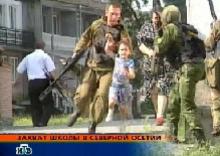
RFE/RL notes that the North Ossetian Parliamentary Commission is expected to release its final report on Beslan today:
North Ossetia's deputy parliament speaker Stanislav Kesaev, who heads the regional parliamentary commission, said today that the 30-page report contains "more questions than answers." He said most questions pertain to the federal authorities' decision to storm the school.Meanwhile, Itar-Tass reports that the the deadline for completing the official federal Russian investigation into the Beslan raid has been pushed back by another three months to March 1 2006. (via chechnya-sl)
Russia blames the bloodbath on the hostage takers. But rights groups believe federal security forces are largely responsible for the heavy death toll.
Update: As was widely expected, the North Ossetian report concludes that the federal authorities botched the rescue at Beslan.
The BBC's account of the report is here.
Monday, November 28, 2005
The Spitting-Cell
Croyez-moi, les religions se trompent dès l'instant qu'elles font de la morale et qu'elles fulminent des commandements. Dieu n'est pas nécessaire pour créer la culpabilité, ni punir. Nos semblables y suffisent, aidés par nous-mêmes. Vous parliez du jugement dernier. Permettez-moi d'en rire respectueusement. Je l'attends de pieds ferme: j'ai connu ce qu'il y a de pire, qui est le jugement des hommes. Pour eux, pas de circonstances atténuantes, même la bonne intention est imputée à crime. Avec au moins entendu parler de la cellule des crachats qu’un peuple imagina récemment pour prouver qu'il était le plus grand de la terre ? Une boîte maçonnée où le prisonnier se tient debout, mais ne peut pas bouger. La solide porte qui le boucle dans sa coquille de ciment s'arrête à hauteur de menton. On ne voit donc que son visage sur lequel chaque gardien qui passe crache abondamment. Le prisonnier, coincé dans la cellule, ne peut s'essuyer, bien qu'il lui soit permis, il est vrai, de fermer les yeux. Eh bien, ça, mon cher, c'est une invention d'hommes. Ils n'ont pas eu besoin de Dieu pour ce petit chef-d'oeuvre.
Alors? Alors, la seule utilité de Dieu serait de garantir l'innocence et je verrais plutôt la religion comme grande entreprise de blanchissage, ce qu'elle a été d ‘ailleurs, mais brièvement, pendant trois ans tout juste et elle ne s'appelait pas religion. Depuis, le savon manqué, nous avons le nez sale et nous nous mouchons mutuellement. Tous cancres, tous punis, crachons-nous dessus, et hop! au malconfort! C'est à qui crachera le premier, voilà tout. Je vais vous dire un grand secret, mon cher. N'attendez pas le jugement dernier. Il a lieu tous les jours.
Alors? Alors, la seule utilité de Dieu serait de garantir l'innocence et je verrais plutôt la religion comme grande entreprise de blanchissage, ce qu'elle a été d ‘ailleurs, mais brièvement, pendant trois ans tout juste et elle ne s'appelait pas religion. Depuis, le savon manqué, nous avons le nez sale et nous nous mouchons mutuellement. Tous cancres, tous punis, crachons-nous dessus, et hop! au malconfort! C'est à qui crachera le premier, voilà tout. Je vais vous dire un grand secret, mon cher. N'attendez pas le jugement dernier. Il a lieu tous les jours.
Believe me, religions are on the wrong track the moment they moralize and fulminate commandments. God is not needed to create guilt or to punish. Our fellow men suffice, aided by ourselves. You were speaking of the Last Judgment. Allow me to laugh respectfully. I shall wait for it resolutely, for I have known what is worse, the judgment of men. For them, no extenuating circumstances; even the good intention is ascribed to crime. Have you at least heard of the spitting-cell, which a nation recently thought up to prove itself the greatest on earth? A walled-up box in which the prisoner can stand without moving. The solid door that locks him in the cement shell stops at chin level. Hence only his face is visible, and every passing jailer spits copiously on it. The prisoner, wedged into his cell, cannot wipe his face, though he is allowed, it is true, to close his eyes. Well, that, mon cher, is a human invention. They don't need God for that little masterpiece.Jean-Baptiste Clamence, in La Chute, by Albert Camus (1956)
What of it? Well, God's sole usefulness would be to guarantee innocence, and I am inclined to see religion rather as a huge laundering venture - as it was once but briefly, for exactly three years, and it wasn't called religion. Since then, soap has been lacking, our faces are dirty, and we wipe one another's noses. All dunces, all punished, let's all spit on one another and - hurry! to the little-ease! Each tries to spit first, that's all. I'll tell you a big secret, mon cher. Don't wait for the Last Judgment. It takes place every day.
Slow Vote
At the Prague Watchdog, Lecha Sadayev gives his impressions of yesterday's elections in Chechnya (my tr.):
ARGUN, Chechnya - In spite of clear and warm weather, voting in the Kremlin-staged parliamentary elections was sluggish in the town of Argun, situated 15 km south-east of the Chechen capital Grozny.
At 10 am on November 27, i.e., two hours after voting began, the courtyard of voting station No. 4 was deserted, apart from about twenty duty policemen.
Despite the fact that all 2148 local voters live in a radius of 50 to 200 metres around the school, by 10 am only 62 people had voted here. At adjacent voting station No.2 no more than 110 of the registered 2130 voters arrived at the ballot boxes in the first 2 hours.
Voting was somewhat more active in the courtyard of secondary school No.1 in the centre of the town. Here the local authorities organized a concert with singing and dancing. Accordingly, the turnout of voters there was much higher: by10am more than 360 people had voted, comprising almost 20% of the total number.
In the first half of the day, voting was also rather slow in the other towns and districts of the republic. According to Ismail Baykhanov, head of the republic’s electoral commission, the 25% barrier necessary for the elections to be acknowledged as having taken place was not crossed until 13.00 Moscow time.
Revisiting the Orange Revolution
In EDM there's an interesting two-part series by Taras Kuzio called The Orange Revolution Revisited. It's in two parts, here and here. From the conclusion of Part 2:
Both Yushchenko and Tymoshenko have positive and negative traits. If the Orange coalition could reunite during, or after the 2006 parliamentary elections, these traits could potentially balance one another to promote a reform agenda and Euro-Atlantic integration (Ukrayinska pravda, November 19). The only alternative to an Orange coalition in the 2006 parliament would be parliamentary coalitions composed of either "Kuchma-lite" or "Kuchma-hard" political forces.
Sunday, November 27, 2005
Zakayev's Address
At chechnya-sl, Jeremy Putley has posted the text of Akhmed Zakayev's address to the London Conference on Chechnya, held on November 25.
Annihilation Plan - II
Referring to a post in this blog that featured Edward Lucas's portrait of the people who helped to put the restored democracies of Eastern Europe back on the rails after the collapse of Communism, Marius Labentowicz points out that it was Mr Radek Sikorski - the new Polish Defence Minister, mentioned in Edward Lucas's essay as one of the East European émigrés subsequently to develop political careers in their home countries - who showed these plans to the public for the first time. And Marius quotes from David Rennie's Telegraph article:
The defence minister, Radek Sikorsky, showed off the map at an emotional press conference.
He described it as a "personally shattering experience", pointing to a long line of nuclear mushroom clouds neatly stamped along the Vistula, where Soviet bloc commanders assumed that Nato tactical nuclear weapons would rain down to block reinforcements arriving from Russia.
About two million Polish civilians would die in such a war, and the country would be all but wiped off the face of the Earth, he said.
On the map, western Europe lay beneath a chilling overlay of large red mushroom clouds: Warsaw Pact nuclear strikes, using giant warheads to compensate for their relative lack of precision.
Soviet bombs rain down on cities from northern Denmark down to Brussels, the political headquarters of Nato. Large red clouds blot out cities such as Hamburg, Frankfurt, Stuttgart, Munich and Baden Baden, Haarlem, Antwerp and Charleroi, above the Franco-Belgian border.
On the map, smaller blue mushroom clouds showed expected Nato targets - most of them relatively precise attacks - including strikes on Warsaw and Prague.
The map dates from a time when the balance of power was radically different from now. In Washington the vacillating Jimmy Carter was suffering a series of defeats - the Iranian revolution and the subsequent seizure of the United States embassy in Teheran. Britain was at a low ebb, racked by strikes, and just putting its faith in Margaret Thatcher.
The Kremlin, however, was stretching its muscles - preparing for its ill-fated takeover of Afghanistan.
Perhaps because the map shows a limited war game exercise, entitled Seven Days to the River Rhine, rather than full invasion plans, troops stop at the Rhine, and there are no attacks or bomb strikes on Britain, or on France.
Large blue Nato nuclear bombers are shown flying out of bases in East Anglia, and squadrons of Nato fighters are shown scrambling from Danish bases into combat over the Baltic.
The decision to unveil the Warsaw Pact documents is one of the first moves of Poland's new conservative government. Mr Sikorsky described it as an attempt to draw a line under the country's Communist past, and "educate" the Polish public about the old regime.
He did not deny that the opening of the archives will be seen as a provocation in Moscow. Russian-Polish relations have sharply deteriorated recently, amid rows over a planned oil pipeline, and Polish support for democratic revolutions in Russia's backyard, first in Ukraine, and now Belarus.
Mr Sikorsky, a former dissident who studied at Oxford University, said: "These are documents that are crucial for educating the public, and showing how Poland was kept as an unwilling ally of the Soviet Union. This government wants to end the post-Communist period.
"It's important for citizens to know who was a hero, and who was a villain. It is important for the civic health of society to make these things public."
The files being released would include documents about "Operation Danube", the 1968 invasion of Czechoslovakia. They also included files on an army massacre of Polish workers in Szczecin in the 1970s, and from the martial law era of the 1980s.
Saturday, November 26, 2005
Annihilation Plan
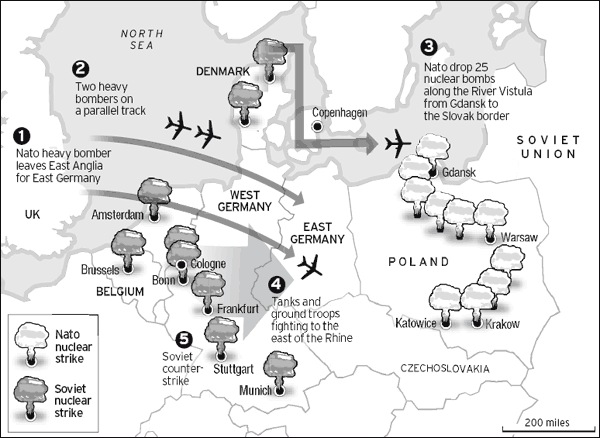
Stephen Castle reports in the Independent that the new government in Poland has released a Cold War map detailing the Warsaw Pact's training plans for a nuclear war:
Dating from 1979, the map reveals how Soviet forces could respond to a Nato assault by invading Germany, Belgium and the Netherlands.There also reports on the issue in the Telegraph, the Guardian, and the FT.
Red and blue mushroom clouds are marked on the map, showing Soviet nuclear bombs raining down on cities including Brussels, Antwerp, Munich and Stuttgart, and Nato nuclear strikes on Warsaw and a line of Polish territory, cutting the country in two. The Nato objective was to halt a second wave of Soviet troops sweeping westwards from Russia. Polish military chiefs said yesterday that about two million people would have died in Poland alone. Meanwhile, Britain and France appeared to have escaped unscathed, so separate plans may have existed for them.
London Conference
At chechnya-sl, Jeremy Putley has posted his notes on the London conference on Chechnya, held yesterday, November 25.
Friday, November 25, 2005
Genocide
Tomorrow Ukraine will hold ceremonies to commemorate the great famine of 1932-33. President Yushchenko called for the famine to be recognized by the international community as genocide:
Several million people died in Ukraine during the winter of 1932-33. Though the then-Soviet republic grew sufficient amounts of grain to feed its people, Soviet leader Josef Stalin requisitioned it for sale abroad to fund construction of Soviet industry.
Tomorrow, Ukraine will hold ceremonies in memory of the tragedy and mark a naitonwide minute of silence.
Ukrainian officials, including Yushchenko, will speak at the event.
Anti-Anti-Americanism
Via Far Outliers, a link to Paul Berman's examination of four books which study France's new look at America.
Thursday, November 24, 2005
War on the West
According to FSB head Nikolai Patrushev, Russia is beset by foreign spies. Meanwhile the war on NGOs continues.
Blackout
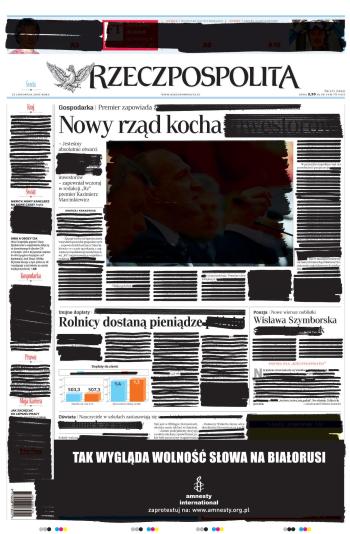
Marius writes that Polish daily newspapers blacked out their front pages yesterday in a protest against media repression in neighbouring Belarus.
AP reports that
The main pages of Gazeta Wyborcza and Rzeczpospolita looked as if a censor had taken a black marker to them, with most text and photographs crossed out. The two papers were joining a protest led by Amnesty International.It's possible to join the protest at this link. When the screen comes up, you get a choice: If you don't care that human rights are being violated and you just want to read an article about it, click (blue writing) 'I don't care' - nie obchodzi mnie.
At the bottom of both front pages, the human rights group wrote: "This is what freedom of speech looks like in Belarus." The papers then printed their front page in full on page three, and carried commentaries and reports of humans rights abuses in Belarus.
Amnesty also ran an advertisement in Rzeczpospolita calling on Belarussian President Alexander Lukashenko to observe human rights treaties protecting freedom of expression.
"The Belarussian authorities are increasingly employing harassment, intimidation, excessive force, mass detentions and long-term imprisonment as methods to quash any civil or political dissent," Amnesty wrote in the open letter.
Parliament Speaker Marek Jurek supported Amnesty's campaign and called for international rights to be observed by Minsk. "We must take strong action in defense of the accepted international principles and we must demand that they are observed in Belarus and in the nations that have relations with it," Jurek said on state radio.
Polish leaders and human rights groups have spoken out strongly in favor of democratic change in the eastern neighbor Belarus. Poland has also stood in support of the Polish minority there, saying it was not enjoying full rights.
Also Wednesday, UN human rights experts met in Warsaw to discuss the plight of the ethnic Polish minority in Belarus.
"In the 21st century, in the center of Europe, it's hard to believe you can shut someone away because he has a different opinion," said Angelica Boris, a leader of the Union of Poles in Belarus who has been detained several times by Belarussian authorities.
If you want to fight censorship that violates human rights in Belarus, click (blue writing) 'I protest' - protestuję.
Wednesday, November 23, 2005
Idigov in Brussels - II
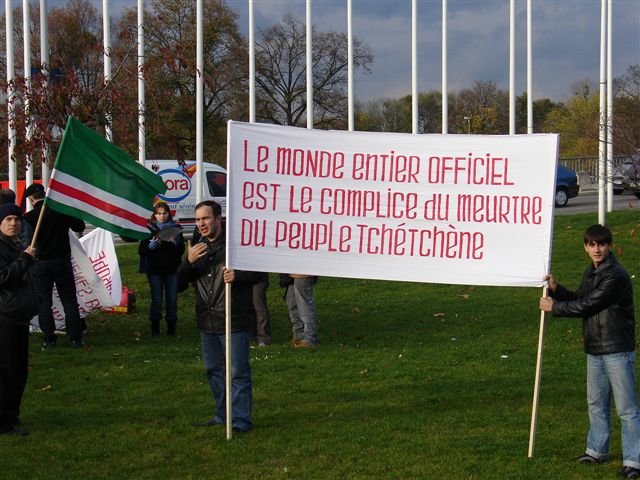

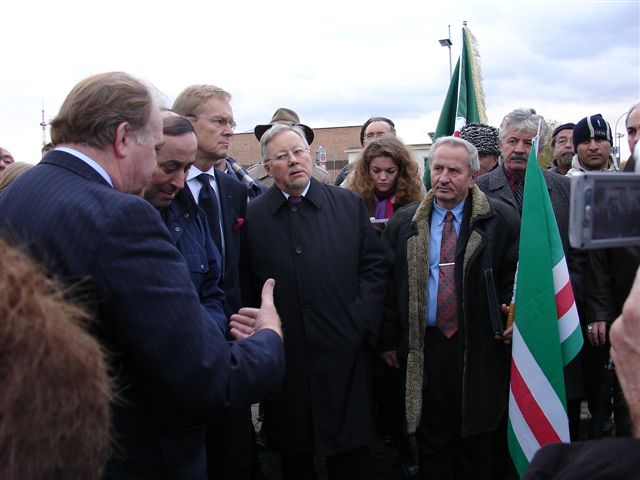

Some photos of Chechens in Brussels at the European Parliament on November 16 2005 (courtesy of MAK).
See also in this blog: RFE/RL: Idigov in Brussels
Tuesday, November 22, 2005
Iraq: the Battle in the Beltway
By George Friedman
With President George W. Bush's poll ratings still in the doldrums, the debate in Washington has become predictably rancorous. For their part, the Democrats continue to insist that Bush lied about weapons of mass destruction to justify the invasion of Iraq, despite the fact that Bill Clinton launched Operation Desert Fox in 1998 on the basis of similar intelligence. The Bush administration didn't manufacture evidence on WMD: If evidence was manufactured, it was manufactured during Clinton's administration -- and the Democrats know this. On the other hand, the Bush administration has slammed the Democrats' criticism of the war, with one congresswoman charging a Democratic congressman -- a congressman who served for 37 years in the Marine Corps and was awarded the Bronze Star and two Purple Hearts while in Vietnam -- with cowardice for advocating a withdrawal. Republicans know better.
The current debate is making both sides look stupid. But lest we despair about the fate of the republic, it should be remembered that political debate in the United States has rarely been edifying and, during times of serious tension, has been downright incoherent. What is important about the current debate is not so much its content -- there is precious little of that -- as the fact that it serves as a barometer of the current situation in Washington as well as in Iraq. What the debate is telling us is that we have come to a defining moment in the war and in U.S. policy toward the war. That means that it is time to step back and try to define the root issues.
Intelligence Failures and Guerrilla War
Whatever the origin of the war -- and Stratfor readers are aware of our views on why the war was begun -- we can pinpoint the moment at which the Bush strategy first ran into trouble. In mid-April 2003, just a few weeks after the fall of Baghdad, guerrilla attacks in the form of small bombings began to take place. By May 2003, attacks were occurring daily. It started to become clear that a guerrilla war had been launched.
When people talk about intelligence failures, they inevitably speak about the WMD issue. That was trivial, however, compared to the failure of the U.S. intelligence community to discover that the Baathists had planned for continued warfare after the fall of Baghdad. Indeed, they did not even resist in Baghdad. Understanding that defeating the United States conventionally was impossible, they focused on mounting a guerrilla war after U.S. forces had occupied the country.
The guerrilla campaign was not spontaneous. It came together much too quickly and escalated far too efficiently for that to be the case. The guerrillas clearly had access to weapons caches, possessed a rudimentary command, control and communications system, and had worked out some baseline tactics. They were too widely dispersed in their operations to be simply a pick-up game. Somebody had set these things in place. That meant that someone should have detected the plans.
There were two reasons for this intelligence failure. First, detecting the kinds of preparations being made is not easy. The United States was heavily dependent on networks created by the Shiite leader Ahmed Chalabi, and the guerrillas were Sunnis. We suspect that the sourcing prior to the war blinded the United States to preparations being made in Sunni territory. Second, and more important, Washington had a predetermined concept about Iraq and Iraqi resistance, which many shared.
The United States had fought the Iraqis during Desert Storm, and emerged with a complete lack of respect for the Iraqi forces. Just as the Israelis had developed a concept of the capabilities of the Egyptian forces in the 1967 war -- a concept that proved to be disastrously incorrect by the 1973 war -- so the Americans had reached a set conclusion about Iraqi forces. Moreover, they had drawn political conclusions: Saddam Hussein's regime was unpopular and its fall would be greeted with emotions ranging from indifference to joy. Thus, the Americans focused on what they expected to be a conventional military campaign that would create a blank slate on which the United States could draw a new political map.
There was another side to this. The American experience in guerrilla warfare was fixed in Vietnam. The lesson of Vietnam was that the United States was defeated by two things: first, sanctuaries for the guerrillas that the United States could not attack -- including a complex logistical system, the Ho Chi Minh Trail -- and second, the terrain and vegetation of Vietnam, which prevented effective aerial reconnaissance and placed U.S. forces at a tactical disadvantage. Iraq's topography did not offer sanctuary or cover. Therefore, a full-scale insurgency would be impossible to mount.
The United States had failed to learn important lessons from the Israeli situation, in which guerrilla warfare -- incorporating wildly unconventional means such as suicide bombers -- was waged without benefit of sanctuary or clear supply lines. But more importantly, the Americans had failed to take into account that while Iraq could not field a large, effective conventional force, guerrilla warfare requires a much smaller number of troops. Moreover, they failed to consider that the behavior of forces defending Iraq's seizure of Kuwait during Desert Storm might be different than the behavior of forces resisting American occupation of Iraq proper.
Intelligence failures occur in every war, and this one was certainly much less significant than, for instance, the failure at Pearl Harbor. But this failure was conjoined with the administration's assumption that, given the character of the Iraqi soldier and the nature of Iraqi society, Iraqi resistance would not be sustained. That error, coupled with the intelligence failure, generated today's crisis. The problem is an intelligence failure overlaid by a misconception.
Insurgency and Inertia
If intelligence failures are a constant reality in war, the measure of a military force is how rapidly it recognizes that a failure has occurred and how quickly it adjusts strategy and tactics. In this case, the administration's concept about Iraq blocked the adjustment: The Bush administration's position, as pronounced by Donald Rumsfeld, was that the guerrillas did not constitute an organized force and that they were merely the "dead-enders" of the Baathist government. This remained the administration's position until July 2003.
That meant that for about three months, as the guerrillas gained increasing traction, there was no change in U.S. strategy or tactics. Strategically, Washington continued to view Iraq as a pacified country on which the United States could impose a political and social system, much as it did with Japan and Germany after World War II. This had a specific meaning: The Baathists had been the ruling party in Iraq; therefore, driving former Baathists out of public life, a process that mirrored what happened in Germany and Japan, was the strategy. Tactically, since there were no guerrillas -- only criminals and remnants of the former regime -- no military action had to be taken. U.S. forces remained in an essentially defensive posture against a trivial threat.
The decision to force the Baathists out of public life had two effects. First, it drove the Baathists closer to the guerrillas. They had nowhere else to go. Second, it stripped Iraq of what technocrats it had. After a generation of Baath rule, anyone with technical competence was a member of the Baath party. That meant that the United States had to bring in contractors to operate Iraq's infrastructure. But if we assume that the Baathists over time could be replaced by other Iraqis with sufficient training, then this was a rational policy.
The administration realized its error in June and July 2003. It replaced CENTCOM commander Gen. Tommy Franks earlier than scheduled with Gen. John Abizaid. The problem was that the insurrection, by then, had taken root. It is not clear that there was ever a point when the insurrection could have been stopped, but certainly, the three-month lag between the opening of the guerrilla war and the beginning of an American response had made it impossible to simply stop the insurrection.
At the same time, the insurrection had a basic weakness: It was not an Iraqi insurrection, but a Sunni insurrection. To underscore a point that most Americans seem unable to grasp, most of Iraq never rose against the Americans. The insurrection was confined to the Sunni regions and -- despite some attempts to expand it -- the Shia and Kurds were not only indifferent, but completely hostile, to the aspirations of the Sunnis. If the American Achilles' heel was its inability to force a military solution to the insurrection, the weakness of the Sunnis was their inability to broaden the base of the insurrection.
However, once it was established that the insurrection was under way, the American conception collapsed.
Reaction: Negotiations
First, the view of the Iraqis as essentially passive following the war gave way to a very different picture: The Sunnis were in rebellion, and the Shia were confidently preparing the way for a government they would dominate. Iraq was not Japan. It was not a canvas on which a contemporary MacArthur could overlay a regime. It was not even an entity that could be governed.
This led to the second shift. The United States could not unilaterally shape Iraq. The other side of this coin was that the United States had to make deals with a variety of Iraqi factions -- and this meant not only the Shia, Sunnis and Kurds, but also factions within each of these groups. Indeed, the United States had to deal not only with the Iraqi Shia, but also with the Iranians, who had real influence among them. The United States had to try to split that community -- which in turn meant dealing with former Baathist officials who were supporting the fight against the United States. In other words, the United States had to deal with its enemies.
When you don't win a war, you can end it only through negotiations, and those negotiations will take place with the people you are fighting -- your enemies. At the first battle of Al Fallujah, the Americans made their first public deal with the Baathists. Indeed, the American strategy turned into a political one: U.S. forces were fighting a holding battle with the guerrillas while negotiating intensely with a dizzying array of people that, prior to July 2003, the United States would have had arrested.
The American concept about Iraq is long gone. The failure to identify the intentions of the Baathists after the war is now history. But the essential problem remains in Washington's public posture:
1. The administration cannot admit what is self-evident: it does not have the ability, by itself, to break the back of the Sunni insurrection. To achieve this, the United States needs help from non-jihadist Sunnis -- Baathists -- as well as the Shia. U.S. troops cannot achieve the mission alone.
2. In order to get this help, the United States is going to have to make -- and is, in fact, making -- a variety of deals with players it would have regarded as enemies two years ago, and must make concessions that would seem to be unthinkable.
These negotiations are constant. The United States is doing everything it can to get former Baathists into the political process -- people who were close to Hussein. It is working intently with people like Ahmed Chalabi who were close -- some say very close -- to the Iranians. It is cutting deals left and right like a Chicago ward boss.
This is, of course, precisely what the United States must do. Its best chance at a reasonable outcome in Iraq is to split the Sunni community between jihadist and Baathist, and then use the Baathists to counterbalance the Shia -- without alienating the Shia. It takes the skill of an acrobat, and the fact is that Bush has not been too bad at it. The war itself has become a side show. U.S. troops are not in Iraq to win a war. They are there to represent U.S. will and to act as a counterweight in the political wheeling and dealing. War is politics by other means, so being shocked by this makes little sense. Still, the numbers of U.S. troops are irrelevant to the real issue. Doubling them wouldn't help, and cutting them in half wouldn't hurt. The time for a military solution is long past.
Battle in the Beltway
The problem with the hysteria in Washington is this: In all the negotiations, in all the promises, bribes and threats, the one currency that counts is the American ability to deliver. The ability to craft a deal depends on the ability of Bush to threaten various factions, and to make guarantees that can be delivered on. There is a pretty good chance that some sort of reasonable settlement can be achieved -- not ending all violence, but reducing it substantially -- if the United States has the credibility it needs to make the deals.
The problem the Bush administration has -- and it is a problem that dates back to the beginning of the war -- is its inability to articulate the reality. The United States is not staying the course. It has not been on course -- if by "course" you mean what was planned in February 2003 -- for two years. The course the United States has been on has been winding, shifting and surprising. The fact is that the administration has done a fairly good job of riding the whirlwind. But the course has shifted so many times that no one can stay it, because it disappeared long ago.
Having committed the fundamental error -- and that wasn't WMD -- the Administration has done a sufficiently good job that some sort of working government might well be created in Iraq in 2006, and U.S. forces will certainly be withdrawn. What threatens this outcome is the administration's singular inability to simply state the obvious. As a result, the Democrats -- doing what opposition parties do -- has made it appear that the Bush administration is the most stupid, inept and incompetent administration in history. And the administration has been reduced to calling its critics cowards.
The administration's position in Iraq is complex but not hopeless. Its greatest challenge is in Washington, where Bush's Republican base of support is collapsing. If it collapses, then all bets will be off in Iraq. Bush's challenge is to stabilize Washington. In fact, from his point of view, Baghdad is more stable than Washington right now. The situation inside the Beltway has now become a geopolitical problem. If Bush can't pull it together, the situation in Iraq will come apart. But to forge the stability he needs in Washington, the president will have to explain what he is doing in Iraq. And he is loath to admit, from his own mouth, that he is making deals with the enemy.
Send questions or comments on this article to analysis@stratfor.com.
With President George W. Bush's poll ratings still in the doldrums, the debate in Washington has become predictably rancorous. For their part, the Democrats continue to insist that Bush lied about weapons of mass destruction to justify the invasion of Iraq, despite the fact that Bill Clinton launched Operation Desert Fox in 1998 on the basis of similar intelligence. The Bush administration didn't manufacture evidence on WMD: If evidence was manufactured, it was manufactured during Clinton's administration -- and the Democrats know this. On the other hand, the Bush administration has slammed the Democrats' criticism of the war, with one congresswoman charging a Democratic congressman -- a congressman who served for 37 years in the Marine Corps and was awarded the Bronze Star and two Purple Hearts while in Vietnam -- with cowardice for advocating a withdrawal. Republicans know better.
The current debate is making both sides look stupid. But lest we despair about the fate of the republic, it should be remembered that political debate in the United States has rarely been edifying and, during times of serious tension, has been downright incoherent. What is important about the current debate is not so much its content -- there is precious little of that -- as the fact that it serves as a barometer of the current situation in Washington as well as in Iraq. What the debate is telling us is that we have come to a defining moment in the war and in U.S. policy toward the war. That means that it is time to step back and try to define the root issues.
Intelligence Failures and Guerrilla War
Whatever the origin of the war -- and Stratfor readers are aware of our views on why the war was begun -- we can pinpoint the moment at which the Bush strategy first ran into trouble. In mid-April 2003, just a few weeks after the fall of Baghdad, guerrilla attacks in the form of small bombings began to take place. By May 2003, attacks were occurring daily. It started to become clear that a guerrilla war had been launched.
When people talk about intelligence failures, they inevitably speak about the WMD issue. That was trivial, however, compared to the failure of the U.S. intelligence community to discover that the Baathists had planned for continued warfare after the fall of Baghdad. Indeed, they did not even resist in Baghdad. Understanding that defeating the United States conventionally was impossible, they focused on mounting a guerrilla war after U.S. forces had occupied the country.
The guerrilla campaign was not spontaneous. It came together much too quickly and escalated far too efficiently for that to be the case. The guerrillas clearly had access to weapons caches, possessed a rudimentary command, control and communications system, and had worked out some baseline tactics. They were too widely dispersed in their operations to be simply a pick-up game. Somebody had set these things in place. That meant that someone should have detected the plans.
There were two reasons for this intelligence failure. First, detecting the kinds of preparations being made is not easy. The United States was heavily dependent on networks created by the Shiite leader Ahmed Chalabi, and the guerrillas were Sunnis. We suspect that the sourcing prior to the war blinded the United States to preparations being made in Sunni territory. Second, and more important, Washington had a predetermined concept about Iraq and Iraqi resistance, which many shared.
The United States had fought the Iraqis during Desert Storm, and emerged with a complete lack of respect for the Iraqi forces. Just as the Israelis had developed a concept of the capabilities of the Egyptian forces in the 1967 war -- a concept that proved to be disastrously incorrect by the 1973 war -- so the Americans had reached a set conclusion about Iraqi forces. Moreover, they had drawn political conclusions: Saddam Hussein's regime was unpopular and its fall would be greeted with emotions ranging from indifference to joy. Thus, the Americans focused on what they expected to be a conventional military campaign that would create a blank slate on which the United States could draw a new political map.
There was another side to this. The American experience in guerrilla warfare was fixed in Vietnam. The lesson of Vietnam was that the United States was defeated by two things: first, sanctuaries for the guerrillas that the United States could not attack -- including a complex logistical system, the Ho Chi Minh Trail -- and second, the terrain and vegetation of Vietnam, which prevented effective aerial reconnaissance and placed U.S. forces at a tactical disadvantage. Iraq's topography did not offer sanctuary or cover. Therefore, a full-scale insurgency would be impossible to mount.
The United States had failed to learn important lessons from the Israeli situation, in which guerrilla warfare -- incorporating wildly unconventional means such as suicide bombers -- was waged without benefit of sanctuary or clear supply lines. But more importantly, the Americans had failed to take into account that while Iraq could not field a large, effective conventional force, guerrilla warfare requires a much smaller number of troops. Moreover, they failed to consider that the behavior of forces defending Iraq's seizure of Kuwait during Desert Storm might be different than the behavior of forces resisting American occupation of Iraq proper.
Intelligence failures occur in every war, and this one was certainly much less significant than, for instance, the failure at Pearl Harbor. But this failure was conjoined with the administration's assumption that, given the character of the Iraqi soldier and the nature of Iraqi society, Iraqi resistance would not be sustained. That error, coupled with the intelligence failure, generated today's crisis. The problem is an intelligence failure overlaid by a misconception.
Insurgency and Inertia
If intelligence failures are a constant reality in war, the measure of a military force is how rapidly it recognizes that a failure has occurred and how quickly it adjusts strategy and tactics. In this case, the administration's concept about Iraq blocked the adjustment: The Bush administration's position, as pronounced by Donald Rumsfeld, was that the guerrillas did not constitute an organized force and that they were merely the "dead-enders" of the Baathist government. This remained the administration's position until July 2003.
That meant that for about three months, as the guerrillas gained increasing traction, there was no change in U.S. strategy or tactics. Strategically, Washington continued to view Iraq as a pacified country on which the United States could impose a political and social system, much as it did with Japan and Germany after World War II. This had a specific meaning: The Baathists had been the ruling party in Iraq; therefore, driving former Baathists out of public life, a process that mirrored what happened in Germany and Japan, was the strategy. Tactically, since there were no guerrillas -- only criminals and remnants of the former regime -- no military action had to be taken. U.S. forces remained in an essentially defensive posture against a trivial threat.
The decision to force the Baathists out of public life had two effects. First, it drove the Baathists closer to the guerrillas. They had nowhere else to go. Second, it stripped Iraq of what technocrats it had. After a generation of Baath rule, anyone with technical competence was a member of the Baath party. That meant that the United States had to bring in contractors to operate Iraq's infrastructure. But if we assume that the Baathists over time could be replaced by other Iraqis with sufficient training, then this was a rational policy.
The administration realized its error in June and July 2003. It replaced CENTCOM commander Gen. Tommy Franks earlier than scheduled with Gen. John Abizaid. The problem was that the insurrection, by then, had taken root. It is not clear that there was ever a point when the insurrection could have been stopped, but certainly, the three-month lag between the opening of the guerrilla war and the beginning of an American response had made it impossible to simply stop the insurrection.
At the same time, the insurrection had a basic weakness: It was not an Iraqi insurrection, but a Sunni insurrection. To underscore a point that most Americans seem unable to grasp, most of Iraq never rose against the Americans. The insurrection was confined to the Sunni regions and -- despite some attempts to expand it -- the Shia and Kurds were not only indifferent, but completely hostile, to the aspirations of the Sunnis. If the American Achilles' heel was its inability to force a military solution to the insurrection, the weakness of the Sunnis was their inability to broaden the base of the insurrection.
However, once it was established that the insurrection was under way, the American conception collapsed.
Reaction: Negotiations
First, the view of the Iraqis as essentially passive following the war gave way to a very different picture: The Sunnis were in rebellion, and the Shia were confidently preparing the way for a government they would dominate. Iraq was not Japan. It was not a canvas on which a contemporary MacArthur could overlay a regime. It was not even an entity that could be governed.
This led to the second shift. The United States could not unilaterally shape Iraq. The other side of this coin was that the United States had to make deals with a variety of Iraqi factions -- and this meant not only the Shia, Sunnis and Kurds, but also factions within each of these groups. Indeed, the United States had to deal not only with the Iraqi Shia, but also with the Iranians, who had real influence among them. The United States had to try to split that community -- which in turn meant dealing with former Baathist officials who were supporting the fight against the United States. In other words, the United States had to deal with its enemies.
When you don't win a war, you can end it only through negotiations, and those negotiations will take place with the people you are fighting -- your enemies. At the first battle of Al Fallujah, the Americans made their first public deal with the Baathists. Indeed, the American strategy turned into a political one: U.S. forces were fighting a holding battle with the guerrillas while negotiating intensely with a dizzying array of people that, prior to July 2003, the United States would have had arrested.
The American concept about Iraq is long gone. The failure to identify the intentions of the Baathists after the war is now history. But the essential problem remains in Washington's public posture:
1. The administration cannot admit what is self-evident: it does not have the ability, by itself, to break the back of the Sunni insurrection. To achieve this, the United States needs help from non-jihadist Sunnis -- Baathists -- as well as the Shia. U.S. troops cannot achieve the mission alone.
2. In order to get this help, the United States is going to have to make -- and is, in fact, making -- a variety of deals with players it would have regarded as enemies two years ago, and must make concessions that would seem to be unthinkable.
These negotiations are constant. The United States is doing everything it can to get former Baathists into the political process -- people who were close to Hussein. It is working intently with people like Ahmed Chalabi who were close -- some say very close -- to the Iranians. It is cutting deals left and right like a Chicago ward boss.
This is, of course, precisely what the United States must do. Its best chance at a reasonable outcome in Iraq is to split the Sunni community between jihadist and Baathist, and then use the Baathists to counterbalance the Shia -- without alienating the Shia. It takes the skill of an acrobat, and the fact is that Bush has not been too bad at it. The war itself has become a side show. U.S. troops are not in Iraq to win a war. They are there to represent U.S. will and to act as a counterweight in the political wheeling and dealing. War is politics by other means, so being shocked by this makes little sense. Still, the numbers of U.S. troops are irrelevant to the real issue. Doubling them wouldn't help, and cutting them in half wouldn't hurt. The time for a military solution is long past.
Battle in the Beltway
The problem with the hysteria in Washington is this: In all the negotiations, in all the promises, bribes and threats, the one currency that counts is the American ability to deliver. The ability to craft a deal depends on the ability of Bush to threaten various factions, and to make guarantees that can be delivered on. There is a pretty good chance that some sort of reasonable settlement can be achieved -- not ending all violence, but reducing it substantially -- if the United States has the credibility it needs to make the deals.
The problem the Bush administration has -- and it is a problem that dates back to the beginning of the war -- is its inability to articulate the reality. The United States is not staying the course. It has not been on course -- if by "course" you mean what was planned in February 2003 -- for two years. The course the United States has been on has been winding, shifting and surprising. The fact is that the administration has done a fairly good job of riding the whirlwind. But the course has shifted so many times that no one can stay it, because it disappeared long ago.
Having committed the fundamental error -- and that wasn't WMD -- the Administration has done a sufficiently good job that some sort of working government might well be created in Iraq in 2006, and U.S. forces will certainly be withdrawn. What threatens this outcome is the administration's singular inability to simply state the obvious. As a result, the Democrats -- doing what opposition parties do -- has made it appear that the Bush administration is the most stupid, inept and incompetent administration in history. And the administration has been reduced to calling its critics cowards.
The administration's position in Iraq is complex but not hopeless. Its greatest challenge is in Washington, where Bush's Republican base of support is collapsing. If it collapses, then all bets will be off in Iraq. Bush's challenge is to stabilize Washington. In fact, from his point of view, Baghdad is more stable than Washington right now. The situation inside the Beltway has now become a geopolitical problem. If Bush can't pull it together, the situation in Iraq will come apart. But to forge the stability he needs in Washington, the president will have to explain what he is doing in Iraq. And he is loath to admit, from his own mouth, that he is making deals with the enemy.
Send questions or comments on this article to analysis@stratfor.com.
Big Britain
Johann Hari, on a UK TV show that mocks the vulnerable:
But the blame for Little Britain lies out here in Big Britain. When the show first started, it was not the bile-fest it is today. There was a gentler, absurdist edge to the first series, but it soon became clear that the viewers preferred a comedy of jeering and sneering. The jokes curdled and became poisonous - and Walliams and Lucas were simply giving us what we want. So what does it say about us that we are a nation that pines for gags about stupid, poor people and old women pissing themselves in public?
Categories
In many ways this is a "special interest" or "minority interest" blog. In the eighteen months or so of its existence I've also seen it referred to as "political". Although political issues feature here, particularly as they relate to Russia, Eastern Europe, and the "war on terror", the attempted focus from the outset has been ethical and humanitarian. I also like to think that the posts - often presenting material without comment except for what appears in the headings - have reflected the "solidarity of the solitary", and that they will continue to do this.
DM
DM
Monday, November 21, 2005
More Rights Abuses
From today's RFE/RL Newsline:
RUSSIAN TROOPS CONFESS TO MURDER OF CHECHEN CIVILIANS. Unnamed Russian servicemen have confessed to apprehending three Chechen civilians on the outskirts of Grozny on 16 November and shooting them in the back of the head as they lay prone on the ground, Interfax reported on 19 November quoting Maksim Toporikov, military prosecutor for the combined Russian forces in the North Caucasus. Nurdi Nukhadjiev, who heads Chechnya's service for the defense of constitutional rights, said the Defense Ministry has not clarified the circumstances of and motive for the killings, and he said that human rights groups intended to stage large-scale protests. LF
HUMAN RIGHTS ACTIVIST ARRESTED IN DAGHESTAN. Osman Boliev, head of the human rights NGO Romashka, was detained on 15 November while washing his car outside his home in Khasavyurt, Interfax and Chechenpress reported on 18 and 21 November, respectively. A search of Boliev's automobile yielded a hand grenade that served as grounds or charging him with illegal possession of weapons. He is reportedly also suspected of maintaining contacts with illegal armed formations. Boliev has lodged two formal omplaints with the Strasbourg-based European Court for Human Rights, one in connection with the abduction of a resident of Khasavyurt in October 2004 and a second in connection with the murder of a six-year-old Chechen girl during a "special operation" in the summer of 2005. LF
Vive la différence
Two Canadian journalists, Jean-Benoît Nadeau and Julie Barlow, have published a book about the deep differences that exist between the French and the (North) Americans. The book exists in two versions, one in French and the other in English. From the French version:
Aborigènes
«Les Français sont leurs propres aborigènes, au sens de peuple originel. C'est ce qui explique qu'ils puissent être si résolument modernes et si férocement archaïques. Ils ont inventé le Concorde mais continuent à produire des fromages à moisissure comme le roquefort, ils paient avec une carte à puce mais leur droit pénal applique certains principes datant de l'Inquisition.»
Couple
«Le couple américain typique cherche à donner une image d'harmonie. Pour les Français, si un couple ne se contredit pas, il est suspect. Il ne renâcle pas à se disputer en public, voire à prendre un tiers comme témoin. C'est assez bizarre au début, mais on s'y fait.»
Homme
«Pour un Nord-Américain, l'homme accompli à la française est une tapette. Un homme, cela ne fait pas de poésie, pas de littérature, cela ne soigne pas trop son apparence. Un homme, cela doit avoir des biffetons gros comme ça, ça parle fort, c'est un peu beauf, très cow-boy Marlboro. Ce malentendu sur ce qui définit la virilité est une des sources de mépris mutuel entre Français et Nord-Américains.»
Terror and Justice
J'ai toujours condamné la terreur, je dois condamner aussi un terrorisme qui s'exerce aveuglément, dans les rues d'Alger par exemple, et peut frapper ma mère ou ma famille. Je crois à la justice, mais je défendrai ma mère avant la justice.Albert Camus, speaking in Stockholm, 1957
Rights Lawyer Refused Entry
Monday, November 21, 2005
See also in this blog: Dmitrievsky Trial
British Embassy Inquires Why Rights Lawyer Refused Entryvia chechnya-sl)
Reuters
London has asked Moscow to explain why it barred a British lawyer from entering Russia to observe the trial of a journalist who published an article by a Chechen rebel leader, the British Embassy said on Friday.
Human rights groups said on Tuesday that Bill Bowring had been detained at Sheremetyevo airport, questioned for four hours and finally refused entry despite having a valid Russian visa.
"We have concerns and we are quite surprised. We have taken up our concerns with the [Foreign Ministry] at a high level," said Alan Holmes, an embassy spokesman. "This type of event is extremely rare in our experience."(
See also in this blog: Dmitrievsky Trial
Sunday, November 20, 2005
The Absent Ally
Garry Kasparov, on the "Putin as an ally in the war on terror" policy of the Bush government:
It's hard to imagine a more potent recipe for fomenting radicalism than the one cooked up by the Putin regime. Every citizen in the region is treated as a potential terrorist, and the few Russian soldiers brought up on charges of abuse are quickly freed by the courts. When the law of the land is blatantly corrupt, the rule of Sharia with the Qur'an in one hand and a gun in the other begins to look tempting. The blood-revenge tradition of the region and Islam are an explosive mix.
Nor is Russia an ally on terror outside its borders. Nuclear and missile technology flow to Iran, and Syria's dictatorship is shielded from U.N. investigation of its terror activities, all while the Kremlin says it is trying to help by exploiting its "special relationship" with these rogue states.
What's overlooked or ignored is how well this situation suits Putin and his clique. They have a vested interest in sowing instability at home and abroad in order to reap higher oil prices and justify an oppressive level of security, the two things they require to stay in power. This is policy, not negligence or mere obstructionism. With a Potemkin economy and dwindling liberties, force will eventually be required to repress an increasingly restive Russian populace—difficult to justify in a "stable environment," hence the need for enemies.
The U.S. president and European leaders may quarrel, but there is little doubt they share a belief in the sanctity of human life. In Russia today the state is matching the terrorists blow for blow, dragging us down to the lowest denominator of morality. Incendiary grenades and tanks were used against terrorists and child hostages alike in Beslan, and the investigation remains blocked. Military poison gas killed 130 hostages in the 2002 Nord-Ost theater siege, and the hundreds of survivors cannot get effective treatment for the side effects because the government refuses to release the composition of the toxin they inhaled.
Allies must have common goals and values. Putin's Russia shares neither with the West today. It is time that the leaders of the free world stopped pretending otherwise.
Saturday, November 19, 2005
Havel Writes To Putin - II
More details, via Iceland Review, of the letter addressed to Russian President Vladimir Putin by Vaclav Havel and other former heads of state, :
See also in this blog: Havel Writes to Putin
President Vigdis Finnbogadóttir, and seven other former presidents, including Vaclav Havel, sent Russian president Vladimir Putin a letter expressing their concern over the state of human rights in Russia, reports Fréttabladid.
According to the Prague Daily Monitor (PDM) and the Czech News Agency (CTK) the letter states that "the information that free media carry or confirm arouse the suspicion that the Russian state exerts unacceptable pressure on the free- and democratic-minded opposition in Russia; that the freedom of the media is kept in check and restricted, and that prosecutors and courts are wrongfully influenced."
The letter is signed by former presidents Fernando Henrique Cardoso (Brazil), Mary Robinson (Ireland), Vigdis Finnbogadottir (Iceland) and Rexhep Meidani (Albania), and former Prime Ministers Kim Campbell (Canada), Petre Roman (Romania) and Philip Dimitrov (Bulgaria). The group met in Prague last week.
According to PDM/CTK the letter "calls on the Russian government, and particularly Putin, to respect internationally recognized democratic standards and individual freedoms."
PDM/CTK reports the former leaders say that they "will appeal to the other governments' representatives not to repeat the mistakes committed within the policy of appeasement and not to sacrifice human rights and political freedoms for business interests and the vision of advantageous investments."
See also in this blog: Havel Writes to Putin
Fascism in Russia
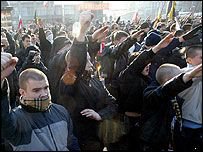
Via UCSJ, the Union of Councils for Jews in the Former Soviet Union:
(via chechnya-sl)
News
Window on Eurasia: Fascism in Russia Threatens Caucasus, Daghestani Mayor Says
(November 18, 2005)
Paul Goble
Tallinn, November 18 - Fascism in the Russian Federation is generating anti-Russian attitudes among many in the northern Caucasus who until recently had been loyal to Moscow, a development that may point toward even greater violence across that region in the future, according to the major of the Daghestani city of Khasavyurt.
In an interview conducted by the Regnum news agency and posted online by IslamNews.ru on Wednesday, Mayor Saygidpasha Umakhanov said that fascism among Russian officials and ordinary Russian citizens is creating an explosive situation in many regions of the northern Caucasus. His words on this point merit extensive quotation.
"Peoples in the Caucasus today are humiliated and abused," Umakhanov said. "Every day one or two corpses are returned to the Caucasus from the center of Russia - and these are precisely the victims of fascism. But these fascists," he continued, "like in Voronezh are called simply hooligans."
At the same time, the Khasavyurt mayor said, "in the Caucasus itself, [Russian security forces frequently] shoot at people who have no connections with terrorism only because they are accidentally acquainted with suspicious personalities."
Moreover, he continued, "it is no secret that there exist an unjust division of Russians into classes, the 'white' and the 'black' races. Skinheads are shown on television solemnly swearing to destroy all non-Russians and shouting slogans like 'Russia for the Russians.'"
"And when we today do not see in the administration of the President or in the federal government or in the force structures a single representative of the national minorities of the Caucasus, the thought begins to creep into our minds: is there someone in the leadership of the country supporting the fascists?"
"We here in the Caucasus and in Daghestan are all for the struggle with terrorism. We defended our republic when it was necessary from the invasion of the militants. As a result, we do not understand when special units come to us, cordon off districts and entire cities, and insult people, and after the operations things of value have disappeared."
"Such a policy is capable of setting the people against the programs of the President. In Nalchik, this led to the rising of 100 people, but with us it is already possible that there are no fewer than ten to twenty thousand indignant young men who have arms."
This situation is made even worse, Umakhanov argued, by the behavior of the current leadership of Daghestan. "In 1999, the leader of [Daghestan itself] publicly called for the people to arm themselves by selling their property and livestock. And now, he wants to take away these arms."
And the mayor concluded with obvious regret, "with each passing day, the situation [in Khasavyurt, which successfully repelled Chechen militants six years ago and in Daghestan as a whole and in its capital Makhachkala in particular where violence has become increasingly common] is becoming worse and worse."
In other comments, Umakhanov complained that his city of 120,000 people currently received inadequate funding from Moscow and Makhachkala, less than 20 percent of what other cities in the republic are getting per capita. But he said he had been able to make up some of the shortfall by turning to local businessmen.
The mayor said that his city, which is located not far from the border with Chechnya, has many refugees from that republic, adding that ethnic Chechens currently form 30 to 40 percent of those involved in the city's markets.
And he indicated that he supported the request of those residents of the northern Caucasus who were seeking to leave Russia and resettle in a Western country where their rights would be respected. "If America takes [this group] in," Mayor Umakhanov said, "at the very least, there these people will not be called 'blacks'."
Friday, November 18, 2005
Distortion and Propaganda
Via RFE/RL
18 November 2005 -- The French Embassy in Moscow today protested a new version of an advertisement by a Russian nationalist party that makes indirect reference to recent French riots.
The original Rodina party commercial for Moscow city local elections depicted a group of young people from the Caucasus throwing watermelon rinds on the ground in the path of a blond Russian mother pushing a baby pram.
The party leader, Dmitrii Rogozin, and a party candidate then demand that everyone speak Russian and "clean the filth out of our city".
The commercial sparked charges of racism, and the national election commission has asked prosecutors to determine whether it violated any laws.
The new version introduces the same scene saying it took place in Paris one year ago, with the participants speaking French with Russian voiceovers.
The French Embassy today said the commercial distorts recent events in France and went against the spirit of mutual understanding in French-Russian relations.
(ITAR-TASS/newsru.com)
18 November 2005 -- The French Embassy in Moscow today protested a new version of an advertisement by a Russian nationalist party that makes indirect reference to recent French riots.
The original Rodina party commercial for Moscow city local elections depicted a group of young people from the Caucasus throwing watermelon rinds on the ground in the path of a blond Russian mother pushing a baby pram.
The party leader, Dmitrii Rogozin, and a party candidate then demand that everyone speak Russian and "clean the filth out of our city".
The commercial sparked charges of racism, and the national election commission has asked prosecutors to determine whether it violated any laws.
The new version introduces the same scene saying it took place in Paris one year ago, with the participants speaking French with Russian voiceovers.
The French Embassy today said the commercial distorts recent events in France and went against the spirit of mutual understanding in French-Russian relations.
(ITAR-TASS/newsru.com)
Time Travel
Jens-Olaf at Estland has a post linking to some truly astonishing "then-and-now" photographs of the Estonian capital, Tallinn.
France-Algeria, January 1956
Pendant le discours de Camus, on pouvait entendre les cris furieux des manifestants, en bas, sur la place. Camus dut entendre les «Camus au poteau», car Poncet vit le visage de son ami « crispé et blême », luttant pour garder son sang-froid et jetant des coups d'oeil désespérés vers les grandes fenêtres qui donnaient sur la foule en colère. En bas, bien que les orateurs et l'assistance ne pussent pas les voir, certains ultras levaient le bras à la manièге fasciste. Les extrémistes, qui menaçaient de forcer le barrage de gendarmes, commencèrent à lancer des pierres dans les vitres et en brisèrent quelques-unes. La rumeur circula que la police risquait d'être débordée par les ultras, ce qui ne manquerait pas d'entraîner des combats entre militants du FLN et extrémistes français de droite, tout cela pour protéger Camus. Il commença à lire son texte d'une voix plus rapide. Un débat avait été prévu - sur l'insistance de Camus -, mais dés qu'il eut achevé la lecture de son texte, Camus murmura quelque chose à Roblès qui proposa ruer la séance. Le court texte de soutien en faveur de l'appel à la trêve n'eut guère le temps de circuler dans l'assistance, et il ne récolta que les dizaines de signatures. Le texte du discours de Camus fut publié à Alger, et le nom de l'imprimeur rendu à dеssein illisible pour éviter les représailles - tant le climat était tendu. (Camus reproduisit le texte de ce discours dans Actuelles III.)
--Herbert R. Lottman, Albert Camus (tr. Marianne Véron), 1978
--Herbert R. Lottman, Albert Camus (tr. Marianne Véron), 1978
Thursday, November 17, 2005
The Tinfoil President
From today's Washington Post (free reg req'd):
Unable to comprehend Ukraine's Orange Revolution, which began a year ago when hundreds of thousands of people took to the streets of Kiev to reject a fraudulent presidential election, Russia's ruling coterie invented a conspiracy theory. Western intelligence agencies, they reasoned, had poured money into Ukrainian civil society groups that were then used as fronts to organize the insurrection. Only someone like President Vladimir Putin, an isolated former KGB agent with little taste for democracy, could embrace such a preposterous idea. Yet Mr. Putin's paranoia now is set to become the basis for a far-reaching crackdown on civil society in Russia. President Bush, who is to meet Mr. Putin tomorrow in South Korea, cannot ignore this assault on freedom.Hat tip: BH
Mr. Putin's initiative comes in the form of legislation abruptly introduced last week in parliament, which he already converted into a rubber stamp. The new law would require all 450,000 noncommercial associations in Russia to re-register with the government; force groups that until now have operated without registration to obtain one; and ban all organizations from using foreign funding for "political activity." Chapters of foreign organizations, such as Human Rights Watch or the Carnegie Moscow Center, would be banned, as would foreign employees of nongovernmental organizations. In effect, the measure would drive most foreign NGOs out of Russia, make it impossible for foundations such as the National Endowment for Democracy to operate and subject all Russian civic groups to the whims of the secret police, who would be able to deny registration to any they deemed suspicious.
Russian officials pretend that the purpose of the legislation is to stop money laundering and other operations by terrorist organizations. But the real motive was stated publicly last week by one of the sponsors of the legislation, Alexei Ostrovsky, who told the newspaper Nezavismaya Gazeta that it "should help the government crack down on politically active NGOs that receive foreign funding and might use the money to promote an Orange revolution." Mr. Ostrovsky linked the bill to a meeting Mr. Putin had with human rights activists in July, in which the president declared that he would not tolerate foreign funding of NGOs.
In reality, the new law is part of a broader campaign by Mr. Putin to ensure that the corrupt autocracy he has created survives the next round of Russian elections for parliament and president in 2007 and 2008. Candidates who might challenge the regime, such as former prime minister Mikhail Kasyanov, are being threatened with criminal prosecution. Now Mr. Putin plans to crush any possibility that Russians would respond to a rigged vote with their own democratic uprising, by eliminating any and all civic organizations deemed potentially unfriendly, including all those sponsored by the West. Russian experts say the law could be completed by Jan. 1, the day Mr. Putin's government is due to take over the chairmanship of the Group of Eight industrial nations. Mr. Bush can look forward to toasting the unprecedented accession of a Russian president to leadership of what was once an exclusive club for democracies, even as Mr. Putin tears up the charters of the U.S. foundations, think tanks and human rights groups operating in Moscow. Is Mr. Bush really prepared to accept such a leader?
Wednesday, November 16, 2005
Dmitrievsky Trial
From PRIMA, news of the opening in Nizhny Novgorod of the legal case against Stanislav Dmitrievsky, editor of "Legal Defence" (Pravo-Zashchita) and executive director of RCFS, the Russian-Chechen Friendship Society, who is accused of "inciting racial, national and social hostility."
Update: Interfax is reporting that the opening of Dmitrievsky's trial has been delayed until November 25.
On Sept. 2, 2005, charges were filed against Dmitrievski based on Statute 282 of the Criminal Codex of the Russian Federation - “actions, aimed at inciting animosity and hostility, as well as humiliation of human dignity of representatives of either group based on gender, race, nationality, language, origin, religion, or belonging to a certain social group.” If convicted, the defendant can face up to five years in prison. The charges were filed in January of this year based on the publication in “Legal Defense” newspaper of a statement by Aslan Maskhadov and Akhmed Zakaev that called for a peaceful resolution of the Russo-Chechen conflict. The published statement contains scathing criticism of the Russian government's actions, the Russian military forces and, specifically, President Vladimir Putin. The defense counsel consider the above mentioned accusations to be politically motivated and in direct violations of the constitutionally-guaranteed freedom of speech right.
RFE/RL: Idigov in Brussels
Chechnya: Pro-Independence Envoy Gets Sympathetic Reception At European Parliament
By Ahto Lobjakas
Chechen politician Akhyad Idigov at the European Pariament
(RFE/RL)
Pro-independence Chechens had a rare opportunity today to rally support for their cause in the European Union. Members of the European Parliament (MEPs) representing countries surrounding the Baltic Sea received Akhyad Idigov in Strasbourg. Idigov is the head of the foreign relations committee of what the European Union considers to be the last freely elected Chechen parliament. Idigov said he was received sympathetically in Strasbourg. And an MEP instrumental in organizing Idigov's visit said deputies supportive of the Chechen independence movement will attempt to formally raise the issue in the European Parliament.
Brussels, 15 November 2005 (RFE/RL) -- Idigov's meeting in Strasbourg today is a sign of the changing times.
The European Parliament has shed the sluggish detachment that has previously characterized much of its relations with the bloc's eastern neighbors, especially Russia. The change in tone follows the arrival of deputies from eight formerly communist states that have become new EU members. Kelam said Russia can no longer hide its abuses in Chechnya behind the excuse of fighting international terrorism. He noted that if Moscow is in control of the situation it must be able to guarantee normal conditions.
Some 25 MEPs from the so-called Baltic-Europe Intergroup provided an unusually high-level audience for the visiting pro-
independence Chechen envoy. The deputies came mostly from the three Baltic States, but also Finland, Germany, and Britain, among others.
In a telephone interview with RFE/RL from Strasbourg, Idigov said he is in Strasbourg representing the exiled deputies who were voted into office in the parliamentary polls of 1997. International monitors who observed the parliamentary balloting said it was free and fair.
Idigov told RFE/RL he is trying to force Chechnya onto the EU's political agenda: "In concrete terms, we want that they raise the question of what is happening in Chechnya. What I mean are the violations, the colossal sacrifices that the people of our country, the Chechen people, bear today -- that that question is examined, regardless of the various accusations, that they are charged with being involved in terrorism and other things. Fair enough, we are saying. If, indeed, such accusations are made, we, our side -- the resistance and our Chechen parliament -- we want that this issue is examined."
Idigov said the EU cannot stand aside since Chechnya is "a part of Europe."
Tunne Kelam, an Estonian MEP, played the lead role in organizing Idigov's visit to the European Parliament.
He told RFE/RL that the issue of Chechnya is perceived in a "slanted" fashion throughout most of the EU. Kelam says EU demands for Russian oil and gas, in particular, "massively outweigh" any concerns about human rights violations in Chechnya.
Kelam said putting EU politicians in contact with "living witnesses" of the Chechen conflict is necessary to maintain the relevance of the issue in Europe: "I think that what is most important is to keep these issues alive, by means of living witnesses. It is one thing to consider the statistics. Let us take as an example [a Chechen] information sheet on how many thousands of people have been killed in the course of these two wars, how many have become refugees, how many children have lost their lives or their homes. But it is another thing entirely to be able to communicate with representatives of the Chechen people who have seen all this with their own eyes."
Idigov said he wants to counter attempts by Moscow to portray Chechens "as an irresponsible nation of children, unable to manage its own affairs."
Kelam concurs. It is essential, he says, that the Chechens who want to change their circumstance are not seen "as terrorists and nothing else."
Idigov told RFE/RL he had detected interest among the MEPs he addressed. He said many deputies had asked him for ideas as to what the European Parliament should do to contribute to the resolution of the conflict:
"Their interest gives me reason to believe that they will work in this direction, despite the fact that they're politicians, despite the fact that there is a point at which this problem is resolved only by bringing to bear the entire EU apparatus. Nevertheless, [there is a need] to raise this question and to demonstrate that the issue remains very acute. And they understood this and, it seems to me, they promised they will work with the issue."
At today's meeting with Idigov, Lithuanian MEP Aloyzas Sakalas was particularly scathing about the Russian record in Chechnya. Sakalas said Russia is involved in state terrorism that, by comparison, overshadows the human rights breaches for which the autocratic regime in Belarus is currently being vilified.
Kelam said he has asked the European Parliament's Russian delegation to give Idigov a hearing at its meeting tomorrow.
Kelam said that although the European Parliament has adopted many resolutions on Russia citing problems in Chechnya, the EU's member states and the European Commission have largely ignored them.
However, he said attempts to force the EU to take account of Chechnya in its relations with Russia will continue: "The final goal must be, I think, a separate, free-standing debate of the Chechen issue in the European Parliament with the adoption of a resolution. A more practical issue is how to put pressure on the European Commission so that it would start putting much more emphasis on this problem in its relations with Russia. Because, at the end of the day, it is the responsibility of the Russian government to normalize the situation [in Chechnya]."
Kelam said Russia can no longer hide its abuses in Chechnya behind the excuse of fighting international terrorism. He noted that if Moscow is in control of the situation, it must be able to guarantee normal conditions.
"If it cannot do that after 10 years of war," Kelam concluded, "then perhaps that is the most convincing argument that what is best for Chechnya is autonomy or independence."
Idigov told RFE/RL that an expected 700 to 1,000 Chechen refugees will hold a protest rally in Strasbourg tomorrow. He estimates there are more than 50,000 displaced Chechens in Europe.
By Ahto Lobjakas
Chechen politician Akhyad Idigov at the European Pariament
(RFE/RL)
Pro-independence Chechens had a rare opportunity today to rally support for their cause in the European Union. Members of the European Parliament (MEPs) representing countries surrounding the Baltic Sea received Akhyad Idigov in Strasbourg. Idigov is the head of the foreign relations committee of what the European Union considers to be the last freely elected Chechen parliament. Idigov said he was received sympathetically in Strasbourg. And an MEP instrumental in organizing Idigov's visit said deputies supportive of the Chechen independence movement will attempt to formally raise the issue in the European Parliament.
Brussels, 15 November 2005 (RFE/RL) -- Idigov's meeting in Strasbourg today is a sign of the changing times.
The European Parliament has shed the sluggish detachment that has previously characterized much of its relations with the bloc's eastern neighbors, especially Russia. The change in tone follows the arrival of deputies from eight formerly communist states that have become new EU members. Kelam said Russia can no longer hide its abuses in Chechnya behind the excuse of fighting international terrorism. He noted that if Moscow is in control of the situation it must be able to guarantee normal conditions.
Some 25 MEPs from the so-called Baltic-Europe Intergroup provided an unusually high-level audience for the visiting pro-
independence Chechen envoy. The deputies came mostly from the three Baltic States, but also Finland, Germany, and Britain, among others.
In a telephone interview with RFE/RL from Strasbourg, Idigov said he is in Strasbourg representing the exiled deputies who were voted into office in the parliamentary polls of 1997. International monitors who observed the parliamentary balloting said it was free and fair.
Idigov told RFE/RL he is trying to force Chechnya onto the EU's political agenda: "In concrete terms, we want that they raise the question of what is happening in Chechnya. What I mean are the violations, the colossal sacrifices that the people of our country, the Chechen people, bear today -- that that question is examined, regardless of the various accusations, that they are charged with being involved in terrorism and other things. Fair enough, we are saying. If, indeed, such accusations are made, we, our side -- the resistance and our Chechen parliament -- we want that this issue is examined."
Idigov said the EU cannot stand aside since Chechnya is "a part of Europe."
Tunne Kelam, an Estonian MEP, played the lead role in organizing Idigov's visit to the European Parliament.
He told RFE/RL that the issue of Chechnya is perceived in a "slanted" fashion throughout most of the EU. Kelam says EU demands for Russian oil and gas, in particular, "massively outweigh" any concerns about human rights violations in Chechnya.
Kelam said putting EU politicians in contact with "living witnesses" of the Chechen conflict is necessary to maintain the relevance of the issue in Europe: "I think that what is most important is to keep these issues alive, by means of living witnesses. It is one thing to consider the statistics. Let us take as an example [a Chechen] information sheet on how many thousands of people have been killed in the course of these two wars, how many have become refugees, how many children have lost their lives or their homes. But it is another thing entirely to be able to communicate with representatives of the Chechen people who have seen all this with their own eyes."
Idigov said he wants to counter attempts by Moscow to portray Chechens "as an irresponsible nation of children, unable to manage its own affairs."
Kelam concurs. It is essential, he says, that the Chechens who want to change their circumstance are not seen "as terrorists and nothing else."
Idigov told RFE/RL he had detected interest among the MEPs he addressed. He said many deputies had asked him for ideas as to what the European Parliament should do to contribute to the resolution of the conflict:
"Their interest gives me reason to believe that they will work in this direction, despite the fact that they're politicians, despite the fact that there is a point at which this problem is resolved only by bringing to bear the entire EU apparatus. Nevertheless, [there is a need] to raise this question and to demonstrate that the issue remains very acute. And they understood this and, it seems to me, they promised they will work with the issue."
At today's meeting with Idigov, Lithuanian MEP Aloyzas Sakalas was particularly scathing about the Russian record in Chechnya. Sakalas said Russia is involved in state terrorism that, by comparison, overshadows the human rights breaches for which the autocratic regime in Belarus is currently being vilified.
Kelam said he has asked the European Parliament's Russian delegation to give Idigov a hearing at its meeting tomorrow.
Kelam said that although the European Parliament has adopted many resolutions on Russia citing problems in Chechnya, the EU's member states and the European Commission have largely ignored them.
However, he said attempts to force the EU to take account of Chechnya in its relations with Russia will continue: "The final goal must be, I think, a separate, free-standing debate of the Chechen issue in the European Parliament with the adoption of a resolution. A more practical issue is how to put pressure on the European Commission so that it would start putting much more emphasis on this problem in its relations with Russia. Because, at the end of the day, it is the responsibility of the Russian government to normalize the situation [in Chechnya]."
Kelam said Russia can no longer hide its abuses in Chechnya behind the excuse of fighting international terrorism. He noted that if Moscow is in control of the situation, it must be able to guarantee normal conditions.
"If it cannot do that after 10 years of war," Kelam concluded, "then perhaps that is the most convincing argument that what is best for Chechnya is autonomy or independence."
Idigov told RFE/RL that an expected 700 to 1,000 Chechen refugees will hold a protest rally in Strasbourg tomorrow. He estimates there are more than 50,000 displaced Chechens in Europe.
Yushchenko Party In Crisis
Writing in EDM, Oleg Varfolomeyev notes that
The People's Union-Our Ukraine party of President Viktor Yushchenko (NSNU) is undergoing a severe identity crisis just four months ahead of the crucial parliamentary polls scheduled for March 26. Addressing the NSNU congress on November 12, Yushchenko said the party should win the election. This may be little more than wishful thinking. Yushchenko left after delivering his speech, and what happened next showed that the party might be too seriously ill to win.
Chechnya: Meetings in Berlin
At chechnya-sl, Jeremy Putley has posted a BBC report on pro-Chechnya meetings in Berlin.
Tuesday, November 15, 2005
Havel Writes To Putin
From RFE/RL:
Havel Writes Letter To Putin Over Human Rights
(AFP)
15 November 2005 -- Former Czech President Vaclav Havel has sent a letter to Russian President Vladimir Putin urging him to improve the state of human rights in Russia.
Jakub Hladik, a spokesman for Havel, said today the letter expresses concerns about growing clampdown by the Russian government on opposition political parties, the media, and the judicial system.
It also calls on Putin to respect international democratic standards and individual freedoms.
The letter was coauthored by eight former political leaders, including ex-Brazilian President Fernando Henrique Cardoso and Mary Robinson, who served as both president of Ireland and the United Nations high commissioner for human rights.
(CTK)
Havel Writes Letter To Putin Over Human Rights
(AFP)
15 November 2005 -- Former Czech President Vaclav Havel has sent a letter to Russian President Vladimir Putin urging him to improve the state of human rights in Russia.
Jakub Hladik, a spokesman for Havel, said today the letter expresses concerns about growing clampdown by the Russian government on opposition political parties, the media, and the judicial system.
It also calls on Putin to respect international democratic standards and individual freedoms.
The letter was coauthored by eight former political leaders, including ex-Brazilian President Fernando Henrique Cardoso and Mary Robinson, who served as both president of Ireland and the United Nations high commissioner for human rights.
(CTK)
Monday, November 14, 2005
RCFS - Case Dismissed
Court Refuses to Close Russian-Chechen Friendship Society
Created: 14.11.2005 16:10 MSK (GMT +3), Updated: 16:35 MSK, 6 hours 52 minutes ago
See also in this blog: RCFS Under Threat - II
RCFS Under Threat
Created: 14.11.2005 16:10 MSK (GMT +3), Updated: 16:35 MSK, 6 hours 52 minutes ago
RFE/RL notes:
MosNews
A court in Nizhny Novgorod has refused to satisfy a request from the Federal Registration Service to close down the Russian-Chechen Friendship Society, the Gazeta.ru website reported Monday.
The Federal Registration Service filed a complaint against the RCFS in spring, after the RCFS failed to provide the necessary documents on its financial activities during an unscheduled check. The documents in question were with the Tax Inspection Service at the time.
After the RCFS society provided the papers in June and no violations were found, the registration service demanded the Society change its name so that the word “Russian” was not used. The reason given was that the NGO only has offices in a few regions of Russia and not all over the country.
The International Helsinki Human Rights Group earlier accused the Russian authorities of the unjustified destruction of the NGO.
RCFS is a Nizhny Novgorod-based NGO, which distributes independent information about the human rights situation in the Caucasus, defends the interests of victims of war crimes and assists children and disabled people victimized by the conflict in Chechnya.
The NGO was founded in 2000 and has branch offices in Nazran and Grozny. It has repeatedly criticized the Russian authorities for severe human rights and humanitarian law violations in Chechnya and the surrounding areas.
The court did not provide an explanation for its decision today. But RCFS head Stanislav Dmitrievskii welcomed the ruling as a "truly independent decision."
RCFS still faces a $35,000 tax bill imposed by authorities who say the group's foreign grants amount to profit and should be taxed.
See also in this blog: RCFS Under Threat - II
RCFS Under Threat
Minerals
by Tua Forsström
(my tr.)
1
It’s green the way it’s green in May
It rains the way it rains in May when it’s green
In the clear dream we know that we dream
In the clear dream we are aware of dreaming
The horses run, it rains on the horses
2
One should keep one’s minerals in a box
Dust wears out their durability
The brilliance that surrounds everything deserted
One must keep them dark
3
I dreamed I was too dirty to go
to a doctor in Grand Popo, Benin, West Africa.
The doctor turned my ears inside out. It
hurt. There are things that can’t be buried
or dug up, one doesn’t know what they are and there
are many rooms in the underworld and glitter
from spaceships that have crashed.
4
But somebody lift her then
quickly so her waist doesn’t break
or the whole of her breaks
and just let her be
5
During the dark season
One must pass through many intermediary rooms
In a sprawling city with monuments
Greetings From A New Home
6
Digital silence is confusing. I know
an answering machine on which someone constantly holds their breath
and listens, forwarding one’s dejected messages
to a secret intelligence service and from there to the Worst
Department where they carry the documents on silver trays
silver-happy in wonderful blue garments made of fabric.
7
It wasn’t because it was useful
I’ll take the one with the stained paws
A cloud of rain blows through the heart:
I was homeless and you took me home
8
It wasn’t because of the things
It wasn’t because it was useful
It was because of the frogbit and the slimed-up
lake, I remember the frogbit!
9
The one with the stained paws
We were children in the light green hazel wood
There are flowing grounds where currents meet and
whirl green and waves blow in different directions
10
There was a little crowd of us who went to the market in Grand Popo
every Saturday at ten, bright patterns children and old folk goats dogs
hens and fairly domesticated pigs. In the middle Leena and I marched
fair-complexioned and really unnatural. Anyway we walked in the red dust
and the red mud in the hollows after cloudbursts God knows how long ago
forgotten and never have we laughed as we did along the village street in Grand
Popo when none of us had any idea what it was all about.
11
Through the foliage of the chandelier
the sky with stars of gold above the pulpit:
ÒAnd you will ask me:
From how far away did you see me
when we were alive that time?
12
Tunnel of smoke and cloud
Someone carried me in their arms I think
There were creatures there that did not leave me
It was dark. It went quickly
13
(old)
Apples thud silently to the ground
You will live in a single room
The radio destroys nearly all the characters
Mama I want to go home All the time
at home now
(my tr.)
1
It’s green the way it’s green in May
It rains the way it rains in May when it’s green
In the clear dream we know that we dream
In the clear dream we are aware of dreaming
The horses run, it rains on the horses
2
One should keep one’s minerals in a box
Dust wears out their durability
The brilliance that surrounds everything deserted
One must keep them dark
3
I dreamed I was too dirty to go
to a doctor in Grand Popo, Benin, West Africa.
The doctor turned my ears inside out. It
hurt. There are things that can’t be buried
or dug up, one doesn’t know what they are and there
are many rooms in the underworld and glitter
from spaceships that have crashed.
4
But somebody lift her then
quickly so her waist doesn’t break
or the whole of her breaks
and just let her be
5
During the dark season
One must pass through many intermediary rooms
In a sprawling city with monuments
Greetings From A New Home
6
Digital silence is confusing. I know
an answering machine on which someone constantly holds their breath
and listens, forwarding one’s dejected messages
to a secret intelligence service and from there to the Worst
Department where they carry the documents on silver trays
silver-happy in wonderful blue garments made of fabric.
7
It wasn’t because it was useful
I’ll take the one with the stained paws
A cloud of rain blows through the heart:
I was homeless and you took me home
8
It wasn’t because of the things
It wasn’t because it was useful
It was because of the frogbit and the slimed-up
lake, I remember the frogbit!
9
The one with the stained paws
We were children in the light green hazel wood
There are flowing grounds where currents meet and
whirl green and waves blow in different directions
10
There was a little crowd of us who went to the market in Grand Popo
every Saturday at ten, bright patterns children and old folk goats dogs
hens and fairly domesticated pigs. In the middle Leena and I marched
fair-complexioned and really unnatural. Anyway we walked in the red dust
and the red mud in the hollows after cloudbursts God knows how long ago
forgotten and never have we laughed as we did along the village street in Grand
Popo when none of us had any idea what it was all about.
11
Through the foliage of the chandelier
the sky with stars of gold above the pulpit:
ÒAnd you will ask me:
From how far away did you see me
when we were alive that time?
12
Tunnel of smoke and cloud
Someone carried me in their arms I think
There were creatures there that did not leave me
It was dark. It went quickly
13
(old)
Apples thud silently to the ground
You will live in a single room
The radio destroys nearly all the characters
Mama I want to go home All the time
at home now
Sunday, November 13, 2005
France 1953
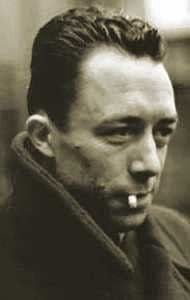
Il y déclara qu’il refusait de partager la satisfaction de la presse bourgeoise à l'idée qu’un crime stalinien compensait l'exécution, la même semaine, des Rosenberg aux États-Unis. «Mais si je crois impossible, dit-il encore, que les émeutes de Berlin fassent oublier les Rosenberg, il me semble bien plus affreux que des hommes qui se disent de gauche puissent essayer de dissimuler dans l'ombre des Rosenberg les fusillés allemands. » Il considérait les émeutes de Berlin comme l'événement le plus grave survenu depuis la libération de la France et il réclamait, avec les organisateurs du meeting, qu'une соmmission syndicale internationale d'enquête fût envoyée en Allemagne de l'Еst.
Le 14 juillet à Paris, au cours d'une manifestation organisée рlace de la Nation par les partisans du Mouvement pour le triomphe de libertés démocratiques (l'organisation de Messali), la police interrompit un défilé d'ouvriers musulmans portant des banderoles réclamant la libération de Messali Hadj (alors incarcéré quelque part dans le sud-ouest de la France). Les bagarres firent sept morts et quarante-quatre blessés du côté des musulmans, et quatre-vingt-deux Ыessés parmi les policiers. Une fois de plus Camus écrivit une lettre à «Monsieur le directeur », cette fois celui du journal le Monde, pour protester contre l'ouverture d'une information contre X pour violences à agents, alors qu'en vérité la violence avait été dirigée contre les Nord-Africains, dans « un racisme qui n'ose pas dire son nom». Il réclamait une enquête pour déterminer qui avait ordonné aux forces de police d'ouvrir le feu et qui, au sein du gouvernement, poursuivait alors «cette très ancienne conspiration du silence et de cruauté qui déracine les travailleurs algériens, les fait vivre misérablement dans des taudis et les désespère jusqu'à la violence pour les tuer à l'occasion». Cette exhortation n'allait pas être écoutée, non plus qu'aucun autre appel en faveur des Algériens musulmans en France métropolitaine où en Afrique du Nord et, en l'espace d'un an, l'escalade des tensions allait déboucher sur l'insurrection armée.
--Herbert R. Lottman, Albert Camus, tr. Marianne Véron
Saturday, November 12, 2005
Battle Cries
At With A Grain Of Salt, Dr Bhaskar Dasgupta reflects on how "the Iraqi insurgents’ video showed how the insurgents shot a downed pilot in cold blood, all the while intoning 'Allah-u-Akbar', in a revenge attack for the marines killing the wounded insurgent in a Fallujah mosque. Quite shocking, no? In another video, somebody was invoking the name of God, while going about lopping an Egyptian’s (accused of being an informer) head off":
The Vikings screamed and imitated animal sounds, during battle, to intimidate their enemies. One of their cries was "Ahoy!" which has now taken on a much kinder meaning in common usage. The other example is from Japanese war history where attacking the kamikaze and ordinary pilots battle cry was "Tora, Tora, Tora!" which means, "Tiger, Tiger, Tiger!". They would also shout “Banzai” as well, which means literally ‘may you live ten thousand years’ and was used in salutation of the emperor and not just as a battle cry. . Battle of Britain pilots would bellow “Tally-ho” as a sign that the enemy has been sighted and battle will commence.Read the whole thing.
The French revolutionaries used “Liberty” as a battle cry. But quite often, “follow me”, “charge”, “after me” were battle cries used by officers wanting to lead by example, we have disparate evidence of this battle cry being used by English Armoured corps officers in the North African Campaign, in various WW II battles, by Palmach in Israel, etc.
But it is crying out God’s name which seems to be the most common. During the Middle Ages, the English Kings use the motto "Dieu et mon droit" ("God and my right") as a battle cry, for example Edward III's rallying cry at the Battle of Crécy. In Spain, during the Reconquista from the Moors, they cried "Santiago", looking for holy protection from St. James, the patron saint of Spain. The French knights of the Middle Ages used "Montjoie! St Denis!", while the Crusaders used the cry “Denique coelum!” (‘Heaven at last!’). At the Battle of Hastings, the Saxon army officers cried "Olicrosse!" and "Godamite!", while the regular foot soldiers cried "Ut! Ut! Ut!" ("Out! Out! Out!"). The Normans' cry was "Dex Aie!" ("God aid us!"). This was last used by the Royal Guernsey Light Infantry during the First World War.
I have already mentioned the cries of ‘Allah-u-Akbar’, but when one sees the other religious ground in India, we see huge examples of battle cries. "Bole So Nihal, Sat Sri Akal" is the battle cry of Sikhs who, by virtue of their religion, and their location in North West India, were involved in many wars and battles against the Muslim invaders, the British etc. The British Indian Army (and its predecessor, the British East India Company Presidency Armies) have a very long history. In addition, these regiments were usually arranged and organised on the basis of religion and region. So you would have Bengal Regiments, Madras Regiments, Sikh Regiment, Mahar Regiment, Maratha Regiment, so on and so forth. You would hear cries such as “Jai Bhavani”, “Jai Durga”, “Jai Kali” and “Jai Jagdamba” (strangely enough, the cries seem to be requests to the Goddesses for safety and protection).
It was a fascinating exercise to read all these collated research snippets about battle cries. If one closed one’s eyes, one could almost hear these cries, the sounds of battle, the screams and groans of the wounded, the ringing of swords or the sounds of explosions, smell the stench and the smoke and feel the horror of war. You could almost hear the battle cries floating over the mass of struggling men, down the ages, who have whipped themselves up into a frenzy, almost berserker rage. I wonder what would have happened at night, when tired, hungry, bloodied men would be sitting around their camp-fires, hearing the hyenas and dogs tearing apart the dead, looking at empty bed rolls, and wondering about the families of the dead soldiers. Not much use for a battle cry at this stage is there? Strange indeed are the ways of men at war. Eleanor Roosevelt talked about war being the worst way to solve a problem saying: "I can not believe that war is the best solution. No one won the last war, and no one will win the next war."
Friday, November 11, 2005
RCFS Under Threat - II
Re. Coordinated Efforts by the Russian Authorities to Close Down the Russian-Chechen Friendship Society (RCFS)
Dear all,
1. Unexpectedly, the judge in the court procedure regarding the de-registration of the Russian-Chechen Friendship Society (RCFS), changed her mind, and fixed the next hearing in this case in Nizhny Novgorod for Monday, 14 November, 10:30 am.
Just ten days before she had decided that the hearing was postponed for an indefinite period of time, until the case isconsidered by the superior body, the Panel of Judges on civil cases at the Supreme Court of the RF.
2. The next, and maybe final, hearing on the criminal case against Stas Dimitrievsky, the head of the RCFS, based on a charge under part 2b of Article 282 ("inciting hatred or enmity on the basis of ethnicity and religion") for having allowed the (re-)publication of two articles on the Chechen conflict, Aslan Maskhadov’s open letter to the European Parliament and Akhmed Zakaev’s appeal to the people of Russia, will take place in Nizhny Novgorod on Wednesday, 16th November, 10:00 am.
If convicted in this criminal case, Stas Dimitrievsky faces up to 5 years imprisonment.
3. The hearing of the Arbitrage Court in Nizhny Novgorod regarding alleged tax evasion of the RCFS will also take place on Wednesday, 16th November, 2:30 pm.
In a very unusual manner, the RCFS had been ordered by the tax inspectorate to pay profit tax for grants to implement specific human rights projects in the period from 2002 to 2004 from three foreign donors, and to pay a fine, totalling 1.001.561 Rubles (around 28.200 Euro).
Additionally, on the basis of the conclusions made by the tax inspectorate, also a criminal case was commenced by the Interior Ministry. Mr. Dimitrievsky is yet not formally indicted, but this could be taken up right after a decision of the Arbitrage Court.
Please find attached the newest statement of the RCFS on the developments.
Sincerely,
Joachim Frank
(International Helsinki Federation for Human Rights)
******************************
INFORMATION CENTER OF THE RUSSIAN-CHECHEN FRIENDSHIP SOCIETY
RUSSIAN-CHECHEN
INFORMATION AGENCY
Press Release #1596 from November 11, 2005
Report from Nizhny Novgorod
URGENT MESSAGE
Court hearing on liquidation of the RCFS have unexpectedly fixed on 14 November. The judge Samartseva has changed her mind, all of a sudden.
11.11.2005. The Russian-Chechen Friendship Society received a notification signed by the judge Samartseva stating that she had scheduled the main hearing of the case concerning the suit lodged by the Ministry of Justice against the RCFS on November 14. Thus, she has overruled her own decision taken on November 1, 2005 to postpone consideration of the case for an indefinite period of time.
As we reported before, on 2 November 2005 the judge of Nizhny Novgorod region Court Samartseva postponed consideration of the suit lodged by the Ministry of Justice against the Russian-Chechen Friendship Society with the demand to close the organization down. The time for the next hearing has not been fixed.
The Russian-Chechen Friendship Society was represented by Alexander Lavrent'ev who appealed not to consider the suit as according to the “Law on Public Associations” the registration body has not right to lodge a suit with the demand to destroy an organization. After the judge made a decision not to comply with the request, the RCFS representatives stated that they were going to appeal this decision in the superior court by submitting a complaint. The judge made a decision to postpone the case hearing for an indefinite period of time until the case is considered by the Panel of Judges on civil cases at the Supreme Court of the Russian Federation.
The judge’s notification was signed on 3 November but sent on 8 November. The RCFS had it delivered only today, in the second half of the day.
The letter from Samartseva says, “I have to inform you that in accordance with parts 1 and 2 of Article 223 of the Civil Code of the Russian Federation, part 1 of Article 371 of the Civil Code the ruling not to comply with the request can’t be an obstacle to hold the main hearing of the case.
Thus, I have to inform you that the date of the main hearing is scheduled now on 14 November 2005 at 10 am”.
According to the RCFS staffers, this sudden decision evidences an assumption that it has been done on purpose in order to create as many obstacles as possible for the RCFS to carry out their defense and to exhaust them by court hearings that follow one another.
From our correspondent
Editor in Chief Stanislav Dmitrievskiy
The publication of this release was made possible by European Union within the framework of the project “Open information about Chechnya in the name of peace and human rights: Russian- Chechen Information Agency” and The National Endowment for Democracy within the framework of the program “Russian-Chechen Information Partnership”
__________________________________________
Joachim Frank, Project Coordinator
International Helsinki Federation for Human Rights
Wickenburggasse 14/7
A-1080 Vienna
Tel. +43-1-408 88 22 ext. 22
Fax: +43-1-408 88 22 ext. 50
Web: http://www.ihf-hr.org
______________________________________
See also in this blog: RCFS Under Threat
Dear all,
1. Unexpectedly, the judge in the court procedure regarding the de-registration of the Russian-Chechen Friendship Society (RCFS), changed her mind, and fixed the next hearing in this case in Nizhny Novgorod for Monday, 14 November, 10:30 am.
Just ten days before she had decided that the hearing was postponed for an indefinite period of time, until the case isconsidered by the superior body, the Panel of Judges on civil cases at the Supreme Court of the RF.
2. The next, and maybe final, hearing on the criminal case against Stas Dimitrievsky, the head of the RCFS, based on a charge under part 2b of Article 282 ("inciting hatred or enmity on the basis of ethnicity and religion") for having allowed the (re-)publication of two articles on the Chechen conflict, Aslan Maskhadov’s open letter to the European Parliament and Akhmed Zakaev’s appeal to the people of Russia, will take place in Nizhny Novgorod on Wednesday, 16th November, 10:00 am.
If convicted in this criminal case, Stas Dimitrievsky faces up to 5 years imprisonment.
3. The hearing of the Arbitrage Court in Nizhny Novgorod regarding alleged tax evasion of the RCFS will also take place on Wednesday, 16th November, 2:30 pm.
In a very unusual manner, the RCFS had been ordered by the tax inspectorate to pay profit tax for grants to implement specific human rights projects in the period from 2002 to 2004 from three foreign donors, and to pay a fine, totalling 1.001.561 Rubles (around 28.200 Euro).
Additionally, on the basis of the conclusions made by the tax inspectorate, also a criminal case was commenced by the Interior Ministry. Mr. Dimitrievsky is yet not formally indicted, but this could be taken up right after a decision of the Arbitrage Court.
Please find attached the newest statement of the RCFS on the developments.
Sincerely,
Joachim Frank
(International Helsinki Federation for Human Rights)
******************************
INFORMATION CENTER OF THE RUSSIAN-CHECHEN FRIENDSHIP SOCIETY
RUSSIAN-CHECHEN
INFORMATION AGENCY
Press Release #1596 from November 11, 2005
Report from Nizhny Novgorod
URGENT MESSAGE
Court hearing on liquidation of the RCFS have unexpectedly fixed on 14 November. The judge Samartseva has changed her mind, all of a sudden.
11.11.2005. The Russian-Chechen Friendship Society received a notification signed by the judge Samartseva stating that she had scheduled the main hearing of the case concerning the suit lodged by the Ministry of Justice against the RCFS on November 14. Thus, she has overruled her own decision taken on November 1, 2005 to postpone consideration of the case for an indefinite period of time.
As we reported before, on 2 November 2005 the judge of Nizhny Novgorod region Court Samartseva postponed consideration of the suit lodged by the Ministry of Justice against the Russian-Chechen Friendship Society with the demand to close the organization down. The time for the next hearing has not been fixed.
The Russian-Chechen Friendship Society was represented by Alexander Lavrent'ev who appealed not to consider the suit as according to the “Law on Public Associations” the registration body has not right to lodge a suit with the demand to destroy an organization. After the judge made a decision not to comply with the request, the RCFS representatives stated that they were going to appeal this decision in the superior court by submitting a complaint. The judge made a decision to postpone the case hearing for an indefinite period of time until the case is considered by the Panel of Judges on civil cases at the Supreme Court of the Russian Federation.
The judge’s notification was signed on 3 November but sent on 8 November. The RCFS had it delivered only today, in the second half of the day.
The letter from Samartseva says, “I have to inform you that in accordance with parts 1 and 2 of Article 223 of the Civil Code of the Russian Federation, part 1 of Article 371 of the Civil Code the ruling not to comply with the request can’t be an obstacle to hold the main hearing of the case.
Thus, I have to inform you that the date of the main hearing is scheduled now on 14 November 2005 at 10 am”.
According to the RCFS staffers, this sudden decision evidences an assumption that it has been done on purpose in order to create as many obstacles as possible for the RCFS to carry out their defense and to exhaust them by court hearings that follow one another.
From our correspondent
Editor in Chief Stanislav Dmitrievskiy
The publication of this release was made possible by European Union within the framework of the project “Open information about Chechnya in the name of peace and human rights: Russian- Chechen Information Agency” and The National Endowment for Democracy within the framework of the program “Russian-Chechen Information Partnership”
__________________________________________
Joachim Frank, Project Coordinator
International Helsinki Federation for Human Rights
Wickenburggasse 14/7
A-1080 Vienna
Tel. +43-1-408 88 22 ext. 22
Fax: +43-1-408 88 22 ext. 50
Web: http://www.ihf-hr.org
______________________________________
See also in this blog: RCFS Under Threat
When East Met West
In his witty and always informative weekly newsletter, Edward Lucas describes the "brainy émigrés" who helped to put the restored democracies of Eastern Europe back on the rails after the collapse of Communism:
I first came across them in the 'Infobiuras' of the Lithuanian pro-independence movement, Sajudis, in early 1990.
Young, bright-eyed Americans, Canadians and Australians, steeped by fervently patriotic parents in the history of countries they hardly knew, bent on fulfilling their historical destiny. They translated documents into English, briefed journalists, advised politicians and generally brought a blast of optimistic, confident radicalism to the nervous, blurry world of collapsing Communism.
Sometimes the results were more spectacular than productive. During one of the hairier moments of the Lithuanian independence struggle, when it seemed as though the West, with the honourable but minor exception of Iceland, was going to abandon Lithuania to the mercies of Soviet stormtroopers, I remember hearing one beefy young Lithuanian émigré bellowing down the phone "Don't be such a f***ing jerk!" I asked him who he'd been talking to. "The American ambassador in Moscow," he replied tersely.
There were grown-ups too. The most impressive, Stasys Lozoraitis, ran, unsuccessfully, for president of Lithuania in 1993. He had spent his whole life as ambassador to the Vatican and United States, in quixotic service to a country that most of the world thought had disappeared in 1940. He was urbane, polyglot, amusing, and charismatic, with an Italian wife who added a rare touch of glamour and sophistication to the drab, stodgy world of Lithuania. Elsewhere, these high-powered émigrés included a deeply impressive Canadian-Latvian professor of linguistics, a forceful young man who ran the Estonian section of Radio Free Europe and an ambitious Polish refugee-journalist, who after studying at Oxford in the early 1980s spent time in Soviet-occupied Afghanistan with the resistance.
The galaxy of talent had some black holes too. There was one adviser to a Baltic foreign ministry whose sole qualification was a diploma in bar management and a hard-drinking old bat in an economics ministry whose previous job was as a junior public relations woman for a theme park. One of the most energetic and engaging Lithuanian émigrés turned out to have been working for both the KGB and the Americans (in what order was never completely clear).
But the presumption then was that even the most modest émigré talent was badly needed. Even the most superficial knowledge of the way the West worked was a big advantage. Knowing how to use a computer, handle phone messages, talk politely to strangers in English and organise travel to faraway places were all rare skills. That changed quickly. But the best émigré talent is still around. The Canadian professor, Vaira Vike-Freiberga, is now president of Latvia and one of the few East European politicians with a claim to world status. The young man from Radio Free Europe, Tom Ilves, is now a leading member of the European Parliament. The Anglo-Polish journalist, Radek Sikorski, has just been sworn in as defence minister. But the political balance has changed. Now the diaspora appears provincial and out of touch. In Toronto, Ealing and the Chicago suburbs, they are still baking the old recipes, learning folk songs, sending children to Saturday school and keeping the church afloat. But the diaspora is no longer the political lungs of nationhood: the source of free ideas and discussion, a constant reminder that the Communist version of the past, present and future was an evil fiction.
In politics, it's the homeland that's humming. But not in economics. A million East Europeans or more have gone abroad in search of jobs and education. That raises a big question for the ex-captive nations: can they ever attract these bright, mobile people back home?
Subscribe to:
Posts (Atom)