A Step At A Time

Reflections on the new world order. The blog can also be accessed here

Thursday, August 31, 2006


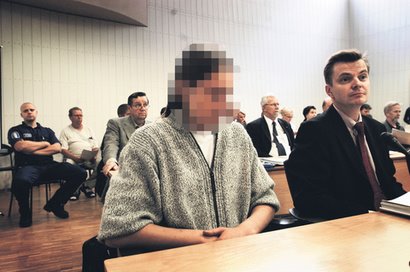
Porvoo Arsonist Sentenced


Kalle Holm, the 18-year-old arsonist who set fire to Finland's Porvoo Cathedral has been sentenced to three years and two months' imprisonment, Hufvudstadsbladet reports. As a first-time offender, he only needs to serve half the sentence, and so will be released in December 2007.


Malika Soltayeva

Chechnya, according to the Russian Federal authorities, is returning to a state of normalcy after decades of unrest. A process of "Chechenization" is supposed to be underway, transferring the task of law-enforcement to pro-Moscow Chechen officials who are generally assumed to have given up any sympathies they might have had for separatism or national independence. The government they represent, led by the 3-year-old premier Ramzan Kadyrov, is presented to the nations of the West as an example of how radical Islam can be defeated and made to obey.

Yet there are many signs that this is far from what is actually happening on the ground. Indeed, if one looks closely, one discovers that not only is the closure of independent mosques leading, as Anna Neistat reported in the London Review of Books in July, to a re-radicalization of Chechen youth -- the Kadyrov regime itself is increasingly showing itself to be as ruthless and bloody as the Islamists it professes to replace. C.J. Chivers, whose shattering, extensive account of the Beslan tragedy, The School, aroused empathy and horror throughout the world, has written for the New York Times a description of what happened to a Chechen woman who because of some aspects of  her family life managed to incur the violent wrath and vindictiveness of the local security forces:

The humiliation of Malika Soltayeva, a pregnant Chechen woman suspected of adultery, was ferocious and swift.

Ms. Soltayeva, 23, had been away from home for a month and was reported missing by her family. When she returned, her husband accused her of infidelity and banished her from their apartment. The local authorities found her at her aunt’s residence. They said they had a few questions.

What followed was no investigation. In a law enforcement compound in this town in east-central Chechnya, the men who served as Argun’s police sheared away her hair and her eyebrows and painted her scalp green, the color associated with Islam. A thumb-thick cross was smeared on her brow.

Ms. Soltayeva, a Muslim, had slept with a Christian Russian serviceman, they said. Her scarlet letter would be an emerald cross. She was forced to confess, ordered to strip, and beaten with wooden rods and hoses on her buttocks, arms, legs, hands, stomach and back.

“Turn and be condemned by Allah,” one of her tormentors said, demanding that she position herself so he could strike her more squarely.

The torture of Ms. Soltayeva, recorded on a video obtained by The New York Times, and other recent brutish acts and instances of religious policing, raise questions about Chechnya’s direction.

Read it all.


Amnesty International and Lebanon - II

The idea that a country at war can't attack the enemy's resupply routes (at least until it has direct evidence that there is a particular military shipment arriving) has nothing to do with human rights or war crimes, and a lot to do with a pacifist attitude that seeks to make war, regardless of the justification for it or the restraint in prosecuting it [at least if it's a Western country doing it], an international "crime."

Law professor David Bernstein, quoted in Alan Dershowitz's searching analysis of Amnesty International's capitulation to double standards in its repeated attacks on Israel.


See also: Amnesty International and Lebanon


Ten Years since the End of the "First Chechen War"


By Umalt Chadayev

(my tr.)  

Via Prague Watchdog

Ten years ago Aleksandr Lebed and Aslan Maskhadov brought the war of 1994-1996 to a virtual conclusion. The signing of the so-called "Khasavyurt accords" was preceded by the seizure of the Chechen capital and other towns and major population centres by guerrilla forces on August 6.

In Russia today the "Khasavyurt Peace", which in the view of many signified the federal centre’s defeat by the Chechen guerrillas and very nearly its capitulation to them, is usually “attributed” to the late General Alexander Lebed. It is, however, obvious that Lebed, who was then in government service, acted on the direct orders of Boris Yeltsin, the master of the Kremlin at the time.

"By the summer of 1996 the situation in Chechnya had more or less reached deadlock,” a local political analyst believes. “The Russian army occupied almost the whole of Chechnya, but fighting continued all the same. In nearly every population centre there were self-defence groups and Ichkerian government bodies parallel to those of the pro-Moscow forces. The guerrillas were present in practically every town and village. Indeed, after the end of the ‘first’ war Maskhadov and other field commanders said that only 800 guerrillas took part in the seizure of Grozny on August 6, and that the remaining several thousand had already been in the city for a long time. This in itself tells us something."

"In the end Lebed saved the lives of thousands of Russian soldiers and tens of thousand of civilians,” he says. “The fact is that nearly all the places in Grozny where Russian soldiers were deployed were subject to a total blockade. The soldiers’ supplies of water, food and ammunition had run out. General Pulikovsky's ultimatum, which demanded that Grozny’s inhabitants should leave the city in 48 hours, and threatened to wipe it off the face of the earth with air and artillery, was dictated more by the hopelessness of the situation than anything else. The situation was no longer under the Russian soldiers’ control, and many local law-enforcers either went over to the side of the guerrillas or simply fled."

The agreement signed at Khasavyurt between the Russian and Chechen sides was given an ambiguous reception even at the time. The generals spoke of having been “robbed of victory” and "not allowed to finish off the guerrillas”, while the ultra-patriots called the document “capitulatory” and “treacherous” with regard to Russia – even though at Khasavyurt Lebed and Maskhadov agreed only on a cessation of hostilities, the withdrawal of Russian troops, the joint combating of crime and terrorism, and the future restoration of Chechnya’s social and economic sphere.

Nationalistically-inclined Russian politicians were extremely irritated by the point in the agreement which stated that relations between Chechnya and Russia were to be built on the observance of the principles of international law, and not in accordance with the Russian constitution. In other words, the Chechen Republic was acknowledged as being subject to international law, and this could be treated as a de facto recognition of the republic’s independence.

The original plan was for two Russian military brigades – one from the Ministry of Defence and one from the Interior Ministry – to be permanently deployed on the territory of the Chechen Republic. However, by the end of December all units and subdivisions of federal forces were withdrawn from Chechnya.

In the night of August 31, General Lebed and Aslan Maskhadov signed two documents at Khasavyurt: the "Announcement of a cessation of hostilities in the Chechen Republic" and the "Principles for identifying the foundations for mutual relations between the Russian Federation and the Chechen Republic”. These two documents became the basis of a ceasefire which lasted approximately 20 months.

The bottom line under the “first Chechen war” was drawn, however, not by General Lebed but by Boris Yeltsin. On May 12, 1997, Aslan Maskhadov, who had been elected President of the Chechen Republic of Ichkeria in national elections several months earlier, signed the "Agreement on peace and the principles of mutual relations between the Russian Federation and the Chechen Republic of Ichkeria" with Russia’s President Boris Yeltsin. One of the points of this document made it clear that the two sides forever rejected "the application of force and the threat of the application of force for the resolution of any disputed issues.”

Nevertheless, the signing of the agreement did not prevent the Kremlin from starting a new war in Chechnya in the autumn of 1999. It was now called a "counter-terrorist operation", as distinct from the "establishment of constitutional order" of 1994.

Translated by David McDuff.


Wednesday, August 30, 2006


Usmanov To Buy Kommersant

A report in Helsingin Sanomat says that Alisher Usmanov, generally considered a supporter of Russia's President Putin, has bought the Kommersant newspaper.

Update: However, RFE/RL Newsline notes:

In the latest in a string of media reports about the possible sale of the business daily "Kommersant," which is one of the few remaining major papers not controlled by the Kremlin, metals magnate Alisher Usmanov said on August 30 that he might buy the daily for about $200 million, "The Moscow Times" reported on August 31 (see "RFE/RL Newsline," April 5 and June 8 and 9, 2006). Usmanov said that he would not fundamentally change the editorial policy or management but would consider "improvements," such as more color. Self-exiled oligarch Boris Berezovsky, who once owned the paper, told "The Moscow Times" by phone that Usmanov is a level-headed businessman who "doesn't let political passions get the better of him." Berezovsky added that "the authorities will try to influence the company's policies by leaning on Usmanov, of course, but I know that he is also very protective of his personal reputation. He will try to find a reasonable compromise in the interest of 'Kommersant' [that will] allow him to maintain as much independence as is possible in Russia today, while not spoiling his relationship with the authorities." "Forbes" puts Usmanov's personal fortune at $3.1 billion. He and his partners hold the country's largest iron-ore assets through the Metalloinvest holding company. He also works as a troubleshooter for the state gas monopoly Gazprom. Usmanov said, however, that he is under no pressure from the Kremlin to buy the daily, adding that it is "purely a business deal."
PM


...AND SOME JOURNALISTS ARE CONCERNED. Some Russian websites and news agencies reported on August 31 that Usmanov has already concluded the deal to buy "Kommersant." Interfax, however, said that the "deal will be completed by the end of the week." Whatever the case may be, several journalists told that news agency that the daily will need to maintain its current editorial policy if it is to hold its position in the market. Rodionov publishing house President Aleksei Volin said that "'Kommersant' will lose its influence and its readers if they turn it into another [state-run daily] 'Rossiiskaya gazeta' or the printed counterpart" of the state-run television news program. Igor Yakovenko, who is a leader of the Russian Union of Journalists, said that the sale of "Kommersant" is linked to preparations for the 2007 parliamentary elections. He argued that the daily will either become the mouthpiece of the pro-Kremlin Unified Russia party or retain a certain degree of independence in order to maintain its credibility. Gazprom spokesman Sergei Kupriyanov told Interfax that Usmanov's
purchase of "Kommersant" "was carried out as a personal investment
and is not related to his work with Gazprom." PM


Hizballah Rearming

According to Stratfor's Colin Chapman, Hizballah continues to receive a steady supply of arms and ammunition from Syria and Iran -- the principal method of transportation being the mule train, and the principal area of stockpiling the Bekaah Valley.


Chavez in Syria

Venezuelan dictator Hugo Chavez is in Damascus today, repeating his usual messages of unveiled hostility to the United States and the West in general, and declaring that Venezuela and Syria are united against "U.S. imperialism". On Tuesday, following his trip to China, Chavez was in Malaysia, where the ostensible reason for his current bout of globe-trotting became apparent. Via AP:
In a visit to Malaysia earlier Tuesday, Chavez suggested his country is set to win a UN Security Council seat, saying the support of Malaysia and other nations would help defeat a U.S. campaign to block Venezuela's bid.

"We're going to occupy that seat with the support of countries like Malaysia," Chavez was quoted as saying by Venezuela's state news agency at an event with Malaysian business leaders.

U.S. officials, alarmed by Chavez's deepening ties with countries such as Iran and North Korea, have sought to block his country's bid for a rotating Security Council seat and are backing Guatemala instead.

Over the last six weeks, Chavez has traveled to a dozen countries, including Argentina, Russia, Belarus, Iran, Vietnam, Qatar, Mali, Benin, China, Malaysia and Syria, in what his opponents argue is a costly effort to drum up support for the UN bid.

Chavez insists he has not urged other nations to vote in favor of Venezuela, saying many countries have independently voiced support.


The Bending of Minds

On the Arutz-7 website, David Bedein writes about the new textbooks being issued to Palestinian schoolchildren by the Palestinan Authority, in which Israel does not appear on any of the maps, and in which the very name "Israel" is replaced by "Palestine". This move comes at the same time as PA leader Mahmoud Abbas has reportedly launched a new peace initiative with Israel.

As the writer shows, a new generation of Palestinians is being prepared for an erasure of Israel from the map of the world.

Tuesday, August 29, 2006


Russia-Lithuania Tension Continues

In the wake of the recently-imposed Russian oil blockade of Lithuania, Lithuanian officials have made statements about the need to impose restrictions on rail traffic between Russia and Kaliningrad Oblast. Russia's Deputy Foreign Minister Vladimir Titov has called the statements "provocative" and "politically motivated":
Titov argued that such Lithuanian "hints" amount to "political repairs..., which are spurious and provocative. Those who came up with such ideas must be aware that threats of this kind could have consequences for bilateral relations." He acknowledged that the Lithuanian statements about the trunk line came in response to the recent Russian shutdown of the Druzhba-1 oil pipeline to Lithuania's Mazeikiu oil refinery, which is the only refinery in the Baltic states and which a Polish firm is about to acquire at the expense of Russian interests. But Titov said that "it is regrettable that an accident on the Druzhba pipeline has given rise to so much speculation. The pipeline cannot be fully restored instantly. The accident [that led to a massive leak] must be investigated and measures taken if an environmental disaster is to be prevented." He claimed that an unspecified amount of Russian oil is still reaching the refinery by "alternative routes...in line with signed agreements" (see "RFE/RL Newsline," August 16, 17, and 22, 2006). PM

RFE/RL Newsline


Beslan: Report Blames Federal Forces

Via RFE/RL:
August 28, 2006 -- A member of the Russian parliamentary commission investigating the 2004 Beslan hostage crisis says it may be federal forces, and not the militants orchestrating the siege, who started the final battle that claimed the vast majority of victims.

Yury Savelyev, an explosives expert and a Duma deputy with the Motherland (Rodina) party, says in a report published today in the "Novaya gazeta" weekly that forensic evidence suggests the battle may have been started by Russian soldiers firing rocket grenades from a building across from the school that was the site of the hostage siege.

Some federal investigators say it was the detonation of bombs planted inside the school by the hostage takers that caused a massive fire and sparked a gun battle in which the majority of the 330-plus siege victims were killed. Members of the investigating commission called Savelyev's report a "deliberate falsification."

The report comes just days before the second anniversary of the September 1-3 siege.


More from the Newsline:

The website pravdabeslana.ru has posted a 700-page, six-part report by Yury Savelyev, a member of the Russian State Duma commission that investigated the September 2004 Beslan hostage taking, including the events that triggered the storm of the school in which most of the 332 victims died. Savelev claimed that the authorities were aware of the impending seizure of the school at least three hours in advance; that an initial proposal by then-North Ossetian President Aleksandr Dzasokhov to try to persuade the hostage takers to release the children in exchange for 800 government personnel was rejected, and Dzasokhov was threatened with arrest if he sought to negotiate with the hostage takers; that the authorities decided to storm the school building, but create the impression that they did so in response to actions by the hostage takers; and security personnel opened fire on the school building from mortars and flame-throwers while the hostages were still inside the building. The initial findings of the Duma commission faulted local police and officials for their response to the hostage taking, but Russian Deputy Prosecutor-General Nikolai Shepel said an investigation by his office failed to establish any failings on the part of law enforcement agencies during the siege (see "RFE/RL Newsline," December 29, 2005). The commission's official investigative report is expected to be released in September. LF
The Russian text of the Savelyev report is here.


Porvoo Arson Trial


In the Finnish press some details are emerging of proceedings at the trial of the chief suspect in the Porvoo arson attacks in May, which led to the burning down of the town's historic cathedral. Iltalehti reports (my tr.) that the suspect had researched church fires that took place in Norway during the 1990s.
In the view of head prosecutor Petri Vaaja the motive was hatred of Christianity.

While the chief suspect denies that he planned the attack, he admits that his opinion of the Christian faith influenced the night's events.

"Christianity was brought here by force and it holds particular sway in Finland and Europe. But Christianity does not represent European culture in any way, especially in the Nordic countries."


The Rules of the Game

Counterterrorism Blog has a post by Douglas Farah asking: What Is Russia's Real Game?
In an increasingly confused world, it has become apparent that Russia, for all its talk, is consistently positioning itself against the interests of the United States, Europe - and often on the side of Islamist radicals.
Read the rest.

Monday, August 28, 2006


Climate Change

At Robert Spencer's Jihad Watch, a change of attitude appears to be taking place with regard to the role played by Moscow in the war on terror and its connection with Iran. While the arguments traditionally heard on JW have tended to suggest that, while Russia may suffer from problems associated with the implementation of democracy, it's still a reliable ally in the confrontation with militant Islam. Now, however, especially in the comments boxes, one notes a different approach, with the Russian government being viewed less and less in this rather positive light. One or two Russian nationalists still hold forth at length in the comments, but the general balance of opinion has apparently shifted against them.

Sunday, August 27, 2006


Britain Involved in Gaza Hostage Release

Debka (a fertile source of well-researched but often speculative information, on the whole to be handled with caution) considers that
Various Palestinian middlemen were used by British agents at the request of the US to bring the Fox journalists [Olaf Wiig and Steve Centanni] home. They worked out a convoluted deal which entailed their public conversion to Islam, an anti-American harangue on air and a six-figure cash ransom paid under the table to Dughmush to fund his terrorist militia’s operations in Gaza. While the first two parts of the ransom were publicly aired, the third part will no doubt be vehemently denied. But the face remains that a terrorist chief who freelances for at least three fundamentalist terrorist organizations walks free with a strong incentive to develop his profitable hostage-taking business.
Whatever the facts of the deal that was struck may be, it seems fairly clear that Britain was involved in the release of the hostages at some level. On August 16, A NewstalkZB/Reuters report confirmed that
The British Consul has contacted the office of Palestinian Authority President Mahmoud Abbas asking for assistance in securing the pair's release and Palestinian security forces have been deployed.

-----

Prime Minister Helen Clark says New Zealand's diplomats credited to Palestine are based in Turkey and they will work with British authorities to try to secure Mr Wiig's release.


Russia Choking Finland - IV

The smoke from out-of-control forest fires in Russia's Leningrad district (around St Petersburg) continues to drift westward into Southern Finland, causing heavy air pollution. The smoke affects an area as far north as Tampere. (HS)

Saturday, August 26, 2006


The Energy Bully

Discussing Russia's recently-imposed oil blockade of neighbouring Lithuania, the Washington Post looks at the implications for the rest of Europe:
For consumers of Russian fossil fuels, such as Western Europe, there is little threat that oil prices will dramatically increase because of a "leaky" Russian pipeline -- the continent can easily obtain oil from other countries. But whether orchestrated by Mr. Putin or caused by inadequate infrastructure, a slowdown in the production or transportation of Russian natural gas would be much harder for Western Europe to rectify and could seriously undermine Western economies.

Both the oil pipeline's leak and the way Russia has taken advantage of it should serve as a warning to countries dependent on Russian natural gas. Countries in Western Europe in particular should invest in more liquefied natural gas terminals to accommodate tankers from other countries that produce natural gas. The West relies on Russian energy supplies at its peril.


Slavic Converts to Islam and Islamism

A terrorist group calling itself Karachai Jamaat was recently liquidated by security services in Russia. According to reports, including this one by RFE/RL's Victor Yasmann, the group contained not only ethnic Daghestanis and Karachayans, but also Slavic Russians and Ukrainians:
The Slavic members of the group were devoted Muslims who chose to enter the ranks of militant Islam. As sign of their dedication to the cause, they reportedly destroyed their identification documents and adopted Muslim names.

Among them were ethnic Ukrainian Vitaly Zagorulko, an officer in Russia's Interior Ministry and a graduate of the Rostov High Militia School, and police colleagues Viktor Semchenko, a Russian, and David Fotov. Another alleged Karachai Jamaat member was a former Russian paratrooper, Yury Menovshchikov, and Russian Army veteran Ivan Manarin, an ethnic Russian. All but Manarin, who is now under arrest, were killed in fighting with federal special forces.


Travel Writing from Ukraine and Belarus

Publius Pundit has returned from a visit to Ukraine and Belarus, and posts the first part of a description of his experiences.


Elina Ersenoyeva

Via IHF:

To: Valery Kuznetsov, Prosecutor of the Republic of Chechnya, RF
Via facsimile + 7 (8712) 22 31 44, + 7 (095) 777 92 26
Copy: Yuri Chaika, Prosecutor General of the RF
Via facsimile +7(495) 292 96 00
Vladimir Lukin, Ombudsman for human rights of the RF
Via facsimile +7(095) 207-76-30

Open Letter by the International Helsinki Federation for Human Rights (IHF), Federation Internationale des Ligues des Droits de l’Hommes (FIDH) and Center “Demos”

18 August 2006. Vienna-Paris-Moscow

Dear Mr. Prosecutor:

According to our information, on 17 August 2006, a 26-year-old journalist and civic activist, Elina Ersenoyeva, was abducted by unknown representatives of security services in the center of Grozny. Elina is a staff-member of a local non-governmental organization “INFO-MOST” and a correspondent of the “Chechen Society” newspaper. The Youth Information Center for HIV/AIDS Prevention “INFO-MOST” is a joint project of UNICEF and the Department on Youth Affairs of the Government of the Chechen Republic. Elina Ersenoyeva’s numerous publications in the “Chechen Society” have been focused on social problems, refugee issues, etc.

On 17 August, around nine o’clock in the morning, Elina and her aunt, Rovzan, got off a taxi near the House of Fashion at the Prospekt Pobedy, the main street of Grozny. Elina was planning to go to the office. However, several unknown armed men in camouflage and face-masks approached the women from behind and forced them into two separate cars that were waiting near the sidewalk. Elina and Rovzan had their heads covered with bags and were taken in unknown direction. A while later, the cars stopped. The women were taken out and put into a basement. Soon afterwards, with her head still covered and her vision completely blocked, Rovzan was once again forced into a car and then set free in a street in Grozny. As she reported to the “Chechen Society” editor, “In that basement, Elina was still next to me. I called her and she replied. Then, I called again in a little while and she wasn’t there anymore. After what seemed like two hours, they took me from the basement with the bag still over my head and put into a car again. When the car stopped they pushed me out. I took the bag off but the car was already far away. I asked some passers-by where I was and it proved to be Grozny”.

Around noon, Elina suddenly rang Rovzan from her mobile phone, said that she was allowed to make one phone call and asked to keep things quiet and not to tell her mother. She also said that everything would work out because she wasn’t guilty of anything. Then, at seven o’clock in the evening, Elina called her mother directly and told her she’d be released later at night. She immediately passed the phone to some man who confirmed her words. However, she did not return home neither that night nor the next day. Her mobile phone has been switched off since of evening of 17 August.

On 18 August, in the morning, Elina’s mother, Rita, was urgently summoned to their native village of Starye Atagi. Rita did not give us any details on what she had leant there about the fate of her daughter but stressed that the attention of the competent authorities as well as that of the general public Elina’s abduction may help set her free.

To note, two days prior to her abduction, Elina addressed the International Helsinki Federation and Center “Demos” with a plea for help. In her letter, Elina was explaining that she and her family have been persecuted by local enforcement agencies (“Kadyrovtsy”). She also explained that the persecutions had to do with the fact that in November 2005 she had married a man who appeared to be a rebel-fighter:
“Starting March this year, I and my family-members (mother and two brothers) have been persecuted primarily by the so-called Kadyrovtsy. Those people have been threatening us non-stop for months already. My husband was killed over a month ago but the persecutions haven’t ended – in fact, they’ve grown even worse. The enforcement agencies are threatening us with violence and death because my late husband was a rebel. During that whole time-period, which is less than a year, they took my mother away several times and subjected her to severe beatings, threats and extortion. Mamma is an old woman and her health is poor. She has a heart condition and suffered a heart attack… Every time they took her in, they would beat her and take away her money and jewelry. Nowadays, momma’s even afraid to leave the house…”.

***

Dear Mr Prosecutor!

The International Helsinki Federation for Human Rights (IHF, Vienna), Federation Internationale des Ligues des Droits de l’Hommes (FIDH, Paris), and Center “Demos” (Moscow) hereby strongly request you to launch an investigation of Elina Ersenoyeva’s abduction without any delay and to do everything in your powers to ensure her immediate release and to bring to justice the perpetrators in the abduction as well as those members of the Chechen security forces that threatened her and her family.

Yours truly,

Aaron Rhodes, Executive Director of the IHF

Siddiki Kaba, President of the FIDH

Tanya Lokshina, Chair of Center “Demos” and member of the Expert Council under the Ombudsman of the Russian Federation


See also: Basayev "Widow" Kidnapped


Chavez to Visit Syria

Venezuelan dictator Hugo Chavez said on Friday that he plans to visit Syria "to bolster diplomatic ties", Reuters reports. Chavez has also said that he intends to visit North Korea.

The Syrian visit will come in the wake of Chavez's recent friendly visits to Russia, Belarus, and Iran. He is currently in Communist China.

Friday, August 25, 2006


Lebanon War Moves to Central Asia


Registan has a post about Israel's relations with the ex-Soviet Central Asian republic of Uzbekistan, noting an RFE/RL report which describes how the Uzbek government has stripped an Uzbek-Israeli joint venture of its exclusive rights to process a strategic metal and has assumed a direct supervisory role over its export contracts.

Meanwhile, AIA presents an in-depth analysis of the rapidly-developing political and military process now underway in Central Asia, involving the transfer of traditional Sunni Islamist loyalties to Shiite Islamic militarism, as Hizballah leader Hassan Nasrallah becomes a hero not only in the Arab world, but also in the world of Central Asian fundamentalist Islam.


Moscow's Role in the Lebanon War

At NRO, former Romanian intelligence officer Ion Mihai Pacepa discusses Moscow's role in the Lebanon war against the background of the Kremlin's involvement in Middle East terrorism since the 1960s:
The Kremlin may be the main winner in the Lebanon war. Israel has been attacked with Soviet Kalashnikovs and Katyushas, Russian Fajr-1 and Fajr-3 rockets, Russian AT-5 Spandrel antitank missiles and Kornet antitank rockets. Russia’s outmoded weapons are now all the rage with terrorists everywhere in the world, and the bad guys know exactly where to get them. The weapons cases abandoned by Hezbollah were marked: “Customer: Ministry of Defense of Syria. Supplier: KBP, Tula, Russia.”

Today’s international terrorism was conceived at the Lubyanka, the headquarters of the KGB, in the aftermath of the1967 Six-Day War in the Middle East. I witnessed its birth in my other life, as a Communist general. Israel humiliated Egypt and Syria, whose bellicose governments were being run by Soviet razvedka (Russian for “foreign intelligence”) advisers, whereupon the Kremlin decided to arm Israel’s enemy neighbors, the Palestinians, and draw them into a terrorist war against Israel.
Read it all.

See also: Russia's Role in the Lebanon Crisis


Israel Buys 2 More Nuclear-Capable Submarines

From AP: Israel has purchased two more nuclear-capable Dolphin submarines. The submarines are German-made, and provide sophisticated second strike capabilities which should act as a significant deterrent to any nuclear attack by Iran.

AP's correspondent notes:
The purchases come at a time when Iran is refusing to bow to growing Western demands to halt its nuclear program, and after Iranian President Mahmoud Ahmadinejad has called for Israel to be "wiped off the map."

The new submarines, built at a cost of $1.3 billion with Germany footing one-third of the bill, have diesel-electric propulsion systems that allow them to remain submerged for longer periods of time than the three nuclear arms-capable submarines already in Israel's fleet, the Jerusalem Post reported.

The latest submarines not only would be able to carry out a first strike should Israel choose to do so, but they also would provide Israel with crucial second-strike capabilities, said Paul Beaver, a London-based independent defense analyst.

Update: The German government is now doing its best to soft-pedal this move, saying that the submarines will not be supplied until 2010, and will be for non-nuclear defensive purposes only.

Thursday, August 24, 2006


Iran "Has Advanced Centrifuges"

An RFE/RL report quotes an Iranian dissident group as stating that Iran has already built 15 of the P-2 enrichment centrifuges that lie at the centre of the present standoff between Iran and the West over Iran's nuclear program, and that hundreds more could be built in the near future:
The National Council of Resistance of Iran (NCRI) says the advanced technology could help Iran dramatically speed up uranium enrichment and eventually lead to atomic-bomb material.

The chairman of NCRI's Foreign Affairs Committee, Mohammad Mohadessin, told a news conference in Paris today that his group has located what it believes is a secret production site for P-2 centrifuges near Tehran.

Mohadessin further claims blueprints for the P-2 centrifuges were provided to Iran in 1995 by a black-market network run by Abdul Qadeer Khan, then Pakistan's leading nuclear scientist.

NCRI, which is widely believed to be a front group for the Mujahedin-e Khalq (People's Mujahedin) of Iran, is considered a terrorist organization by the United States.

In August 2002, the group was among the first to alert the world of Iran's uranium-enrichment activities.
Haaretz covers the story here.

Meanwhile, Reuters is reporting that Germany has joined the United States in condemning Tehran's insistence on enriching uranium, thus bringing a European dimension to the pressure on Iran, and countering the wishes of Moscow.


Basayev "Widow" Kidnapped


In their latest imaginative exploit, the Moscow-backed Chechen primary structures have kidnapped a female journalist, Elina Ersenoyeva, claiming that she married terrorist leader Shamil Basayev a year before his death. While there appears to be no objective evidence to support the claim, the kidnapping represents a novel, though disturbing, development in the curious, shadowy Chechen version of the war on terror.

(via Marius)

Update: members of the journalist's family now say that their daughter was indeed secretly married to Basayev, though the marriage may have been a forced one, and the guerrilla leader was "using" her. RFE/RL has more here.


Katyusha Forest Damage

Arutz-7 has published a photo-essay by Josh Shamsi, showing the damage to thousands of acres of forest in Northern Israel caused by fires ignited by Hizballah's Katyusha rockets.


To Be or Not to Be

Kevin Sites reports from Israel.


Russia Choking Finland - III

Finland's main Swedish-language daily newspaper Hufvudstadsbladet has published a selection of readers' letters about the serious health problems caused by the smoke that has blown into Finland from the forest fires that have burned just over the border in Russia during past weeks. Some excerpts (my tr.):
- As the country with the EU’s presidency, Finland ought to have been much sharper in its choice of words and should also have taken up the question with other EU countries. Russia has no right to wreck the environment of a neighbouring country, especially when that country is ready to help with the problem.

- Polluting the air of a neighbouring country is a gigantic environmental crime. Finland’s government ought to complain and take the matter to the international court in the Hague. The government should act much more forcefully in the case.

- What do the deadly smoke particles contain? I suffer badly from asthma and allergies. Who is going to pay these extra costs? The Russian Duma or the Finnish parliament?

- I got lung cancer five years ago, and am now starting to get really tired of all this. Our cowardly authorities are seeing to it that the whole of the population of Southern Finland will fall ill. Our politicians, especially the social democrats, are so scared of Putin’s cannons that they don’t dare to do anything.

- The Russians have definitely not done enough. They haven’t even accepted help from Finland. So Finland should send Russia a stiff bill for all the extra doctor’s expenses, all the extra hospital visits and all the personal suffering the smoke has brought with it.

- The government has been asleep for a week. They ought to have reacted at once. And in Russia they ought to put out all the fires immediately. I think we ought to have helped them, even though they didn’t ask for help. Elderly people and asthma patients have found it hard to breathe.

- Our authorities haven’t done enough. When garbage tips and compost heaps burn, it's dangerous. We don’t know what’s burning in them. Our authorities have behaved very badly. I have never known anything like it.


See also: Russia Choking Finland
Russia Choking Finland - II


Personality Cult

In the Moscow Times, Timur Aliyev writes about Chechnya's Prime Minister Ramzan Kadyrov, who turns 30 this year, making him eligible for the Chechen presidency. The preparations for Ramzan's enthronement as the country's supreme leader involve poetry contests, plays, the sacrificing of sheep, and a series of commemorations of Ramzan's father, slain President Akhmad Kadyryov, who was assassinated in 2004. The aim is to pass on the father's charisma to the son:
Perhaps the most elaborate celebration of the former president was the premiere of "Vow," a play put on by the State Chechen Theater in Grozny. Set in the early years of the second Chechen war, the play's main characters include Akhmad Kadyrov, Chechen rebel leaders Dzhokhar Dudayev and Aslan Maskhadov, and former Russian Defense Minister Pavel Grachev. The hero of the play is Kadyrov, whose character courageously fights Wahhabi extremists and ultimately breaks with Maskhadov. In the end, Kadyrov triumphs.

Wednesday, August 23, 2006


Far-Right Terrorism

In the aftermath of Monday's bombing of a multi-ethnic Moscow market by far-right white extremists, a Russian human rights worker reflects :
"What we are talking about is a group that was deep underground and which used techniques that amount to terrorism," said Vladimir Novitsky, legal director of the non-governmental Moscow Human Rights Bureau.

"This is of course a new level of preparation compared to the attacks by skinheads which are usually just opportunistic," said Novitsky, who has represented targets of race-hate propaganda in court. "This is a cause for concern."


The Problem at CiF

Oliver Kamm has reservations about aspects of the Guardian's Comment is Free group blog, which he praises for the imaginative writing of many of the contributors but condemns for the indiscriminate nature of its group identity which, he believes, leads to a situation where the site "in one important respect does not work as it must have been intended to":
But there are serious drawbacks to the site also. Some of those weaknesses are to do with the blogging medium itself, of which I am broadly sceptical (as I've written here). Others are to do with the heavy bias of its contributors towards some subjects but not others (e.g. not much on the elections in Congo). But there is one characteristic specific to CiF that I doubt Ms Henry and her colleagues can have foreseen. The intention of drawing readers into the conversation has had consistently appalling consequences, at least in the posts that I have followed. The threads below the posts have been skewed, and in some cases dominated, by contributors who hold exceptionally peculiar ideas and appear susceptible to anti-Jewish notions. The site invites readers to alert the editors to offensive or otherwise unsuitable comments, but this appears to work only partially, owing to the volume of material. In general, as well as being inadequately moderated (which is not a criticism of the newspaper: I don't see how it's possible even in principle for the editors to keep up with the constant flow of bile), the threads contain much personal abuse and poor English. Full marks to The Guardian for providing the facility, and all sympathy to it for trying to resolve the problem. But there definitely is a problem, and it's one that other newspapers will have to consider carefully before expanding into the blogging medium.


Amnesty International and Lebanon

By accusing Israel of war crimes in the Lebanon conflict, Amnesty International has shown that it has lost its way in the modern world. Once a trusted and respected organization which, among other things, revealed persecution and injustice in the Soviet Union and Soviet bloc and supported efforts to stop them, it has become damaged - party to a disreputable international campaign to delegitimize the State of Israel and give comfort to its enemies. The damage goes much further: Amnesty's other activities, such as its wholly laudable campaigns for justice in Darfur, Sierra Leone, Chechnya, Sri Lanka and beyond are placed in doubt and jeopardy by this accusation, which ignores the circumstance that Israel did not deliberately target civilians in the conflict, but tried to defend itself against indiscriminate attack by extreme, fascistic forces that are devoid of regard for human life and dignity. The accusation and the accusers display a nihilism that can only in the end destroy Amnesty International itself.


The Wrong Umarov - II

More on the strained efforts of the Moscow-backed Chechen government to claim the capture of an Umarov, even if it wasn't the Umarov they really wanted. Via Prague Watchdog (my tr.):


Ichkerian President’s brother who surrendered was abducted a year ago

Umalt Chadayev

CHECHNYA - On August 18 the Russian media reported a sensational item of news. Reports linked to the press service of Chechen premier Ramzan Kadyrov announced that Dokka Umarov, who replaced Abdul-Khalim Sadullayev in the post of President of Ichkeria after he was killed in June, intended to lay down his arms.

Some time later, Ramzan Kadyrov’s press secretary informed the Interfax news agency that Umarov had personally given himself up to Ramzan Kadyrov in the city of Gudermes. This did not, however, cause a sensation. Later it was announced that it was not Dokka Umarov who had turned himself in, but his elder brother, Akhmad.

At a press conference with journalists in Grozny, Akhmad Umarov said he had come to Ramzan Kadyrov voluntarily because he believed Kadyrov would deal fairly with members of illegal armed units, and because he trusted Kadyrov’s guarantees of personal safety.

"I’m tired of being constantly on the run. My father has been kidnapped. I am going to try to find him. In 2005 I was arrested by representatives of the law enforcement bodies, and they held me somewhere for almost a year," said the older Umarov. In response to a question about his brother he said he had last met him in 2004. A feature about Akhmad Umarov was shown on local television channels for several days running.

Meanwhile, according to information obtained by staff of a number of human rights organizations it has been established that the brother of Dokka Umarov who "voluntarily surrendered" was abducted by officials of unidentified law enforcement bodies back in February or March 2005, and was thought to have disappeared without trace.

"In reality, Akhmad Umarov could not have voluntarily given himself up to Ramzan Kadyrov, as he was kidnapped by law enforcement officials a year and a half ago. Abducted at the same time were Dokka Umarov’s aged father Khamad, his wife, his six-month-old son, and two of his nephews. Umarov’s wife and son were later released, but until recently nothing was known about the others," says a local human rights activist. "Now they’ve announced that Akhmad Umarov has voluntarily turned himself in. It’s interesting to speculate where he could have been all this time.”

"I consider that what has happened is just another routine PR campaign by the authorities. Since they couldn’t manage to arrest Dokka Umarov, they produced his elder brother in public, saying he had given himself up voluntarily. Though as far as I know, Akhmad Umarov isn’t guilty of anything apart from being Dokka Umarov’s brother. Unlike his younger brother, he hasn’t taken part in any military campaigns, either in the past or currently," the respondent says.

The human rights activist thinks that the authorities will most probably try to bring in Akhmad Umarov as a mediator in negotiations with his distinguished brother. Some residents of Chechnya are convinced that the showing of the “surrendered” Akhmad Umarov on local television channels was primarily intended to demonstrate to the separatist leader that his brother is still alive and that Akhmad’s life depends on how his younger brother behaves.

Contrary to popular belief, the practice of taking the close relatives of separatist leaders hostage was also employed by law enforcers during the first Chechen war. In 1995 President Dzhokhar Dudayev’s brother Makharbi, who worked as a taxi-driver, was arrested in Grozny. Makharbi Dudayev was taken to Moscow and placed in solitary confinement in Lefortovo Prison. It was proposed to exchange him for one of the Russian officers who had been taken prisoner by Chechen soldiers. Dzhokhar Dudayev condemned this seizure in extremely sharp terms and said he would not take part in an exchange of his brother – in every respect a civilian – for prisoners of war. Makharbi Dudayev was later released nevertheless.

In the course of the present military campaign the practice of taking the relatives of field commanders and separatist leaders hostage acquired a much wider scope. In March 2004 law enforcement officials under the command of Ramzan Kadyrov seized several dozen close relatives of Magomed Khambiyev, who was Ichkerian Minister of Defence in the years of President Aslan Maskhadov’s administration. It was proposed that in exchange for the lives of the hostages Khambiyev should give himself up to the authorities, which he was forced to do on March 8 of the same year.

In December 2004 two brothers of President Aslan Maskhadov, his aged sister and five distant relatives were seized in Grozny and its environs by unidentified armed men in camouflage uniform, and taken to an unknown destination. Several months after Maskhadov’s death they all were released again.

Translated by David McDuff.

See also: The Wrong Umarov


Yukos: Moscow Extradition Threat to U.S. Businessman

Moscow continues to slowly ratchet up its campaign against the West, and particularly against U.S. and British interests around the world. Its latest efforts focus on the oil company Yukos, and involve an oil blockade of Lithuania.

Yukos founder Mikhail Khodorkovsky is currently serving a nine-year sentence in a penal labour camp essentially for having presented a political challenge to the Kremlin. Now U.S. citizen Stephen Theede, former Yukos chief executive, says that he is being threatened with extradition to Russia if he moves outside the U.S. or Britain.

Stephen Theede resigned from Yukos last month, after the company was declared bankrupt by the Russian authorities. Then last week the Prosecutor General in Moscow launched a criminal case against him and threatened the other Yukos executives, accusing them of stealing the company's foreign assets, principally an oil refinery in Lithuania. Vladimir Socor has a detailed analysis of the current Russian oil blockade of Lithuania here. It's an alarming situation that, as Socor says, is being almost totally ignored "by Western believers in Russia’s reliability as an energy supplier."

Interviewed on BBC Radio 4's Today programme, Stephen Theede had the following to say:

We're just appalled at these accusations. First of all, they announced last Thursday that they were going to initiate an investigation into our international assets. The fact of the matter is that company management did set up a foundation in early 2005 to protect our international assets from expropriation by the Russian Federation. And that came on the heels of the expropriation of our largest Russian asset Yukosneftegaz, in late 2004, and it was after that that we concluded there was absolutely nothing we could do to save our Russian assets if the Russian authorities wanted to take them. But we felt we had a strong fiduciary responsibility to take steps to protect the assets that we could protect, and that was our international assets. And so using a long known technique in the Netherlands, we set up a foundation to protect these assets from unfriendly hands.

What about the criminal case that's actually being brought against you? Are you going to fight it, or are you simply going to ignore it?

We're not going to sit on our hands. This is just an amazing move that the Russian authorities have taken, to open an investigation against individuals who are not residents of Russia. They are trying to impose their will on those of us who have spent the last two years doing nothing but trying to do the right thing in protecting the interests of the company. And it brings up, I think, an important point of what I've discovered in the time I've been in Russia, and that is that even though my principles have always been to always do the right thing, time after time, but in Russia today the key to success is more doing what the authorities want you to do rather than doing the right thing.

Do you feel extremely bruised by this whole process?

I just feel angry about this whole process. What complicates it for me personally is I see things that go on in Russia that would be considered illegal in any country in the West, and the results of these illegal activities are then in essence exported to Western countries and the actions that were taken in Russia seem to be forgiven and ignored and overlooked. It's just creating a Russia that is becoming more and more confident that they don't need to comply with Western standards in order to be accepted and get along in the West. And I think it's creating a much harder Russia, I think it's creating a Russia that's going to be increasingly more difficult to deal with - where does it all stop?

You resigned last month as chief executive of Yukos. What do you see your role being now?

Well, I resigned all of my responsibilities with Yukos as president as well as on the board of directors of Yukos Oil Company. I want my role to be reduced substantially to the point where I can put the Yukos saga behind me and move on, with my life. It would appear that the Russian authorities are going to make it difficult for me to do that, at least for a while. The fact that they've announced an investigation may or may not allow them to invoke certain extradition treaties that are in place with a number of European countries. I don't know how serious a threat extradition might be - just my motto here is going to be for a while better safe than sorry, so my travels will be restricted mainly just to the UK and the US. Outside of that I will probably be very, very careful.


Update: In the Washington Post, Peter Finn has a report on the same story. An excerpt:

"We have worked every day to do the right thing, but in Russia doing the right thing isn't what they're looking for," Theede said. "What they're looking for is doing what they want you to do. We're caught in this completely impossible situation where for us, doing the right thing is defending the company from the Russian authorities' attack on it. But if we fulfill our fiduciary responsibility, we are going to be on the wrong side of the fence from the Russian authorities."

The other claimant in the Dutch courts is Rosneft, Russia's state-owned oil company, which acquired Yukos's prime asset at an auction that Theede and others said was rigged. Theede and other Yukos executives unsuccessfully attempted to prevent Rosneft holding a public offering that raised billions of dollars in London earlier this year. Rosneft has pushed for Yukos's liquidation in Russia, and it is expected to snap up most of its remaining assets in the country when the bankruptcy is finalized.

"We felt that it was our responsibility to protect our international assets; I mean that's what management does when they are under unfriendly attack or facing a takeover," Theede said. "We established the foundation they referred to in order to provide protection for the assets and begin a sale process so that legitimate creditors could be paid."

And that includes Rosneft, but also Group Menatep, he said.

The Russian authorities are unlikely to succeed in prosecuting Theede and the others. Foreign courts, including those in London, have repeatedly refused to extradite Russian employees of Yukos to Moscow in earlier cases. But that is little consolation to Theede.

"Many, many people have told me, 'Consider the source; we know this can't be right,' but there are going to be people who don't fully understand, read these things and wonder," Theede said. "I've never had to face a situation like this in my life and I'm quite angry."


Tuesday, August 22, 2006


Roed-Larsen

Via Ynet:

Larsen calls on Israel to end Lebanon embargo

United Nations Middle East Envoy UN envoy Terje Roed-Larsen told reporters in Tel Aviv on Tuesday that the United Nations sees it appropriate that Israel lifts an embargo imposed on Lebanon.

Larsen said the world body received no new information on two Israeli soldiers kidnapped by Hizbullah. (Aviram Zino)

I can't help feeling that the statements issuing from this "envoy" sound ever more inappropriate, offensive, and divorced from moral reality.

Meanwhile, the head of Italy's Senate defence committee, who has spoken with Iran's security chief Ali Larijani, has said that the two abducted soldiers, Ehud Goldwasser and Eldad Regev, are alive, though "not in great condition". It appears that Iran wants Italy to negotiate the release of the two men.


Musicians and the Terror Alert

The new travel restrictions at UK airports are having a devastating effect on musicians, particularly string players, according to Britain's Musicians' Union:
It says its members "are reporting significant lost earnings" because they are unable to take their instruments on board aircraft as hand luggage.

Many instruments are too fragile to be placed in the hold of an airliner, the union told the BBC News website.

But the Department for Transport says the security regulations will "be in place for as long as they need to be".
Certainly, it's generally out of the question for violins, violas and cellos to be stowed in the hold, though it's a moot question whether some brass and woodwind instruments would suffer quite so badly from being handled in this way.

But the "devastating effect" on musicians' careers is surely as nothing compared to what could happen if these restrictions were not enforced...


Grass - III

In a Der Spiegel transcript of excerpts from his television interview of last week, German author Günter Grass talks about his recent confession that he was a member of the Waffen-SS. Although the interviewer, Ulrich Wickert, gives him plenty of room for self-justification, Grass's responses are far from reassuring, as the following snippet makes clear:
Wickert: You experienced a horrible situation in 1967, during a reading of "Örtlich betäubt" ("Local Anesthetic") at a church conference. A man walked onto the stage, said he wanted to be provocative, greeted his comrades from the SS, swallowed a cyanide capsule and died. What were you thinking at the time?

Grass: It was a shocking incident. When I visited the Scheub family a few weeks later and spoke with his widow and children, I learned more about this man, who was completely torn. On the one hand, he was still caught up in these Nazi ideas that had shaped him. But at the same time, he considered himself a pacifist as a result of his wartime experiences, and he helped his two older sons, who both wanted to be conscientious objectors, to write their statements. A strange man. A daughter of Scheub's has just published a book in which she quotes the passages I wrote about this incident in "Diary of a Snail," because the matter affected me deeply.

Wickert: Wouldn't it have been a relief for you to be able to write about your own, similar experiences?

Grass: It's difficult to say in retrospect. I didn't do it, and I'll just have to stand by that -- and I'll certainly be listening to these accusations for a long time to come. All I can say about the issue is that it's a topic in this book. I spent three years working on it, and I've written everything I have to say about it, and anything I say now, essentially after the fact, is only by way of explanation as it relates to the book.
(via Marius)

See also: Grass
Grass - II


Night Vision Equipment: More Details

A report by Michael Evans in the London Times newspaper gives some more background to the discovery of military night-vision equipment in a bunker in Southern Lebanon. The Times has managed to locate the company that supplied similar equipment to Iran in 2003:
Sources at the firm, SDMS, of London, said that the published serial numbers on one of the kits found by the Israelis did not match any aspect of the contract that it had won to supply Iran with equipment for counter-narcotics operations on the Iranian-Afghan border.

The Israelis claimed that the equipment they had uncovered in a house in a village in southern Lebanon was for highly sophisticated military use. They confirmed that it was British, and the Foreign and Commonwealth Office promised a full investigation.

One source at the company, which is a distribution firm, not a manufacturer, said: “The kit we supplied was actually made in Russia, which makes some pretty rugged equipment. But they were not the sort of systems which the Israelis seem to be talking about.”


Monday, August 21, 2006


Airliner Plot: 11 Charged

Eleven people have been charged in connection with the London airliner plot.

Metropolitan police stated that bomb-making equipment has been found, and that the scale of the plot is "immense" and global.


Russia Choking Finland - II

Helsingin Sanomat reports that smoke from forest fires in Russia's Leningrad district has again arrived in Finland. During the afternoon, the smoke content of the air in Finland's capital city Helsinki rose to ten times the normal, and is still increasing. The authorities are urging people who suffer smoke-related symptoms to go indoors and close their windows.

See also: Russia Choking Finland


British Naiveté in the War on Terror

The background to the revelation that Britain has indirectly been supplying Hizballah terrorists with night-vision equipment shows how naive the British authorities have been in their dealings with Iran.

The batch of 250 night-vision systems received a special export licence in 2003 because they were "supposed" to be used by Tehran in efforts to stop drug smuggling. Iran merely forwarded the gear to Hizballah as part of a shipment of arms and equipment. Thus, a policy of "constructive engagement" with the enemies of the West has once again led to a situation where the West is conniving in its own defeat.


Some Finns Show Support for Israel

A section of Finnish public opinion has challenged the anti-Israeli attitudes and policies of Finland's left-wing political leadership.

From Arutz Sheva: a large crowd in central Helsinki, Finland, took to the streets on Sunday
to demonstrate its support for Israel. Almost a week after the end of the war in Lebanon, an estimated 2,800 demonstrators expressed their support at a solidarity rally that was patrolled by dozens of police officers.

Among the demonstrators were many members of the local Jewish community, alongside non-Jewish Finns. “We decided to show the citizens of Helsinki another point of view,” said businessman Yaron Goresh, who has been living in Finland for the past 18 years. “Every day at 5:00 p.m., the Muslim community holds an anti-Israel demonstration opposite the embassy. So we decided to answer them.”
Ynet has a report here.

Hufvustadsbladet writes about the event here (in Swedish).

See also: Finland's Reservists Say No

Sunday, August 20, 2006


Hizballah's Russian Weapons

RFE/RL reports on Russian arms shipments that are currently arriving in Syria, containing weapons that are being passed to Hizballah:

August 20, 2006 -- The daily Israeli newspaper "Maariv" says Israel has provided Moscow with documents and pictures that prove Hizballah used Russian-made weapons during the recent fighting in Lebanon.

The newspaper quotes unidentified senior security officials as saying that an Israeli delegation presented the evidence during a recent visit to Moscow. The report says the weapons had been provided by Russia for the Syrian Army.

The officials say a fresh Russian arms shipment is due to arrive in Syria in the coming weeks.

Meanwhile, Israel has set up a ministerial working group on Syria.

Foreign Minister Tzipi Livni's office said in a statement today the group is to make a diplomatic assessment concerning Syria. The statement said the assignment was not related to "any type of negotiations" with Damascus.

Media reports, however, say the group will submit an assessment on the prospects for renewing peace talks with Syria, which have been stalled since 2000. Israel captured the Golan Heights from Syria in the 1967 war.
See also:
Russia Is Arming Hizballah


Grass - II

In the New York Sun, Daniel Johnson has written a powerful and damning indictment of the Nobel Prize-winning German author Günter Grass:

Open Letter to Günter Grass - Part I

Open Letter to Günter Grass - Part II

(via Melanie Phillips)


The Wrong Umarov

A few days ago, the Moscow-backed Chechen authorities were boasting about the surrender of Ichkerian President Doku Umarov.

However, subsequent statements retracted this claim: the authorities now said it was Doku Umarov's younger brother who had given himself up.

Now it turns out that Doku Umarov doesn't have a younger brother...


Finland's Reservists Say No

It looks as though there may be some difficulty in sending a Finnish peacekeeping battalion to take part in the proposed U.N. force in South Lebanon. Although Finland's former chief of defence General Gustav Hägglund has publicly stated his view that Finland should join the force, Finland's military reservists are of a different opinion, and are opposed to the move.

The Finnish Reservists' Association (Suomen Reserviläisliitto) has issued a statement that concords with the widely held view that Israel is responsible for the death of a Finnish UN observer when the UNTSO post at Khiam, South Lebanon, was hit during an Israeli airstrike on Hizballah positions in late July. The statement, issued by the association's chairman, Osmo Suominen, considers that the attack on the UNTSO post was intentional.

Finland's Swedish-language daily Hufvudstadsbladet writes that
Suominen expressed surprise at the Finnish decision-makers' toothless approach to the issue and wondered why the incident did not lead Finland to give Israel a diplomatic note or why the [Finnish] ambassador was not recalled for discussions with the foreign minister.

According to Suominen, as Finland currently holds the EU's presidency, it should have demanded that those responsible be held to account and that the EU should discuss a trade embargo or other sanctions against Israel.

The Reservists' Association has 33,000 members divided among 359 member groups.
Such hostile attitudes towards Israel are widespread in Finnish public opinion. The reservists' statement is all the more remarkable coming from an organization which has as its main aim "the strengthening of the national defense will".

See also in this blog: Finland and the War in Lebanon

Saturday, August 19, 2006


Grass

The German novelist Gunter Grass — who served in the Wehrmacht — recently lectured in the New York Times about postwar “power blocs,” in terms that suggested the Soviets and the Americans had been morally equivalent. German problems of reunification, he tells us, were mostly due to a capitalist West, not a Communist East that caused them.
Victor Davis Hanson, writing in 2005


On Anti-Americanism

Anti-Americanism is a phenomenon as old, actually even older, than the United States itself. Although it has gone through various periods and emphases, the main themes have remained remarkably consistent, long predating either the influence of Hollywood or America being a great power internationally. Two of the most important are the vision of the United States as a bad society, which threatens to become the model for the whole world, and that of America as seeking global conquest.

For example, the first clear statement of anti-Americanism came from the French lawyer Simon Linguet in the 1780s. The dregs of Europe, he warned, would build a dreadful society in America, create a strong army, take over Europe, and destroy civilization. If one were to be talking about the spread of notions like democracy and liberty, Linguet’s fear was something of a personal premonition. A few years later, he was guillotined by the French revolution.

Similarly, the first use of the word “Americanization” has been traced to an 1867 article in a French journal which warned that the import of American agricultural machinery would end with the elimination of French culture. It is no accident that France has long been the global capital of anti-Americanism. Indeed, the level of hatred toward the United States in the 1920s and 1930s, as well as other decades, has been arguably higher than today.


Barry Rubin, Understanding Anti-Americanism

Friday, August 18, 2006


Repression of Cuban Journalists - II


Via Reporters Without Borders, an excerpt from the case of one of the 25 Cuban journalists currently serving long terms of imprisonment in Cuban jails:

Víctor Rolando Arroyo Carmona


Arrested on 18 March 2003 at his home in Pinar del Rio.

Sentenced on 30 March to 26 years in prison (one of the heaviest sentences imposed on the independent journalists) by the Pinar del Rio provincial people’s court. The prosecution asked for life imprisonment. Aged 51.

Arrest and trial

The verdict was announced at the end of a single hearing that lasted 12 hours (for four defendants). The court appointed a defence lawyer because Arroyo refused to choose one, saying the outcome of the trial had been decided in advance. He was accused of "undermining national independence and territorial integrity" and the judge called him a "traitor to Cuba" and "lackey of the US government."

When the verdict was announced, he consoled his mother, Martha Carmona, and wife, Elsa González Padrón, who were present. "Don’t be upset, I’m not going to die in jail," he said.

He was sent to prison in Guantanamo, 1,100 km from where he lived.

Police searched his home and seized a computer, fax, camera and cash and used his Transcard credit card to draw out $100 he had in his account. A TV set and furniture were sequestered in the house.

- Arroyo has belonged to the UPECI (Independent Cuban Journalists and Writers Union) agency since 1996 and contributed to the website CubaNet and Radio Marti.

- He has been in prison twice before.
The first time was in 1996 for publishing an unauthorised article called "El Tabaco," criticising tobacco growing methods in Pinar del Rio, where the famous Havana cigars are produced.

He was jailed again on 14 February 2000 and sentenced this time to six months in prison for "possessing public property," an offence that had been dropped in practice since the dollarisation of the economy. He had bought toys in hard-currency shops in Pinar del Rio that he was going to hand out to poor children in the city as part of the "Three Kings of the Millennium" project funded by the diaspora to revive the traditional Catholic Three Kings Day festival in Cuba. The toys were confiscated and have not been returned.

- He also ran one of the biggest independent libraries in Cuba (part of the Varela Project network), containing about 5,000 books.

In prison

On 14 April, Cubanet printed an open letter from him to foreign minister Felipe Pérez Roque describing as a "badly-concocted joke" the minister’s 24 March remarks to the foreign media that prisoners were being treated well and without being humiliated." The journalist noted that the 75 dissidents arrested in 2003 had been imprisoned very far from their home towns. He accused the authorities of keeping them shut up for months in windowless cells, with no right to use the telephone, with bad food and with little medical care that was also used as a means of pressure.

A cubanet.org article on 10 June reported that the health of Cubanet journalist Víctor Rolando Arroyo was very worrying. He has high blood pressure, headaches and diarrhea and has lost between 15 and 20 kg since he was imprisoned. Nonetheless, he was moved to a punishment cell for protesting against the way a fellow inmate was treated. Although the 21-day punishment period established in the regulations has elapsed, he is still in solitary confinement. Most of the letters sent by his wife Elsa González Padrón have not been delivered.

Cubanet.org reported on 16 July that Victor Rolando Arroyo was not receiving the necessary treatment for the high blood pressure and infection he is suffering from. He has also been banned from leaving his cell.
Read it all.


Ceasefire in Trouble

As the precarious ceasefire in Lebanon continues to look increasingly fragile, GLORIA director Barry Rubin writes in the Jerusalem Post about precedents for the present situation, including the United States response to Pearl Harbor, the Allied resurgence in Europe after 1941, and Israel's own comeback after the Yom Kippur War of 1973:
If the war restarts, Hizbullah is going to face far greater pressures, especially since the Israeli government's leaders have already been harshly criticized for going too slowly in the ground offensive.

And that is not all. Hizbullah may face a two-front war. Lebanese Christians, Druze and Sunnis, the majority of the population, are largely angry at how Hizbullah dragged their country into a war and is increasingly subjugating it to Iran and Syria.


Israel and the British Media

Interviewed in the JC, Shuli Davidovitch, the departing Israeli press attaché in London, talks about her time in Britain and her view of the British media coverage of the crisis. She is heartened by the fact that not all the British press is anti-Israel, and that some papers at least, including the Times, the Telegraph, the Sun, the Express and the Spectator, do try to give a balanced view of the situation. On the other hand, she comments:
"Definitely some papers never give any credit to Israel... for some people, especially on papers such as The Guardian and the Independent, the human face of the Israeli doesn't exist. It's always the helmet, the rifle, the aggressor, the occupier. You can have the most pleasant meetings and lunches with them, but it's frustrating, because you feel that what you say falls on deaf ears."

The Independent, Davidovitch notes, had launched a campaign in conjunction with the Save the Children charity. "Lebanese children, because - of course - Israeli children aren't suffering. When it comes to human misery in Israel, you don't see it. Israeli refugees don't exist." Another example: the mayor of Sderot wrote an op-ed talking about the daily firing of Qassam rockets at his town, but, she says, The Guardian refused to take his article. And, "during the academic boycott, one of the commentators on Ma'ariv offered an op-ed and didn't even get a reply. I mean, be polite."


The Spider's Web

Some faint echoes surrounding the two recent airport security scares.

Several of the intelligence "experts" called in by Sky, BBC and CNN on Thursday referred to the fact that both of the suspect individuals were women, and were at pains to point out a possible link - centred on the notion of precedents - to the "Chechen Black Widows" episode of August 2004, when two Russian airliners were blown out of the sky by what Russian authorities claimed were Chechen suicide bombers, though this has never established by independent inquiry. The expert advice sounded suspiciously like a propaganda opportunity for someone.

Huntington, W. Virginia brings to mind Reston, N. Virginia. It's in Reston that in May this year a server began to host strange mutations of the extremist but also FSB-infiltrated Kavkaz Centre website. Probably quite unrelated, but it's hard to avoid reflecting that the general edginess now afflicting airline travel around the world may be fertile ground for the growing of various intelligence-led fantasies and disinformation campaigns. Countries such as Iran, Syria and the Russian Federation have much to gain in terms of destabilizing the West's security arrangements.

Thursday, August 17, 2006


Russia's Role in the Lebanon Crisis


AIA has published a detailed analysis of Russia's involvement in the Lebanon crisis, giving a day-by-day account of the Kremlin's machinations as it sought - somewhat ineffectively - to create the image of Moscow as a "peacemaker" and intermediary. The article reveals the elaborate lengths to which the Russian leadership is evidently prepared to go in the course of this process, showing how it switched between statements that appeared to support "Israel's right to live in conditions of safety" and public utterances and discussions that suggested the exact opposite. Putin's "right to live" statement of July 25 was followed only two days later by a meeting that contradicted it entirely:
In two days the Deputy Director of the Middle East and North Africa Department of the Russian Foreign Ministry, Oleg Ozerov, was taking part in a "round table" discussion that had gathered Russian diplomats and experts, Lebanese and Palestinian politicians and journalists. With Ozerov's tacit consent, the participants of the forum declared Israel "the shock-troops of global fascism", and Ozerov himself accused Israelis of the attempts "to bomb Lebanon back to the Stone Age". On July 31, the Russian Foreign Ministry subjected Tel Aviv to strictures for "the gross violation of elementary norms of international humanitarian rights". On a level with this, three days later, again in a Foreign Ministry statement, it was marked that "there are no doubts on the necessity of providing security of Israel, preclusion of bombardments of the Israeli territory and acts of terror with the victims among civilians".
The article reaches the conclusion that Russian Middle East policy has not yet greatly evolved since the Soviet era. Moscow still tries to appear as a "mediator" in the conflict, while in general following a pro-Arab line which does not, however, commit it to direct action. Its statements and actions are a balancing act that is founded on simulation. The consequences of this are not without danger:
Fundamental revision of its regional policy is required to change the status of Russia in the Middle East. Most likely, at least up to the 2008 presidential elections, the Kremlin would be not making such a decision. Accordingly, in the immediate future, Russia will continue to simulate an active participation in the further settlement of the Middle East conflict, simultaneously playing no essential role in it. One should expect that, as before, this will be widely used by the conservative regimes and radical elements in the region, in particular Iran, Syria, HAMAS and Hezbollah. Factually not reckoning with Russia’s interests, they are considering the "Russian factor" as one of the elements of restraint of activity of the United States in the Middle East, and also within the frame of strengthening of their own international position.


Repression of Cuban Journalists

Tomorrow, August 18, is an international day of protest on behalf of 25 journalists currently being held in Cuban prisons by the Cuban government. Most of the journalists are in poor health, serving lengthy sentences, and being subjected to ill treatment under harsh conditions.

The Inter American Press Association (IAPA) lists the names of the imprisoned journalists, who are serving terms ranging from 1 to 27 years, as:

Ricardo González Alfonso; Víctor Rolando Arroyo; Normando Hernández González, Julio César Gálvez; Adolfo Fernández Sainz; Omar Rodríguez Saludes; Héctor Maseda Gutiérrez; Mijaíl Barzaga Lugo; Pedro Arguelles Morán; Pablo Pacheco Avila; Alejandro González Raga; Alfredo Pulido López; Fabio Prieto Llorente; Iván Hernández Carrillo; José Luis García Paneque; Juan Carlos Herrera; Miguel Galván Gutiérrez; José Ubaldo Izquierdo; Omar Ruiz Hernández; José Gabriel Ramón Castillo; Léster Luis González Pentó Alfredo Felipe Fuentes; José Manuel Caraballo Bravo; and Oscar Mario González.

The IAPA is appealing for mass editorials in newspapers and other media to highlight the journalists's case, to urge their release, and to call for an end to Cuban government harassment of independent journalists.

Via:

IAPA

The American Thinker
Val Prieto/Michelle Malkin
Uncommon Sense
Wall Street Cafe


Primakov on Lebanon

Moscow's true intentions regarding the Middle East conflict and Russia's role in it can be gleaned quite clearly from this RFE/RL Newsline report on recent remarks by Yevgeny Primakov:

RUSSIAN EXPERT SAYS ISRAEL WAS READY TO BOMB SYRIA AND IRAN

Middle East expert and former Prime Minister Yevgeny Primakov was quoted by "Izvestia" on August 17 as saying that Israel prepared its recent incursion into Lebanon "for a very long time...to bring about the collapse of Lebanon...and a possible civil war." He argued that the Israelis hoped that other elements in Lebanese society would then rally against Hizballah and destroy its power. Primakov believes that Israel was prepared to bomb Syria and Iran if they became involved in the conflict. He said that Israel did not succeed in its objectives, however, and must now return to the negotiating table, where Russia will play a key role. Primakov believes that there is little danger of a major confrontation emerging in the immediate future in the Middle East because the United States has no interest in one in the run-up to the November mid-term elections. He added that he hopes that Washington has "drawn the conclusion" from the latest crisis that it was unwise "to export democracy and revolution around the world. The Trotskyites have already shown that this is a hopeless task." Primakov recently said the United States would not mind seeing Syria and Iran dragged into the Lebanese conflict (see "RFE/RL Newsline," July 31, 2006). PM


Israel: the Polish Analogy

In NRO, Jonah Goldberg discusses the role of Israel as the focal point of a struggle that is not only one between the West and its enemies, but also between the twin evils of al-Qaeda and Hizballah:
It’s clear that Israel isn’t going to be a Czechoslovakia thrown over the side by the West. What’s less clear is whether it might eventually become a Poland, a nation carved up under a temporary truce between twin evils (the so-called Hitler-Stalin pact) before they went at each other’s throats.
(via Rumanian Minorities)


Russia Choking Finland

For the past two weeks, scores of apparently out-of-control forest fires raging in Russia's Leningrad district, adjacent to Finland, have caused severe air pollution. A report in the Swedish-language daily Hufvudstadsbladet claims that the smoke is costing Finland's health services tens of millions of euros, as more and more Finns, mainly the elderly and the infirm (especially sufferers from lung and heart disease), have to visit hospital for treatment. Some rainshowers in recent days have improved the air quality somewhat, but it is still as poor as in the most polluted regions of Europe, a health spokesman is reported as saying.

See also in this blog: Forest Fires in Estonia


Kuriles Incident

From RFE/RL's Newsline (August 16):

JAPANESE FISHERMAN KILLED IN KURILES INCIDENT.

A Russian patrol boat on August 16 fired on the Japanese fishing schooner "Kisshin Maru No. 31" near Kaigara Island in the southern Kuriles, which are held by Russia but claimed by Japan, nhk.or.jp and Reuters reported (see "RFE/RL Newsline," October 14, 2005, and February 22, March 23, and August 3, 2006). One fisherman died in the gunfire, the first fatality since October 1956 in an area where maritime incidents are otherwise common. Russian officials took the Japanese ship, the remaining three crew members, and the body of the dead fisherman to Yuzhno-Kurilsk, Interfax reported. The Military Prosecutor's Office in Sakhalin is investigating the incident, in which Russian officials claim that the "Kisshin Maru" ignored repeated warnings to stop. The Japanese authorities are also investigating. The Japanese Foreign Ministry has lodged a protest with the Russian Embassy in Tokyo, calling the killing "totally unacceptable" and demanding compensation and the repatriation of the crew. The Russians rejected the claim on the grounds that the schooner had violated Russian territorial waters, RIA Novosti reported. Russian officials said that the crew lacked documents or other identification, and that the ship carried a large quantity of illegally caught crab and octopus. The Russian authorities will file criminal charges against the Japanese captain for illegal entry into Russian waters. PM


Force Without Justice

From Prague Watchdog (my tr.):


August 16 2006

Lawyer beaten by police official in Chechnya

By Umalt Chadayev

GROZNY, Chechnya – On August 15 the acting head of the police station in Chechnya’s Urus-Martanovsky district struck the lawyer of one of the detained. This has been revealed by members of the Memorial human rights centre.

According to existing information, on the afternoon of August 15, Zhabrail Abubakarov, a lawyer of the Chechen Bar Association, arrived at the Urus-Martanovsky district police station with his client Adam Pidiyev in order to take part in investigative inquiries. After acquainting himself with a number of materials relating to the case, the lawyer accompanied by the investigator went up to the second floor of the building in order to make a photocopy of one of the documents. In one of the offices. Abubakarov noticed some police officials whom he knew, entered the office and greeted them.

"One of the officials in the room, Umalatov, the police station’s acting head, demanded in a coarse manner that the lawyer explain why he had mentioned him in his letters of complaint. (Umalatov was formerly the investigator of the Pidiyev case, which Abubakarov is defending)", a Memorial human rights worker says.

"To this, Abubakarov replied that during the period of the investigation Umalatov had exerted psychological pressure on his client, and because of this he had written a letter requesting that Pidiyev be re-interrogated at Pre-Trial Detention Centre (SIZO) No. 1 in Grozny".

"Thereupon Umalatov, insulting both the lawyer and his client in language that can’t be quoted, leapt up from his seat and punched Abubakarov in the face, after which he grabbed him by the throat and tried to punch him again. However, Abubakarov managed to break free and leave the building," the human rights activist says.

"Abubakarov has written to Russia’s Procurator General requesting that criminal proceedings be opened against the police officer who attacked him, and also that his client Adam Pidiyev be transferred from the Urus-Martanovsky district police station to Grozny’s Pre-Trial Detention Centre No. 1. The lawyer fears that after the recent incident Umalatov may apply physical coercion to his client."

According to information obtained by Memorial, five lawyers have gone missing in Chechnya during the years of the second Chechen war. Two of them were found murdered, while the fate of the others is still unknown.

"What happened to Zhabrail Abubakarov is of course outrageous," said Shakhman Akbulatov, director of Memorial’s North Caucasus office.

"But this is far from the first case of coercion (including physical coercion) being applied to lawyers by the state’s investigative bodies. If those bodies allow lawyers to be treated in this fashion, then it may be imagined how suspects and the accused are dealt with. Confessions are often "knocked out" of them by means of blackmail, threats and direct physical pressure. Unfortunately, this is a widespread practice."


Translated by David McDuff.

Wednesday, August 16, 2006


Terror Topics

Jamestown's Global Terrorism Analysis has some items of interest today:

1) Abdul Hameed Bakier discusses the easy availability on the Web of instructions for making liquid explosives. Sites offering detailed information include the website of the Palestinian al-Aqsa Martyrs' Brigade. This is one site that today's meeting of interior ministers and EU officials might have wanted to direct its attention to.

2) Michael Scheuer examines the London airline terror plot, observing that
perhaps most troubling for the West, there is no sign that any of the 24 Islamists arrested last week in the United Kingdom were motivated by their hatred for Britain's or the West's freedoms, liberties and lifestyle—the motivation most frequently attributed to Islamist fighters by the West's political leaders and media. The arrested men, moreover, were not impoverished and uneducated—two more of the factors that Western leaders hold as major motivations for terrorists. Most of the arrested were middle-class individuals with jobs, wives, children and futures; several were ardent soccer fans; one was a record company executive; and another was a university student in biomedicine (Time, August 11).
3) Andrew McGregor looks at Hizballah's creative use of anti-tank weaponry, much of it either Russian-designed or Russian-supplied.


Breaking the Status Quo

George Friedman, in his latest special report for Stratfor on the Middle East conflict, considers that Israel has lost an important psychological battle in its struggle with Hizballah. While in 1973 Egypt withdrew its forces and accepted the arrangement whereby the Sinai was turned into a buffer zone, and Syria stopped making direct challenges to Israeli power in the region, preferring to seek accommodation with Israel, Hizballah has now broken that status quo:
In this conflict, what Hezbollah has achieved is not so much a defeat of Israel as a demonstration that destruction in detail is not an inevitable outcome of challenging Israel. Hezbollah has showed that it is possible to fight to a point that Israel prefers a cease-fire and political settlement to a military victory followed by political accommodation. Israel might not have lost any particular battle, and a careful analysis of the outcome could prove its course to be reasonable. But the loss of the sense -- and historical reality -- of the inevitability of Israeli military victory is a far more profound defeat for Israel, as this clears the way for other regional powers to recalculate risks.
Friedman supposes that neither Hizballah nor its Syrian and Iranian backers expected such an outcome. The question now, he suggests, is how they will utilize that outcome, having achieved it.

Tuesday, August 15, 2006


Cameron on Britain's Security

British Conservative leader David Cameron, speaking today on Britain's security:

I do not believe that the [Labour] Government is doing enough to fight Islamist extremism at home, or to protect our security.

They have done things they should not have done - like freeze the Home Office budget for three years.

There are things they have not done which they must do - like making intercept evidence available in court.

And there are things they said they would do which they have not done - like following through on the Prime Minister's twelve point security plan and recommendations on community cohesion.

Let's look at what needs to be done in each of these three areas.

First, we must invest in our own Police and security services to ensure we are doing all we can to prevent any future atrocities.

Second, we must enforce our existing laws and strengthen them where necessary, so suspected terrorists, and those that incite them, are prosecuted, convicted, and imprisoned - or when appropriate, deported.

And third, we must build the fabric of our own society so we can confront and defeat the twisted ideology that is perverting the minds of the potential terrorists.
On the other hand, it was Cameron who together with William Hague and other leading Tories criticized Israel's response in Lebanon as "disproportionate"...


Airport Security: Focused Screening

In the continuing passenger chaos at London's Heathrow and Gatwick airports, largely brought about by the BAA's apparent inability to apply the new security measures, the U.K. Times reports that

The Government is discussing with airport operators plans to introduce a screening system that allows security staff to focus on those passengers who pose the greatest risk.

The passenger-profiling technique involves selecting people who are behaving suspiciously, have an unusual travel pattern or, most controversially, have a certain ethnic or religious background.


Not before time, some might suggest.


Iranian Holocaust Cartoons

An exhibition of 204 cartoons mocking the Holocaust has opened in a hall in Tehran, next door to the Palestinian Embassy. The winner of the cartoon contest will receive a prize of $12,000. The cartoons are intended as a response to the publication last year by the Danish newspaper Jyllandsposten of caricatures of the prophet Mohammed.

Earlier this year, some of the cartoons now on display were published in the Iranian newspaper Hamshahri in conjunction with Caricature House. A few were republished in the West by the blog Irregular Times, which commented:
It is my sincere hope that a member of the staff at Hamshahri finds this web page and notes with interest how a Westerner reprinted the cartoons ... and managed NOT to be arrested for it. I then hope that the staff of Hamshahri might begin considering publishing the Mohammed comics itself, and resolving its own case of glaring hypocrisy.

Monday, August 14, 2006


The War of the 21st Century

In a press conference today, President Bush said that Iran "must stop fostering and supporting terror", that Syria must cease supplying weapons to Israel's enemies, and that the free world must unite in the face of the common foe - ideologically driven Islamist terrorists. He characterized the war on terror as "the war of the 21st century".

More details of Bush's speech here.


Moscow's New Indifference in the War on Terror

In EDM, Pavel K.Baev writes about Moscow's gradually shifting foreign policy, which is now in the process of "wrapping up" Russia's war on terror, and becoming indifferent to the anxieties and sufferings of the West:
The outstanding success of the British secret services in foiling a terrorist plot that could have claimed hundreds of lives did not fail to make headlines in the Russian media. Newspapers emphasized particularly the fact that all detained suspects were young Muslims of Pakistani origin born in the UK and noted that this network had been penetrated by undercover agents and carefully monitored for many months (Rossiiskaya gazeta; Izvestiya; Vedomosti, August 11). There was, however, a distinctive tone of indifference to the mainstream commentary. It was the chaos in Heathrow and other British airports that received the most extensive coverage, including the plight of a group of Russian school children who had missed their scheduled flight (Lenta.ru, August 10). The broadly held perception is that, except for these interruptions in commuting to London, the crisis is not particularly relevant to Russia.
The article notes that counter-terrorism, which has become the "trademark" of the Putin regime, is being decommissioned:
Apparently, the Kremlin has decided that the usefulness of this topic has been exhausted and a more flexible line would be more appropriate for the period of “peace and prosperity” that is planned to culminate in the transfer of power to a new hand-picked successor (Gazeta.ru, August 7).


Lebanon: Western Media Bias

A Ynet report points to many instances of bias by some sections of the Western media in the reporting of the Israel-Lebanon conflict, including the sidelining of the rocket onslaught on Haifa, the ignoring of dissenting voices in Lebanon, and the refusal of many Western news agencies to characterize Hizballah leaflets as propaganda, while at the same time using the term "propaganda" to describe the Israeli leaflets dropped on Beirut and other Lebanese population centres ahead of air raids on Hizballah positions. Particularly at fault are CNN and the BBC, the report says.

As a tentative ceasefire appeared to take hold, CNN reported on the "thousands of refugees (who) poured back into southern Lebanon, trying to return home." There was, however, no coverage given in the report to the thousands of displaced Israelis in central and southern Israel, who are waiting to go back to their own homes in northern Israel, some of which have been destroyed.

The BBC website, following a previous trend , dedicated just one image, out of a succession of eight photographs to the experiences of Israeli civilians in the north.

The other photographs in the series focused on the IDF fighting in Lebanon, and Lebanese civilians caught up in the war. There were no images of Hizbullah members engaged in fighting.

"Air strikes were launched against targets in various parts of Lebanon, causing several deaths and injuries," a caption read under an image of an injured Lebanese child.

The selection of images and accompanying captions strongly suggested that the BBC believes Hizbullah was "responding" to Israeli actions: "Hizbullah responded with more rockets fired at northern Israel, forcing people to seek safety in shelters," the British media outlet said.


Putin Praises Castro

Putin has congratulated Fidel Castro on his 80th birthday:
"You are well known in Russia as one of the most prominent and bright political leaders of contemporaneity," the president's congratulatory letter says.
The Russian poet Yevgeny Yevtushenko has given a public interview about his relation to the Cuban dictator which appears to revert to the kind of statements the poet used to make during the Cold War era:
Yevtushenko believes that Castro's magnetic personality and charisma contributed to Khrushchev's decision to deploy nuclear missiles in Cuba.

"Khrushchev had no aggressive intentions toward the United States," Yevtushenko said. "He never seriously intended to use the missiles. He was already an elderly man, one of the last who had participated in the October Revolution. He understood perfectly well all the things in the Soviet Union that didn't work because of the terror under Stalin, and he fell in love with Castro and the other young Cuban leaders who managed to pull off the revolution without our help. He simply wanted to protect them."

Sunday, August 13, 2006


Antisemitism in Norway and Europe - II

The Norwegian journalist Mona Levin has written a reply to Jostein Gaarder, who wrote a column in the Norwegian daily newspaper Aftenposten calling for the destruction of the State of Israel. Her reply is to Gaarder's second article, in which he claimed to have had second thoughts about some of the statements in the original column.

My translation (functional rather than literary) follows:

Under Pressure of Obedience

Jostein Gaarder starts a debate that rebounds in his face, then he withdraws, then he reappears in order to explain what he “really” thinks – more or less the same as before, but expressed in slightly less prophetic language. He is sorry if he has hurt anyone.

“Do you think a Lebanese life is worth the same as a Jewish one?” Gaarder asked me in one of those countless debates on August 7. I gave him a speechless look. Later I realized it had been a cardinal error for me not to replied to his absurd question. How could Gaarder be in any doubt as to the answer? Does he himself perhaps think that a Lebanese life is worth more than a Jewish one? Let me mention at least two possible reasons for his question: Gaarder really seriously believes that I think a Jewish life is worth more than an Arab one. Consequently, and this is reason No. 2, he defines me solely and exclusively as a Jew, ergo someone who ranks themselves higher than others...

In Gaarder’s mind, as in the minds of many of his intellectual supporters (and some who are not so intellectual), I am neither a Norwegian, a woman, a writer, someone’s mother, or someone’s partner – I am solely and exclusively a Jew, and therefore the possessor of a quite special way of thinking, an ethnic mentality that renders me innately blind to the suffering of others. It means that in any context, at any time, I can be demanded for my view of the conflict in the Middle East.

If I think that Israel is abominable, if I bow my head in shame, then I become an acceptable Jew who may live in Norway for a long time and have a friend in Jostein Gaarder. If I think that there are also two sides to this affair, then I’m an unbalanced Zionist, paranoid and over-reacting, and have only myself to thank for anti-Jewish reactions.

Gaarder is able to write his column No. 2, published in Aftenposten yesterday, without mentioning that there are two sides to the conflict, while I, as a Jew, am placed under pressure of obedience to distance myself from one of the sides.

When a lady by the water’s edge somewhere in peaceful Norway picks up a glove and it explodes all over the world, this shows how inflammatory the subject is, and how important it is to be careful. The telephones ring night and day. Of the almost 200 email messages I have received so far, by far the majority express warming support., followed by shock that an author with such a large international field of impact should let the cat out of the bag in such an ugly manner. The messages come from several corners of the world, and from Klassekampen [Norwegian left-wing newspaper], from international media and from private individuals. From the latter group there also come various threats, prophecies/certainties about my imminent death, delight in my destruction. Like most Jews in the world, I am secular. If once a year I visit a synagogue, it’s in the same way as many Christians visit a church on Christmas Eve – there is something moving about it, something that evokes old fragrances and memories. In Norway today it is only Jews who have to have police protection all year round when they go to worship.

In Norway the number of Jews is in inverse proportion to the ignorance about us. There are 1300 of us, all of very different political, religious, social and economic backgrounds. Not all of us are members of any Jewish congregation (there are two), but nonetheless have a Jewish identity, one we ourselves want to define. But in his column of August 6, Gaarder has redefined me in his image, which is based, through a prophecy, on medieval prejudices against Judaism.

Thomas Hylland Eriksen, professor of social anthropology, goes further. (Aftenposten, August 10). He takes my citizenship away from me by demanding that Norwegian Jews must swear allegiance to the Norwegian state. Thank you so much, professor. My family will soon have been Norwegian for 150 years. It is true that all our civil rights were taken from us in 1940-45, but we got them back afterwards. When you have removed them again, must I then publicly distance myself from Israel in order to get my passport back, perhaps stamped with a J, like the one my family had 60 years ago?

Because of Israel, Hylland Eriksen wipes out my only nationality, namely the Norwegian one. What other Norwegian citizen is demanded for allegiance in this connection? For what else must I be reprimanded apart from being a Jew?
And now I hear the cries out there: Can’t one criticize Israel without being called an antisemite? Can’t you stop harping on about the Holocaust?

I see it like this: criticism of Israel is okay. When the media are full of it every day, all year round, I don’t understand how anyone can call it taboo. Criticism of Jews because they are Jews, in Israel or outside it, is not okay. Those who criticize (and hate) must take responsibility for their use of words, so that it doesn’t end in anti-Jewish abuse.

Criticism of religion is okay. Insulting of, scorn and contempt for a particular religion, in this case Judaism, is not okay. A hotch-potch of religion, politics and collective condemnation of all the world’s Jews in all ages is very definitely not okay. Just as not okay as believing that all Muslims are fundamentalist suicide bombers.

Where the Holocaust is concerned it is hard not to talk about it, because it affects most Jews on earth. The Holocaust is an aching wound on the body of Europe, one which makes Europeans so uncomfortable about cleaning that the inflammation spreads. I myself can write about this today because I narrowly escaped deportation in 1942, when I was three years old. Most of my family did not escape. The knowledge that this happened in the so recent past, and the knowledge that Holocaust denial is flourishing today, makes it hard to forget. And if for one moment I were to forget, then Hylland Eriksen helps me to remember, he who thinks that Jews have not been humiliated enough here in Norway.

So far no one in this debate knows what I think about the war in Lebanon, because I haven’t expressed an opinion. That doesn’t mean that I support the war. It doesn’t mean that I don’t support it. I have no duty to present my view in public when I’m talking about something entirely different – namely, how cruelly the uncontrollable hatred in Gaarder’s first column struck me.

What I have expressed an opinion about is the absolute right of Norwegian Jews to walk Norwegian streets and attend Norwegian schools in safety, even if war is raging in the Middle East. I demand the right to a secure, Norwegian life, with or without a Star of David around my neck, and without being considered to be a fifth columnist. If I can’t do that, it’s a political problem, and the politicians will have to deal with it. So far the reaction has been hesitant and late, but if the politicians don’t take responsibility now, they may silently be preparing the ground for open antisemitism.

On August 8 Erna Solberg (leader of Høyre, the Norwegian Conservative Party) distinguished herself by refusing government co-operation with the Frp ( Progress Party) because of the Frp’s friendliness towards Israel. I haven’t seen any denial of this so far. But when the debate about Norwegian anti-Jewish attitudes is echoing around the whole world, would this not have been a suitable pretext for the Conservatives to confirm the security of the civil rights of Norwegian Jews as something absolutely self-evident?

Let me make one thing clear: I am not of course calling Solberg an antisemite, any more than I (somewhat less, of course) have called Gaarder one. I maintain that in his first column he contributed to legitimising antisemitic and racist ideas, attitudes and actions. I have received quite a lot of proof of that, especially via email, during recent days.

By means of his form and sarcastic remarks, Jostein Gaarder incited to war and not to peace. That is something he must take the responsibility for. And, to give the selective humanist reply to his question in the introduction: for me a life is a life.

That is how we think here in Norway. That is how I was brought up.
See also:

Antisemitism in Norway and Europe


Finland and the War in Lebanon

The war in Lebanon has been causing some movement in Finnish political life. Finland, which currently holds the rotating presidency of the European Union, is represented in the outside world by its foreign minister, Erkki Tuomioja. Tuomioja has not made himself popular in U.S. and Israeli circles by leading the European chorus of denunciation of Israel's military operations in Lebanon, and calling for an "immediate ceasefire" practically from the first day of the conflict. A recent Helsingin Sanomat feature (in English) gives some idea of Tuomioja's international role, and his own perception of it. It is perhaps summed up in the disclosure that "for years he has carried a small international peace symbol on the lapel of his jacket."

During the Finnish presidential election campaign last January, in which Tarja Halonen, also a left-winger, was returned to the presidency only in the second round, voices began to be raised among the Conservative opposition, led by the National Coalition Party's Sauli Niinistö, on the subject of Finland's foreign policy, which many Finns consider to be too much focused on the EU, while ignoring the possibilities that might be offered by a more pro-Atlantic orientation, and by full membership of NATO. One commentator in particular, the political analyst Henrikki Heikka,a senior researcher at the Finnish Institute of International Affairs, led the pro-NATO line in the debate.

Although Finland is not a member of NATO, the country contributes the second highest number of soldiers per capita in NATO's operations in the world, and has been in command of NATO's operations in parts of Kosovo. Yet, as Mr Heikka pointed out during the presidential campaign, "for reasons related more to tradition and domestic politics than anything else – Finns prefer to call the country's foreign policy 'military non-alignment'. Finland's neighbour Russia is, of course, firmly anchored in an anti-NATO position, despite occasional propaganda forays suggesting an interest in "co-operation".

The conflict in Lebanon, and Finland's role in it via Mr. Tuomioja, have once more brought these opposing views to public attention, with the recent publication of a Helsingin Sanomat article (Finnish only, subscribers only) by Mr. Heikka once again advocating an officially pro-Atlanticist direction in Finland's foreign policy, and Ms. Halonen once again rejecting such a proposal out of hand.

Although the difference of views is presented by both sides as a mere question of verbal definitions and political formulae, there seems little doubt that it represents a genuine divergence of opinion on foreign policy, moving along traditional "conservative-versus-leftist" lines. Such a political split exists in various forms in many other European countries, including Britain (where the debate is given further edge by pressure coming from Britain's large Muslim communities), and it will be interesting to see how it develops in the world's now rapidly changing security situation.

Saturday, August 12, 2006


André Glucksmann on Selective Outrage

In Sign and Sight, André Glucksmann writes about reactions to the conflict in Lebanon which, he suggests, reflect value systems that have become divorced from reality and gone crazy:
The outrage of so many outraged people outrages me. On the scales of world opinion, some Muslim corpses are light as a feather, and others weigh tonnes. Two measures, two weights. The daily terrorist attacks on civilians in Baghdad, killing 50 people or more, are checked off in reports under the heading of miscellaneous, while the bomb that took 28 lives in Qana is denounced as a crime against humanity. Only a few intellectuals like Bernard-Henri Lévy or Magdi Allam, chief editor of the Corriere della Sera, find this surprising. Why do the 200,000 slaughtered Muslims of Darfur not arouse even half a quarter of the fury caused by 200-times fewer dead in Lebanon? Must we deduce that Muslims killed by other Muslims don't count - whether in the eyes of Muslim authorities or viewed through the bad conscience of the west? This conclusion has its weak spots, because if the Russian Army - Christian, and blessed by their popes - razes the capital of Chechnian Muslims (Grosny, with 400,000 residents) killing tens of thousands of children in the process, this doesn't count either. The Security Council does not hold meeting after meeting, and the Organization of Islamic States piously averts its eyes. From that we may conclude that the world is appalled only when a Muslim is killed by Israelis.
(via Andrew Sullivan)


The Broadened Offensive

The most recent Stratfor special report ("Israel Launches Major Offensive", 17:55 BST) says that yesterday's confusion has now been replaced by a degree of clarification. The political crisis which appeared to cloud the horizon of Israel's strategy in the conflict has been overcome at least temporarily, or put into abeyance, and the decision has been taken to invade Southern Lebanon - this being the minimum objective. A full invasion of Lebanon looks possible, if not yet probable.

IDF chief Lt..Gen. Dan Halutz's announcement after the approval of the UN ceasefire resolution that Israel was expanding its operations in Lebanon and that these would likely take another week to complete was followed by Northern Command chief of staff Brig. Gen. Alon Friedman's statement to press and media that he expects the operations to be pursued all the way to the Litani River. Some units have already reached the Litani, according to television reports.

In order to degrade the Hizballah communications and command control. air strikes were carried out on Tyre and Sidon in order to cut electricity power supplies.

The ground fighting has been intense, as more and more units have approached Hizballah fighting positions. Hizballah losses so far are estimated by the IDF at 20 killed. The report says that the IDF advance westward is coming from Taibe and Qantara, on an axis approximately 5 miles from the Israeli border.

A major assault on the village of Al Ghandourieh, near Marjayoun (which is held by Israeli forces), involved a fierce firefight which resulted in a lessening of Hizaballah rocket attacks throughout the morning:
The advance seen thus far is methodical and, in spite of reports, fairly conservative. The Israelis do not seem to be carrying out slashing armored attacks, but are concentrating on combined arms operations to isolate and destroy strong points. It is now clear that, unless another shift takes place among Israeli leadership, the destruction we expected in the south is taking place. This has already diminished rocket fire into Israel, but we remain doubtful that all rocket attacks can be shut down by attacking the south. Further operations remain an option, although that option is uncertain in this political environment
One issue now, the report supposes, is what will be the response of Hizballah. There is speculation that Hizballah may now bring long-range missiles into service, probably with conventional warheads, though this is not certain. The other issue is how far the Israeli forces will be allowed to go into Lebanon.


Interview with a Hizballah Terrorist

This Mossad video shows an interview with a 22-year-old Hizballah terrorist. Some of the details that emerge during the interview are of particular interest, including the apparent presence of Hizballah training structures within the Lebanese Army, and the specific use of Russian weaponry by the terrorist organization.

The terrorist's CV:

Joined Hizballah in 1998 when he was 15
Completed 45-day guerrilla training in Ba'al Bek
Training included weapons, explosives and communications.
Completed anti-tank training at El A'uzi
Completed district command training

Trained in anti-aircraft (Sager) operations
Completed two exercises in Iran run by Iranian military personnel
Participated in (failed) attempt to kidnap Israeli soldiers in 2005
Participated in kidnapping of IDF soldiers Eldad Regev and Ehud Goldwasser


Israel's Strategy

Contemplating the apparent vacillation of the government of Israel during past days, Stratfor comments in its latest special report:
When a government becomes uncertain, it normally reverts to established patterns. We would have expected a major invasion weeks ago, and we did expect it. Something is holding the Israelis back and it is not simply fear of casualties. The increasing confusion and even paralysis of the Israeli government could be explained simply by division and poor leadership. But we increasingly have the feeling that there is an aspect to Israeli thinking that we do not understand, some concern that is not apparent that is holding them back from doing what they would normally do.


Resolution 1701: Text

The text of the operative provisions of UN Resolution 1701 is here.

Friday, August 11, 2006


Putin and Ahmadinejad Confer (Again)

According to RIAN, the presidents of Russia and Iran have held another telephone discussion on the situation in the Middle East.
Vladimir Putin and Mahmoud Ahmadinejad "discussed the current situation in the Middle East," the statement said. "In this regard both presidents agreed that the situation in Lebanon and in the whole region had escalated further."
Meanwhile, the Israel Defence Force has been ordered to move up to the Litani River, though this potentially week-long process could be halted depending on the outcome of negotiations at the U.N. and on whether the new U.S.-French draft ceasefire resolution includes the disarming of Hizballah, among other things.


Katyusha Politics

In Jamestown's Terrorism Monitor, Andrew McGregor discusses the method by which Hizballah has managed to convert a World War II-derived armament into an instrument of political and ideological aggression:
The 122mm Katyusha (range: 20-25 kilometers) is the mainstay of Hezbollah's rocket arsenal. "Katyusha" is somewhat of a generic term today, covering a wide variety of small, unguided, solid-fuel rockets produced by a number of countries, including Iran. The Katyushas all have a common origin in the Soviet BM-8 and BM-13 truck-mounted rocket launchers that were used against the German army in 1941. Fired in short-range volleys of as many as 48 rockets at a time, they had an immediate military and psychological impact on German troops.

Hezbollah usually fires their version of the Katyusha one at a time from improvised launching facilities. Some Katyusha-type multiple-rocket launching systems were specifically designed to be dismantled into single units for guerrilla use. In 2001, the first truck-mounted launching systems were reported in Hezbollah's arsenal, making more effective volley-launches possible. There are some recent instances of volley-firing, such as the attacks on the Israeli town of Acre on August 3.

Once in the air, the cheaply-made Katyushas are remarkably difficult to stop. A few years ago, Israel and the United States cooperated in a joint project to develop a "Tactical High Energy Laser" (THEL) to bring down such rockets by igniting the warhead in mid-air through the use of a high-energy chemical laser. In tests the system successfully destroyed several Katyusha rockets, but mobility difficulties and technical concerns related to the chemical fuel led to a cut in funding for the project in 2004. Research is underway on a more-portable version with an electrically powered laser, but production of this costly system is still years away.

The unguided Katyusha is not intended to strike a specific target. Rather, it is designed to be fired with 16 or more of its kind in a salvo that rains destruction upon a certain area, preferably a troop concentration, massed armor or fortified emplacements. By firing Katyusha-type rockets singly (often into sparsely occupied parts of Israel) Hezbollah has forgone the tactical use of this weapon for strategic purposes. Here Hezbollah signals its mastery of media warfare; the media covers wars like a sporting event, with the scorecard being the most important element in determining who is winning. Besides the daily updates of the number of troops killed, the number of civilians killed and the number of air-raids launched, the media also dutifully records the daily tally of rockets fired. Despite causing insignificant physical damage, each rocket arrives like a message of defiance, a signal to the Arab world that Israel is not invincible. Hezbollah routinely looks for new uses for existing weapons in its arsenal, and in this case they have transformed a battlefield weapon into a means of political warfare.


Deterrence

Writing in the Jerusalem Post, Brig.-Gen. Doron Almog, who was head of the IDF's Southern Command from 2000 to 2003, expresses the view that the research and development efforts of the State of Israel must concentrate on devising missile defence systems that expand the present capability to include the interception of the majority of missiles launched at the country. The enemy's missile technology is likely to evolve during the next 10 years to a point where the whole of Israel will be vulnerable to missile attack.
Deterrence is closely linked to the operational abilities of the military and its weapons systems, as well as to the willingness to use them and to exact a very high price for the unrestrained rocket attacks being carried out against the State of Israel.

If Israel currently had arms capable of intercepting 90% of the rockets, and with the IAF attacking Hizbullah as it has been doing until now, there would be no need to send in ground forces and the entire debate we have witnessed over the offensive in South Lebanon would be irrelevant. In such a situation, Hizbullah would understand the ineffectiveness of its missile arsenal and would likely be reluctant to use it.

But in the absence of this type of weapons system, Israel has no choice but to gain deterrence and a decisive outcome through a combination of massive ground forces in south Lebanon supported by the air force and navy, and a more massive attack on Lebanon's infrastructures.

The collective memory of all those living in the Middle East - especially Iranians, Syrians and the Palestinians - must be seared by the sight of the terrible price that Lebanon is paying for the destruction caused to Israel during this war, to create a psychology of deterrence.


Moscow Plans A Diversion

Russia is planning a new Middle East ceasefire proposal of its own, based on a 72-hour "humanitarian truce".

United States U.N. Ambassador John Bolton has responded by saying

he did not think it was helpful to distract attention from negotiations over the US-French draft.

"We're not playing games here," said Bolton. "This is very serious."

Bolton said it was still possible that the council would be ready to vote Friday on the US-French proposal. (AP)

Le Monde reports that Dan Gillerman, Israel's ambassador to the U.N.,
considers that Russia's call is "a bad idea". He says he has met with Mr (Vitaly) Churkin, to "explain to him that a ceasefire of this kind would fulfil only one objective - to allow Hizballah to regroup and regather its strength." (my tr.)

Thursday, August 10, 2006


Ceasefire?

According to sources in Jerusalem, diplomats of France and the United States are working on a new draft resolution which would lead to a ceasefire in the North - Ynet News says that the resolution could be voted on by the U.N. Security Council as early as tomorrow Friday.

Components of the resolution are said to include:

1. The deployment of genuine military forces, apparently French and German, in southern Lebanon

2. The implementation of Resolution 1559 (but no disarming of Hizballah)

3. Negotiations on a prisoner swap

4. The establishment of a mechanism for future Israeli-Lebanese dealings


Targets of Hizballah - II

The airline terror plotters were apparently of Pakistani origin - which suggests Al-Qaeda involvement, rather than an Iran-based one.

Nonetheless, as Hizballah begins to supplant AQ worldwide, its adherents and operatives are likely to acquire an international complexion.


The Airliner Plot

Stratfor's special reports on the foiled terror air plot tend towards the perception that while Al-Qaeda is still active, it is less of a threat than it was.

Today's first report sees four "takeaway lessons" from the incident, suggesting that 1) the organization is finding it harder to launch successful attacks outside the Middle East 2) given the arrest figures of 24 out of 50 operatives, it might be concluded that AQ's security has been severely compomised 3) while 9/11 changed the world and Madrid changed Spain's government, all that the London plot has done is to close down an airport temporarily 4) Shiite Iran and Hizballah are now the dominant force in Islamic world terrorism, while Sunni/Wahhabi Al-Qaeda "appears unable to do significantly more than issue snazzy videos."

The second report concentrates on the technical aspect of the airliner plot, and looks at precedents, in particular the 1994-95 "Operation Bojinka", a Philippines-based militant Islamic operation which involved a plan to simultaneously destroy 12 airliners en route to the United States from cities in Asia. In the initial trial experiment, the original nitrocellose-based device detonated, but did not succeed in bring down the Philippine Airlines flight on which it was placed, and so the operatives developed a liquid acetone peroxide explosive which was, however, lost in an apartment fire. Abdel Basit, the author of the conspiracy, fled to Pakistan, but was betrayed to the authorities by one of his accomplices. Bojinka was not a suicide operation - the plotters were supposed to conceal the devices and then jump off the planes.

The report speculates on why it appears to have taken the British authorities so long to arrest the August 10 plotters. Possible reasons may have included the size and complexity of the operation, the reticence and hesitation of one of the suicide plotters who finally got cold feet, or just a general breakdown in operational security. "These arrests," the report concludes,
demonstrate the threat remains very real. One of two other factors also is in play, however. Either the British government's counterterrorism efforts are sufficiently robust as to allow them to penetrate al Qaeda operations in some instance at least, or, as we have discussed in the past, al Qaeda's operational security has been degraded. Either way, penetration is now more possible -- raising the possibility that, though al Qaeda remains a threat, it is not the strategic threat it once was.


Targets of Hizballah

To borrow a phrase: we are all targets of Hizballah now.

Wednesday, August 09, 2006


Haifa's Arabs Won't Leave the City

Via Ynetnews:
Former Knesset Member and Haifa resident Issam Mahoul on Wednesday categorically rejected Hizbullah chief Hassan Nasrallah's call to Arab residents of Haifa to evacuate the city.

"We have nothing to do outside of Haifa, and we have no reason to panic. The Palestinian people are especially unwilling to be refugees of any kind again," Mahoul told Ynet.


An Open Letter to Muslims

PRESS RELEASE:

AN OPEN LETTER TO MUSLIMS ONLY
(Read And Circulate Message For Peace)

Dear Muslim Brothers and Sisters,

God forbid if any one of our near one and dear one is killed then the killer is evil, a beast and what not and should get penalty but if one among us kills anybody then he is not evil and we start lying, denying or even justifying the killing.... double standards?

Being Muslims, many of our brothers and sisters are not working for peace. They are misguided, mistaken and spreading the virus of hatred and revenge through telling deliberate lies, disinformation and false accusations, which is resulting in death and miseries for number of innocent people living around the world at the hands of merciless KILLER MUSLIMS and also bringing bad name to Mohammed (PBUH) who never killed anyone in his life time.

Instead of teaching about Good & Evil, certain Radical Muslim Clerics are only "Trading in Religion". They teach us about accusing, abusing and killing the non-Muslims. They try to hypnotize us to Hate and Kill the non-Muslims and brethren of other sects or be killed and without using any common sense, we readily believe in whatever is being said by these Hate Mongers. Actually, they are "Agents of Satan" who is paying them heavily and in return they are cutting at the very roots of the Ummah. Instead of "Mourning" most of the Muslims are rejoicing on the brutal killings of the non-combatant innocent civilians and "The Murderers" have always been "Our Great Heroes".

Before it is too late and the Curse Of God falls upon us, we should use common sense, find out the TRUTH and must change ourselves to save Muslims from becoming the most "Hated, Isolated, Discredited and Suspicious" people in the world. We must start working for promoting "Sectarian Harmony and Religious Tolerance" in the society and should prove to the WORLD through our deeds that Islam is not a religion of Zero Tolerance and Mohammed (PBUH) teaches "Love & Peace" and not Gangsterism, Terrorism, Barbarism, Extremism, Sectarianism, Cruelty, Inhumanity and "Hatred & Killing" of the innocent civilians.

Islam is a religion of peace. Islam teaches respect and love for all even the animals. But many narrow-minded Muslims have so far failed to learn anything good from the teachings of Mohammed (PBUH) who preaches love for the peoples of all religions. We are far away from the basic principle of Islam i.e. "Enjoining the people to do Good and forbidding them from Doing Evil" and thus, possess no quality of the civilized society. Unfortunately, many of us show Zero Tolerance towards others and have wrongly learnt few thing to be called as good Muslims and those are "hate" the non-Muslims and "Accusing, Abusing and Cursing" the non-Muslims. ...act of madness?

The killing of others in the name of religion is a Sin. Can a FATHER ever teach his Children to be the permanent Enemies of each other?

The time has come for us to stop readily believing in whatever is being said, read and written by the LIARS / Hate Mongers. Unfortunately, some misguided-Muslims believe that the Holy Koran and Holy Prophet (PBUH) both have instructed Muslims that the opponents be KILLED and that they are simply following the orders. We should use our own common sense and only believe which is logical, convincing and in the best interest of the humanity.

Why do we hate others so much, may be they are better humans then what we are. My feeling is that the Muslims should unite to discredit and deactivate the fringe mullahs (Preachers of Hate) who promise a quick trip to paradise to people who have little and sacrifice themselves with bombs strapped to their bodies. If the mullahs (THE LIARS) thought that it really was a way to paradise they would be strapping bombs to themselves! Their followers are kept too ignorant to see this for themselves and enlightened Muslims should educate them. We must promote understanding and peace. We are all watched by the same God and need to help one another, not Hate and Hurt.

Our contention is that the WORLD should resolve the conflicts facing the Muslim World to stop the terrorism. Unfortunately, all the disputes facing the Muslim World are our self created. The root causes of all the disputes are based on the Muslim Philosophy of Hate against the non-Muslims. The Muslim literature, teachings and preaching are spreading and injecting this hatred in hearts and minds of the Muslims. Our intolerant behavior is further proved by the root causes of all the pending conflicts that we (Muslims) cannot live side by side in peace with the non-Muslims. All the disputes facing Muslim World can be resolved easily, only if we (the Muslims) are able to condemn the "Philosophy of Hate" created in us by our past and present elders who have divided the peoples of the world in the name of "Religion, Cast and Creed".

Fellow Muslims! if God is one and he loves mankind, we should value each others life and strive to protect each other than thinking that if we kill we shall have reward. God looks at human beings not as belonging to different religions, that is why the rain falls to all, the sun shines to all and we all breathe the air freely. We are all created or given life in the very same way- whether Muslim, Christian, Hindu, Jew etc. Let us learn to love each other sincerely.

The change of heart and mind is possible to achieve if we keep up our relentless efforts for a violence free and peaceful world. We need to preach love, kindness and humanity with extremist devotion and mission. The mullahs (THE LIARS) and the preachers of HATE must be excommunicated at every level and we should stop giving them donations as it is our money which is being used by them to spread HATRED for killing of the innocents.

We must also stop dividing the World into Muslim and non-Muslim blocks. Our political leaders and religious teachers must offer positive ideas. Without the ability to imagine a better world, we cannot build anything together. Tolerance of the beliefs of other peoples in the world, warmth and friendship across racial cultures MUST be the objective of all peace loving people worldwide. What is being offered today through religion is "Death, Destruction and Sufferings".

MY PRAYER FOR PEACE:

Merciful God, please give to peoples of the world, the required wisdom and determination, to Forgive and Forget the bitterness of the past and learn to live in peace like brothers and sisters, by condemning the divisions and hatreds created in us by our past and present elders. (Amen)

Please Read And Circulate this Message For Peace.
Thank you.

S.A.Rehman
Peace Activist
PAKISTAN

........................

AN OPEN LETTER TO

Osama bin Laden and Ayman Al-Zawahiri.
(Wherever You Are)

Aslam-o-Alaikum!

Do you know what degree of shame, abomination, misery and wretchedness is being heaped on the innocent and peace-following Muslims all over the world because of this so-called and self styled Jihad of yours?

Do you know how many innocent, unsullied people are being daily butchered as result of this professed Jihad of yours? How many children are being orphaned and women being widowed precisely for the same reason.

And do you know, killing one faultless human being is like killing the entire humanity. You must definitely be knowing that you will surely be held accountable for this all bloodshed. Will you, then, be able to face your God? I challenge, no!

Then, why have you become an agent of some hidden hand. Why are you taking the responsibility of the murder of entire humanity to yourself on his behest. Why are you dragging the Muslims down? Why are you demeaning Islam by presenting it as a terrorist religion? Acting like this, which religion are you rendering a great service to? Are you raising the standard of Islam high or you (if you reflect on it) are causing the heads of the followers of the path of the righteous bow down with shame in-front of the entire humanity.

Today most of the Muslims believe that you are not a true Muslim but planted by the enemies to destroy the image of Islam.

For God's sake, take recourse to sense, and announce a CEASEFIRE at-once so the inhabitants of world may be introduced to that divine aspect of the Muslims at whose hands no soul suffer, whose words and actions bear no tinge of dichotomy, whose speech when uttered, conveys to others the message of love and protection, whose thoughts, when thought, are devoted to the well being of others. Herein lies the true success, and herein lies the victory of the true religion of Allah.


S.A.Rehman
(Peace Activist)
PAKISTAN

CC:- Dear Muslims,
All those who connived with Osama must forswear. The people, who still cooperate with Osama etc, will be the equal partners in the sin of terrorism. All the criminal elements and their supporters cooperating with Osama Bin Laden and other dissidents, who want to spread lawlessness and anarchy in the fortress of Islam, have gone astray from the righteous path of Islam and are terribly mistaken. They and their supporters, who are the copartners in their hideous crime, should recant for the sake of the glory of Islam. They should abjure this path of evil and try to atone for all the repercussions of all the wrongdoings they have committed so far.


Nasrallah's Threat

The full ghoulishness of Nasrallah's threat to Haifa is underscored in this Lenta.ru report, which gives Nasrallah's "special message" to Haifa's Arab residents this evening (my tr.):
"I am bound to say that we grieve for your martyrs and your wounded. I beg and entreat you to leave this city. During the final stage, your presence and the things that have happened to you have not allowed us to attack this city with full resolution."


Moscow Demands Release of Palestinian Speaker

In yet another sign that Moscow is now publicly beginning to adopt an anti-Israeli, anti-Western stance in the Lebanon-Israel conflict, the Russian foreign ministry has called on Israel to release the speaker of the Palestinian parliament, who was detained at the weekend along with other members of the Hamas-led government.


Israeli Cabinet Approves Widening of Operations

From YNET:
Against the difficult backdrop of casualties in southern Lebanon, the Security Cabinet approved the widening of operations in Lebanon. Soldiers will now be sent to operate against rocket launchers across the region. The aim – to find and destroy rocket launchers used to attack northern Israel. Nine cabinet ministers supported the operation, while three – Ophir Pines, Shimon Peres, and Eli Yishai – abstained.

Cabinet members authorized the prime minister and defense minister to set the boundaries and outline of the operation. In recent days an operation until the Litani River had been discussed, in accordance with IDF recommendations.


Selective Amnesty

From this Prague Watchdog report (my tr.) it appears that while Russia and the Moscow-backed Chechen authorities are intent on granting amnesty to Islamist terrorists, the majority of whom hail from countries other than Chechnya, they are far less keen on helping the local population, which has been traumatized by years of warfare and repression by Russian forces.

In Chechnya, little faith in amnesty

By Umalt Chadayev

CHECHNYA – The amnesty declared in mid-July this year by Nikolai Patrushev, head of the National Anti-Terrorist Committee (NAK) and Russia’s Federal Security Service (FSB), for members of illegal armed formations in the North Caucasus is producing results as more than a hundred men have voluntarily laid down their arms and given themselves up since its declaration, officials of the law-enforcement agencies say.

"During the past three weeks over a hundred guerrillas and their accomplices have voluntarily given themselves up since the declaration of the amnesty for participants of illegal armed formations in the republic. This is already an impressive result. In my view, an extension of the period of amnesty to the end of September is completely justified and will enable the surrender of dozens more," a Chechen law-enforcement official said.

On the whole, however, the population views the amnesty with caution. "As far as I know, there have been repeated amnesties for guerrillas, seven of them, I think,” says 46-year-old Grozny resident Dukvakha Salamov. They were declared both in the ‘first war’ and in the present one. But what really happened? Dozens, even hundreds of men who believed the authorities and gave themselves up were abducted, killed, or went missing without trace."

"After the end of the first war (1994-1996) the Russian State Duma declared a general amnesty for those who had taken part in military actions on either side of the conflict. But when the ‘counter-terrorist operation’ began, the actual result was that the amnestied men were arrested and sent to ‘filtration camps’, with many being sentenced to long terms of imprisonment,” says Dukvakha. “It’s not done to talk about this now, but even Salman Raduyev’s guerrillas who attacked the hospital in Kizlyar were granted amnesty by a special resolution of the Russian State Duma, in exchange for the Novosibirsk policemen who were taken hostage in the village of Pervomayskoye. But what happened to Raduyev, Atgeriyev, and the others? I don’t believe that this amnesty will give the men who have decided to lay down their weapons a real chance of returning to civilian life.”

"I’m looking through the reports about guerrillas surrendering in the Chechen Republic, and I’m left with a strange feeling that the men who are “voluntarily giving themselves up” are either those who didn’t fight in this war or those who at various times rendered some small services to the guerrillas. The other day there was information that one of Salman Raduyev’s guerrillas had given himself up, then that former members of the Ichkerian National Guard had also done so, then there was talk of some accomplices surrendering, and so on. But I mean, the ‘Raduyevites’ were granted amnesty in 1996, while the fact of having served in the ranks of the Ichkerian National Guard in the years of Maskhadov's presidency doesn’t mean that those men were guerrillas," says a local human rights defender who does not want to be identified. "It was an official organization of the existing government of the day, analogous to the troops of the federal Interior Ministry, and so those men don’t need any sort of amnesty."

"The Russian leadership isn’t really offering the former guerrillas anything except a verbal (and later possibly a written) declaration of amnesty. No mechanisms have been created in order to help those men to adapt to civilian life, to solve their problems, especially the problems of security, obtaining jobs, and so on. I’m afraid they are going to end up like the old Russian military proverb: ‘It was smooth on paper, but they forgot about the ravines.’”

In the opinion of Makka, a female resident of Groznensky district who lost two sons in the course of the military campaigns, the declaration of amnesty for the guerrillas shows that they are a real force, not a gang of bandits hiding in mountain gorges and impenetrable forests. "I recently heard [Chechen Premier] Kadyrov say on TV that there were about 60-70 Chechen guerrillas and 200-300 foreign ones left in the republic,” she says. “But if there are so few of them, why bother declaring an amnesty? They’ve killed thousands of people, yet they’re declaring an amnesty for a handful of folk, most of whom are foreigners, i.e., mercenaries. I think it’s just another PR stunt by the authorities, and the guerrillas are still a serious force, in spite of everything the military says. Otherwise no one would bother talking to them."

"The death of Basayev, just like the deaths of Sadullayev, Maskhadov, and before them Dudayev and the others, won’t lead to an ending of the war. And amnesties won’t change anything. What’s needed is a real political dialogue with the armed opposition, not threats and ultimatums. If the opposition doesn’t exist (and that’s what Moscow claims, at any rate), then why declare an amnesty for them and call on them to lay down their weapons?" says a human rights activist.


Translated by David McDuff.
(MD/T)


Germany, Russia and Hizballah

The Lebanon-Israel conflict is closely linked to the strategic interests of two powers - Germany and Russia.

In the secret negotiations that have been taking place for an exchange of hostages between Israel and Hizballah, Germany and Russia have divided the mediating functions between them, AIA reports,basing its analysis on information supplied by a senior embassy official in Tel Aviv.
On July 21 in an interview to the Israeli daily Ma’ariv Prime Minister of Israel Ehud Olmert announced the fact of participation of Russia in the negotiations on an exchange of the captured servicemen. Almost simultaneously, the information on the German-Russian intermediary mission was confirmed at once by some German media, in particular the daily Berliner Zeitung. On July 28 the London-based newspaper Al-Hayat wrote about an arrival in Beirut of the German mediators and the beginning of their contacts with the representatives of Hezbollah.
The report describes an ongoing process of interaction between Moscow and Berlin, both of which aim to settle the Israel-Lebanon crisis in tandem with each other. Moscow is primarily concerned with raising its prestige in the Middle East region, with the leading role in the tandem being taken by Berlin - Germany has a partial concurrence of interests with Russia concerning Iran, and ever since the early 1990s Germany has been Iran's main partner and supporter in the West. The AIA report points out that Berlin has also been one of the principal advocates of a "critical dialogue" of the EU with Tehran. During the past decade German-Iranian relations have often been conducted under the pretext of an intermediary mission on the issue of Israeli prisoners of war and abductees. Although more recently, with the accession of Angel Merkel as Chancellor, Germany has publicly altered its line to accommodate the concerns of Israel, the U.S. and Britain, the basic underlying tendency of German policy on Iran has not essentially changed. Now, however, the German intermediaries have landed in a situation of stalemate.
On the one hand, they would not like to ignore “the Iranian factor”, but on the other hand, they are compelled to reckon with the refusal of their own leadership to closely cooperate with the Islamic republic. In this connection it is convenient to Germany that the contacts with Iran on the Lebanese problems have been completely undertaken by Russia.

Beyond all question, Moscow does not agree with the present approach of Berlin to Tehran. Still on July 13 Sergey Lavrov expressed his doubts that the Islamic republic renders financial support to Hezbollah. In a week he criticized those who accuses «the third countries», meaning Iran, in unleashing the Lebanese-Israeli conflict. As follows from the Lavrov’s words, Russia, in its turn, has been aspiring to put pressure on Hezbollah by the means of the regime of the Ayatollahs. According to the European sources, Moscow is trying to convince Teheran that its participation in the Lebanese settlement would promote creation of a favorable atmosphere for the further discussion of the Iranian nuclear program in the United Nations Security Council
In addition, both Germany and Russia are working for an accommodation with Syria, and both are anxious to give Damascus an active role in settling the Israel-Lebanon conflict. However, while Germany would like an arrangement between Syria and Western Europe, Moscow is deeply suspicious of such a move, seeing it as a threat to Russian interests, especially in the military and economic sector. Therefore, Moscow will do all it can to try to prevent any normalization of relations between Syria and the West, while Berlin continues its attempt to steer a course between the line of the Kremlin and the line favoured by the nations of West,

For a history of Germany's struggle for influence in the Middle East, see the AIA article

German Intelligence between Israel and Hezbollah
.


Not Territory But Terror

"The issue in this crisis is not territory but terror."

- Dan Gillerman, Israel's Ambassador to the UN

Tuesday, August 08, 2006


The Irony of War

There's not much to smile about in the present Lebanon crisis, perhaps, but this website has successfully managed some (rather grim) humour.

(Via Zionist Conspiracy)


The Ground Offensive - II

Stratfor has resumed its series of special reports on the Israel-Lebanon conflict. The hiatus was prompted, the organization says, by the fact that there has been "nothing to report". Although a great deal of fighting was taking place, the war appeared to have settled into a fixed pattern, and diplomacy seemed almost to have ground to a halt, at least temporarily.

Stratfor's perception is that the conflict has now entered a new phase. The report asserts that at the Israeli cabinet meeting of August 7, Israel appeared to have turned its back on the idea that the crisis can be solved by diplomatic methods. While Maj. Gen. Moshe Kaplinsky's appointment as Lt. Gen. Dan Halutz's representative at Northern Command for the duration of the war can be seen as as a criticism of Northern Command's performance during the past few weeks, the principal inference that can be drawn from the appointment is that from now on Israel is going to be much less restrained in its pursuit of the war. In particular, the ground campaign will be intensified in coming days, though precisely what this will involve is not yet clear: the possibilities are the addition of more divisions to the Southern Lebanon campaign, an eventual attack into the Bekaa Valley, which was discussed in an earlier Stratfor report, or a move on Beirut by land.

The report sees Hizballah's options as now quite limited:
In the south, the militants are committed to a static defense that they seem to be executing well. In the Bekaa Valley, they might opt to resist or to draw the Israelis in and then try to impose an insurgency on them. The same in the southern Beirut area. They might also decide to try and launch some of the longer-range rockets they claim to have, assuming the Israeli air force hasn't taken them out.
At all events, the analysis concludes, Israel's fighting strategy has shifted once again, as this new phase of the war begins.

See also: The Ground Offensive


Moscow Backs Siniora on UN Delay

As expected, the Kremlin is supporting the Lebanese government in its stalling on the proposed UN resolution for a cessation of violence:
Russia's UN ambassador said Moscow would not agree to any resolution which did not have Lebanese approval.

"It is obvious for us that the draft, which is unacceptable to the Lebanese side, should not be passed because it will only prolong the conflict and violence," Vitaly Churkin said.


Dilemma

The Jerusalem Post's David Horovitz discusses Israel's ethical dilemma in the phase that the conflict has now reached. Faced with the need either to intensify the air campaign or to launch an expanded ground offensive, the country's leaders hesitate, for they know that either step will involve a much heavier loss of civilian life, and an even more hysterical response from the Arab world and beyond. Horovitz thinks that the State of Israel must now decide to break with its traditional stance in this regard: threatened by an enemy that has no morality and no humanitarian principles, Israel must adjust its thinking and strategy, for the motto of the struggle is now kill or be killed:
Our own sense of why the Jews must have a nation of their own is born in part of our appreciation of the Jewish values that underpin it. Our Jewish values are what sustained our nation in exile over the centuries.

But in this hostile Middle East, in this ruthless and hypocritical era, Israel increasingly faces the question of whether it can cling to those values and still survive - or perhaps more accurately, whether it needs to reinterpret what those Jewish standards require it to do in order to survive.

Sooner or later, Israel will have to decide how far it is prepared to use the devastating force it has at its disposal in order to maintain its right to national life in this vicious part of the world.


Ukraine: The Return of Kuchma-ism

After 7 months of paralysis and uncertainty, Ukraine finally has a prime minister and cabinet. In EDM, Vladimir Socor analyzes the new government, with its preponderance of ministers from Yanukovych's Party of Regions, writing that it "marks a return to power not just of the Party of Regions, but to a certain extent of the phenomenon of Kuchma-ism and some of its personalities."


Stop Crying and Start Acting

Some good advice from Israel's Foreign Minister, Tzipi Livni, and from Dalia Itzik, Speaker of the Knesset, for the lachrymose Lebanese PM Fouad Siniora.


Moral Equivalence

What's really striking about many of the news media reports coming out of the Lebanon conflict - particularly, but not exclusively, those of the BBC - is the attempt by journalists, columnists and presenters to talk of "the two sides", of "Israel and Hezbollah", as though a parallel could be drawn between the Israeli people, who are trying to defend their country against murderous attack from outside, and the murderous attackers, who represent not much more than a gang of nihilistic terrorists who have been armed to the teeth by neighbouring states that want to destroy Israel.

This is not a war in the conventional sense, between two nation states, but rather a proxy aggression by Iran and Syria, with tacit (and now and then not so tacit) support from the Lebanese government, not only against Israel, but also against the West in general.

In the latest comments thread at Biased BBC there are plenty of examples of the moral equivalence that's a feature of the corporation's coverage of the conflict, culled from the air by viewers and listeners.

The media have an important responsibility in this crisis, which is being manipulated by the Iranian and Hizballah propaganda machine using methods clearly derived from techniques that were evolved in the 1970s and 1980s by the Soviet special services, and are still being developed today. Yet most Western media outlets are shrugging off that responsibility. It's to be wondered how long it will take for them to realize the extent to which they are being manipulated.

Monday, August 07, 2006


BBC News and Reutersgate

The BBC news programme Newsnight aired a segment on the Reutersgate story, interviewing a Reuters rep and a Telegraph journalist who were far from apologetic, and in general proposing the version that in "the fog of war" it's "inevitable" that distortions and falsifications occur - as examples,Tim Whewell, the segment's presenter, referred to filmed World War II appearances and speeches by Churchill which were actually staged by an actor, and to the photographs of prisoner abuse in Iraq by British troops which turned out to be faked.

The Telegraph journalist offered the argument that even if the photo of the dead child in a rescuer's arms was a fake, it still conveyed the tragedy of the event.

There was an "exclusive" long-distance interview with Adnan Hajj, but it didn't last long, because of what were apparently "technical difficulties". Hajj basically denied all the accusations, and claimed the photos were authentic.

Still, at least the story was aired - and "bloggers" were praised for their acuity and sharpness of vision. "Internet bloggers", viewers were told, were there to keep the MSM on its toes.


Mexico and Israel

In Front Page Magazine, Allan Wall writes about a recent diplomatic tiff between Israel and Mexico over the current crisis in the Middle East:
It all began when a group of Mexican intellectuals and magnates published a statement in a newspaper, criticizing Israel for the conduct of its war against Hezbollah in Lebanon.

Israeli ambassador to Mexico David Donnan struck back, arguing that by placing all the blame on Israel, the document encouraged terrorism.

This was too much for the SRE (the Mexican foreign ministry), which reprimanded the Israeli ambassador for overstepping his bounds as a diplomat.
As the article points out, the diplomatic exchange has some interesting implications: not only does it affect issues concerning the interference of one nation in another's affairs - it also throws a searching light on the question of relations between Mexico and the U.S. Among other things, the article notes that
Mexico’s aggressive lobbying abroad contrasts with its hypocritical denunciations of Israel’s rhetorical self-defense at home.


Antisemitism in Norway and Europe

Booman Tribune has posted a complete translation of Norwegian establishment author Jostein Gaarder's Aftenposten article "God's Chosen People". (via Andrew Sullivan).

Debates continue on Aftenposten's Middle East discussion forum, but after reading the posts there it's obvious that the antisemites are in the overwhelming majority.

Really not a great deal has changed in Norway and Europe on this matter since the 1930s - public attitudes remain largely the same. That the problem seems to be particularly serious in the countries of Scandinavia, especially Norway, may strike some people as surprising.

See also in this blog: Antisemitism in Norway and Europe - II


Lebanese Propaganda Failure

The Lebanese premier's assertion that 40 people had been killed in an Israeli air raid on the village of Houla in south east Lebanon proves to be false. He has now revised the death toll to one.

This increases the uncertainty about much of the media reporting of the conflict, particularly as it relates to Lebanese casualties, which appear to be vastly inflated.

Meanwhile, rockets continue to fall in their hundreds each day on Northern Israel, with 15 people killed yesterday. Yet the world's media one-sidedly downplay these terrible casualties.

Ehud Olmert has gone on television (18.00 BST) to declare that this is a struggle for the survival of the people of Israel, a war fought not only by all Israelis, but by all Jews.


Families of Kidnapped Soldiers Take Action

Relatives of abducted Israeli soldiers Eldad Regev, Ehud Goldwasser and Gilad Shalit will be meeting with Knesset faction leaders on Tuesday to make clear that any diplomatic agreement with Lebanon must also include the soldiers' return.


Reuters Withdraws All Freelance's Photos

Reuters has withdrawn all 920 photographs by the Lebanese freelance who doctored the two pictures he took of the Israel-Lebanon conflict.

(via lgf)


Moscow Says U.S. Sanctions "Unlawful"

On Saturday, the FT reported that the United States has imposed sanctions on two Russian arms suppliers - Rosoboronexport and the Sukhoi aircraft maker - for selling material to Iran that could be used for the manufacture of WMD.

Now Moscow has responded by claiming that the sanctions are "unlawful":
Russia’s foreign ministry called the sanctions unacceptable, saying they threatened future partnership with the US. The defence ministry said they were ungrounded and suggested they were US retaliation for Russia’s agreement last month to sell more than $1bn of arms and military aircraft to Hugo Chávez, the Venezuelan president.
RFE/RL has a further report here.


A Bad Ceasefire

In many ways it seems as though the ceasefire proposal currently under negotiation at the UN has actually increased the violence rather than reduced it. Writing in Arutz, Ted Belman considers that no ceasefire is better than a bad ceasefire, and he outlines some alternative proposals:
Under no conditions should Israel allow Hizbullah to win any concessions. They would simply validate its "resistance". Israel should say "no" to an exchange of prisoners other then the prisoners captured subsequent to the kidnapping of Ehud Goldwasser and Eldad Regev, and should say "no" to the retreat from Sha'aba Farms.

As part of a long-term plan, Israel should cause all Lebanese south of the Litani River to move north of it. Most have already done so. The purpose of this being threefold: 1) Israel will be able to remain in occupation up to the Litani River without being attacked on the ground; 2) it will end the Katyushas being fired at Israel; and 3) it will keep the pressure on Lebanon to sign a permanent peace agreement. If Jordan and Egypt can do it, then why not Lebanon? As with Egypt, this would be a land-for-peace deal.

Finally, Israel should continue attacking Hizbullah and prevent any missiles from entering Lebanon.


Sunday, August 06, 2006


The Existential War

Andrew Sullivan writes that
The current war is not only bringing out the Jew-haters in America, like Mel Gibson, but also in Europe. Yesterday, one of Norway's leading writers, Jostein Gaarder, author of best-seller "Sophie's World," with 26 million copies in print, wrote an astonishing op-ed in Aftenposten, Norway's leading paper. It's called God's Chosen People.
Sullivan quotes some excerpts from the article, which contains such sentiments as
We no longer recognize the State of Israel. There is no way back. The State of Israel has raped the world’s recognition and will not receive peace before it lays down its weapons ...
Earlier today, Sky News aired an extraordinary interview with British MP George Galloway, in which he insulted the presenter several times, denigrated the State of Israel in loud and strident tones, and in general behaved in a way that some thought had been buried in the Germany of the 1930s and 40s. I share Sullivan's conclusion, that
I think we are in the beginnings of an existential war to destroy the Jewish state. And this much I fear: it will not end, sooner or later, in a ceasefire.


Czechoslovakia 1938 - Israel 2006

In the present world situation, a comparison increasingly heard is that between Israel and Czechoslovakia. Just as it was believed by the nations of Europe that all Hitler wanted was the Sudetenland, and to destroy the existence of Czechoslovakia, so today it is often thought that all that radical Islam and its leaders want is to wipe Israel from the map. If that is happens, many think, the Islamists will be satisfied and world peace will be restored. This is a modern version of the appeasement of totalitarian fascism shown by Britain, France and other supposedly "civilized" countries in the 1930s. There are, however, some important differences in the contemporary situation. Writing in the New Republic, Joshua Muravchik points to one of them:
To denounce Israel for using “disproportionate” force is tantamount to telling Israel to accept its role as the victim. In this way the EU hopes to propitiate the Islamists, just as Chamberlain and Daladier offered up Czechoslovakia to Hitler. As before, this craven gesture would lead to disaster for Europe. Israel, however, is not Czechoslovakia, and it will ignore the EU. For that, Europeans owe it thanks.


Reuters Admits Beirut Photo Was Altered

The Reuters news agency has admitted that it altered a photograph of Beirut after an aerial bombardment, and has withdrawn the photo, suspending the photographer "until investigations are completed into changes made..."

The photographer who sent the altered photo is the same one behind many of the images of Qana, which were also thought to have been staged.

Ynet News has the details.

Charles Johnson's Little Green Footballs, which first raised the alert on the faking of the photograph, is discussing the issue further.

See also: The Power of Images in the Media War (via Giyus.org)


Occupied Territory

Michael J. Totten has published a remarkable gallery of his photographs from Hizballah-occupied South Lebanon.


Russian AT Weapons Causing Most IDF Casualties

Moscow has been supplying modern anti-tank weapons to Syria, which are being passed on to Hizballah. A report in Haaretz notes that
The Hezbollah anti-tank teams use a new and particularly potent version of the Russian-made RPG, the RPG-29, that has been sold by Moscow to the Syrians and then transferred to the Shi'ite organization.

-----------------------------------------------------------------------


During the battle at Ghajar, which is inside Israeli territory and has an Alawite population, Hezbollah fighters fired more than 300 anti-tank rockets of different types, including the new RPG-29, which targetted various armored vehicles and two Merkava Mark-2 tanks. One of the two tanks had the necessary armor to deflect the missiles, but the other took a hit to the body.

Following the battle at Ghajar, Israeli inquiries that Russia was transferring modern anti-tank weapons to Syria and on to Hezbollah were received with anger. The Russians demanded proof that this had been done.

Contrary to common practice, Israel transferred to Russia the tail-end of a rocket for analysis. The Russian response was that in the absence of a serial number they were hard pressed to identify it as part of a load delivered to Syria.


The Power of Images in the Media War

It seems that Reuters has been doctoring photos from Beirut to make the damage from aerial bombardment look worse than it actually is. (Via lgf)

Meanwhile, the Jerusalem Post has an editorial complaining about the poor quality of Israeli media management:
Hizbullah and the Palestinians know the value of propaganda. They often fight their media battles by the dirtiest possible means. An expose in these pages on Thursday by former Sunday Telegraph correspondent Tom Gross revealed that Hizbullah officers supervise CNN reports, that a CBS reporter admitted Hizbullah overseers determine what's filmed, that repeated shots of several downed buildings lend Beirut the erroneous image of devastated WWII Dresden, that journalists are threatened, that Hizbullah holds their passports for ransom, that their analyses are skewed to curry favor, and so on.

Not only doesn't Israel engage in significant preemptive damage control, it often seems resigned to lose by default. The axiomatic official Israeli attitude often seems to be that "the world hates us."


Saturday, August 05, 2006


An Unjust Resolution

It's hard to see how the draft resolution on the cessation of violence that has just been agreed between the U.S. and France can be accepted by Israel - or, for that matter, by the international community. For it legitimizes Hizballah, a terrorist group that is not a national state. It puts Hizballah on an equal footing with a democratic country which has suffered aggression at their hands.

A ceasefire on this basis would merely allow Hizballah to regroup and rearm, while allowing Syria and Iran to escape responsibility for what has happened.

In any case, the document is being rejected by the Lebanese and Hizballah.

Reuters has published the text.

Gazeta.ru reports at 02:13 Moscow time Sunday that Hizballah has given the thumbs down to the draft resolution. Lebanese Hizballah minister Muhammad Fanish is quoted as saying: "We reject any ceasefire agreement while Israeli soldiers are in Southern Lebanon." This follows the Lebanese government's announcement that it "does not agree" with the resolution, the discussion of which it considers "premature" (gazeta.ru, August 6).


Blair on the Lebanon Conflict

The purpose of the provocation that began the conflict was clear. It was to create chaos, division and bloodshed, to provoke retaliation by Israel that would lead to Arab and Muslim opinion being inflamed, not against those who started the aggression but against those who responded to it.

Tony Blair, Los Angeles, USA, August 1

The full text of his speech is here.


U.S. Message to Cuba

The text of the message of U.S. Secretary of State Condoleezza Rice to the Cuban people, broadcast on August 4:
Today I would like to speak directly to the Cuban people. We in the United States are closely watching the events in Cuba. Much is changing there, yet one thing remains constant: America's commitment to supporting a future of freedom for Cuba, a future that will be defined by you, the Cuban people.

The United States respects your aspirations as sovereign citizens, and we will stand with you to secure your rights, to speak as you choose, to think as you please, to worship as you wish, and to choose your leaders freely and fairly in democratic elections. All Cubans who desire peaceful democratic change can count on the support of the United States. We encourage the Cuban people to work at home for positive change, and we stand ready to provide you with humanitarian assistance as you begin to chart a new course for your country.

The United States is all for encouraging all democratic nations to join together and call for the release of political prisoners, for the restoration of your fundamental freedoms, and for a transition that quickly leads to multiparty elections in Cuba. It has long been a hope of the United States that a free, independent and democratic Cuba would be more than just a close neighbor - it would be a close friend. This is our goal now, more than ever, and throughout this time of change all of you must know that you have no greater friend than the United States of America.


Pro-Fascist Rally in London

London faces a large pro-fascist, pro-Hizballah demonstration today, organized by the so-called Stop the War Coalition. It will be addressed by British MP George Galloway, who has publicly "glorified" Hizballah and the "Lebanese resistance".


U.S. Imposes Sanctions on Russian Arms Suppliers

The United States has imposed sanctions on two state-owned Russian companies - Rosoboronexport and aircraft maker Sukhoi - which are selling arms to Iran, the FT reports:
US relations with Russia hit another obstacle on Friday when the State Department imposed sanctions on two Russian companies – one of which has close connections with President Vladimir Putin – for selling arms to Iran. The move angered the Russian government.

The State Department imposed the sanctions on the two companies, as well as two Indian firms, two North Korean companies and a Cuban group, because it said they were exporting material that could contribute to the development of weapons of mass destruction by Iran or a cruise or ballistic missile system.

In imposing sanctions the State Department is hitting at a close friend of Mr Putin. Sergei Chemezov, who heads Rosoboronexport, served as a KGB officer with the Russian president in East Germany in the 1980s and has boasted that their relationship helped his company “get a lot of issues resolved fast”.

Friday, August 04, 2006


Russia Is Arming Hizballah

AIA has published a four-part series of articles written last year by Michel Elbaz, examining the relations between the Russian government and Hizballah. The analysis shows that the Russian special services have been arming and equipping the Islamist extremist organization, supplying it not only with weapons and missiles, but also with military and technical advisers: Russian ex-officers were recruited by MJI (Muntamat al-Jihad al-Islami or "Islamic Jihad Organization") from elite and special units for training missions in Hisballah's Lebanese bases. Initially, the article states, "several dozen ex-'military advisers' who had trained the Syrian Army in the eighties in Lebanon were hired. As mercenaries they came back and taught Hezbollah`s terrorists in the Bekaa Valley how to plant mines, sharp shoot and collect intelligence."

From the study:
Besides the transfers of weapons purchased by MJI operatives in Russia, there was another way to arm Hezbollah with Russian weapons – by means of the military cooperation between Moscow and Tehran. In several cases, the data substantiating these transfers has become known to the Western media and was published as part of an effort to stop the transaction. For example, on April 16,s 1997, Bill Gertz wrote in The Washington Times: "Russia is selling advanced air- defense systems to Iran, including the latest version of a hand-held anti-aircraft missile that Tehran intends to provide to Hezbollah terrorists. Such transactions would violate a pledge Russian President Boris Yeltsin made during the 1994 summit with President Clinton to block all new conventional arms sales to Iran. The missile sales talks took place in February and last month between Iranian intelligence agents and Russian arms brokers in Moscow, who offered two S-300 series anti-aircraft missiles launchers (SA-10 and SA-12) for sale at discount prices, Pentagon intelligence officials said." The newspaper also learned that this deal worth $180 million includes, besides 96 missiles for SA-10 and SA-12, 500 shoulder launched "Igla" missiles, part of which Iran planned to hand over to Hezbollah.

History repeated itself three and a half years later. On October 24, 2000, American sources reported, "Since yesterday 325 Russian missiles are being loaded into freight train and a ship to be transferred to Iran. The deal between Moscow and Tehran on purchasing of 700 "Igla" missiles and other weapons worth $1.75 billion was signed three weeks ago." The deal came about, even despite President Clinton's personal appeal to President Putin to cancel it. Israeli sources reported that part of the missile shipment later fell to Hezbollah`s lot. In January, 2005, Israeli security sources expressed anxiety following the upcoming deal between Russia and Syria on delivery of "Igla" missiles to Damascus. The Israelis fear that the missiles will be transferred from Syria to Hezbollah and may even fall into the hands of the Palestinian terrorist organizations.
Read it all.

Update: the articles are given topicality by today's AP report that Iran is to supply Hizballah with surface-to-air missiles, including Russian-made SAMs.


Double Standards - II

It is not surprising that Hamas and Hezbollah are excluded from the Russian terror list, as the Kremlin is known to be sympathetic towards these organizations. Earlier this year Russian President Vladimir Putin invited Hamas representatives to Moscow to meet Russian officials, while Hezbollah is supported by Syria and Iran, two countries that have close ties with Russia. Nevertheless, Sapunov hinted that the Russian government could add the two groups to the list in the future. He said, “We recognize international terror lists, for example, the lists of the United Nations and the lists of such superpowers as the USA and the European Union. We consider them when we communicate with the special services of various countries.”

The Russian authorities do not recognize Hamas and Hezbollah as terrorist organizations not only because they believe they pose no threat to Russia, but also because the Kremlin is very angry at Western countries that do not recognize the Chechen rebels as terrorists. During a press conference after the G-8 summit in St. Petersburg in July, Putin crossly said that if Syria and Iran are branded state sponsors of terrorism, then Great Britain should also earn that designation because London refuses to extradite Chechen rebel envoy Akhmed Zakaev to Russia (Newsru.com, July 16).

---------------------------------------------------------------------------

In fact, the Russian authorities care little about which organizations they put on the list. Rather, they are seeking a legal basis for extraditing to Russia Chechen rebel envoys like Zakaev. But a close look reveals their arguments to be very weak.


Andrei Smirnov, Eurasia Daily Monitor, August 4, 2006


Double Standards

There are, of course, criticisms one can make of Israeli strategy and tactics, but the volume and ferocity of denunciation Israel faces is still remarkable. It far outdoes the level of global condemnation visited on Russia for its actions in Chechnya or Syria for its actions against its own people in Homa. Many countries, anxious to put Israel in the dock, themselves supported campaigns, from Kosovo to Afghanistan, which tragically claimed the lives of innocents but which were still necessary to counter totalitarianism. The treatment of Israel today demonstrates that the double standard still operates.

Michael Gove, in the JC, August 4, 2006


Netanyahu on the New Fascism

Former Israeli Prime Minister Binyamin Netanyahu has given a 9-minute interview to Sky News in which he outlines the nature of the threat posed by Syria and Iran in the present Middle East conflict. He characterizes it as "the new fascism".

While the interview is fairly brief, somewhat confrontational, and at times ventures into what Netanyahu wryly describes as "soundbite land", it does provide a clear and succinct analysis of the current situation, and goes some way to counter the ceaseless claims and insinuations by Western media - especially the BBC - that it is Israel's intransigence that is responsible for the crisis.

Netanyahu sees the top priority for Israel as the destruction of Hizballah. On the subject of Israeli bombing of Lebanese cities, he points to the case of the Nazi V-2 rocketing of London and other British cities in 1944-45. Churchill's response was to flatten German cities - Dresden was annihilated. Israel's reponse to Hizaballah rocket attacks has been much more measured.

Hizballah would not last more than a day or two without the support of Syria and Iran, Netanyahu says - the Hizballah forces are trained in Iran. Hizballah is not a social welfare organization, but rather one dedicated to wiping Israel off the map.

Netanyahu points to the existence of two groups of what he calls "mad militants" - Al-Qaeda and Hizballah. The two groups are competing with one another for supremacy, but fighting each other is only a prelude to fighting the West.

There are two primary tasks: taking out Hizaballah's missile arsenal, and dealing with the "mother" problem of Iran. Iran's missiles can now reach London and even the United States, and if Iran acquires a nuclear capability, it will use it against those targets.

So it's important to engage Iran - put pressure on it to disarm, not by offering it "carrots", but by implementing sanctions should Iran not comply. The same goes for Iran's current use of proxies like Hizballah.

If there is a ceasefire now, that will be tantamount to "taking aspirin for cancer". The cancer must be removed, and only then can there be a cessation of the conflict.


--------------------------------------------------------------------------------------


While Binyamin Netanyahu's interview may be somewhat schematic, it represents a type of conversation that's badly needed in Britain. As Melanie Phillips points out in her diary,

Israel is the defining moral issue of our time. Appallingly, Britain has put itself on the wrong side. The prejudice that now consumes what passes for public debate simply puts it beyond the moral pale. What is happening now in Britain is shocking beyond words.


Thursday, August 03, 2006


Russia Restoring Soviet Borders - II

RFE/RL NEWSLINE Vol. 10, No. 140, Part I, 2 August 2006

PUTIN PUTS FSB IN CHARGE OF 'VITAL FACILITY NETWORKS.'

President Putin signed a decree on July 31 making the Federal Security Service (FSB), which is the successor to the KGB, responsible for information security of computer and telecommunications systems at "vital facilities," "Nezavisimaya gazeta" wrote on August 1. The daily quoted a "reliable source close to the upper echelons of the Ministry of Culture and Mass Communications" as saying that the government compiled a classified list of vital facilities, including television broadcasting installations, in March. The FSB reportedly will monitor how such facilities are protected but will not guard them itself. The daily's source added, however, that "the FSB is particularly interested in the content [of broadcasts]. In fact, it is already in control of many things [by having its own] people in key positions." He said that the FSB will play a role in both the financial aspects of broadcasting and the content in the run-up to the 2007 legislative elections. Experts estimate the official revenues of television broadcasting in Russia for 2005 at nearly $3 billion. PM


See also: Russia Restoring Soviet Borders


Moderate Extremists

The so-called "moderate" King Abdullah of Jordan has warned that
Israel should 'understand that peace won't be obtained by wiping out Hizbullah,' as 'in two years a new Hizbullah will be set up in other countries, maybe in Jordan, Syria, Egypt, and Iraq'.

So much for the King's moderate image.


Bias at the BBC - II

Michelle Malkin writes about a tasteless and apparently vile BBC "comedy show" which makes fun of the tragedy of September 11, and of jihadi suicide attacks on Israeli civilians.

While the BBC's news coverage of the present crisis in Lebanon borders on the crudely partisan, doing its utmost to find reasons for accusing Israelis of "war crimes" as they attempt to defend their country, this manufacturing of entertainment out of human misery really hits a new low. That the corporation can think of broadcasting such material in the present world situation is almost unbelievable.

The video, showing real-life BBC presenters taking part in the show, is here.

Tom Gross has a hard-hitting article in NRO.

See also: Bias at the BBC


Merkel Criticizes Putin Over Khodorkovsky's Imprisonment

The German newspaper Berliner Zeitung has published the contents of a letter from Angela Merkel to the leader of Germany's Free Democrat Party (FDP), criticizing the conditions under which Mikhail Khodorkovsky is being imprisoned.

RFE/RL notes that Merkel's comments came in response to a plea from Germany's opposition Free Democrats for her to raise Khodorkovsky's case with Russian President Vladimir Putin.

In the letter, Merkel says violations of human rights in the prison worry the German government greatly.


Uzbek Singer on Trial for Song about Andijon Massacre

Dadakhan Khasanov, a popular singer and political dissident in Uzbekistan, finds himself in a position he remembers well from Soviet days. He is on trial for having written a song.


Yushchenko Backs Yanukovych for PM

From RFE/RL:
Yushchenko Backs Rival For Prime Minister

August 3, 2006 -- President Viktor Yushchenko has decided to nominate his pro-Russian rival, Viktor Yanukovych, to become Ukraine's new prime minister.

Yushchenko, in a televised address early today, said he made the decision after Yanukovych, a former prime minister, agreed to back a national-unity declaration that safeguards the president's moves toward closer Ukrainian integration with Western Europe and free-market reforms.

"Following from what I have said, I have made the decision to put forward Viktor Yanukovych for the post of Ukraine's prime minister,” Yushchenko said. “By this I want to once again stress that I understand the whole complexity in the east and the west of Ukraine, regarding this nomination for the post of prime minister. I call on the country to understand that today we have a unique chance to realize all that we talked about, and to bring the country together for a political understanding."

In making his decision to nominate Yanukovych, Yushchenko rejected his other option of dissolving parliament and calling new elections.

Yanukovych is now expected to lead a coalition government backed by a parliament majority of his Party of Regions, the Socialists, and the Communists.

Yushchenko's decision is aimed at ending four months of political uncertainty following elections in which no party won a majority of parliament seats.

(compiled from agency reports)


Russia Restoring Soviet Borders

A report in Kommersant newspaper describes how Russia is presently completing the process of expanding its border zones in many areas from the present 5km back to the Soviet-era 30km extent. These zones will be off-limits to outsiders, and will be under the direct control of the FSB (KGB), which assumed responsibility for the border service in 2003. The report notes:
If the average depth of the border zone is assumed to be 15 km., 550,000 sq. km. of Russian territory have been turned over to the control of the FSB. That is the size of France. Along the land border alone, the border zone consists of about 330,000 sq. km. (the size of Finland). The FSB can now limit the right of citizens to enter or travel in that territory and control any economic activity there.


Humanitarian Situation in Chechnya and Ingushetia - Report

A new Prague Watchdog report (my tr.):


Chechen authorities plan to return refugees living in Ingushetia to Chechnya


By Liza Osmayeva

CHECHNYA / INGUSHETIA – A few days ago representatives of a special commission of the Moscow-backed Chechen government began work with migration officials of Ingushetia's Interior Ministry on an inspection of Chechen refugee camps in Ingushetia.

"People must live under normal conditions, in their own houses, and not in these pitiful sheds, and we will do everything possible to help them in this. We are ready to render any assistance if a person really needs it. Citizens whose accommodation is still intact must return to their homes, while those who have nowhere to go will be given suitable help with resettlement, including the obtaining of compensation. These are our citizens, and everything that we are doing today is being done for them," says Imran, one of the members of the Special Commission for Checking the Observance of Norms and Regulations of Residence in Temporary Accommodation Centres (TACs).

It should be recalled that the Special Commission began its work in Chechnya two months ago, after the Moscow-backed Premier Ramzan Kadyrov made some extremely harsh public remarks about the TACs. In July Kadyrov announced that a maximum reduction must be made in the total number of displaced persons by August 5, adding that all residents of TACs in Ingushetia will be returned home by the end of the current year. At the same time, Kadyrov stressed that one ought not to “go too far” on this sensitive issue, and that the refugees should only be returned on a voluntary basis.

The Special Commission is made up of district administrative heads, together with representatives of the republic’s Migration Service and law-enforcement agencies. In the course of the commission’s activity, several TACs in the Chechen Republic have already been dismantled, with more than half of the people living in them for one reason or another taken off the books. It is now continuing its work in Ingushetia.

A process of re-registration is currently taking place in the compact accommodation centres (CAPs) for Chechen refugees in Ingushetia, in the course of which the precise number of internally displaced persons living in the camps is being established. In future, this work will be continued by Chechen village administrative heads, who will directly attempt to "persuade" their people to return home.

In fact, many forced migrants really would like to return home, but for various reasons are in no hurry to do so. One of these reasons remains, as before, the problem of the lack of personal security in their home country, although, as the internally displaced people acknowledge, this issue is not as urgent as it was previously. The foreground of concern is now occupied by questions of a social and economic nature – the lack of money for the restoration of housing, communications and jobs.

Some of these people simply have nowhere to go - their houses in Chechnya were destroyed in the course of military operations, and it is just as hard to obtain compensation for them today as it was several years ago. Others have managed to obtain employment during their stay in Ingushetia and are now afraid of losing this relatively stable income, and so on.

"It has to be admitted that at present the problem of security in Chechnya is not as serious for the refugees as it was. The basic reason why people are in no hurry to return home is the lack of housing and of money for its restoration. In many districts of Grozny the problem of the lack of drinking water is the same as before. You have to buy water from private sellers. What’s more, there are definitely not enough jobs in Chechnya, and how am I to support three children and a sick wife?" complains Shamil, a resident of Grozny’s Staropromyslovsky district, who is residing in one of the CAPs in Nazran.

Today some 60 CAPs are functioning on the territory of Ingushetia. According to different sources, somewhere from 10,000 to 13,000 internally displaced persons from the Chechen Republic are living in them. There are rumours that it is planned to close down Ingushetia’s CAPs for Chechen refugees by the autumn of 2006.

Meanwhile, some observers and local human rights activists are disturbed by the situation that is unfolding. In their opinion, if the closures take place, in the near future thousands of people may end up on the street. Aslambek Apayev, director of the Committee for the Protection of the Rights of Forced Migrants, a non-profit organization, believes that signs the refugees are to be moved out can already be observed.

"There have recently been some alarm signals from the CAPs in Ingushetia. People are reporting that the owners of the businesses on whose territory the CAPs are located are telling the Chechen refugees to vacate the accommodations they’re occupying. Thus, for example, the inhabitants of the Angusht CAP in Nazran have been given until August 1 to leave the camp’s territory. If they don’t comply, they’re being threatened with a cut-off of gas and electricity," Apayev told Prague Watchdog’s correspondent.

The situation in Ingushetia’s other CAPs, and also in the private sector, is no better. The non-governmental organization Chechen Committee for National Salvation reports that as a result of the visit by representatives of the Special Commission to Ingushetia, more than 50% of Chechen refugees in the Malgobeksky district have been dropped from the lists of recipients of humanitarian aid.

In Apayev’s view, what is happening is directly connected with the authorities’ plans to put into liquidation all the CAPs in Chechnya and Ingushetia. "The authorities have repeatedly made attempts of this kind. All kinds of methods, including the disconnection of electricity, gas and water, have been used to force the refugees to return to their native land. Now attempts are once again being made to persuade them to go home, this time without anything being promised in return. I consider that what is happening is a gross violation of the forced migrants’ rights, since the majority of them have nowhere to live in Chechnya, and no alternative accommodation is being offered to them," he says.

It should be recalled that last November Ingushetia’s Chief Sanitary Inspector issued a special order which recommended the closure from January 1, 2006 of all 67 CAPs for Chechen refugees on the territory of Ingushetia. The reason given was the failure of the CAPs to meet the requirements of Sanepidnadzor, the state sanitary authority. However, the intervention of human rights activists and the Chechen authorities succeeded in delaying the process of closing down the CAPs, and according to some reports the agreements for the lease of accommodations to the refugees were extended until autumn 2006.


Translated by David McDuff.

See also: TACs in Chechnya and Ingushetia

Wednesday, August 02, 2006


Hizballah's Tactics

In Terrorism Focus, Jamestown analyst Andrew McGregor discusses some essential aspects of Hizballah's tactics and capabilities in the present war, which go beyond the purely military, and have much more in common with the tactics of terrorist psy-ops:
Hezbollah leaders believe that their fighters have a perspective on conflict losses that gives them an inherent advantage; according to Naim Kassem, deputy leader of Hezbollah, "[The Israeli] perspective is preservation of life, while our point of departure is preservation of principle and sacrifice. What is the value of a life of humiliation?" (Haaretz, December 15, 1996). With no hope of overwhelming Israel's well-supplied military, Hezbollah fighters concentrate on inflicting Israeli casualties, believing that an inability or unwillingness to absorb steady losses is Israel's strategic weakness.

Hezbollah has also mastered the field of information warfare, videotaping attacks on Israeli troops that are then shown in Israel and around the world, damaging public morale and degrading the myth of IDF invincibility.


North Korea Helping Hizballah

It appears that North Korea assisted Hizballah with tunnel construction in Lebanon.

Via Jamestown's Terrorism Focus:
In addition to receiving support from Iran and Syria, Hezbollah is also believed to be benefiting from assistance provided by North Korean advisers, according to a July 29 report in al-Sharq al-Awsat. The report quotes a high-ranking Iranian Revolutionary Guards officer, who stated that North Korean advisers had assisted Hezbollah in building tunnel infrastructure, including a 25 kilometer underground tunnel. The officer explained that the North Koreans were filtered into Lebanon "in the guise of [domestic] servants by Iranian diplomats" (al-Sharq al-Awsat, July 29). The report also provides specifics on Iran's assistance to Hezbollah, such as Tehran's training of Hezbollah naval units, the construction of underground command and control centers, the construction of underground weapons depots and the training of three Hezbollah missile units consisting of 20 men each.


Rocket Attacks On Haifa

More gruesome evidence - if more evidence were needed - of Hizballah aiming to threaten urban life in Israel. This home video from Haifa shows the sudden and random nature of the attacks, which are reminiscent of the Nazi V-2 raids on London in 1944 and 1945.

Tuesday, August 01, 2006


The Ground Offensive

Stratfor's latest special report by George Friedman on the progress of the Israeli ground offensive in Lebanon, which is now well underway, concentrates on outlining Hizballah's tactics and strategy, which Friedman characterizes as "more like the way the Japanese defended Pacific islands against the U.S. Marines during World War II than anything else." This, Friedman suggests, is the war that Hizballah wanted and has prepared for, involving a broad dispersion of forces and a system of dug-in bunkers, with a decentralized command - the main aim being to withstand artillery and air strikes and compelling the Israeli forces to engage at close quarters. Like the Japanese, the Hizballah forces do not necessarily expect to survive the battles - theirs is a suicide tactic, aimed at the inflicting of maximum casualties, thus laying the groundwork for a political settlement which will drive the Israelis into counterinsurgency. Using an operational map, Friedman charts the IDF's objectives, showing that in order to secure an end to Hizballah rocket attacks, Israel will have to push back the terrorist forces to Riyaq in order to terminate the threat from the Zelzal-2s, to Baalbek to protect Tel Aviv, and to Hermel to protect Haifa. (See the maximum Hizballah rocket strike range map). This will have to be done on the ground, as intelligence from the air is less reliable than on-the-spot reconnaissance.

So Israel will have to drive deep into Lebanon, moving north-east into the Bekaa Valley, and also north along the coast, and then deal with intense fighting in the south of the country along the Litani. There is also the question of whether the fighting may not also be equally intense in the more northern areas, where Hizballah may be just as prepared as in the south.

With Gen. Dan Halutz, IDF chief of staff and planner of the air campaign, currently in hospital, his place has been taken by Maj. Gen Moshe Kaplinsky. Friedman notes that
Kaplinsky is drawn from army, having commanded the Golani Brigade, with long experience in Lebanon. This brings expertise on ground warfare to the top spot in the IDF, particularly in combined infantry-armored operations in Lebanon. Israel has focused down on the main battle now. Hezbollah has been focused for a while. As the cliche goes, the outcome is in doubt, in large part because like all wars, the end of this one is political -- and the intersection of the political with the military complicates the war enormously.


A Dictator Is Dying - Cubans Rejoice

A description from the Miami Herald of reaction on the Miami streets to the news that Fidel Castro, who is suffering from a serious illness, has transferred power to his brother Raúl.

(via lgf)


Qana - Questions

This Israeli blogger has some questions about what happened at Qana. In particular:
The Time Gap: The IDF photos and records indicate that the building was hit (either directly or the launchers next to the building) between 12 and 1am. The building did not fall until 8am (seed) - seven to eight hours after the bombs hit. There is no explanation for this gap in time. If the building collapsed as a result of the bombs, why were there dozens of children in the building 8 hours later? And if the building did not collapse as a result of the bombs, why did it collapse?

The Banner: within a few hours of the building collapse, there was a large rally in Beirut against Israel and the US. The rally featured a 30+ foot long poster featuring a picture of Condi and the words ""The massacre of children in Qana 2, is the gift of Rice. The clever bombs..Stupid". According to one comment that I have seen on Israel Matzav (by someone claiming to be a professional printer), making such a poster would be an all-day affair. In other words, for such a large, high-quality poster to be ready and in place within hours of the Qana incident, production would have had to start before the building fell down (hmmmm).

Read the whole thing.


Damascus and its Moscow Rear

In the context of the escalating crisis in the Middle East, the Axis Information and Analysis website has published a lengthy and detailed study of military and strategic relations between the Russian and Syrian governments. In the article, analysts Pavel Simonov and Sami Rosen discuss the resurgent threat of Moscow once again becoming involved in the conflict with Israel, mainly as a result of its policies towards Syria. It's not so long ago that Russian officers, with the backup of Soviet military advisers, fought alongside the Syrians against the Israelis on Lebanese territory.

While there is no doubt that Moscow is sincerely worried about the prospect of history repeating itself, the constant expressions of support for Syrian President Bashir Assad which have flowed from the Kremlin ever since the beginning of the current escalation of the crisis in Lebanon, coupled with the continuation of massive deliveries of armaments to Syria from Russia, don't give the impression that the Russian government is doing much to avoid the possible negative consequences of such a policy.

From the last part of the AIA article:
Arms deliveries

After the collapse of the Soviet Union the deliveries of the Russian armament to Syria were considerably reduced, though were not stopped completely. In 1992-1993 Moscow sold to Damascus the T-72 tanks for the total of $270 million. In 1996 an agreement was concluded on deliveries to Syria of a large party of machine-guns and grenade launchers, their ammunition and missiles for the mobile anti-tank missile launchers of the “Konkurs” type.

Besides, the Russian side had undertaken the initiative to modernize tanks of the Syrian army, in particular to equip them with modern electronic equipment. In 1998-1999 Moscow sold to Damascus a party of anti-tank missile launchers "Cornet-E" and "Metis-M", for a total of $138 million. Besides, in 1998 during the visit of the Russian Minister of Defence Igor Sergeev to Syria, the parties agreed about the sale to this country of the Su-27 front fighters, T-80 tanks, and S-300 antiaircraft-missile systems, for a total of $2 billion. Simultaneously, the Russian side undertook the initiative to modernize the park of warplanes of the Syrian army. In January 2005, Syrian President Bashar al-Assad paid a visit to Moscow. Then the Declaration on further development of friendly relations and cooperation between the two countries was signed. Separate attention was paid «to development of traditional cooperation in the military and technical sphere».

Within the last year Moscow delivered to Damascus antiaircraft-missile installations of the "Strelets" type suitable for mounting on helicopters, ships and armor. In parallel, the Russian manufacturers have informed on the conclusion of the contract with Syrians about the sale of the “Pantsyr” type newest air defence systems. The bilateral top-level military cooperation contacts have been proceeding also in the latest time. In September 2005, the chief of the General Staff of Syrian army Ali Habib visited Moscow. His Russian counterpart Yury Baluevsky paid a visit to Damascus in January 2006. According to Russian sources, during those visits deliveries to Syria of the Su-30 fighters, Yak-130 training warplanes, «Pantsyr-S1» complexes of air defence, and two diesel submarines, as well as the issue of modernization of MiG-29 fighters and a thousand of T-72 tanks were discussed.

Advisers and professional training

Though at the end of the 1980s - the beginning of the 1990s the number of the Soviet and later on - the Russian military advisers and experts had been considerably reduced in Syria, they are still working in this country. In the last years their number reached nearly 100 people. And since the beginning of the 2000s, a gradual increase of the number of Russian military experts is marked in Syria. Besides, since the Soviet period, preparation of the officer staff for the Syrian army in the military educational institutions of Russia has not stopped. In 2005 the both sides agreed to double their number (up to 60 people).

Point of material support

Since the Soviet period there is a point of material and technical support of the Navy, located at the South Syrian coast of the Mediterranean, in the Russian property. This object includes warehouses of the coastguard service, a raft workshop and three sea moorings. After the corresponding agreement was signed in spring 1983, repair and updating of the material stocks of the ships of 5-th flotilla of the USSR Navy was carried out in Tartus till autumn 1991. In 1999 there were the intelligence vessels of the Russian Navy that were tracking the NATO warships taking part in the Yugoslavian campaign. In June 2006 it became known that the Russian experts begun works to deepen the bottom at the Syrian ports of Tartus and Latakia (the latter was also used by the Soviet Navy in the past).

Military rear of Syrian-Iranian alliance

In the light of the aforesaid, it is obvious that in case of the conflict, it will be the Syrian units under command of the recent graduates of the Russian military universities equipped with modern combat technique of the Russian manufacture that will withstand the Israeli troops. It is not only ascertaining of the facts, but also an integral component of the military doctrine of the Syrian-Iranian alliance. The contract on the military cooperation signed by the ministers of defence of the two countries this June eloquently testifies that Syria and Iran have been considering Russia as the “rear” of their confrontation with Israel. In this document the sides agree upon the necessity of increase by Damascus of import of the Russian arms on the eve of an eventual conflict with Israel. According to the contract, Tehran undertakes the initiative to pay for the Russian deliveries for the needs of the Syrian army. An important place in the agreement is allocated to the cooperation of Iran and Syria on the Lebanese direction, especially in rendering assistance to the armed formations of Hezbullah...
See also in this blog:

Russia and Syria
The Middle East and Russia's New Game

Russia May Relocate Warships To Syria


Qana - III

A Lebanese Christian website quotes a source who blames Hizbullah for the deaths at Qana, claiming that Hizbullah moved disabled children into the building that was struck, and then placed a rocket launcher on its roof in a bid to provoke an Israeli response:
Mais pourquoi une bavure pareille, une erreur? Un massacre prémédité? Une source généralement bien informée nous raconte sa version :

« Le Hezbollah, coincé par les 7 points proposés par le premier ministre Fouad Siniora, qui mettait un plan de déploiement de l’armée libanaise sur tout le territoire et essentiellement au Sud Liban, et donc le désarmement de la milice du parti de Dieu, a voulu faire échouer ces négociations. Il a mis en pace un plan machiavélique en créant un événement qui lui permettrait d’annuler ce projet. Sachant très bien qu’Israël n’aura pas d’état d’âme pour bombarder des cibles civiles, des militants du Hezbollah ont installé une base de lancement de roquettes sur le toit d’un immeuble à Cana et y ont entassé des enfants infirmes dans la ferme intention de voir une réplique de la part de l’aviation israélienne et créer une nouvelle situation, utilisant le massacre de ces innocents pour reprendre l’initiative des négociations. »

Ajoutant : « ils ont utilise Cana qui a déjà été un symbole d’un massacre d’innocents, ils ont fomenté un Cana 2 ».
There is more on the story here.


The Division of America

Writing in JWR, David Horowitz warns of the consequences of what he calls the division of America, and the influence of the blame America-firsters, "whose hysterical fear of the reality we face takes the form of pathological denial which causes them to project the enemy's rabid hatred for us onto our own commander-in-chief":
One month into the fighting which began with the attacks on Israel, the scenario for the West's defeat in this phase of the war is quite obvious and quite simple.

The appeasers of Islamo-fascism who have been calling for a cease fire and bewailing "civilian casualties" in Lebanon and Gaza will succeed. Hezbollah will agree to turn over its arms to the pro-Hezbollah Lebanese army. The pro-Hezbollah UN will establish a security zone on Lebanon's southern border to keep the area clear of non-government militias (of which Hezbollah is the only one). The credulous in the Western camp will greet this as a victory for the peacemakers. But exactly the opposite will be the case.

According to a recent poll in Lebanon eighty percent of the Lebanese Arabs support Hezbollah. In other words, just as Hamas (created by the same Muslim Brotherhood as spawned al-Qaeda) is now the Palestinian government, so Hezbollah will emerge as the government of Lebanon. The Lebanese army will become the new Hezbollah "militia," with 75,000 soldiers added to its terrorist ranks. Only this won't be a militia. It will be the terrorist army of a sovereign power enjoying the right to openly negotiate its arms deals with Syria and Iran. The next battle with Iran, in other words, will be World War III.

Archives

May 2004   June 2004   July 2004   August 2004   September 2004   October 2004   November 2004   December 2004   January 2005   February 2005   March 2005   April 2005   May 2005   June 2005   July 2005   August 2005   September 2005   October 2005   November 2005   December 2005   January 2006   February 2006   March 2006   April 2006   May 2006   June 2006   July 2006   August 2006   September 2006   October 2006   November 2006   December 2006   January 2007   February 2007   March 2007   April 2007   May 2007   June 2007   July 2007   August 2007   September 2007   October 2007   November 2007   December 2007   January 2008   February 2008   March 2008   April 2008   May 2008   June 2008   July 2008   August 2008   September 2008   October 2008   November 2008   December 2008   January 2009   February 2009   March 2009   April 2009   May 2009   June 2009   July 2009   August 2009   September 2009   October 2009   November 2009  

This page is powered by Blogger. Isn't yours?


TERROR-99: Moscow Bombings