Friday, June 30, 2006
Character Assassination
Edward Lucas takes an incredulous look at the mysterious assassination of Georgia's President Saakashvili.


Friends Extradited
Extradition issues have recently been figuring in the news, particularly in connection with the attempts by Russia's Federal Security Service and law enforcement agencies to secure the extradition from Britain and Israel of Russian businessmen and politicians perceived to be hostile to Moscow and the Kremlin.
It's sad to see, therefore, that the use of extradition as a political and judicial weapon is not confined to states like Russia. The West, too, has its own political ideologues and agents whose commitment to personal liberty is shaky, to say the least - and this is particularly true of Britain and the United States.
On March 31 2003, David Blunkett, the then UK Home Secretary, signed an Extradition Treaty on behalf of the UK with his United States counterpart, Attorney General John Ashcroft, which was promoted on the basis of the need for a streamlined extradition process to deal with the new global terrorist threat after September 11. One of the first cases to arise for consideration under the new treaty was that of three British NatWest investment bankers, who were charged with having conspired to commit "wire fraud", sending faxes and emails across US federal borders in furtherance of an alleged conspiracy to defraud NatWest. If convicted, the men face up to 35 years in a US penitentiary.
As the Friends Extradited website makes clear, no charges - either criminal or civil - have ever been lodged against the men in the United Kingdom, and all three protest their innocence. It appears that a law intended to trap terrorists has been misapplied in a way that is reminiscent of the judicial system in states where democracy and the following of due process are held in low regard.
In a letter to the Financial Times today, Jeremy Putley has commented on the NatWest Greenwich case. Though the letter was published in the paper edition, it did not appear in the FT's electronic editions, and the author has asked me to give it an airing here:
Update: the letter is now available in the electronic editions, but only as a restricted access item.
It's sad to see, therefore, that the use of extradition as a political and judicial weapon is not confined to states like Russia. The West, too, has its own political ideologues and agents whose commitment to personal liberty is shaky, to say the least - and this is particularly true of Britain and the United States.
On March 31 2003, David Blunkett, the then UK Home Secretary, signed an Extradition Treaty on behalf of the UK with his United States counterpart, Attorney General John Ashcroft, which was promoted on the basis of the need for a streamlined extradition process to deal with the new global terrorist threat after September 11. One of the first cases to arise for consideration under the new treaty was that of three British NatWest investment bankers, who were charged with having conspired to commit "wire fraud", sending faxes and emails across US federal borders in furtherance of an alleged conspiracy to defraud NatWest. If convicted, the men face up to 35 years in a US penitentiary.
As the Friends Extradited website makes clear, no charges - either criminal or civil - have ever been lodged against the men in the United Kingdom, and all three protest their innocence. It appears that a law intended to trap terrorists has been misapplied in a way that is reminiscent of the judicial system in states where democracy and the following of due process are held in low regard.
In a letter to the Financial Times today, Jeremy Putley has commented on the NatWest Greenwich case. Though the letter was published in the paper edition, it did not appear in the FT's electronic editions, and the author has asked me to give it an airing here:
The Editor
Financial Times
London
Sir
A treaty unequal in execution and content
With respect, it is not the lack of reciprocity that is the chief concern over the US-UK extradition treaty of 2003. A more fundamental consideration is that it is wrong in principle for this country to hand over its citizens under extradition arrangements where there is no requirement for prima facie evidence that there is a case to answer. It is particularly wrong for the courts to rule that human rights considerations do not give grounds to refuse the US request. This is not solely because extradited individuals will probably be incarcerated for extremely lengthy periods while the cases are prepared for court hearings.
It must also be considered relevant that in recent times the American administration has routinely denied detainees in its custody access to courts, legal counsel and relatives; it has engaged in deceptions in order to subvert basic human rights protections and the rule of law, by moving detainees around and keeping them in secret locations; it has been involved in the secret transfers of detainees between itself and countries known to use torture; and it has unlawfully abducted individuals from other countries. Documented conduct towards prisoners of the US administration includes instances of treatment indistinguishable from torture.
Amnesty International wrote last year: “The USA’s continuing penchant for secrecy in the field of detentions betrays a lack of genuine commitment to its international obligations on human rights and the rule of law.”
This country must pay heed to its own standards. The extradition of three former investment bankers should now be urgently reconsidered.
Jeremy Putley
Update: the letter is now available in the electronic editions, but only as a restricted access item.
Presidential Tit-for-Tat
Moscow is blaming the United States for the deaths of the four abducted Russian embassy workers in Iraq at the hands of an Al Qaeda group. Following up on the FSB's recent assassination of ChRI President Sadulayev, President Putin has ordered Russia's secret services to find and kill the kidnnappers.
Meanwhile, in EDM, Andrei Smirnov notes that Shamil Basayev, now Ichkeria's vice-president, has created a new assassination strategy that targets the FSB:
Meanwhile, in EDM, Andrei Smirnov notes that Shamil Basayev, now Ichkeria's vice-president, has created a new assassination strategy that targets the FSB:
On June 21 assassinations rocked the city of Khasavyurt, in the North Caucasus republic of Dagestan. Saigidsalim Zabitov, head of the local police organized crime division, was shot dead together with Shamsudin Kachakaev, a policeman who was accompanying him. Rebels ambushed their car late at night as Zabitov returned home.
According to Kommersant, the rebels had been hunting Zabitov for two years, finally succeeding on their fourth attempt. In 2004 gunmen planted an explosive device on a street that Zabitov usually passed on his way to work, but that day he took a different route. Next the rebels tried to plant a bomb near his house, but the bomb detonated accidentally, killing the rebel planting the mine in front of the gate to Zabitov's house. In 2005 Zabitov was shot in the hip but survived. He was regarded as one of the most ruthless fighters against local militants, and had helped eliminate Chechen field commander Anvar Visaev and Abdullah Kadyrov, leader of the Chechen and Dagestani rebel groups in Khasavyurt. On October 1, 2005, Zabitov headed a special operation against a rebel group in the village of Tortuybi-Kala Kommersant, June 22).
Zabitov's death follows that of his colleague, Dzhabrail Kostoev, in Ingushetia, another restive North Caucasus republic. Like Zabitov, Kostoev had battled the Ingush insurgency, although his drive was fueled by the deaths of two of his brothers, policemen who were killed during the rebel assault on Ingushetia in June 2004 (Kommersant, May 18). The first attempt to kill Kostoev was made in 2005, when he was the police chief of Nazran. A roadside bomb hit his car, wounding him, but Dzhabrail managed to survive. Kostoev refused to be cowed by the militants and did not hesitate to assist the Russian Federal Security Service (FSB) in fighting the Ingush and Chechen insurgents. Before he was killed by a car bomb in May, Dzhabrail Kostoev had been named first deputy interior minister of Ingushetia.
The assassinations of Zabitov in Dagestan and Kostoev in Ingushetia were not the only insurgency operations this year targeting senior police officers in the North Caucasus. In March Magomed Magomedov, a deputy head of Dagestan's criminal investigation department, and two other senior officers from the organized crime division were killed. Musa Nalgiev, commander of the Ingush police special-task unit was shot dead in Ingushetia on June 9, and two months earlier, on April 12, rebels fired two shots at the headquarters of the anti-terrorism department in the city of Nalchik, the capital of Kabardino-Balkaria, using disposable grenade launchers. Official reports say that a soldier in the watch tower near the headquarters was killed, but locals told Regnum news agency that the second shot had destroyed a car parked at the facility, killing two officers inside the vehicle (Regnum, April 12). The officers were likely the primary target of the attack.
In May rebel leaders described their new tactics to the media. Just two days before the assassination of Kostoev, the Kavkaz Center website posted an interview with Amir Magas, the commander of the Ingush insurgency. Magas said that Chechen warlord Shamil Basaev had convened a meeting of the North Caucasus rebel commanders in Chechnya during which he called on rebel factions to set up "special operations groups all over the Caucasian front, which should target personalities and conduct operations to destroy objects planned in advance." Magas called the formation of these groups an adequate response to the FSB activities in the region (Kavkaz Center, May 15).
Indeed, their name, Special Operations Groups, sounds very similar to the Unified Special Groups (or SSG in Russian) of the FSB and the Russian Interior Ministry that operate in the North Caucasus. These SSGs are subject to the Operations and Coordination Directorate of FSB whose headquarters are located in the town of Pyatigorsk in Stavropol Krai (the ethnic-Russian-dominated region of the North Caucasus) or to the Regional Operations Anti-Terrorist Staff headquartered in Khankala, a Russian main military base in Chechnya (Novaya gazeta, January 19). These Unified Special Groups are usually those unidentified masked men whom human rights organizations like to talk about and who enter houses in Chechnya, Ingushetia, Kabardino-Balkaria, or Dagestan to detain those whom they suspect in rebel activity. By giving a similar name to his special squads Basaev wants to demonstrate the capability of his forces and that the rebels are not weaker in the Caucasus than the Russian security officials.
Aslan Maskhadov, the Chechen rebel leader killed last March, often said that the Russian army is just a primitive force and the FSB and Russian military intelligence are the brains of the Russian forces in the North Caucasus. However, the FSB will also become a benign force without information provided by local police in the region. That is why the rebels target senior police officers, diligent individuals who work hard against them. Basaev and his commanders know that weakening local police forces will in turn weaken FSB activity in the region, and weak Russian intelligence will ultimately weak the Kremlin's control over the North Caucasus.
Thursday, June 29, 2006
Narrowing the Options
From Prague Watchdog
June 28 2006
[My tr]
June 28 2006
[My tr]
Basayev's appointment as Ichkerian vice-president may narrow separatists' options
By Umalt Chadayev
CHECHNYA – On June 27 Chechen pro-guerrilla websites published a decree of the new President of the Chechen Republic of Ichkeria (ChRI), Dokka Umarov, appointing Shamil Basayev, former first deputy chairman of the Ichkerian government, as its vice-president. In the opinion of a number of observers this appointment may significantly reduce the political options of the Chechen armed resistance.
"In my view, Shamil Basayev's appointment as ChRI vice-president may not leave the Ichkerians the option of any political maneuver. Russia refused any dialogue with the democratically elected Ichkerian President Aslan Maskhadov, so they're not likely to talk to Umarov, and even less so to Basayev," says a Chechen political analyst.
"Basayev has long been declared an international terrorist, and now the Kremlin will have plenty of opportunities to say how "the other side" now consists exclusively of bandits, the terrorists and murderers, with whom it's impossible and pointless to talk about anything."
"Dokka Umarov may be a good soldier, an expert in guerrilla warfare and so on, but neither he nor Shamil Basayev can really be considered politicians. Though I wouldn't go so far as to characterize Basayev as an Islamic fundamentalist or a Moslem fanatic. He was born in the Soviet system and lived and grew up in it, and that "Soviet-ness" can't be eradicated. Yes, he is probably a man of deep religious faith, but he's not an expert on religion as Abdul-Khalim Sadulayev was, for example, and at the same time he's not as 'Sovietized' as Dzhokhar Dudayev or Aslan Maskhadov were," he says.
"I don't think the change of Ichkerian leadership will cause any fundamental realignments in the guerrillas' tactics and strategy. After Maskhadov's death, Basayev and Umarov effectively took over the leadership of the guerrillas. Now these two principal guerrilla leaders, the last of the Ichkerian 'Mohicans', have merely formalized on paper the real state of affairs in the separatists' camp", the political analyst considers.
The republic's law enforcement agencies are certain that the separatists' actions following the death of Aslan Maskhadov and his successor Abdul-Khalim Sadulayev, who was killed in the town of Argun nearly two weeks ago, show that they have now completely exhausted their resources.
"Umarov has made Basayev his vice-president not out of any great love for him, but because there was no one else to appoint. The Zakayevs, the Udugovs and other ardent 'Ichkerians' ran abroad long ago and have not done badly for themselves there. Now Umarov and Basayev have the whole of Ichkeria at their disposal, since the other serious figures simply didn't remain with them," an officer of the Chechen police is convinced.
At the same time, many in Chechnya recognize the fact that Basayev is a rather charismatic personality, with indisputable authority in the separatists' camp.
"No one mentions it now, but after the first Chechen war Shamil Basayev was a very real hero for most Chechens (and not only Chechens). It shouldn't be forgotten that he came second to Aslan Maskhadov in the Chechen presidential elections of January 1997. And even now he retains the highest authority among the guerrillas. One must give him his due, he's a man of courage, and one who is out of the ordinary, though I personally don't excuse many of his actions, such as the seizure of the school in Beslan, for example," says Khalid Movsarov, a 22-year student at the Grozny Pedagogical Institute.
Shamil Basayev's biography
Shamil Basayev was born in 1965 in the mountainous Vedensky district of what was then still the Chechen-Ingush ASSR. After his return from the army he attended the Moscow Agriculture Institute, but was dismissed in his second year for poor academic performance. Basayev's name first became known in Chechnya in the autumn of 1991, when Russia declared a state of emergency in the republic and made an attempt to send in troops. Then, as a sign of protest against Moscow's actions, three Chechens hijacked a Russian passenger aircraft to Turkey. One of those three Chechens was the then still unknown Shamil Basayev.
After the beginning of the war in Abkhazia Basayev, headed the first group of Chechen volunteers, who left for this republic and took part in armed confrontations with the Georgian army. In 1993 Basayev became commander-in-chief of the forces of the Confederation of the Peoples of the Caucasus (KNK) and deputy Abkhazian defence minister. On his return to Chechnya, he was appointed commander of the reconnaissance and sabotage battalion of the ChRI armed forces, which was usually called the "Abkhazian battalion".
With the outbreak of war on the territory of the Chechen republic in 1994, Dzhokhar Dudayev made Shamil one of the front-line commanders. In June 1995 Basayev's unit seized the town of Budennovsk in Stavropol Territory, southern Russia. In exchange for the lives of the hostages Basayev demanded the cessation of military actions in Chechnya and the opening of negotiations between Moscow and the ChRI leadership. Military actions stopped for several months. In August 1996, guerrilla units under the command of Maskhadov, Basayev, Gelayev and a number of other commanders took the city of Grozny, which led to the signing of the so-called Khasavyurt Accords and the ending of the first Chechen war.
In 1997 Shamil Basayev was appointed vice-premier of the ChRI government, and later acting head of the Ichkerian government. At the beginning July 1997, he resigned.
After the beginning of the second Chechen war, Basayev was again appointed commander of one of the fronts, and one of the leaders of the defence of Grozny. As he was leaving Grozny, now surrounded by Russian troops, in the winter of 2000 Basayev was blown up by a landmine, and part of his leg was subsequently amputated. Several times the Russian military reported the his death, but on every occasion this information was not confirmed.
In June 2004 guerrilla units claimed by Russian law enforcers to be under the general command of Shamil Basayev carried out attacks on a number of military and police targets in the republic of Ingushetia. He also took responsibility for the seizure of hostages in the North Ossetian town of Beslan in September 2004, and the attack on Nalchik, the capital of Kabardino-Balkaria, in October 2005.
Shamil Basayev is a recipient of the highest awards of the ChRI: "K'oman Siy" (honour of the nation) and "K'oman Turpal" (hero of the nation). He bears the title of Ichkerian Divisional General.
Translated by David McDuff.
Wednesday, June 28, 2006
Goodbye Moscow
A contributor to scb has posted an account of the recent split between Moscow and the Russian Orthodox Church in Britain, which is joining the Constantinople Church:
Senior members of the Diocese and Bishop Basil have decided that it is necessary to move away from the Moscow Patriarchate in order to preserve what exists in this country.
Here are couple of quotes from the letter I received today.
"There are many in the newly liberated Church in Russia who do not or cannot understand the different situation in which we find ourselves in Great Britain and in Western Europe. This has lead to an attempt to impose, with a heavy hand, Russianess which does not fit with the local Russian Orthodox Church set up in this country."
"There is also a section of the present Church Hierarchy in Moscow which seeks to impose a firm hand on parishes and dioceses across Western Europe which is perceived as oppressive. We feel unable to accept and collude with this. It is a misguided quest to make all things Russian and conformed to what is in reality a non Orthodox mind set".
Tuesday, June 27, 2006
Gas Hike Protest In Ukraine
Via BBC:
Ukrainians protest over gas hike
Ukraine is dependent on Russia for most of its gas
Tens of thousands of people have protested in the Ukrainian capital, Kiev, against plans to sharply raise gas and electricity prices.
A BBC correspondent in Kiev said the protests were as big as those during the 2004 Orange Revolution, which swept President Viktor Yushchenko to power.
Consumers face a near doubling of gas and electricity prices from 1 July, Ukraine's trade unions say.
Russia doubled the price of gas supplies to Ukraine earlier this year.
Ukrainians protest over gas hike
Ukraine is dependent on Russia for most of its gas
Tens of thousands of people have protested in the Ukrainian capital, Kiev, against plans to sharply raise gas and electricity prices.
A BBC correspondent in Kiev said the protests were as big as those during the 2004 Orange Revolution, which swept President Viktor Yushchenko to power.
Consumers face a near doubling of gas and electricity prices from 1 July, Ukraine's trade unions say.
Russia doubled the price of gas supplies to Ukraine earlier this year.
Russia-Belarus Military Exercises
On June 22 the Washington Post published an AP report from Minsk, Belarus on the sixth day of military exercises between Russian and Belarusian forces, categorizing them as "the largest ever for the two former Soviet republics."
The exercises envisage a joint response to an unnamed, outside military threat. Russian MiG-29 fighter jets practiced intercepting enemy planes over western Belarus over the weekend, as part of the drills.
Belarus' authoritarian president, Alexander Lukashenko - who has been dubbed "Europe's last dictator" by the United States and other Western nations for his relentless crackdown on dissent - has repeatedly accused the West of harboring aggressive intentions.
Russia, meanwhile, has watched warily as former Soviet bloc countries bordering Belarus - Poland, Latvia and Lithuania - have joined NATO. Russian military officials have announced plans to set up a permanent air base in Belarus and deploy air defense missiles there.
Russia and Belarus signed a union agreement in 1996 providing for close political, economic and military ties, and their armed forces have held frequent joint drills.
Rent-a-Demo - II
The Moscow Times has more on the pro-Moscow rallies by non-Russian U.S. citizens, paid for and organized by Russian emigrés in New York:
Pro-Kremlin youth groups have spent $400,000 organizing rallies in New York calling for the extradition of Chechen separatists who have resettled in the United States, The Wall Street Journal reported over the weekend.
Nearly a dozen protests, intended to shape public opinion in the West, were held in the past two years near high-profile venues such as the United Nations headquarters and the World Trade Center site.
The protesters' message -- calling for the return of rebels deemed terrorists by Russian authorities -- is directly at odds with U.S. policy.
The protests in New York were covered by state-controlled Channel One and aired on the station's evening program. Channel One spokesman Igor Burenkov could not be reached for comment Monday.
One protest organizer, Yury Levintoff, said organizers in the United States took pains to hide the involvement of financial backers in Moscow, including Vasily Yakemenko, head of the pro-Kremlin Nashi youth movement, the Journal reported.
Monday, June 26, 2006
Return of an Empire
In FrontPage Magazine, Jamie Glazov is moderator of a symposium on the subject of "When an Evil Empire Returns". Taking part are Lt. Gen. Ion Mihai Pacepa, former acting chief of Communist Romania’s espionage service, James Woolsey, director of the CIA from 1993-95 and a former Navy undersecretary and arms-control negotiator, Yuri Yarim-Agaev, a former leading Russian dissident and a member of the Moscow Helsinki Group, and Fox News military analyst Lt. Gen. Tom McInerney, the co-author with Maj. Gen. Paul Vallely of the book Endgame: The Blueprint for Victory in the War on Terror.
From the debate:
From the debate:
James Woolsey: I would say... that one big problem with our own behavior in the nineties was that we ignored Russian history and assumed that once the Berlin Wall was down and good ol' Boris was in the Kremlin everything would be fine on the political side - and indeed that it was our over-fixation on the death of the communist ideology that led us astray.(Via Babalú Blog)
Frank Fukayama wrote a fascinating book much more nuanced than the title he took from Hegel, but far too many people thought we in fact had reached something like "The End of History". In my judgment we failed to take some steps to help Russia that we could have (and took some of the wrong ones) because we assumed the politics would be fine and focused so heavily on economics that we ignored the necessity of such things as establishing an independent judiciary and encouraging some checks and balances. In the last analysis, however, we couldn't excise the totalitarian/security service tumor mainly because - unlike the situations in Japan and Germany after WW II - we never controlled the patient and he never gave consent to the operation.
Rent-a-Demo
Extracted from: The Wall Street Journal, Weekend Edition, Saturday/Sunday, June 24-25, 2006. Starting in col 3 on A1 and then col 1 on A5. (About half a page).
Read the whole article here.
How U.S. Citizens Mysteriously March For Kremlin Causes(via scb)
* * *
Russian Emigrés Pay Them To Flail Chechen Rebels As TV Moscow Films It All
-----------------------------------------------
By Alan Cullison and James Bandler
-----------------------------------------------
NEW YORK - Hoisting signs and American flags, hundreds of demonstators gathered in a park here for a noisy protest. An organizer explained the sponsors' eclectic mission:
"We are fighting against terrorism, hunger and inequality," he said. Demonstrators had a simple goal: getting paid. "Where's the moneyman?" shouted one of them, Pat Bradley.
Mr. Bradley said he and his wife, Kellie, recovering heroin addicts, had run into a rally organizer that morning outside their methadone clinic and were promised $15 each if they would ride a bus to a park in the Queens borough of New York City and chant slogans for 15 minutes. Mr. Bradley says he alternated shouts of "Stop the terrorism" with a more merchantile cry:
"Show me the money".
The rally last December was one of nearly a dozen paid-for protests organized by Russian emigrés in the U.S. in the past two years. They spent $150,000 to $200,000 in some months, accounting records indicate...
........................
Organizers said the effort was funded by private individuals they declined to name. Some former insiders of the campaign told a different story: that both its instructions and its funding came from Moscow. ...
This account was supported by emails and other documents reviewed by The Wall Street Journal.
.....................................
Read the whole article here.
East Europeans Targeted in Northern Ireland
A string of apparently xenophobic attacks has been noted in Belfast, Northern Ireland. In one incident, three women were beaten with baseball bats when masked men broke into their house and assaulted them.
The attacks appear to be aimed at people from Eastern Europe. According to the BBC
The attacks appear to be aimed at people from Eastern Europe. According to the BBC
Police are also investigating an arson attack in Carrickfergus at 0800 BST on Sunday.
The back of the house at Burleigh Drive was extensively damaged after an oil tank caught fire.
It is believed the people who live in the house are Polish nationals. No-one was injured in the incident.
On Saturday, a Latvian man was attacked by two men on the Moira Road in Lisburn.
They beat him with baseball bats and sticks. He suffered a serious eye injury and head injuries.
Meanwhile, a man arrested in connection with an attack in Castledawson has been released on police bail.
The victim, who is understood to be Lithuanian, was assaulted at a house in Riverside South on Sunday.
Sunday, June 25, 2006
Chechen Children in Devon

From the North Devon Journal, U.K. (June 22):
A children's dance troupe from Chechnya will be performing traditional dances when they take to the stage at Bideford's Edgehill College.
The youngsters, aged eight to 18, form the Daimohk dancers and will be in Bideford on Monday, June 26.
Some of the older performers will also be hosting a workshop for Edgehill students during the day set to a back drop of music performed by Chechen players.
The college is currently home to two students from the dancing troupe.
Magomed and Khasan, both 17, have been Edgehill pupils for the past two years while Khasan's sister Aminat is spending her gap year learning English in Bideford and helping in the school's boarding house.
Tickets are available from the school, tourist information centre and Walter Henry's Bookshop.
Daimohk is also performing at North Devon College on Thursday, June 22 with tickets from the college and tourist information centre and Budehaven Community School, Bude on Friday, June 23.
Tickets for the Bude show are available from the Ark Angel Bookshop and tourist information centre
Via chechnya-sl
Saturday, June 24, 2006
Kumu

Estonia has just marked its annual Victory Day, the anniversary of the victory of Estonian forces against the invading German army of General von der Goltz in 1919, and the subsequent defeat of the twin invading forces of Germany and the Soviet Union, which led to the signing of the Tartu Peace Treaty between Estonia and the Soviet Union in 1920.
Now the Finland-Swedish daily newspaper Hufvudstadbladet writes about Kumu, a new museum of Estonian art. Kumu ("Resonance"), in Estonia's capital city, Tallinn, is designed by a Finnish architect, Pekka Vapaavuori. The newspaper notes that while after the Second World War Finnish artists looked towards the future, their Estonian colleagues chose to do the opposite and look back - to the period before the Soviet occupation when Estonian artists took part in the mainstream of the currents of cubism and modernism in Europe. "We clung firmly to the idea that we were Europeans," says Sirje Helme, director of the new museum.
There are two main exhibits, set to run until 2008 - one, called "Treasury", shows Estonian art from the 18th century until the outbreak of the Second World War, while the other, called "Difficult Choices", presents Estonian art from the end of the war until the restoration of the country's independence in 1991. The second exhibit contains some works which have Soviet repression as their theme, and have not been seen in public before.
The museum is partly built into the rock of the surrounding landscape, and is thus much larger than it looks. A third exhibit, "Different Modernism, Different Avant-garde", focusing on the most recent Estonian art, is due to open in 2007.
Friday, June 23, 2006
Versions of a Death
The Jamestown Foundation's Chechnya Weekly examines both the official and the unofficial versions of the killing on June 17 of ChRI President Abdul-Khalim Sadulayev. While the official version presented by Moscow and the Moscow-backed Chechen authorities is built around a predictably cut-and-dried story of "bandit formations", superior Russian and Chechen intelligence, and Sadulayev's betrayal by his own followers, the unofficial version, reported by Kommersant and the Memorial Human Rights Centre, suggests a different pattern of events. According to Memorial, based on its own investigation,
Abdul-Khalim Sadulaev was discovered by luck. According to its version of events, as reported by the Kavkazky Uzel website on June 20, several FSB officers arrived at the headquarters of the Argun police at around 10 AM on June 17 and asked for assistance in checking a house located in the city's "Indian Hamlet" section. A group of FSB and local police officers numbering up to ten men went to the address and were fired on as they approached the entrance. An FSB officer was killed immediately, after which a policeman tossed a grenade into the house and the group called for reinforcements. Around 20 minutes later, two armed men – one carrying two assault rifles, the other carrying three – approached a home on a neighboring street where a funeral was taking place. The men, whose clothes were stained with blood, asked for the driver of a Gazel microbus that was standing nearby. The vehicle's owner, Argun resident Roman Ubraimov, was summoned and the armed men told him that their comrade had been killed, that many soldiers would be arriving soon and that a large number of civilians might suffer in the ensuing firefight. They demanded that Ubraimov drive them out of the city.
As Ubraimov drove the two militants out of Argun, they passed a large number of military vehicles and hardware that was being brought into the "Indian Hamlet" neighborhood. They were able to drive undetected toward the city of Shali. En route, the militants phoned someone and said, "One of our brothers has been killed." Before they reached a checkpoint at the crossroads located at the Shali district village of Mesker-Yurt, the two militants ordered Ubraimov to stop the car and got out, after which Ubraimov drove back to Argun.
According to Memorial's account, the reinforcements who arrived at the house in "Indian Hamlet" where the shootout took place, found the body of a man inside, subsequently identified as Abdul-Khalim Sadulaev, who had apparently been killed by the grenade that was thrown into the house. The body was taken to the village of Tsentoroi. Local police reported that after the shootout, some "Indian Hamlet" residents said they saw two armed young men and a young woman with three large satchels and bloodstained clothing leave the house through the garden.
Roman Ubraimov, the driver of the microbus, said he had not seen how many people had sat in his vehicle because the gunmen had ordered him not to turn around and had turned his rear-view mirror around so he could not see them. "Thus, according to the information of the Memorial Human Rights Center, the death of A. Kh. Sadulaev was not the result of some sort of pre-planned or large-scale operation," Kavkazky Uzel wrote. "Furthermore, there was no 'surrender' of him [disclosure of his location for 1,500 rubles] by the militants, as was officially declared. A. Kh. Sadulaev was killed by chance as the result of a short armed confrontation during a routine check of a suspicious house and grounds," stated the Memorial Human Rights Center report received by the Kavkazky Uzel editorial office.
Thursday, June 22, 2006
Cold War Parallels
Edward Lucas draws some interesting comparisons between Tariq Ramadan and Mikhail Gorbachev, on the one hand, and Ayan Hirsi-Ali and Andrei Sakharov, on the other.
Bush in Hungary
Via RFE/RL:
U.S. President George W. Bush is in Budapest today to pay tribute to the victims of the 1956 uprising against communist rule in Hungary.
Blair and Britain's Nuclear Deterrent - II
In an earlier post, back in May, I wrote about remarks made by Tom Baldwin on C-SPAN concerning Britain's nuclear policy, and the prospect that Gordon Brown would be less likely than Tony Blair to favour a renewal of the Trident nuclear deterrent. Now, however, Brown has given a Mansion House speech in which he signalled that he does intend to keep and renew Britain's independent nuclear deterrent. The chorus of criticism is coming from the usual sources - CND, the left wing of the Labour Party, and also some unusual ones - surprisingly, perhaps, the newly assertive Conservatives, whose line on the whole issue is a little hard to follow except as an indicator of their continuing resentment about being excluded from power. However, the fact that the criticisms are coming in thick and fast is actually a good sign, for it suggests that Brown, as Blair's most probable successor, may really be in earnest about his government's intentions for the future of Britain's security.
Blair is now promising a debate on the issue of renewal - if Conservatives come into line with Labour, the measure will pass through parliament without difficulty. But there's still likely to be a heated squabble within the Labour Party itself, while the position of the Liberal Democrats is not all that clear, and probably opposed to renewal.
Blair is now promising a debate on the issue of renewal - if Conservatives come into line with Labour, the measure will pass through parliament without difficulty. But there's still likely to be a heated squabble within the Labour Party itself, while the position of the Liberal Democrats is not all that clear, and probably opposed to renewal.
A Chance for Change in Russia
Defender Alert Network has a new action campaign called G8 Summit - A Chance for Change in Russia. It's possible to join an email appeal directed to Chancellor Angela Merkel, President George W. Bush, President Jacques Chirac, Prime Minister Junichiro Koizumi, Prime Minister Romano Prodi and Prime Minister Stephen Harper.
Wednesday, June 21, 2006
Orange Coalition in Ukraine
RFE/RL:
Roman Bezsmertny of President Viktor Yushchenko's Our Ukraine party today told parliament that the agreement -- which has yet to be signed -- was reached on June 20 in talks with the party of former Prime Minister Yuliya Tymoshenko and the Socialist Party.Update, June 22: the coalition has now been confirmed.
What Is The G8 For?
Jackson Diehl, in the Washington Post:
...U.S. officials appear to have resigned themselves to a summit at which Putin will portray himself as ruler of a resurgent superpower. Georgians and Moldovans will watch Western leaders toast Putin while the Russian boycotts of their exports and promotion of separatism in their countries go undiscussed. Russian democrats and independent civil society groups will, if they are lucky, content themselves with meeting mid-level U.S. officials in Moscow. And viewers in the rest of the world might understandably ask, does the Group of Eight exist to serve Russia? Or is there some other purpose?
Fan Club
According to a recent report from the Russian Federation, Osama bin Laden is apparently a London Arsenal supporter. He is also no friend of Ukraine.
(via Rumanian Minorities)
(via Rumanian Minorities)
Gas Wars - II
Some energy-related items from RFE/RL Newsline (June 20):
RUSSIAN MINISTER OPPOSES 'ENERGY OPEC' AND 'ENERGY NATO.' Foreign Minister Sergei Lavrov told reporters in Moscow on June 20 that he opposes any project for gas producers to form an organization similar to the Organization of Petroleum Exporting Countries (OPEC), Interfax reported. He denied that he has heard such proposals, although Valery Yazev, who heads the State Duma's Energy, Transport, and Communications Committee, made the suggestion recently (see "RFE/RL Newsline," June 1 and 6, 2006). Lavrov nonetheless said that he has "heard other calls to create an 'energy NATO' [of consumers to prevent blackmail by suppliers], and this idea certainly is confrontational." During the recent Ukrainian gas crisis, Polish leaders called on consumers to form an "energy NATO" to protect their interests(see "RFE/RL Newsline," January 6, 19, and 20, 2006). PMSee also in this blog: Gas Wars
RUSSIAN LEGISLATOR HAILS POSSIBLE 'GAS ALLIANCE' WITH IRAN. Mikhail Margelov, who chairs the Federation Council's International Relations Committee, was quoted on June 17 by the state-run daily "Rossiiskaya gazeta" as saying that Putin's recent meeting in Shanghai with Iranian President Mahmud Ahmadinejad could mark the beginning of a "gas alliance" between the two countries that would benefit them both see "RFE/RL Newsline," June 15, 2006). At their meeting, Ahmadinejad suggested that the two countries work together to determine the price of natural gas. Margelov noted that "considering that Iran ranks second in the world after Russia in terms of gas reserves, a coordinated gas policy for our countries could make the blue-fuel market more stable and predictable." In related news, the daily "Gazeta" on June 19 discussed the possible implications of an Iranian offer for Gazprom to participate in a gas pipeline linking Iran,Pakistan, and India, which could be extended to China. The paper noted that Russia could exert pressure on its European customers by participating in a pipeline project that would link it to potential Asian buyers. The daily added, however, that "the only problem is that Europe might decide to deal with Russia's gas blackmail seriously and find alternative energy sources. In that case, Russia would have to sell its gas to Asia, but [Asians] won't pay the high prices that Russia charges Europe. Moreover, Gazprom is preparing to help Iran, which is a potential competitor" on the European market (see "RFE/RL Newsline," June 12, 16, and 19, 2006). PM
RUSSIA SEEKS GREATER ACCESS TO BRITISH GAS MARKET. Gazprom has reached an agreement with the Danish firm DONG Energy to supply it with 1 billion cubic meters of gas annually once the planned the planned North European Gas Pipeline, running from Vyborg to Greifswald, comes into service in 2011, the BBC reported on June 19. For its part, DONG will begin in 2007 to sell 600 million cubic meters of gas to Gazprom's U.K. trading arm, giving the Russian monopolist a greater share of the U.K. market. There was opposition in the United Kingdom recently to the possible Russian acquisition of Centrica, the largest U.K. gas distributor (see "RFE/RL Newsline," April 18, 20, 25, and 26, 2006). PM
An Open Game
As Mexico's presidential election approaches, Rodolfo Soriano Núñez at his English-language blog Latin America: Economy and Society presents a detailed analysis of the issues and personalities involved in this unique contest, which may have significant consequences for the rest of the world:
The Mexican election remains, less than two weeks before the actual vote, an open game. There is little or no indication of what the future may bring to a country that has been up until now an oddity of stability, a relatively good mixture of economic and political reforms in an area marred by instability, coups, and the worst income distribution patterns in the world.
Tuesday, June 20, 2006
A Hawk Flies to the Throne
At Prague Watchdog, an essay (my tr.) by Ruslan Isayev entitled Dokka Umarov: A Hawk Flies to the Ichkerian Throne.
ChRI Foreign Ministry Statement
Via chechenpress:
19 June 2006
Some media reports suggested today that a certain group in Iraq demands withdrawal of Russian troops from Chechnya, as a condition for freeing Russian diplomats taken as hostages. This results from a rough provocation of Russian special services. This provocation is intended to convince Western leaders, in view of the upcoming summit-meeting in St. Petersburg, that Russia and the West are “on the same side”.
The CHRI Foreign Ministry absolutely denies that Chechens are involved in the activities of the international terrorist network. We condemn terrorism in all its forms, including that of hostage-taking. The Foreign Ministry also demands, from those who keep Russian diplomats as hostages, to free these diplomats with no preliminary conditions.
This is not the first time when Russia tries to connect the Chechen nation’s struggle for independence with the activities of international terrorist network. For example, some Western leaders, deceived by Russian agents of influence, used to say that Chechens “bitterly fought” coalition forces in Iraq and Afghanistan.
No matter what happens to the disappeared Russian diplomats now, Russian president will tell his colleagues that was “another attack” against Russia by Al-Qaeda.
Against the background of protests caused by assassination of CHRI President, today’s media reports look too “timely”. They are intended to soften the international condemnation of this political crime by the Kremlin.
Besides, many in the West began to ask serious questions about Russia’s true role in the “struggle against international terrorism” now. This made the Russian special services to resort to such a provocation on the eve of St. Petersburg summit-meeting.
The hostage-takers’ declared demands look extremely naïve. The Russian authorities’ disregard for lives of hostages has become notorious. In Dubrovka theatre in Moscow, and in the Beslan school, they cruelly killed hundreds of hostages.
Today, after six and a half years of the Second Russian-Chechen war, one must be very biased in favour of Putin to believe Russian propaganda about Chechens’ alleged involvement in international terrorism.
Once again, the CHRI government responsibly states that it is the Chechen nation who fights against leaders of international terrorism – i. e. the present Russian rulers.
Ahmed Zakayev, Minister of Foreign Affairs
Chechens Demand Release of Russian Diplomats
A Focus news report notes that
Chechen separatists demanded the kidnapped Russian diplomats in Iraq to be released and demanded immediate withdrawal of Russian troops from Chechnya, Reuters reports citing the published statement in Internet by Ahmed Zakayev, so called foreign minister of the Chechen Republic Ichkerya. “The Foreign Ministry of the Chechen Republic Ichkerya is firmly denying any involvement with the international terrorist network and is summoning kidnappers of the Russian diplomats to release them immediately without any further conditions”, Ahmed Zakayev stated.
Umarov

RFE/RL reports that following the death of Abdul-Khalim Sadulayev, Dokka Umarov has been named Ichkerian President. In mid-June 2005 RFE/RL's Andrei Babitsky interviewed Umarov, and the field commander explained his political positions. An excerpt:
RFE/RL: Let's talk about terrorism. Your commander Shamil Basaev planned and carried out several terrorist acts. To justify himself, he wrote in one letter that Allah gives one the right to take away from someone what he has taken from you.
Umarov: In any case, we do not have that right today. If we were to use those methods, then I think not one of us would be able to return as normal humans.
RFE/RL: There were terrorist acts in Beslan, in Moscow, and the responsibility for that blood lies both with the Russian authorities and with the entire Chechen resistance. Does that mean that such acts have been acknowledged, have been granted moral legitimacy by the Chechen resistance?
Umarov: No, in the eyes of the resistance such operations have no legitimacy. We ourselves were horrified by what they did in Beslan. Because we know the concrete facts of what our people hoped for, how it all began.
RFE/RL: Well, no matter what they hoped for, it is obvious that kidnapping children means putting their lives in great danger.
Umarov: That is a fact. Definitely, if one knows what to expect from the Kremlin. I, for example, knowing Putin, knowing his team -- it is a fact that on the first day one could have expected that this would be an enormous threat for the children. And that's how it turned out, that's how the operation ended up.
Monday, June 19, 2006
Condolences
Chechenpress
June, 19 , 2006
He died for Freedom and Justice
We express our deep condolences to citizens of Ichkeria and to the family of CHRI President Abdul-Halim Sadulaev. The courageous President was killed in a battle against superior forces of Russian aggressors and their followers. Chechen President’s life, and his heroic death, prove once again that Putin’s hangmen have no chance to enslave the Chechens. We mourn together with you in this dark hour.
Gerard Batten MEP, United Kingdom
Oleg Gordievsky, United Kingdom
Vladimir Bukovsky, United Kingdom
Victor Suvorov, United Kingdom
Alexander Podrabinek, Russia
David Kudykov, Latvia
Alexander Litvinenko, Russia
Sergei Kuznetsov, Russia
June, 19 , 2006
He died for Freedom and Justice
We express our deep condolences to citizens of Ichkeria and to the family of CHRI President Abdul-Halim Sadulaev. The courageous President was killed in a battle against superior forces of Russian aggressors and their followers. Chechen President’s life, and his heroic death, prove once again that Putin’s hangmen have no chance to enslave the Chechens. We mourn together with you in this dark hour.
Gerard Batten MEP, United Kingdom
Oleg Gordievsky, United Kingdom
Vladimir Bukovsky, United Kingdom
Victor Suvorov, United Kingdom
Alexander Podrabinek, Russia
David Kudykov, Latvia
Alexander Litvinenko, Russia
Sergei Kuznetsov, Russia
Sunday, June 18, 2006
Remembering the Gulag
In Forward, an essay by Gal Beckerman about the task and challenge of remembering the Gulag:
(Via Leopoldo)
"Gulag: Soviet Forced Labor Camps and the Struggle for Freedom," a traveling exhibit now on display until July 4 at Ellis Island's Immigration Museum, sets for itself the enormous task of describing the history and the world of the Gulag (the word is a Russian acronym for Main Administration of Corrective Labor Camps). The exhibit is housed in a long dormitory hall on the third floor of what was the main processing center for immigrants at the beginning of the past century. With its white-tile floors and institutional design, it appropriately feels like an old hospital or prison ward.Read the whole thing.
(Via Leopoldo)
Icons of Barbarity
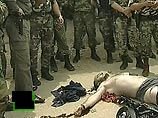
With the usual spin and gruesome propaganda photography, Federal Russian news sources have been trumpeting the killing by special operations forces of Chechnya's President, Abdul-Khalim Sadulayev.
Saturday, June 17, 2006
PW-RFE/RL Broadcast

From Prague Watchdog:
Following is a programme broadcast by Radio Free Europe / Radio Liberty's North Caucasus Service on June 14, 2006. For more programmes see http://www.watchdog.cz/rferl (in Russian only).
100 days of Ramzan Kadyrov’s premiership celebrated in Grozny
Presenter Ruslan Shamayev: The city of Grozny has witnessed the celebration of 100 days of Ramzan Kadyrov as head of the government of Chechnya. Several thousand members of Kadyrov’s fan club marched through the centre of the city in multicoloured T-shirts, praising their idol. However, many of them not were not quite sure why they had come here. Akhmed Sultanov reports from Grozny.
Akhmed Sultanov: It looks as though it can now be said that Ramzan Kadyrov holds the post of prime minister by the will of the people. When he became premier he promised to leave the post after 100 days if he hadn’t achieved any results. This period went under the name "100 Days - 100 Deeds”. The latest SMS poll conducted on local television on Tuesday evening is a vivid demonstration of this. According to the poll organizers, 170,000 residents of Chechnya are satisfied with Kadyrov’s performance. Only 95 people sent negative messages.
On Wednesday the main events of the celebration took place. Thousands of young people dressed in green, red and white T-shirts with Kadyrov’s photograph on them began their demonstration from Peoples’ Friendship Square, moving along Victory Prospect, and on reaching the top of Kadyrov Prospect they stopped in front of the Akhmad Kadyrov monument, where the events were held. These were members of the Ramzan Kadyrov fan club.
Before the demonstration began, the Kadyrov fans crowded in the shade of the trees beside Peoples’ Friendship Square. They were all in high spirits - laughter and jokes could be heard. However, few of them seemed to know why they had come here. This is what one of the young people said:
Kadyrov fan: Ramzan has called us together. Apparently it’s Students’ Day or something. I don’t really know anything about it. They got us together and told us there’d be dancing, a concert.
Akhmed Sultanov: Some of the fans tried to give more mature answers, but friends interrupted them with their jokes:
Kadyrov fan 2: If events like this were held more often, everything would be okay... If the students of the sports faculty all got united, everything would be okay.
Akhmed Sultanov: With a deep sigh, a female student attempted to give an answer to my question, but was thrown into confusion on discovering that she would have to speak Chechen.
Female Kadyrov fan: We’ve come here today to support... in Chechen? No, you’ve got be kidding, I can’t say it in Chechen. You’d better ask somebody else.
But another female student, who did speak Chechen through an ironic smile, told me why she was on the demonstration.
Female Kadyrov fan 2: Everyone’s here, so I am too. They told us we’ve to show our support, and that’s why they’ve got us together. Everyone went running, and so did I. That’s how we ended up here. Young people like these new changes, and the mood’s an expression of that.
Akhmed Sultanov: Then the teachers gathered all the students together. They began their march from this square. Victory Prospect was closed to motor traffic. Chechen police were stationed every 5 metres along the route. On the adjoining streets, almost invisible to the demonstrators, Russian soldiers were deployed, ready for any emergency situation.
The main events took place in front of the Akhmad Kadyrov monument. There, too, there were many officers of the various law enforcement agencies. Looking bored, they were awaiting the appearance of Ramzan Kadyrov, who with his government colleagues had set off to open restored buildings, of which there are indeed many. There’s the House of Fashion building on Victory Prospect, and the dual carriageway on Mayakovsky Street, and the school in Gudermessky district, and a large number of other places. The Chechen parliament has also greatly appreciated the work of the government under Ramzan Kadyrov.
Akhmed Sultanov, Radio Liberty, Chechnya
Not all participants enthusiastic about the celebration
Ruslan Shamayev: Another Radio Liberty correspondent, Usman Khasimikov, followed the events in Grozny. He also talked to some of those who were taking part in the celebration.
Usman Khasimikov: Many discussions and meetings have been devoted to Kadyrov’s work in the post of head of Chechnya’s government. And invariably there has been talk of the successes and positive changes in the republic. Everyone already knows what will be talked about at this celebration. The residents of the republic have been putting two and two together.
Resident: Nearly all the people who are dealing with these questions are hangers-on of Ramzan Kadyrov. When Dukhvakha [Abdurakhmanov], the head of the parliament, was a minister he was okay, but when he became parliament head he began to fawn on Kadyrov. This humiliates the Chechen people in the eyes of others. There’s no change for the better in our lives to speak of. Ramzan Kadyrov is just building a house on sand. It all reminds you of a lonely woman putting on makeup in the hope of attracting somebody. They’re humiliating our people deliberately in order to show that we’re not worth anything.
Usman Khasmikov: T-shirts and flags with portraits of Kadyrov and the slogan "Keep it up!" were on sale in Grozny today. Sporting events were held throughout the districts of Chechnya in honour of this day. Nadterechny district was not left out - there the winners were rewarded with gold watches and valuable prizes.
Usman Khasimikov, Radio Liberty, Chechnya.
The transcript, and its translation into Russian, were made jointly by Prague Watchdog and Radio Liberty. English translation by David McDuff.
Friday, June 16, 2006
Johannes Salminen
While researching background material related to Väinö Linna’s Tuntematon sotilas (The Unknown Soldier), I came across this long and fascinating interview with Finland-Swedish literary scholar and critic Johannes Salminen. It's in Swedish, and it reveals much about postwar Finnish literary and political life, the feuding within the Finland-Swedish literary and cultural establishment, the place of Finland in postwar Europe, Finland's relations with Russia, the Kekkonen era, and many other topics not often discussed in public, either in Finland or abroad.
"Mop-ups" in Chechnya
On June 5, Prague Watchdog reported that security had been significantly tightened in and around the Chechen capital, Grozny. Now a new PW report highlights the reappearance of zachistki ("mop-ups") by security forces (my translation):
Is Chechnya returning to "mop-ups"?
By Umalt Chadayev
CHECHNYA, June 15 - In recent days there has been a sharp increase in the number of “mop-ups”, “special operations” and other military and police operations in the territory of the Chechen Republic.
On the morning of June 15, officers of the Chechen OMON police carried out a passport checking operation in Grozny’s Leninsky district. After setting up mobile checkpoints in one of Grozny’s microdistricts, near Dudayev Boulevard, police inspected all motor vehicles moving in this area. The documents of drivers and passengers also were also subjected to thorough checking. OMON police also made the rounds of apartments in the multi-storey buildings located in the vicinity of Dudayev Boulevard, checking householders’ documents.
Two days earlier, on June 13, similar "special measures" were carried out on the outskirts of the village of Belgatoy, Shalinsky district. In this case the "operation" was conducted by Russian soldiers who were moving around in two armoured personnel carriers. As in Grozny, the soldiers stopped all through motor traffic, checking the documents of drivers and passengers.
On the same day "partial mop-ups" were conducted in the settlement of Valerik, Achkhoy-Martanovsky district. Soldiers and officials of the local law-enforcement agencies checked people’s passports on several streets.
On June 11 soldiers of the federal forces and Chechen police "mopped up" the village of Novye Atagi, Shalinsky district. According to local residents, all routes in and out of the village were blocked by armoured vehicles and military trucks.
On the day before this, the settlement of Duba-Yurt, also in the Shalinsky district, was subjected to a “mop-up”. Despite the fact that no serious rights violations were observed in the course of these special operations, local residents reacted negatively to what was taking place.
"This is our seventh year of mop-ups!" is the angry response of 48-year-old Musa Vakhayev, a resident of Novye Atagi. “That would be long enough to check and re-check every resident of Chechnya. And they’ve checked and re-checked us not dozens, but hundreds of times. How much longer can this go on? If you travel beyond the republic’s borders they check you, when you come back they check you, in Grozny they check you, at home they check you as well! Our whole lives have become one continuous ‘mopping-up’ and checking. When is this all this going to end, and when are they going to let us live normal lives?”
Grozny residents note that there has been a considerable increase in the number of police and soldiers on the streets of the city in recent days. In various districts mobile checkpoints are being set up on the motor highways. These are manned by soldiers and police, often accompanied by armoured cars. All this is causing serious anxiety among the population. People fear possible large-scale military operations, with all the circumstances that may result.
"In my opinion, the increase in the number of law enforcement officials in the cities and the villages attests to the fact that the law enforcers are expecting something. Possibly even large-scale operations on the part of the guerrillas. Rumours are intensely circulating here that something serious may possibly happen during the next few weeks, but no one knows exactly what is in store. It’s said in some villages of the Vedensky and other mountain districts groups of guerrillas have been spotted entering the villages almost openly, buying groceries and other things they need," says Grozny resident Usman Madayev.
Meanwhile a source in the republic’s law enforcement agencies has reported that the Chechnya’s security forces have been on high alert since June 5. "This is connected with the activity of certain bandit formations in the south of republic and adjacent regions,” he says.” In addition, the date of the G8 summit in St Petersburg is approaching, and it’s possible that during this period the leaders of the bandit formations will attempt to show force and announce their presence again. The situation in the republic is under control, and any attempts by them to destabilize it are doomed to failure."
"Police passport checking operations and other similar measures are directed primarily at ensuring the safety of innocent civilians. Only a few days ago law enforcement officials liquidated several large guerrilla hideouts and weapons caches, including some in Grozny, and around ten people suspected of participation in bandit formations or of aiding and abetting the fighters have been detained," the police officer said.
Thursday, June 15, 2006
No Chechen Trace
In Wednesday's Le Monde, a short account of the sentencing of 25 people, all of them Algerian radicals, by a French court in connection with the so-called "Chechen network" case. The five main defendants, including the were each given prison terms of 8 to 10 years, while the others received lesser sentences. Two of the defendants were acquitted. All except one had been accused of helping Islamic fighters in Chechnya. According to the prosecution, the case pointed to the "globalization of the jihad movement."
However, as Norbert Strade points out at chechnya-sl, many details of the case remain unresolved and shadowy. The longest sentence of 10 years went to Menad Benchellali, the groups's alleged "chemicals expert". Yet no evidence that a chemical attack was being prepared has been found. Some of the news reports yesterday repeated the old canard that "ricin" had been discovered. And, Norbert adds:
However, as Norbert Strade points out at chechnya-sl, many details of the case remain unresolved and shadowy. The longest sentence of 10 years went to Menad Benchellali, the groups's alleged "chemicals expert". Yet no evidence that a chemical attack was being prepared has been found. Some of the news reports yesterday repeated the old canard that "ricin" had been discovered. And, Norbert adds:
What they found were typical household chemicals (most people don't even know that they keep stuff in their household which, when mixed in the correct way, will produce a nice bang). The "ricin" were products containing castor oil, the source from which the substance is distilled. Castor oil is widely used in medications, cosmetic products, lubricants, break fluid, laundry detergents, paints, varnishes. Again, it would be very difficult to find a household with no trace of it. And so on. The fact that the prosecution couldn't prove any attack plans including chemicals shows that this was a constructed accusation.What this case and its unsatisfactory resolution show beyond doubt is that Russian special services are still actively supplying "intelligence" to Western governments in the "war against terror", and that this information - or disinformation - is being accepted uncritically at many levels by the press, the media, the judiciary, and even by Western goverments themselves, with potentially and actually disastrous consequences for security.
What really happened was that some Algerian Islamists collected money for the usual Islamic charities (including those trying to aid Chechnya) and thus were automatically targeted by the "fight against terror". The anti-terror careerists of the Bruguière type connected "Chechnya" and "terror" with "ricin" (the propaganda garbage about the Pankisi "ricin labs"), and subsequently had to find "ricin" and other terrorist staples connected to the "suspects".I won't be surprised if the story about a planned attack on the Russian embassy was delivered by the notorious "evidence" providers from the Lubyanka (we all remember the "evidence" produced against Zakayev). Of course this didn't suffice, they needed some important French target in order to make the case intersting for the locals, something similar to the Twin Towers. And what would be more symbolic than blowing up the Eiffel Tower? Why the "terrorists" wanted to blow up Les Halles, as mentioned in another story, a place full of Muslims, is a little more obscure. Perhaps they had an opinion about the architecture, who knows.
Finally, I wonder in which closet the typists from the mainstream agencies and the corporate media keep their IQ when they faithfully reproduce everything they are told by the authorized truth mongers. There is one common trait in all those official terrorist stories: they are absolutely inconsistent and of worse quality in the realm of conspiration theories than even some of the fringe stuff. Like this one: Some Islamists of Algerian descent get the idea that they could take revenge on Russia for Chechnya by blowing up French tourist targets and carrying out chemical attacks against French civilians! A total no-brainer, on the same level as the Manhattan flight chart "found" in a Chechen cave.
Wednesday, June 14, 2006
Tuesday, June 13, 2006
Judging the Judges
The Law West of Ealing Broadway is dismayed by the Sun newspaper's new campaign to name and shame judges whom it considers to be too lenient:
Judges (and to some extent JPs) are deemed to be out of touch, old, posh, and tainted with 'Political Correctness' which is the lazy journo's code for someone he or she can't be bothered to debate with. Senior editors such as Ms Wade move in exalted circles, have nice cars and obliging chauffeurs, dine at Chequers and fly hither and yon in comfortable areas of aeroplanes, their seats paid for by someone else. They are invited to the best parties, and although they are puppets, they are treated with deference that is really being accorded to the proprietor who is pulling the strings. So what could be more fun than calling in the mob to howl down bewigged old coves who can easily be made to look silly in their 18th century court dress?
Monday, June 12, 2006
Tove Jansson Book and Seminar

Call for Papers
Tove Jansson Essay Collection
Tove Jansson Conference
Proposals are invited for contributions to a Collection of Critical Essays on the Finnish author and artist Tove Jansson, under contract to be published by Cambridge Scholars Press, and for papers for a one-day Jansson Conference, to be held at Pembroke College, Oxford on 23 March 2007.
The recent translation of Jansson’s The Summer Book has renewed and expanded international interest in the writer popularly known for her acclaimed children’s books about the charming and philosophically-inclined Moomin characters. We welcome papers from all areas of research, including cross-disciplinary approaches, which deal with any aspect of Jansson’s wide-ranging authorship and art.
The deadline for both proposals is 1 October 2006 and those selected for the Collection or the Conference (or both) will be notified soon thereafter. Essays for the Collection should be 4,000-6,000 words long and final versions will be due on 31 December 2006. Conference papers should be no longer than 20 minutes. Essays may be presented in condensed form at the Conference. Essays and papers must be in English.
The following topics are offered as suggestions only:
The Moomin Oeuvre:
As children’s literature
As parody
As allegory
As philosophy
Comic aspects
The supernatural
The franchised Moomins
Jansson’s novels
Jansson’s memoirs
Jansson’s picture-books
Jansson as artist
Jansson as book illustrator
Jansson as cartoonist
Jansson and artistic / writerly identity
Jansson and politics
Jansson and gender / sexuality
Jansson and language
Jansson in translation
Jansson in comparison with other writers / artists
Themes in Jansson’s writing:
Nationalism
Childhood
Psychoanalysis
The family
Individuality / communality
Bohemia / bourgeoisie
Landscape, nature
Please send proposals of up to 300 words to Kate McLoughlin
Sunday, June 11, 2006
The Faculty of Dreams
I'm currently reading Sara Stridsberg's recently published novel Drömfakulteten (The Faculty of Dreams), which focuses on the life of Valerie Solanas, the feminist writer and author of the SCUM Manifesto who shot the painter and pop artist Andy Warhol. This is going to keep me busy today. It's a very readable novel, but there are some odd details in the text that I may need to comment on when I review the book for SBR.
Saturday, June 10, 2006
The Essential Enemy
I recently came across an interesting and discursive study of anti-Chechen feeling in Russia by the political scientist Emil Souleimanov, who is based in Prague. Souleimanov's essay considers the role played by Chechens and other Caucasian peoples in Russian national life, a role that he sees as being compounded of two intertwined elements: on the one hand, the government's need for an "enemy" to divert attention from the harshness of everyday existence and the possible reasons for it - after all, some 60 per cent of Russia's citizens live below the poverty line - and on the other, a fear of the unknown, of the culturally different:
Stirring up anti-Chechen feelings in Russia has been evident - by several respites and various levels of intensity - already since the early 1990s and it was conditioned mostly by domestic motives.Read the whole thing, for it tells us much about the psychology of modern Russia.
Obviously the picture of an enemy cannot be created from nothing. It has to be somehow rooted and linked to negative associations within the society. In this respect the already formed anti-Chechen (and, in a broader sense, anti-Caucasian) feelings arise from the controversial relationships between Russians and the Caucasian people in their daily life.
While bias against the Caucasus and its people during the Soviet era was rather of a positive character, since the end of the 1970s and especially from the 1980s, a vigilant and distrustful attitude has become dominant. The romanticized picture of a dangerous yet freedom-loving mountain dweller untouched by civilization, which 19th century Russian literature created, was replaced in the 1950´s and 60´s by a picture of the “younger brother,” a sometimes naughty yet charming and vivacious Southerner; “a hero-lover” at Caucasian summer resorts who was both indulged and patronized.
The economically motivated migration of Caucasians to Russian cities intensified in the 1980´s. The fact that they came to a foreign (Russian) and unknown environment (city) where they were usually not warmly welcomed, made the newcomers realize that inevitably they had to rely on themselves, especially in achieving and maintaining their “place in the sun” when competing with local groups.
Thus their clannish and ethnic solidarity became even stronger and soon criminal networks based on ethnic or combined ethnic-clan principles sprang up among some of the youth Caucasian people. Crime and business activities, however, were obviously not the basic conditions for building and strengthening the antipathy of the Russian citizens. Sometimes these were determined by cultural differences as well.
It’s been proven that under specific circumstances the same identifying traits that were once seen as positive, can be viewed as negative. Thus pride sometimes turns into conceit, traditionalism into backwardness, initiative suddenly becomes arrogance, courage is seen to be aggression, an entrepreneurial spirit as greed, etc.
Differentiation based on ethnicity is strengthened by emphasizing real or alleged “differences” such as a diverse language, (visually noticeable) culture, the physical appearance of “strangers” or what is considered their temperament. Even such things as very distinctive gestures, conspicuous intonations during conversation and the natural effort of strangers to band together in a strange environment are considered as a sort of defiance and disrespect toward local citizens.
It’s sad that despite many years of co-existing with Caucasian peoples within one country, the former USSR, their traditions and culture have not been better understood. Russians have superficial and fragmented knowledge of them (as well as about the majority of other nations of the former USSR), which in the best scenario is determined by ardently perceiving the exotic Caucasian “symbolism” so typical of the Soviet period (mountains, daggers, blood feuds, jiggit, adat, shashlik, wine, etc.). And in the worse scenario by subjective stories about “bloodthirstiness,” “treachery,” and the brutality of the mountain dwellers and their advanced business skills.
Nuremberg
"...I didn't go out to Nuremberg until early 1947. By then, the major war crime trials were over. The cases I worked on were the ones involving large industrial and chemical concerns, they weren't all German, some of them were ours, there were Western companies involved -- and then there was the Doctors' Trial, and that was really unspeakable. And the worst thing was that when I got back to Britain two years later, no one - and I mean no one - wanted to know about that. No one wanted to know about what had happened..."
(a colleague, who worked as a translator at the Nuremberg War Crimes Tribunal after she graduated from Oxford in 1946.)
(a colleague, who worked as a translator at the Nuremberg War Crimes Tribunal after she graduated from Oxford in 1946.)
Friday, June 09, 2006
Secret Prisons in Chechnya - II
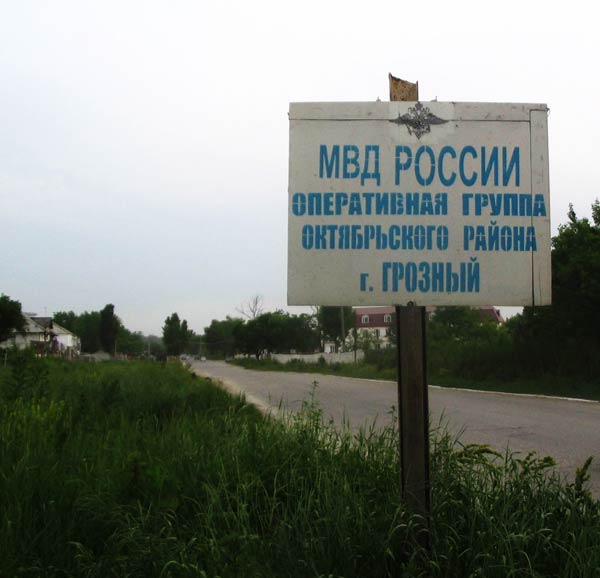
Last month I featured an IHF report on "Unofficial Places of Detention in the Chechen Republic", which was delivered to Dick Marty, the Council of Europe's Legal Affairs Committee rapporteur. Now the Russian human rights NGO Memorial has documented the existence of a secret prison in the Chechen capital Grozny. According to RFE/RL, prisoners there were allegedly tortured, bullied and and detained illegally. Many of the people who were take to the prison have disappeared without trace.
Activists from Memorial took photographs of the cell walls, with writing showing dates of detention and names of prisoners.
The whole of the Memorial report, with photographs, can be viewed in Russian here.
Thursday, June 08, 2006
Boring Belarus
Edward Lucas has an Economist piece about the inadequacy of the outside world's response to the totalitarian crackdown in Belarus. Looking back to the days of the Cold War, he notes:
...defending Václav Havel, Andrei Sakharov and other heroes of the dissident movement was tied, albeit loosely, to our own self-interest. There was tiredness and timidity on our side, but outweighed by fear and greed (as well as idealism and bravery).
But Belarus poses no threat to us. On the contrary, being nice to Russia, Belarus's patron, is very profitable business. Which is why I fear that Olga and her brave friends face a long walk to freedom. When it ends with victory, as it will, I think we will feel pretty embarrassed about how little we helped.
Dictators at the V&A
At Babalú blog, George Moneo has had a response from London’s Victoria and Albert Museum to his letter protesting about their Che Guevara exhibit. The V&A's curator considers that "We have created a vibrant design exhibition, as is our remit, which in the process raises many issues for visitors to consider." However, the exhibit offers a prize of a vacation in Cuba.
DOS Attack in Sweden
Moscow's NATO Line
Throughout the 1990s, Moscow maintained a steady barrage of opposition to the expansion of NATO. In October 1996, the Russian parliament passed a resolution opposing enlargement by a vote of 307-0, and in December of the same year, defence minister Rodionov spoke of "a return...to the Cold War." "NATO Enlargement" became the most obvious point of dissension between Russia and the West, belying the widely-promoted notions of harmony, the idea that Russia was somehow, gradually though painfully, moving into the Western orbit. Then came Kosovo, and the NATO accessions in March 1999 of Poland, Hungary and the Czech Republic. President Yeltsin resigned, and was replaced by President Putin. Russia invaded Chechnya for a second time.
After September 11, 2001, Russian tactics changed. At the NATO Summit held in Prague in 2002, Moscow government adviser Sergei Karaganov, who throughout the 90s had been one of the most active formulators of Kremlin anti-NATO propaganda, with a particular animus directed against the candidate Baltic States of Estonia, Latvia and Lithuania, proposed a new alternative, an account of which was given by RFE/RL's Victor Yasmann:
This was the new Moscow line, seeking to exploit the fears awoken in Western government circles and among the wider public by the September 11 attacks, and also to gain propaganda points from the recent formation of the NATO-Russia Council at Rome, emphasizing "joint peacekeeping operations" and "the fight against international terrorism". But in March 2004, the three Baltic States of Estonia, Latvia and Lithuania joined NATO, along with Bulgaria, Rumania, Slovakia, and Slovenia. In the autumn of the same year, the "Orange Revolution" came to Ukraine. Again, Moscow changed tack. The anti-NATO rhetoric began once more, this time directed against Ukraine, Georgia and Moldova - all of which seek membership of the Atlantic organization. Moscow assiduously cultivated its links with pro-Russian separatist movements in both countries, and let it be known that it would use these links to its own advantage - a tactic last used in the 1930s by Hitler in his Sudetenland policy. While in the 1990s Moscow had exploited disaffection among the Russian-speaking populations of the Baltic States, it had rarely, except perhaps in the case of the Narva referendum crisis of 1993, supported breakaway movements there.
Now, however, in today's London Times it's possible to read an article by Moscow correspondent Jeremy Page, with, among other things, a report on Russian foreign minister Lavrov's latest statement:
After September 11, 2001, Russian tactics changed. At the NATO Summit held in Prague in 2002, Moscow government adviser Sergei Karaganov, who throughout the 90s had been one of the most active formulators of Kremlin anti-NATO propaganda, with a particular animus directed against the candidate Baltic States of Estonia, Latvia and Lithuania, proposed a new alternative, an account of which was given by RFE/RL's Victor Yasmann:
Karaganov declared that every Russian nationalist today -- and he considers himself a nationalist -- "must be a Westerner and must do everything possible to promote Russian integration with NATO and the EU." He argued that military-strategic cooperation with the West has increased Russia's role in the international arena far beyond any that its diminished economic power would justify. This is especially true for South Asia and the Middle East, where Russia's alliance with the United States has unexpectedly revived Russia's tangible levers of political influence.
This was the new Moscow line, seeking to exploit the fears awoken in Western government circles and among the wider public by the September 11 attacks, and also to gain propaganda points from the recent formation of the NATO-Russia Council at Rome, emphasizing "joint peacekeeping operations" and "the fight against international terrorism". But in March 2004, the three Baltic States of Estonia, Latvia and Lithuania joined NATO, along with Bulgaria, Rumania, Slovakia, and Slovenia. In the autumn of the same year, the "Orange Revolution" came to Ukraine. Again, Moscow changed tack. The anti-NATO rhetoric began once more, this time directed against Ukraine, Georgia and Moldova - all of which seek membership of the Atlantic organization. Moscow assiduously cultivated its links with pro-Russian separatist movements in both countries, and let it be known that it would use these links to its own advantage - a tactic last used in the 1930s by Hitler in his Sudetenland policy. While in the 1990s Moscow had exploited disaffection among the Russian-speaking populations of the Baltic States, it had rarely, except perhaps in the case of the Narva referendum crisis of 1993, supported breakaway movements there.
Now, however, in today's London Times it's possible to read an article by Moscow correspondent Jeremy Page, with, among other things, a report on Russian foreign minister Lavrov's latest statement:
Russia issued its strongest warning yet against Nato’s eastward expansion, saying that membership for Ukraine and Georgia would mean a “colossal geopolitical shift”.
The warning was made as anti-Nato protests spread to Kiev from the southern Ukrainian region of Crimea, where joint military exercises with Nato members are due to be held this month and next.
“We have said more than once that every country has the right to take sovereign decisions on who will be its partner in the international arena,” Sergei Lavrov, the Russian Foreign Minister, told the Duma.
“At the same time, the acceptance into Nato of Ukraine and Georgia will mean a colossal geopolitical shift and we assess such steps from the point of view of our interests.”
The Duma also unanimously passed a resolution warning Kiev that joining Nato would damage ties with Moscow.
Analysts said that Russia was trying to foment opposition, which is already widespread, to Nato membership within Ukraine to undermine Viktor Yushchenko, the President who led the Orange Revolution in 2004.
Ukraine is supposed to host “Tight Knot” exercises with Britain from June 14 and “Sea Breeze” exercises with the US and other Nato members and partners from July 17.
But the arrival of 200 US Marine reservists in Crimea last week provoked small but passionate anti-Nato protests, which threaten to scupper Ukraine’s chance of joining.
Wednesday, June 07, 2006
Supporting the Eltuyevs

Residents of the British town of Swindon who have signed a petition urging that a family of Chechen asylum-seekers should not be deported from Britain have received support from the Chechen Refugee Network in the United States, the online local news site This Is Wiltshire reports:
A member of the Chechen Refugee Network in the US contacted the Adver to congratulate the people of Swindon for backing the Eltuyevs.(via chechnya-sl)
More than 1,000 people have signed a petition and 130 readers have filled in a form printed in the paper urging the Home Office to let Islan, Zarina and their three children stay.
Dr Michaela Pohl, the assistant professor in the history department at Vassar College, New York, said: "Things in Chechnya are very complicated and one cannot simply send people back, so I am glad the community is raising awareness and support for this family.
"Basically, I just wanted to send a note of appreciation for your community's integrity and active response."
The family fled torture in Chechnya to come to Swindon in May 2003.
An Adver poll showed 85 per cent of more than 1,100 people who voted wanted them to stay.
Tuesday, June 06, 2006
Redrawing the Lines
Last Friday, Russia's foreign minister announced that the "unrecognized republics" of the former Soviet Union "have a right to self-determination." Writing in Kommersant, correspondents Vladimir Solovyev and Vladimir Novikov see this as an indication that, in the run-up to the G8 conference, Russia "wants to send a message to the West about its exclusive rights in the former Soviet Union and the lengths it will go to to restore its superpower status." The obvious inference to be drawn from the announcement is that Russia no longer respects the territorial integrity of Georgia and Moldova, and that Moscow intends to continue supporting pro-Russian breakaway movements there.
Meanwhile, a Regnum correspondent quotes Moldovan activist Yevgeny Nikolayev as saying that the Ukrainian political crisis may spread to Moldova, and that
Meanwhile, a Regnum correspondent quotes Moldovan activist Yevgeny Nikolayev as saying that the Ukrainian political crisis may spread to Moldova, and that
“[Vladimir] Voronin’s refusal to pursue the policy of ‘Finlandization’ carried out (although on paper) before him and characterized by relatively balanced partner relations with the West, as well as with the East, has broken the constitutional foundations of the society as well as the mental basis of the common Moldovan citizen.”
Moscow Extradition Request Rejected
Reuters reports that a British judge has turned down a request by Russia for the extradition of Boris Berezovsky to face charges of planning a coup in Moscow.
Security Tightened in Grozny
A Prague Watchdog report (my translation)
May 5, 2006
Security measures heightened in Grozny
By Umalt Chadayev
GROZNY, Chechnya – Since this morning (June 5) security measures have been intensified at the police checkpoint located at the entrance to Grozny from the direction of the Kavkaz federal highway. Members of the Akhmat Kadyrov special-purpose police regiment (MPSN) of the Chechen Interior Ministry have been conducting a thorough check of motor vehicles and passengers entering and leaving the capital.
A kilometre-long queue of motor vehicles has formed at the checkpoint. The increased attention of the police has been mainly directed in at motor transport entering the city.
"I was late for work today because there was a huge traffic jam at the block-post (the usual name for checkpoints in Chechnya) at the entrance to the city, caused by cars, buses and minibus-taxis. Everyone and everything was being stopped and checked, even the documents of officials. No one gave any explanation, they just said it was their job," says Alkhazur Usamov, a 33-year-old resident of the Urus-Martanovsky district.
"I was nearly an hour late. The waiting-time in the queue was 40 minutes. I don’t know who they were looking for, or what kind of ‘operation’ it was. They were mostly inspecting cars coming into Grozny, but the inspection of the traffic leaving the city wasn’t so thorough. Some passengers were singled out to have their documents checked," he said.
An Interior Ministry source said that the checks on traffic in and out of the city had been planned. "Nothing unusual has happened. This is just ordinary preventive police work. The measures are being carried out by members of the Kadyrov special-purpose police regiment," he says.
Meanwhile the situation in Chechnya and in Grozny itself remains rather complex. Rumours that “something is going to happen soon” have begun to spread in the republic again. It is probable that the appearance of these rumours is directly linked to the re-launching of guerrilla operations both in the mountainous part of Chechnya as well as in a number of lowland districts and the city of Grozny.
Last year one of the Chechen guerrilla leaders, Shamil Basayev – who occupies the post of vice-premier in charge of power structures in the Ichkerian government – announced that in the summer of 2006 the guerrillas planned to “cross the Volga". Quite recently websites close to the guerrillas posted information that, on a commission from Aslan Maskhadov’s successor, Ichkerian President Abdul-Khalim Sadulayev, Basayev had completed a “tour of inspection” of the North Caucasus republics and had held a conference with guerrilla field commanders.
In the opinion of some observers, the guerrillas may launch a sharp increase in their operations during the next few weeks. "The G8 summit is due to take place in St Petersburg in July. Sadulayev, Basayev, Umarov and the other guerrilla leaders are hardly likely to let slip this opportunity of announcing their presence. Even now there is quite a perceptible increase in guerrilla activity, not only in Chechnya, but also in Ingushetia, Daghestan and other places. Government bureaucrats can talk all they like about the situation being stable, but in reality the war is continuing," a Chechen political analyst thinks.
"The fact that the high command of Russia’s Interior Ministry troops is talking about the need for an increase of 5,000 men in its Chechnya grouping also says a great deal. It looks as though the rosy scenario that’s being drawn for us today by the military, the bureaucracy and practically all the Russian media may not be so bright after all. The situation can change significantly at any moment," he says.
May 5, 2006
Security measures heightened in Grozny
By Umalt Chadayev
GROZNY, Chechnya – Since this morning (June 5) security measures have been intensified at the police checkpoint located at the entrance to Grozny from the direction of the Kavkaz federal highway. Members of the Akhmat Kadyrov special-purpose police regiment (MPSN) of the Chechen Interior Ministry have been conducting a thorough check of motor vehicles and passengers entering and leaving the capital.
A kilometre-long queue of motor vehicles has formed at the checkpoint. The increased attention of the police has been mainly directed in at motor transport entering the city.
"I was late for work today because there was a huge traffic jam at the block-post (the usual name for checkpoints in Chechnya) at the entrance to the city, caused by cars, buses and minibus-taxis. Everyone and everything was being stopped and checked, even the documents of officials. No one gave any explanation, they just said it was their job," says Alkhazur Usamov, a 33-year-old resident of the Urus-Martanovsky district.
"I was nearly an hour late. The waiting-time in the queue was 40 minutes. I don’t know who they were looking for, or what kind of ‘operation’ it was. They were mostly inspecting cars coming into Grozny, but the inspection of the traffic leaving the city wasn’t so thorough. Some passengers were singled out to have their documents checked," he said.
An Interior Ministry source said that the checks on traffic in and out of the city had been planned. "Nothing unusual has happened. This is just ordinary preventive police work. The measures are being carried out by members of the Kadyrov special-purpose police regiment," he says.
Meanwhile the situation in Chechnya and in Grozny itself remains rather complex. Rumours that “something is going to happen soon” have begun to spread in the republic again. It is probable that the appearance of these rumours is directly linked to the re-launching of guerrilla operations both in the mountainous part of Chechnya as well as in a number of lowland districts and the city of Grozny.
Last year one of the Chechen guerrilla leaders, Shamil Basayev – who occupies the post of vice-premier in charge of power structures in the Ichkerian government – announced that in the summer of 2006 the guerrillas planned to “cross the Volga". Quite recently websites close to the guerrillas posted information that, on a commission from Aslan Maskhadov’s successor, Ichkerian President Abdul-Khalim Sadulayev, Basayev had completed a “tour of inspection” of the North Caucasus republics and had held a conference with guerrilla field commanders.
In the opinion of some observers, the guerrillas may launch a sharp increase in their operations during the next few weeks. "The G8 summit is due to take place in St Petersburg in July. Sadulayev, Basayev, Umarov and the other guerrilla leaders are hardly likely to let slip this opportunity of announcing their presence. Even now there is quite a perceptible increase in guerrilla activity, not only in Chechnya, but also in Ingushetia, Daghestan and other places. Government bureaucrats can talk all they like about the situation being stable, but in reality the war is continuing," a Chechen political analyst thinks.
"The fact that the high command of Russia’s Interior Ministry troops is talking about the need for an increase of 5,000 men in its Chechnya grouping also says a great deal. It looks as though the rosy scenario that’s being drawn for us today by the military, the bureaucracy and practically all the Russian media may not be so bright after all. The situation can change significantly at any moment," he says.
Monday, June 05, 2006
Whitened Sepulchre
Tobias Ljungvall has a post on his blog about a recent Swedish radio discussion he took part in with a an expatriate Finnish promoter of Lukashenko's dictatorship in Belarus. Issues surrounding the debate included the actual naming of Belarus: in Swedish and Finnish, it's referred to as "White Russia", a title which as Tobias points out can be rather misleading.
...And Sukhois May Fly On July 5
LIMA, June 5 (RIA Novosti) - Venezuela's president has dropped the heaviest hint yet that his country may be buy Russian-made fighters by saying warplanes could take to the skies during a July 5 military parade to celebrate Independence Day.
Venezuela has already signed a $54-million contract for 100,000 Kalashnikov assault rifles, the batch of which was shown off on television Sunday night, and put pen to paper in the middle of last year on a contract for 15 military helicopters.
Sunday, June 04, 2006
Russian Arms Arrive In Venezuela...
The BBC reports that Venezuela has received its first delivery of tens of thousands of Russian assault rifles.
Latin America: Economy and Society
Rodolfo Soriano Núñez, author of México desde fuera, has resumed updates of his English-language blog Social Change In Latin America, now retitled Latin America: Economy and Society. This is a good information resource, for while one may occasionally find oneself at variance with Rodolfo's take on current events, it is quite obvious that he has a far-reaching grasp of the history and sociology of the region, surpassing much of the discussion of Latin-American society and politics that's currently available in the blogosphere. His latest post concerns today's presidential election in Peru, which is a run-off between Alan García and the Chávez-style populist Ollanta Humala. As RSN points out,
See also: Migrating to Reality
the election has been deeply affected by Venezuelan interventionism and, strangely enough, by the ability of García to gather unexpected expressions of support from those who, few years ago, were their fiercest critics.Read the whole thing, both for its analysis of Peruvian democracy and for its personal exploration of the often complex and trans-national links between Latin American politics, literature and society.
Public figures like Mario Vargas Llosa, who lost in a similar runoff to Alberto Fujimori back in 1990, and many others have expressed, one way or the other, their support for the former President García.
The fact that they are doing so is not so much an expression of belief in García’s proposals or because of “happy memories” associated with his presidential term. Quite the opposite. They express one of Peru's most dramatic and painful paradoxes.
See also: Migrating to Reality
Russia May Relocate Warships to Syria
There are reports that Russia may relocate its Black Sea warships from the Ukrainian port of Sevastopol to a new base at Tartus, in Syria. From RIAN:
Vladimir Zimin, a senior economic advisor at the Russian Embassy to Syria, said Russia had simultaneously launched a modernization project at the port of Latakia, 90 km to the north of Tartus.
The paper quoted an anonymous source at the Defense Ministry as saying that Moscow was planning to form a squadron led by the Moskva missile cruiser within the next three years to operate in the Mediterranean Sea on a permanent basis, in particular for joint antiterrorist exercises with NATO forces.
Russia's Black Sea Fleet currently uses a range of naval facilities in the Crimea under a 1997 agreement that allowed Russia to continue its presence in its neighboring former Soviet republic for rent of $93 million per year.
The fleet is scheduled to withdraw in 2017, but Ukraine has recently voiced concerns that Russia is not paying enough for the facilities and also demanded that a new agreement be signed on inventorizing the bases. Russia has said it will make no concessions over rent or withdrawing the fleet and talks have stalled.
The Defense Ministry source told Kommersant that a Russian naval base in the Mediterranean would not only help Moscow strengthen its position in the Middle East - where it is currently also involved in negotiations on the Iranian nuclear crisis and the Israel/Palestinian issue - but also ensure Syria's security.
Saturday, June 03, 2006
Yushchenko Was Poisoned
After repeated tests by Ukrainian, U.S., German and Japanese experts, Ukraine's state prosecutor has announced that President Viktor Yushchenko was deliberately poisoned with dioxin during the run-up to the Ukraine presidential election of 2004.
"Concentration Camps" in Chechnya
Via Chechnya Weekly:
See also in this blog: Secret Prisons in Chechnya
APPEAL IDENTIFIES CHECHEN "CONCENTRATION CAMPS"
The separatist Chechenpress news agency on May 29 published an appeal by the chairman of the board of the Society of Concentration (Filtration) Camp Prisoners in the Chechen Republic of Ichkeria, Vakha Banzhaev, which claimed that over the last 12 years more than 250,000 Chechens have been killed, 87,000 have "become disabled or crippled," over 130,000 have been detained in camps, and more than 35,000 have disappeared without a trace.
"Russia's political and military leadership, in close cooperation with the bodies of the prosecutor's office, justice, and the so-called 'bureau of death' of Alkhanov and Kadyrov, who are the Russian president's henchmen in the Chechen Republic, is deluding both the Russian and the world public about what is really happening in the Chechen Republic, encouraging and covering up the crimes being perpetrated by the Russian military and its special services," read the appeal. "During the course of two military campaigns hundreds of thousands of innocent civilians have become the victims of this criminal policy, subjected to torture and torment or executed without trial and investigation in filtration camps, waiting stations, dungeons, and drainage pits set up in the deployment areas of troop units and sub-units of the Russian troops."
In the appeal, Banzhaev named over 20 sites in Chechnya that he said are "concentration camp and places of temporary confinement where the above-mentioned crimes have been and still are being perpetrated." He added that prisoners "are also kept in dungeons at virtually every sentry point and deployment area of the occupation troops in the Chechen Republic of
Ichkeria."
Banzhaev wrote that the "most distressing thing is that Russia is carrying out all this barbarity and genocide with the silent assent of the governments of many democratic countries of the world who recognize the observation of basic human rights as one of the main priorities of their domestic and foreign policy."
Banzhaev's appeal was directed to the parliaments and governments of all countries, the United Nations, the Council of Europe, the European Union, the Organization for Security and Cooperation in Europe, the Organization of Non-represented Peoples, and "all organizations involved in human rights and humanitarian activity."
See also in this blog: Secret Prisons in Chechnya
Subscribe to:
Posts (Atom)