A Step At A Time

Reflections on the new world order. The blog can also be accessed here

Tuesday, January 31, 2006


Ukraine: the Danger at the Top


In EDM, Vladimir Socor discusses the crisis of Ukraine's state institutions:
The Kremlin's "gas attack" on Ukraine exploited an ongoing crisis of state institutions in that country and exacerbated the crisis almost to the point of meltdown. This situation undermines the country's and its president's capacity to resist Moscow's emerging strategy to recapture key economic and political positions in Ukraine, one year after the Orange Revolution.

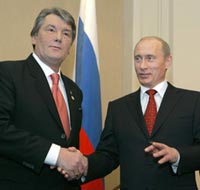
The signing of the January 4 gas agreement with Russia illustrated the dangers stemming from the growing weakness of Ukraine's state institutions. Basically, just two individuals, Fuel and Energy Minister Ivan Plachkov and Naftohaz Ukrainy chairman Oleksiy Ivchenko, negotiated and signed a dubious agreement in complete secrecy in Moscow, without the support of experts from government agencies that are traditionally involved in such negotiations, without consultation with the cabinet of ministers, and without public accountability even after the highly controversial agreement had been signed. Their briefings afterward to the media proved misleading, and they then declined to testify to the parliament, in effect setting up Prime Minister Yuriy Yekhanurov to take the fall. (Yekhanurov initially also dissembled on the gas agreement, but eventually distanced himself from it.) Meanwhile, President Viktor Yushchenko continues describing the gas agreement as an unqualified success even crediting Russian President Vladimir Putin for contributing to the purported success despite massive domestic and international criticism of key parts of the agreement.

The gas agreement provided the parliament with the political excuse to exercise its right to dismiss the government, although the parliament itself will only have the constitutional right to install another government after the March elections. Yushchenko disputes the legal validity of the parliament's no confidence vote and insists that the government has not been reduced to "acting" status, but that it continues to operate with full authority. Nevertheless, the president and government are looking for legal avenues to establish that the government has the standing required for signing international agreements. A determination on that issue cannot be reached, however, because Ukraine does not have an operating Constitutional Court. The parliament and the president are accusing each other over failures to fill and swear in their respective quotas of seats on the Court. Each side fears that the other might use the Constitutional Court as a tool in the conflict between president and parliament over implementation of constitutional reforms.

By all accounts, the president is attempting to renege on his December 2004 agreements with parliament on constitutional reform that would transfer certain presidential powers to the parliament and government. Yushchenko now claims that the procedure of reaching those agreements was hidden from the public and that the substance of the constitutional reforms was not debated or understood prior to their adoption by parliament. Such claims are factually unsustainable. The procedure was highly publicized at the time; the parliament held detailed debates before passing the constitutional reforms; and the pro-presidential bloc Our Ukraine voted for the reforms as well.

Because of his differences with the majority of deputies over the no confidence vote in the government and the constitutional reforms, Yushchenko has launched a war of words on the parliament. He has recently been describing the majorities that oppose him on those issues as "destabilizers," "anti-state," "destructive," "fifth column," "parasitical"; he describes their decisions as "illegal," "anti-people," and the parliament's composition itself as unrepresentative ("lost the people's ideological support"). The president warns that he would call a popular referendum (either before or after the upcoming parliamentary elections) in order to cancel the constitutional reforms. This course, if continued, would cause Yushchenko and his Our Ukraine bloc to lose their remaining or potential allies in this parliament and that to be elected in March. On a fundamental level, it reflects inadequate understanding of political and state institutions as such.

While that inadequacy seems common to a wide range of political forces and interest groups in Ukraine and beyond, it becomes all the more debilitating when it afflicts the top level of the executive branch.

Immediately after the Orange victory, de facto parallel governments emerged in the National Security and Defense Council (NSDC) and the Presidential staff, in addition to the constitutionally empowered cabinet of ministers. One year later, laws have yet to be adopted on the functioning of those institutions. After NSDC's first head, Petro Poroshenko, had vastly exceeded his prerogatives, Poroshenko's successor, Anatoly Kinakh, does so selectively on key issues. During the gas crisis, for example, Kinakh publicly proposed entrusting the management of Ukraine's gas transit pipeline system to Russia. Simultaneously he declared that Ukraine would no longer tolerate infringements of its national sovereignty, such as giving up lucrative contracts for its turbines (an allusion to Washington's earlier demand that Ukraine abandon the turbine contract for Iran's Bushehr nuclear power plant). Both of Yushchenko's appointees as NSDC heads have no background in national security, and both have played the Russia card while in that post. Despite such dysfunctionalities, the NSDC seized a number of portfolios from the Ministry of Foreign Affairs. Meanwhile, for a year after the Orange Revolution, Ukraine had no ambassador in Washington and other key capitals.

In sum, Ukraine is traversing an institutional and a constitutional crisis, as well as a deficit of competence at the top. Against this backdrop, Yushchenko's unofficial meeting with Russian President Vladimir Putin on January 11 in Astana initiated a potentially wide-ranging rapprochement. An embattled Yushchenko feels that he needs that relationship to shore up his presidency and improve his bloc's electoral prospects. For their part, influential Kremlin advisers calculate that a weakened and isolated Ukrainian president might be used, particularly in the post-election period. Risky under any circumstances, a personal rapprochement with the Kremlin could prove especially dangerous for Yushchenko to undertake without the backing of effective democratic institutions and a functioning government.

(Survey based on Ukrainian media coverage of the political crisis, January 2006; see EDM, January 12, 25)


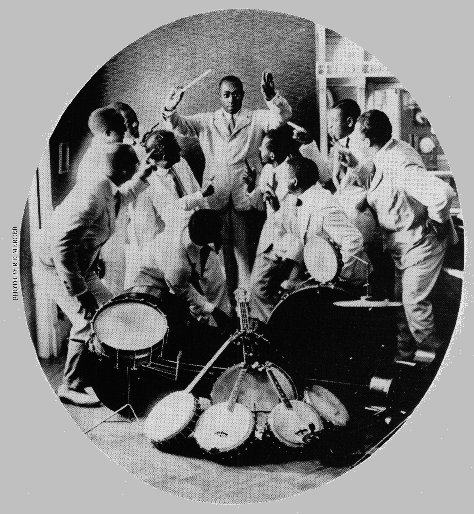
Carnegie Hall, May 2, 1912

The directors of the Music School Settlement were extremely pleased with the evening, both because it resulted in raising nearly $5,000 for the Harlem school, and because the orchestra performed so well. "Don't you worry," Europe had assured Ms. Curtis before the concert, "once those fellows hear that music and catch its swing they'll eat it right up." According to her, they did just that. "'Barbaric'!, one college-bred Negro called the Clef Club," she recalled. "'Barbaric!', we exclaimed in astonished admiration. That an orchestra of such power, freshness, vitality and originality could have remained so long undiscovered in novelty-hunting New York, was a silent and reproachful comment on the isolation of the `Negro quarter."' The large orchestra with its sections of banjos, mandolins, guitars, strings, and percussion, that entirely filled the stage, produced an "absolutely distinctive sound, a 'tang' like the flavor of pine-apple amid other fruits." To David Mannes, the orchestra's sound was "very imposing and seductively rhythmic," and yet the great "surprise" was "the beautiful, soft sound of this strange conglomeration of unassorted instruments." "Its only prototype in tone," he thought, was "the Russian balalaika orchestra." As for the leader, Mannes described Europe as "an amazingly inspiring conductor. Of a statuesquely powerful build, he moved with simple and modest grace, always dominating this strange assemblage before him with quiet control."

Mannes was impressed by the simultaneous singing as well as playing of orchestra members, who sometimes sang in a different clef or pitch than that of the instruments they played. There were also the fourteen upright pianos, placed back to back and played by fourteen of the best ragtime players in town, adding a "truly beautiful, rich and unusual" color to the overall sound. Two aspects of the Clef Club Orchestra's use of the piano are worth noting. First, the instruments, which Elbridge Adams - an official of the American Piano Company - provided as Europe had requested, were not the concert grands that most Carnegie Hall patrons were used to hearing; rather, they were the small uprights of the type that so many of the Clef Club musicians played in their regular jobs as entertainers in the hotels and clubs. The choice was deliberate. Second, the pianos were treated as orchestral instruments, as contributors to the overall sound and not employed in their more familiar role as solo instruments or as single voices in a trio or quintet. As such, Natalie Curtis thought them particularly effective, "weaving a sonorous background of tremolos, deepening with tone-values the roll of the kettledrums, sharpening percussion effects with varieties of pitch, emphasizing rhythmic outline, coloring the accents, blending strings, brass, plectrum and drums into a vibrant unity of sound - a link between them all."
From A Life in Ragtime: A Biography of James Reese Europe, by Reid Badger, Oxford, 1995.

Monday, January 30, 2006


The Clef Club, 1910


The idea for an organization devoted to furthering the professional interests of black popular musicians, singers, and dancers in New York City, given the rising demand for their services downtown, proved a timely and popular one. By April 28, when Lester Walton announced in his column in the Age that a new organization, composed of "well-known musicians and singers of Greater New York, the majority of whom play and sing in the leading hotels and cafes of New York City and provide entertainment for the smart set" had been formed, membership had already grown to more than 135. Among the "well-known musicians and singers" were current or future band leaders Joe Jordan, Ford Dabney, Egbert Thompson, and Arthur "Happy" Rhone; singers Tom Bethel, Henry Creamer, and George Walker, Jr.; and pianists Clarence Williams, Irving "Kid Sneeze" Williams, and John Europe (Jim's older brother). The majority of the original members of the Clef Club, however, played one or several of the stringed instruments then popular in the hotels and nightclubs. Among these were musicians trained in the standard instruments drawn from the European symphonic tradition (violins, celli, violas, and double basses), but the vast majority were players of instruments then associated with American minstrelsy and eastern European and Mediterranean folk music: banjos, mandolins, bandoris (a cross between the banjo and the mandolin), and harp guitars - an awkward double-necked hybrid of an instrument. The most significant technical aspect of the latter instruments is that they must be plucked or strummed, rather than bowed, in order to be played, and their sound, therefore, has a strong percussive, or rhythmic, quality. It is interesting that while there were a few true percussionists (timpani and trap drum players, the latter having recently emerged from the marching band, but considered at the time little more than a vaudeville novelty), there appear to have been no woodwind or brass players in the original Clef Club.
From A Life in Ragtime: A Biography of James Reese Europe, by Reid Badger, Oxford, 1995.


Dmitrievsky Alert


Received from Defender Alert Network:

Dear Friend,

On February 3, a Russian court will decide whether human rights activist Stanislav Dmitrievsky committed a crime when he published articles calling for peace in Chechnya.

If he is convicted, not only could he face up to five years in prison, but a dangerous precedent will be set for all Russians who exercise their right to question and criticize government policies.

This is a critical moment in Russia as a conviction would have a chilling effect on open public debate nationwide.

Please support Mr. Dmitrievsky and take a stand against the further erosion of human rights in Russia by going to the URL below:

http://action.humanrightsfirst.org/campaign/DmitrievskyII?qp%5fsource=ga%5fadv

See also:

Support Stanislav Dmitrievsky!


P is for Pipelines

In European Voice (paid sub required), Edward Lucas has an "A-Zzzzzzzzz guide to European gas wars":

It sounds boring, but it could hardly be more important. So here's a quick guide to the gas wars.

A is for Armenia: a Russian ally trying to break ranks and buy gas from neighbouring Iran - busting the Russian gas monopoly. Will Russia allow it?

B is for the Baltic gas pipeline, Russia's expensive new plan which is aimed at keeping Western Europe hooked on its gas, while bypassing former captive nations like Poland and Ukraine.

C is for China. Russia's planned pipelines to China will create a choice of customers, while European countries will have only a monopoly supplier. Worried? You should be.

D is for diversification. If you buy your gas from just one source (eg Russia), you are a hostage. Go figure.

E is for "Energy Security", which means paying more for energy now in order to guarantee secure supplies later. A nice idea, with few takers F is for France: the country that has cleverly stuck to nuclear power, giving it an enviable dose of energy security.

G is for Georgia, which is now facing a de facto energy blockade after "terrorists" blew up the gas pipeline from Russia. Georgia earlier refused to sell its transit pipeline to Russia.

H is for Hungary, which earlier also had a nasty shock: despite its left-wing government's Russia-friendly policies, it still suffered a nasty hiccup in its gas supplies in the new year.

I is for intermediary companies that broker Russian gas sales to the former empire, such as the infamous, murkily owned, Rosukrenergo. No honest company needs these. When you see or smell one, run fast.

J is for Japan, which loves LNG: diversification is so much easier if you are rich.

K is for Khantsy (and Mantsy) the miserably treated and soon to be extinct ethnic minority, related to the Hungarians, who are the indigenous people in Russia's gas-rich western Siberia. None of the petro-roubles goes to them.

L is for Liquefied Natural Gas, available by the tanker-load from lots of different countries, creating elasticity, clarity and choice.

M is for Moldova, the most shamefully ignored victim of Russia's gas war. Russia is trying to grab its gas company.

N is for Norway, a nice safe source of Western gas, from which many Poles now wish they'd built a planned pipeline five years ago.

O is for Oman, another nice safe, plentiful faraway source of LNG.

P is for pipelines. They come from Russia, destroy competition and create monopolies and corruption. Avoid them if possible (see LNG)

Q is for Qatar, another source of LNG.

R is for renewable energy. Like energy security, a nice idea with no takers at the current price.

S is for Slovakia, where Russia has gobbled up the local gas pipelines.

T is for Turkmenbashi, the dictator of Turkmenistan. If he would agree, a pipeline across the Caspian Sea and Caucasus would solve all our problems. Our pigs would fly too.

U is for Ukraine, whose energy deal with Russia is unravelling already.

V is for Vladimir Putin, the man who has unleashed, albeit clumsily, Russia's energy weapon.

W is for weather - Russia's recent feeble excuse for a dip in supplies to its European customers.

X is for xenophobia (as in Russia's punishment of its former satellites).

Y is for Yamal, the Russian pipeline through Poland. Russia ran a telecoms cable along it - without informing the Polish authorities.

Z is for Zzzzzzzzz, the sound that you get once you start talking about dull but vital subjects like gas...
(via the EdwardLucas email list)

Sunday, January 29, 2006


Double Trouble

Writing in the UK's Sunday Times about a leaked secret document which reveals that MI5 has discovered almost nothing about the worst terrorist attack against Britain despite months of investigation, David Leppard points out that
The leaking of the report is a further embarrassment for Britain’s secret services. At the same time as MI5 has failed to make any significant breakthrough in the London bombings inquiry, the spying efforts of MI6 in Moscow blew up in its face last week.


Skinny White Guys

In the Guardian, Hannah Pool wonders if the UK's black music scene is dead?
Few record company executives (predominantly white middle-class men) understand the current black British underground scene. Even though they might see the financial potential of a new signing, they don't necessarily know what to do with them. "Black artists are the first to go if there is a problem," says Kwaku, of the Black Music Congress, a non-profit organisation which is holding a debate next Saturday at London's City University entitled Should British Black Music Shut Up Shop?, "so many of them are dropped after the first album, the first single even. There is no development, and it is not because there is no talent. There is a lot of talent, but there needs to be sustainability."

Yes, there has been the relative success of Dizzee Rascal, Estelle and, more recently, Kano and Sway, but even they haven't truly hit the big time.

"Kids are doing music on estates, on the street, in their bedrooms, but they are not being taken seriously," says Estelle. "There is not enough faith in black music at a high level. Record company executives, labels and artists are not taking the time to go and see what kids are producing. They don't go to the estates, they don't have that much of a clue."

And when the major labels do sign black British artists, they don't always get it right, or they end up signing acts that either aren't good enough or aren't ready. Or they sign underground white acts such as the Streets or Lady Sovereign, which would be fine if they signed plenty of black artists, too. "They get excited and complacent at the same time, so they think we are all the same," says Estelle. "They lump us all together. I am a black British female artist, so I must be like Ms Dynamite, I must be like Shystie, I must be like Jamelia, but we're all different."

The last boom for black British music was when the UK garage scene exploded at the turn of the millennium. But it didn't make enough money quickly enough, so the A&R men went elsewhere. They went back to what was familiar to them, to the music that reminded them of their youth, the stuff they knew how to sell, their spiritual home: indie music. So, too, have the hordes of white, male, middle-class music journalists, the radio station bosses and, well, pretty much everyone else. You can practically hear their relief to be back on home turf with every breathless Doherty feature.
The whole article is worth reading, both for the light it sheds on the current music scene, and for the insight it gives into some of the less encouraging directions in which British society is currently developing.

Saturday, January 28, 2006


A Rap for Mozart


Leopoldo, who is my only Estonian-Latin-American correspondent, has sent an item from the Agencia Latinoamericana y Caribeña de Comunicación about a "rap for Mozart", which looks promising, as it involves the Mexican conductor Sergio Cárdenas (who is also a notable translator of Rilke's poetry), the Mexican poet Dyma Ezban, and no fewer than 12 virtuoso cellists! It is to be followed later in the year by a Rap for Beethoven.
Músico mexicano de origen presbiteriano sorprende al mundo con un rap para Mozart

MÉXICO, Ene. 27 (ALC). "The Flower is a Key", un rap para Mozart, es una obra del director de orquesta mexicano Sergio Cárdenas, quien dista mucho de ser un rapero, pero que alcanzó un gran éxito precisamente con este tema que combina el pegajoso ritmo del rap con la música clásica de uno de los mayores genios musicales del mundo.

Cárdenas, nativo de Ciudad Victoria, Tamaulipas, quien empezó a trabajar el tema a solicitud de un grupo de violonchelistas de la Filarmónica de Berlín, hizo sus estudios iniciales de música en el Seminario Teológico Presbiteriano de México, y los continuó en Princeton (Estados Unidos) y en Europa.

Ha dirigido orquestas en Austria (entre ellas la Mozarteum, de Salzburgo), Alemania, Egipto y México (fue director de la Sinfónica Nacional) y es profesor de la Escuela Nacional de Música de la Universidad Nacional Autónoma de México.

Es autor de los libros "Estaciones en la música" (1999) y "Un rap para Mozart" (2003), donde reunió textos que versan sobre música y poesía. Además, es un notable traductor de poesía alemana, especialmente de Rainer Rilke, uno de los mayores autores del siglo XX.

El poeta mexicano Dyma Ezban (seudónimo), de la ciudad de León, Guanajuato, aportó al proyecto del rap un poema que había escrito por el bicentenario de la muerte de Mozart. Este viernes el mundo recuerda los 250 años del nacimiento del músico genial.

La pieza fue editada en inglés el año 2002 por la compañía EMI Classics como parte de una retrospectiva de la música norteamericana , con música de Broadway, de los espirituales negros y el rap de Mozart.

"En el proceso de composición, traté de captar el espíritu mozartiano utilizando varios giros melódicos y armónicos característicos de Mozart vertiéndolos en un lenguaje moderno o más contemporáneo y en los ritmos del hip hop que caracteriza al rap", comenta Cárdenas en una entrevista para BBC Mundo.

El "Rap para Mozart" ha tenido tanto éxito que actualmente el músico mexicano prepara una versión sinfónica con 12 virtuosos violonchelistas para estrenarlo el próximo 8 de febrero en la Universidad de Bonn, Alemania.

Cárdenas anuncia igualmente un rap para Ludwig van Beethoven que presentará en octubre de este año en el Festival Internacional Cervantino en la ciudad de Guanajuato, México. (051/2006/presb/art/alc).
-------------------------------
Agencia Latinoamericana y Caribeña de Comunicación
Apartado postal 14-225 Lima 14 Perú
Tel. (51 1) 242-7312 - Telefax (51 1) 446-5219
Correo-e: director@alcnoticias.org
http://www.alcnoticias.org - http://www.alcpress.org


Rescue Chechnya

Received via the chechnya-sl email list:
Canadian Committee For Peace In Chechnya

Invitation to Join

A genocidal war has been conducted by Russia against Chechnya for over a decade. 200,000-300,000 civilians have been killed with as many displaced. A pre-war population of over a million has been reduced to 400,000.The destruction inflicted by the Russian forces on Grozny and many of Chechnya's main towns and villages is only comparable to that inflicted on Stalingrad or Dresden in the Second World War.

Leading Human Rights organizations (e.g. Human Rights Watch, Amnesty International etc.) have documented rampant human rights abuses and disappearances of ordinary Chechen men, women and children that are happening on a near daily basis.

The Canadian Committee For Peace In Chechnya is a group dedicated to highlighting the plight of Chechnya and the Chechen people.

We combine three broad areas of action:

- raising awareness about the plight of Chechens

- addressing the legal, material and educational needs of Chechens anywhere
through cooperating with NGOs and developing our own projects,

- helping the growing Chechen Diaspora become more organized and effective,
strengthen Chechen culture

If you are interested in learning more about our organization, please go to our website (www.rescuechechnya.com). We are looking forward to hearing from you, and hope that some of you will decide to get involved.

Contact Email : chechnya.relief@gmail.com

Friday, January 27, 2006


The Crimes of Communism

In EDM, Vladimir Socor gives a full account of the struggle of the Parliamentary Assembly of the Council of Europe (PACE) - against determined Russian government pressure - to gain approval for a a report calling for "International Condemnation of the Crimes of Communist Regimes." The report condemns both the ideology and the crimes of international communism, and has now been voted on - with a simple majority in favour of approval. Socor, noting that such a move would be unthinkable at the OSCE, which "for all its claims to speak for 'values' -- is structurally dependent on Russia and makes a virtue out of the necessity named 'consensus'," provides the background:
A different kind of Russian problem emerged in the debates on the anti-communism resolution at PACE: Russia's delegation enlisted the support of a sizeable contingent of left-leaning European Socialists, hardline leftists, and residual communists to fight the report. In negotiations prior to the vote, this bloc managed to delete or dilute some formulations in the report, even expunging direct references to the Soviet Union. Even so, the Russian delegation, along with allies on the left, tried to kill the document altogether by returning it to PACE's Political Committee for further revisions. That Committee began work on the report in December 2003, initially under the Dutch Christian-Democrat Rene van der Linden (currently the president of PACE) and then under the Swedish parliamentarian Goran Lindblad, both affiliated with the European People's Party in the Assembly. Ultimately, the PACE resolution to approve the report passed narrowly with 81 in favor, 70 opposed, and some members not voting.

The report notes that the totalitarian communist regimes formerly in power in Central and Eastern Europe, and those still ruling elsewhere, were responsible for mass-scale crimes and suppression of human rights. Without explicitly equating Communism and Nazism, the report calls for condemning these totalitarian ideologies. It calls on all existing communist parties to review critically their own past and to acknowledge and condemn the horrors perpetrated by communist regimes. It urges all post-communist parties and governments in formerly communist-ruled countries to encourage the study of the historical record of communist regimes, ensure that their crimes are appropriately reflected in school textbooks, and institute national days for commemoration of the victims of communist regimes. The report recommends that the Council create a working group of experts to process information on the crimes of communist regimes.

Konstantin Kosachev, chairman of the State Duma's international affairs committee and head of Russia's delegation to PACE, led the fight against the report. Kosachev claimed that not all communist regimes were criminal or violent, though he did not clarify how he categorized the Soviet Union in that regard. "Not everything that's red is blood, some of it may be tomato juice, Mr. Lindblad" -- he lashed out at the rapporteur during the official debate (Interfax, January 25). Moreover, Kosachev charged that the report seeks to assign to the USSR a share of the responsibility for the Second World War and the division of Europe. Finally, he contended that Communist ideology could not be grouped together with Nazi ideology under the category of "totalitarian." Implicitly excusing the former, Kosachev insisted that the report must not place those two ideologies on the same footing.

In Moscow, the Kremlin-linked political consultant Sergei Markov criticized the PACE report in a similar vein. He termed the document a "blow struck against Russia as successor to the communist Soviet Union." Moreover, according to Markov, PACE is "attempting to prop up the undemocratic regimes in the Baltic states, Ukraine, and Georgia, the legitimacy of which rests on anti-communism" (Interfax, January 25).

It would be unthinkable for German officials to describe condemnations of Nazism as blows struck against today's Germany or to feel insulted by the pairing of Nazism with Communism as totalitarian ideologies. Yet this type of attitudes on the part of Russian officials seems to be regarded as normal by many European Socialists, judging by PACE's vote.

Russian Communist leader Gennady Zyuganov seconded Kosachev's efforts in Strasbourg, though using a different line of argument by which he attempted to vindicate communism outright. "Latin America is turning Red," Zyuganov exulted in this context, alluding to Venezuela and Bolivia. The other Russian delegates to PACE had to speak more cautiously than this. But, while the PACE debate was in progress, Russian energy giants Gazprom and Lukoil were rushing to Venezuela and Bolivia with Kremlin-approved project offers.

(Interfax, January 20, 23-25; Radio France Internationale, January 21; Ekho Moskvy, January 24)


ETV

Estland has some links to the newly revamped website of Estonian Television, where it's possible to watch newsclips of Estonian and world events in the Estonian language - great for those of us who are trying to keep our knowledge of the language in some kind of developing state. Among other things, in addition to a 24-hour Mozart festival today, there are recent items on the ice situation in the Baltic near the island of Saaremaa, and a car that caught fire on a Tallinn highway - but international news is also prominently featured. There are also text versions of the video commentaries - a doubly useful feature for those studying the language.

Thursday, January 26, 2006


Ukraine: The Geopolitical Context

In a fascinating essay in Maidan, Mykola Malukha examines the concepts relating to Ukraine in Russia's geopolitical realm. He studies the history of Russia's attitudes towards Ukraine, from the 18th century onward, and shows how the threat of the establishment of an independent Ukrainian state has tended to eat at Russia's geostrategic self-confidence, especially within the context of Russian imperial ambitions. Bismarck said that "Russia could be undermined only if Ukraine was taken away from it."

As an example of present-day Russian nationalist thinking on the subject, Malukha cites a recent (1996) paper by Mikhail Smolin, a Russian political analyst who espouses the "classical" world view principles currently endorsed by the Kremlin. The paper contains the following paragraphs:
"The greatest domestic national problem for Russians as of today should be considered the 'Ukrainian' question. The lack of resolution of this issue could lead to a real tragedy the scale of which would be difficult to imagine. Any variants are possible, including even a war along the lines of that in Yugoslavia. If Russian society and the State do not act in response to the emergence on Little Russian territory of a Ukrainian State, and do not try to expose the Russo-phobic myths which are being assiduously inculcated in Ukrainian society and in the minds of Little Russians living on Russian territory, then in a very short space of time our Motherland will possibly come up against unstoppable problems presented by a Ukrainian State which has joined NATO and is ready for war with Russian as a part of any coalitions.

"'Ukrainism' which is in confrontation with the Orthodox Church, with Russian statehood and with the unity of the Russian people must be extracted from the Russian body as one extracts a harmful virus, freeing us from that ideological fog which prevents many Russians from seeing the greatest harm from the 'Ukrainian movement'. Nationally-minded Russian people, must, for the sake of the future Russian people, under no circumstances recognize the right to exist of a state of 'Ukraine', of a 'Ukrainian people' and a 'Ukrainian language'. History knows neither the first, nor the second nor the third of these – they do not exist. They are fetishes created by the ideology of our enemies."


Osama's Vietnam Syndrome

Osama's Vietnam Syndrome

By George Friedman

Osama bin Laden has broken his long silence: An audiotape containing his latest statement was delivered to and broadcast by Al Jazeera on Jan. 19. The United States has said that the tape appears to be authentic, and there has been ample time for al Qaeda to have denied its authenticity if it were fake. That hasn't happened, so it appears reasonable to assume that this is, in fact, an authoritative statement by the head of al Qaeda.

This obviously puts to rest the question of whether bin Laden is still alive. The tape apparently was recorded after Nov. 22, 2005, since bin Laden discusses the widely circulated story that U.S. President George W. Bush had suggested to British Prime Minister Tony Blair that Al Jazeera's headquarters should be bombed. That story first appeared in the press on Nov. 22. While the tape theoretically could have been made anytime between Nov. 22 and Jan. 19, logic and precedent dictate that it would have been recorded some time before it was aired. It generally takes -- and has always taken -- at least a week, and often longer, for messages from bin Laden to reach broadcast stage. Security requires a slow and tortuous journey, lest the tape be tracked back to bin Laden's location. So we would guess that the tape was not made much after Jan. 1.

If we were to guess -- and this is pure guess -- we would argue that the tape was made after Dec. 15, 2005. Dec. 15 was the date of the election in Iraq. That election drew extensive participation by the Sunni population and posed a serious crisis for the jihadists in Iraq. It raised the real possibility that a substantial portion of the Sunnis would turn against the jihadists, since they would now have a role to play in the government. There were also serious discussions within the Muslim world, and in the United States, as to whether al Qaeda remained functional and whether bin Laden -- who hadn't been seen or heard from since December 2004 -- was still alive. The Dec. 15 date represented a crisis for al Qaeda, and it was logical that bin Laden would be willing to face the security risk involved with making and transporting a tape. Therefore, not that this is critical, but we would guess the tape was made sometime between Dec. 16 and the first week of January.

The recording reveals two things about bin Laden.

First, he is still in touch with the world. He knows what is going on in American politics, he has access to American books -- he mentions one book by name -- and he is aware of the state of operations in Iraq. The level of detail varies, but it is unlikely that he is stuck in a cave somewhere. Unless there are platoons of couriers bringing reports to him -- something that would violate all rules of security -- it would appear that bin Laden is able to access satellite television and possibly the Internet. Wherever he is, there is electricity and some degree of connectivity to the world. He's getting his news from somewhere.

Second, and much more important, bin Laden is aware of the state of the war and has decided that he needs to change tactics somewhat. He acknowledges the possibility of al Qaeda's defeat, which is not like the old bin Laden. On the tape, according to a translation made by The Associated Press, he says:

"Finally, I say that war will go either in our favor or yours. If it is the former, it means your loss and your shame forever, and it is headed in this course. If it is the latter, read history! We are people who do not stand for injustice and we will seek revenge all our lives. The nights and days will not pass without us taking vengeance like Sept. 11, God permitting."

At this juncture, he is separating the war from the attacks of Sept. 11. He is open to the possibility that the war might be lost. However, acts of revenge -- like the Sept. 11 attacks -- will continue. Bin Laden therefore is referring to Sept. 11 as an operation other than war.

In referring to the true war, he specifically cites Iraq and Afghanistan. About those, he speaks -- at the beginning of his recording -- with his usual bravado: "The war in Iraq is boiling up without end and the operations in Afghanistan are continuing in our favor." Thus, there is a disconnect between this assertion that the war continues and that the trends favor al Qaeda, and the assertion that the war might go either way. Two things are clear: First, bin Laden increasingly means, by "war," operations in Iraq and Afghanistan; and second, he views Sept. 11-type operations not as part of the war, but as an alternative to war.

These points are interesting. But what is fascinating and vital is his turn to Vietnam as a mode of analysis and strategy. Bin Laden refers to the U.S. Army as the "Vietnam butcher." This indicates that he has been thinking about Vietnam, but that thinking becomes clearer in the way he addresses the problems and opportunities in Iraq and Afghanistan.

First, he focuses on anti-war sentiment in the United States:

"But I plan to speak about the repeated errors your President Bush has committed in comments on the results of your polls that show an overwhelming majority of you want the withdrawal of American troops from Iraq. But he has opposed this wish and said that withdrawing troops sends the wrong message to opponents, that it is better to fight them on their land than their fighting us on our land."

Bin Laden clearly knows about the polling trends in the United States and obviously knows that Bush has slipped substantially in opinion polls. He overstates the numbers when he says that the overwhelming majority want withdrawal -- it is a majority, but far from overwhelming -- but he clearly is speaking to the anti-war movement in the United States.

He is also speaking to troops in Iraq, saying: "Pentagon figures show the number of your dead and wounded is increasing not to mention the massive material losses, the destruction of the soldiers' morale there and the rise in cases of suicide among them." Bin Laden is portraying the U.S. Army in Iraq as being in fairly desperate straits, while the Pentagon remains indifferent.

Analytically, he views the condition of the United States as if it were Vietnam. Bin Laden is asserting that there is massive sentiment against the war and that Bush, like Lyndon Johnson and Richard Nixon, is resisting that movement and resisting withdrawal. He is portraying the Army in Iraq as if it were the Army in Vietnam, late in that war. The truth or falsehood of the view is not material here -- nor should his statements be taken as propaganda directed at the American public. Bin Laden is not unsophisticated. He is not trying to persuade the American public to oppose the war. His view is that the polls show that Bush's political base has collapsed, along with morale in the U.S. Army.

Bin Laden then pulls a maneuver right out of Ho Chi Minh's playbook, saying:

"We don't mind offering you a long-term truce on fair conditions that we adhere to. We are a nation that God has forbidden to lie and cheat. So both sides can enjoy security and stability under this truce so we can build Iraq and Afghanistan, which have been destroyed in this war. There is no shame in this solution, which prevents the wasting of billions of dollars that have gone to those with influence and merchants of war in America who have supported Bush's election campaign with billions of dollars -- which lets us understand the insistence by Bush and his gang to carry on with war. If you are sincere in your desire for peace and security, we have answered you."

If there is a massive anti-war movement in the United States and if the Army is weary of war, then the next logical move is to offer negotiations toward a cease-fire. Bin Laden completely understands that Bush would reject that offer. His hope is that the offer of a truce would further split the United States -- undermining Bush's political power even more and giving ammunition to those who want an end to the war. "If you are sincere in your desire for peace and security," he says, "we have answered you."

During the Vietnam war, the North Vietnamese introduced the idea of a negotiated settlement in large part because they wanted to provide a rational basis for the anti-war movement. They understood that there would be only a tiny pro-Hanoi movement in the United States. They also understood that as the war dragged on and victory became less visible, support would grow for a negotiated settlement as the only reasonable outcome. The view of the pro-war faction -- that the offers of peace talks did not provide any basis for a real settlement but were a cover for a North Vietnamese victory -- was opposed by those who argued that settlement and withdrawal were the only rational actions for the United States in an unwinnable war.

Wherever he is, bin Laden has done a lot of thinking, and he apparently has come to think of himself as Ho Chi Minh. From his viewpoint, Bush, like Johnson, is resisting a wave of anti-war sentiment. The Army is tired. An offer of a long-term, honorable truce would build up the anti-war faction. Add to that the promise that even if the United States wins the wars in Iraq and Afghanistan, al Qaeda will continue to stage Sept. 11-type attacks, and you have an added incentive for a negotiated settlement.

Bin Laden may be deluding himself, but he smells serious political problems for Bush in the United States and a movement that wants to withdraw forces in return for a truce that guarantees no further attacks on the American public. That is the heart of his message. He is prepared to negotiate a truce. He believes that this will fuel anti-war sentiment today, just as the offer of negotiations fueled anti-war sentiment in the 1960s. And if that truce is agreed to, he believes that he can reshape the Islamic world today much as North Vietnam reshaped Indochina.

What is most clever in this move is that it doesn't require actual negotiations. If Bush starts to draw down forces in Iraq, bin Laden can declare a truce and imply in the Muslim world that he compelled the United States to capitulate. He is trying to trap Bush in two ways. If there isn't a drawdown, Bush would face an anti-war movement calling for truce with al Qaeda. And if there is a drawdown, Bush would face assertions that he is implicitly or secretly agreeing to the truce that bin Laden proposed.

Bin Laden is not Ho Chi Minh. No one will call him "Uncle Osama" or liken him to George Washington, as they did Ho. It is difficult to imagine that anyone -- pro- or anti-war -- in the United States would think seriously of negotiating with him. Even the Europeans, who have never seen an offer of negotiation they didn't like, took a pass when it came to bin Laden. Nevertheless, as a glimpse into bin Laden's strategic thinking, the view is fascinating. Above all, there is this parallel: The most creative diplomacy of the North Vietnamese followed their defeat in the Tet Offensive. The moment that bin Laden's strategic position in Iraq (but not Afghanistan) is at its weakest -- following the Dec. 15 elections -- is the moment he offers a truce.

Fascinating.

Send questions or comments on this article to analysis@stratfor.com.


Human Rights First

http://humanrightsfirst.org/media/2006_statements/hrd_0125_russia.htm

Human Rights First Condemns False Accusations against Russian Human Rights Organizations

NEW YORK – The Russian government has publicly defamed four well-respected human rights organizations by accusing them of collecting funds from the British secret service. The organizations are the Moscow Helsinki Group, the Center for Democracy and Human Rights, the Eurasia Foundation, and the Nizhny-Novgorod-based Committee against Torture. All of the organizations have denied the accusations, pointing out that funds they have received from the British government have come through legal, transparent channels. Ludmilla Alexeeva, chairperson of the Moscow Helsinki Group, a renowned Soviet era dissident and recipient of Human Rights First’s 2005 human rights award, characterized the allegations made in a television documentary as “a sad slander campaign against human rights defenders.” She has demanded an apology from the government.

“The attack on these human rights organizations are part of an escalating government campaign against independent civil society taking place in Russia today,” said Maureen Byrnes, Executive Director of Human Rights First. “If the government forces these organizations to close Russia will recede further into the type of severe repression associated with the Soviet Union.”

Accusations such as the ones made this week could provide the government with justification to close down these vital organizations under a law governing non-governmental organizations that was signed into effect by President Vladimir Putin earlier this month. Igor Kolyapin, chairperson of the Committee against Torture, and Yuri Dzhibladze, director of the Center for Democracy and Human Rights, expressed concerns that the accusations form part of a coordinated government attack on human rights organizations. The accusations are also accompanied by the prosecution under counter-extremism laws of human rights activist Stanislav Dmitrievsky, director of the Nizhny-Novgorod Russian-Chechen Friendship Society. The verdict in this case is expected on February 3, 2006. If he is convicted, it too will have a chilling effect on the activities of human rights defenders in Russia.


Human Rights First is a leading human rights advocacy organization based in New York City and Washington, DC. Since 1978, we have worked in the U.S. and abroad to create a secure and humane world -advancing justice, human dignity, and respect for the rule of law. All of our activities are supported by private contributions. We accept no government funds. Visit our web site: www.humanrightsfirst.org

Human Rights First 333 Seventh Ave., 13th Flr, New York, NY 10001 Tel: (212) 845-5200 Fax: (212) 845-5299 www.humanrightsfirst.org

Wednesday, January 25, 2006


Support Stanislav Dmitrievsky!


You can sign the petition at the following address:

http://www.cjes.ru/actions/action.php?p_id=1&l=en


Support Stanislav Dmitrievsky!


Just a decade ago, journalists in Russia were heard and listened to. Their reports and opinions were waited for and discussed. There was demand for independent information. Journalists and human rights activists had real influence on the authorities (among other things,they did a lot to end the first war in Chechnya).

In the several years, the words "Russian journalism" are perceived differently as journalism is becoming increasingly "nationalized," to be more exact, increasingly state-controlled. The number of sources of information that are independent of the state propaganda is decreasing. Television and radio are mostly state-run and only some newspapers maintain independent views and are not subjected to censorship.

The most controlled information is information coming from the Chechen Republic, where, despite official reports, people still get killed and go missing. One of the few independent and alternative sources of information on the events taking place in Chechnya is the newspaper Pravo-Zashchita, which was founded by the public association Nizhny Novgorod Human Rights Society (NOPCh).

On September 2, 2005, the Nizhny Novgorod prosecutor's office charged the paper's editor-in-chief Stanislav Dmitrievsky with crimes envisioned by Article 282 of the Russian Criminal Code ("fanning ethnic, racial or religious feud in combination with abuse of office"). Dmitriyevsky is facing three to five years in prison if convicted of the charges.

The criminal case against the journalist was opened in January 2005 based on the publication in Pravo-Zashchita of addresses made by Chechen separatist leaders Akhmed Zakayev and Aslan Maskhadov, which contained calls for a peaceful settlement of the Russian-Chechen conflict. Those publications sharply criticized the Russian government, the Russian army, and personally President Vladimir Putin. Human rights activists consider these charges to be politically motivated and aimed at liquidating the constitutional guarantees of freedom of speech. On November 15,2005, the international human rights watchdog Amnesty International issued a statement, in which it expressed concerns about the pressure put by various public structures on NOPCh and said it intends to give Dmitrievsky the status of a political prisoner if he is convicted of the charges.

The trial began on November 16, 2005. On December 15, Dmitrievsky gave his testimony in court and answered questions the parties' questions. In his testimony, he categorically denied all the charges and said he not only does not consider himself guilty, but is insulted by the prosecutor's office's accusations of racism and xenophobia.

One day before the trial, the Nizhny Novgorod region's court rejected the lawsuit filed by the Justice Ministry's Main Registration Department for the Nizhny Novgorod region, which sought the liquidation of the Russian-Chechen Friendship Society.

There is an information war going on against NOPCh in Nizhny Novgorod. Its staff are being threatened with violence (the Nizhny Novgorod region's interior affairs department opened criminal case No. 155200 on October 7, 2005 on the basis of those threats).

On August 15, 2005, the Federal Tax Service's inspection for the Nizhny Novgorod Nizhegorodsky District issued Decision No. 25 to prosecute NOPCh for a tax violation. On September 12, 2005, Justice Yevgeniya Belyakova of the Nizhny Novgorod region's Arbitration Court issued a ruling suspending that decision.

Apparently, the authorities are doing everything to do away with one of the independent sources of information on events taking place in the Chechen Republic and put its editor-in-chief Stanislav Dmitrievsky in prison.

Is Pravo-Zashchita being penalized only for trying to tell people what the state propaganda is not telling them?

Do you agree with it?

If you don't, sign this statement, support Stanislav Dmitrievsky!

Case Materials [Sorry, only russian]

See also in this blog:

Dmitrievsky Trial
Dmitrievsky: Politkovskaya Testifies


Ryzhkov on the Voice Behind the Rock

Vladimir Ryzhkov, independent Duma Deputy:
- This exposure is designed for internal and external consumption. First of all this is a slap on Blair and Great Britain for their obstinacy to deliver Berezovsky and Zakayev. It is interesting that the exposure and film about this took place on the eve of Berezovsky's anniversary. They showed nicely to the people that all human rights organizations - are an instrument of the CIA.


Владимир Рыжков, независимый депутат Госдумы:

– Разоблачение рассчитано на внутреннее и внешнее потребление. В первую очередь это пощечина Блэру и Великобритании за неуступчивость в выдаче Березовского и Закаева. Интересно, что разоблачение и фильм про это состоялись накануне юбилея Березовского. Народу красочно показали, что все правозащитные организации – орудия ЦРУ.
See
http://www.kommersant.ru/doc.html?docId=643044

Tuesday, January 24, 2006


"Spies": Two Quotes

FSB spokesman Colonel Ignatchenko said in Moscow on 23 January that the case involving the four British diplomats "requires a political solution," RIA Novosti reported.
(RFE/RL Newsline, January 24)

Prime Minister Tony Blair declined to comment on the spying allegations. Asked about them at his regular monthly news conference, he said: "I'm afraid you are going to get the old stock-in-trade 'We never comment on security matters' . . . except when we want to, obviously.

"I think the less said about that, the better."
(Washington Post, January 24)


Moscow Attacks NGOs and "Spies"

Via chechnya-sl:

From Le Monde

MOSCOW ATTACKS NGOs AND "SPIES"

From our Moscow correspondent, Marie Jégo

Spies disguised as "students", a stone that emits and receives "coded information", supplies of foreign funding to Russian NGOs: the scenario could be that of a thriller, but for the fact that these were revelations made on Sunday 22 January by the Russian security services (the FSB) on the strength of four British diplomats in Moscow having been detected in carrying out spying activities. These men have not been threatened with expulsion, according to the FSB, which has applied itself to describing their financial links with NGOs.

A film, made by a camera hidden by the FSB, and put at the disposal of the two public television channels (Pervyy and Rossiya), was shown on Sunday 22 and Monday 23 January. In it, men in hoods can be seen walking repeatedly beside a big stone in a Moscow park. "Officials of the British embassy seen walking around the stone included Mark Doe (the second secretary), who came there summer and winter," a commentator explained. According to the spokesman for the FSB, Sergey Ignachenko, who was shown in the broadcast beside a sort of "meteorite" whose longitudinal section gave a view of a transmitter within, "this spy" was in frequent contact with the "transmitting stone" and was accused of "financing NGOs".

The Foreign Office protested in vain - the Russian media repeated the broadcast non-stop, insistent on the links detected between the spies and NGO activists aiming to destabilise the country. The organisations concerned, the Helsinki Group and the Eurasia Fund, were named by Sergey Ignatchenko on television as beneficiaries of support payments received. The president of the Helsinki Group, Ludmila Alexeyeva, acknowledged that one of the diplomats had, in 2004, approved the payment of $40,000 out of the funds allocated to him, thanks to which she had been able to carry out her programme of human rights monitoring. According to her, this episode is best understood as "an attempt to stain a respected organisation. Public opinion is being gradually prepared for the idea of the banning of our organisation, now that the law permits it."

At Memorial, the association inspired by the dissident Andrei Sakharov, the activists do not hide their anxiety. "For the first time," explains the historian Arsen Roginsky, "a politically controlled entity will verify if our activities are in conformity with our statutes." The law requires verification of NGOs' activities and of the uses of 80% of financial contributions received from abroad. Already, Memorial, which led the way in the defence of individual freedoms, and in denouncing the crimes committed by Russian forces in Chechnya, has been subjected to a tax inspection in the spring of 2005. Absolutely nothing was left out, including the bowls donated to the Gulag veterans on the occasion of the commemoration of the 50th anniversary of the uprising at the Kengir camp. The tax authorities required payment of social tax on each bowl, together with a completed information sheet with the details of every beneficiary. Memorial's accountant: "We had to provide thousands of documents to the tax office. It all took a great deal of time, to the detriment of our normal activities". A fine of $57,000 was imposed, a decision Memorial is appealing.

A few hundred kilometres from Moscow another NGO is in difficulty. Stanislav Dimitrievsky, the founder of the Russian-Chechen Friendship Society of Nizhny-Novgorod, is accused of "inciting racial hatred" and faces five years imprisonment for publishing, in 2004, in his newspaper Pravozashchita, an appeal for peace by the Chechen president, Aslan Maskhadov, later killed by the federal forces. The accusation is surprising when one considers the thousands of extremist, racist and anti-semitic organisations which are allowed to exist in Russia undisturbed. The NGO, targeted for a tax inspection, is threatened with closure. According to expert testimony quoted at the trial, it is alleged that he wrote the adjective "putinian" with "a small p" instead of a capital letter, although that is recommended by textbooks. "The authorities want to silence the only trustworthy source of information on Chechnya," according to Oleg Panfilov, an activist for journalists' rights. "We are now learning that freedom of expression is extremism, that there is no war in Chechnya, and that journalists are fanatics," says Yuri Djablidze, of the Centre for Human Rights and Democracy in Moscow.
Accédez à cet article sur Lemonde.fr

http://www.lemonde.fr/

Translated by Jeremy Putley


Cold Comfort

Crispin Black in the U.K.'s Daily Mirror, discussing the Moscow spying allegations, comments that we seem to be back in the "dangerous but strangely reassuring world of John Le Carré and the spy novel":
Putin isn't just nostalgic for the past, he wants to turn back the clock. In particular, he doesn't like sharing political or economic power and if he feels threatened he'll react aggressively.


That's why so many Russian billionaires have come to live here and why both Ukraine and Georgia are currently locked in disputes with Russia over gas supplies.


Another group exercising Putin are non-governmental organisations like Amnesty International and the British Council.


Putin dislikes them because they're not under his control and aren't afraid to criticise his authoritarian tendencies including the brutality of the Russian military in Chechnya.


He wants to curb their activities with new laws and ban any that operate using foreign money. What better way to discredit them than accuse them of being fronts for western intelligence?


And what better way to shore up domestic support for the new laws than to uncover a spying scandal involving British intelligence, deeply ingrained in the Russian psyche as the most duplicitous and ruthless of all.


While Russia no longer has vast armies pointed at Western Europe, it retains considerable influence over us.


It's a major provider of gas to the West and it's offered to enrich uranium for Iran's nuclear programme.


We need to know what plans Putin's Russia has and are right to be wary - it is after all a country run by ex-KGB men.


And all the time there is the suspicion that Russia cannot be trusted, we need spies to uncover exactly what the Kremlin's intentions are.

Monday, January 23, 2006


In EDM, Vladimir Socor writes about the January 22 energy supply cutoff to Georgia:
The selection of targets and close coordination of the blasts leaves no doubt that they aimed for a total halt of Russian energy supplies to Georgia during an unusually cold mid-winter (with Armenia suffering collateral damage). The operation undertaken to that end in two different North Caucasus regions demonstrates the effectiveness of whatever organization carried it out. Suspicions focus variously on elements within Russia's secret services, intent on forcing Georgia to its knees; or on North Caucasus guerrilla groups seeking to discredit Moscow in the region and internationally.

Either version must be seen as a mortifying possibility by Gazprom, as well as Russia's United Energy Systems (UES) and Transneft, and by implication the Russian government. The blasts indicate that Moscow no longer reliably controls energy export routes on Russia's own territory. Gazprom's pipelines to the South Caucasus and to Turkey (Blue Stream), Transneft's oil pipelines from Dagestan and from Azerbaijan to the Black Sea export terminal Novorossiisk, the Caspian Pipeline Consortium's oil line also to Novorossiisk, and UES's planned electricity transmisison lines toward Turkey, all criss-cross an increasingly unstable North Caucasus en route to export destinations.
Socor suggests that the blasts and cut-off should come as as a wake-up call to the West: dependence on Russian gas and energy supplies may be disastrous for its future.


The G8 Test

In its current slightly grotesque "James Bond" spying accusations against Britain, it looks as though the Russian government is testing the water as it takes up the G8 presidency. Writing in the London Times, Jeremy Page notes that
...if this does lead to the four diplomats being expelled from Russia then we can expect that London will respond by kicking the same number out of Britain. Experience suggests that these sorts of intelligence disputes rarely spill over to become major diplomatic rows. At worst, it will sour the atmosphere for a while.

"If this is true, Russia doesn't need to bang on about it. It's proved its point and convinced a large majority of the Russian population that Western funded NGOs are a real threat. The best MI6 can do is keep its head down.

"The upshot of all of this for Russia will be that it is now going to be very hard for the British government to criticise the NGOs Bill, which means it will get at least one G8 member to shut up about it."


Viola Vibrations

The U.K. is apparently suffering a shortage of viola players. But all is not lost - according to the BBC, viola fans are fighting back, "starting with a special concert in Edinburgh this weekend featuring new viola music to raise the profile of the cause." The article also lists some of the better-known viola "jokes":
What's the difference between a viola and a coffin?
The coffin has the dead person on the inside.

What's the difference between a violin and a viola?
The viola burns longer.
The viola holds more beer.
You can tune the violin.

What's the difference between a viola and a trampoline?
You take your shoes off to jump on a trampoline.

What's the difference between a viola and an onion?
No one cries when you cut up a viola.

What's the definition of "perfect pitch?"
Throwing a viola into a bin without hitting the rim.

Why do violists stand for long periods outside people's houses?
They can't find the key and they don't know when to come in.
Read more here.

Sunday, January 22, 2006


Declaration of Interest

Oliver Kamm has a post about a New Statesman review by Richard Gott of Yale historian John Lewis Gaddis's recently-published The Cold War. He points out some uncomfortable facts:
Nowhere in the review do you find the slightest hint or allusion - other than his claim that "the much-derided [Berlin] wall brought a measure of stability to the European scene" - that Gott was scarcely a disinterested party remote from the partisans of both camps. He in fact received covert payments from the KGB. When this was revealed in 1994, Gott resigned as Literary Editor of The Guardian and penned an apologia for the newspaper in which he claimed no harm had come from his activities. It was all a bit of a giggle, in fact: "I enjoyed it."

I would expect nothing less of Richard Gott. But I hope the NS editor, John Kampfner, can be persuaded to state explicitly his reasons for omitting this information (which he certainly knows) from his reviewer's byline.


Imitation Operations

An article I just translated for the Prague Watchdog:

"Special operations" or imitations?

By Umalt Chadayev

CHECHNYA – In Chechnya there are cases where representatives of security agencies [silovyye struktury] report "successful special operations against fighters" which have not actually taken place.

On January 6 on the outskirts of the village of Bamut in the Achkhoy-Martanovsky district (south-west Chechnya), members of the “Akhmad Kadyrov” special-purpose regiment of the Chechen Interior Ministry conducted a "successful special operation", in the course of which four guerrillas were killed. Information about this was disseminated by several Russian media, with reference to Hussein Aydamirov, head of the local police department.

According to the official information, the group that was eliminated planned to carry out a number of acts of sabotage and terrorism against law enforcers and public officials. "We received operational information about the preparation of provocations, and took pre-emptive measures", Aydamirov stated.

However, representatives of human rights organizations say there was actually no “armed clash with a group of saboteurs" on the outskirts of Bamut. Instead, the security agencies simply carried out the imitation of a battle and successful special operation.

"We have an eyewitness, a resident of the village of Bamut, who gave the following testimony. On January 6 he noticed two white “Niva” vehicles on the outskirts of the village. Men in military uniform got out of them (the source assumes that these were local law enforcers), who took out some large objects and threw them into the ditches at the side of the road. After the vehicles left, he discovered there four half-dressed, badly disfigured male corpses (the bones of the slain men had been broken to such an extent that the bodies were folded in half). In addition, the slain men’s clothing was clearly not their own," says a member of the human rights centre Memorial in Grozny.

"This was reported to the district police station (ROVD) of the Achkhoy-Martanovsky district and to the prosecutor’s office. They in turn summoned military personnel from Khankala (the main Russian military base in Chechnya), who after inspecting the corpses loaded them into an ambulance and took away with them. Thus, their identities were not established. But the next day information was disseminated to the effect that that an armed clash had taken place on the outskirts of Bamut, and that ‘four members of a bandit formation under the leadership of field commander Dokku Umarov were liquidated’," he said.

"We have also recorded earlier cases of the imitation of military operations,” says the human rights activist. "For example, on May 9 last year, according to the official version, a battle between a group of eight guerrillas and members of the Security Service of the [Moscow-backed] Chechen President (presently the Anti-Terrorist Centre, but usually called “kadyrovites” by the inhabitants of the republic.) In the course of the exchange of fire the eight guerrillas were reportedly killed.."

“It later became known that among the “slain guerrillas” Khamid Akuyev, a resident of Gudermes, born in 1981, who had earlier been abducted from his grandmother’s house by “kadyrovites”, was identified by relatives. Khamidov’s mother repeatedly applied without success to the various law enforcement agencies, attempting to establish his whereabouts, and then identified her son among the photographs of the "slain guerrillas", which were shown to her at the Kurchaloysky district police station. Moreover, a passport in the name of a Grozny resident called Kulishov was found on one of the slain men. This man had been abducted from his own house on the night of March 14, 2005 by unknown persons," says the human rights defender.

"Or another example. On the night of May 13 on the outskirts of the village of Ishkhoy-Yurt, in the Gudermessky district, a skirmish also took place between members of the SB and a force of guerrillas. In the process of the fight two “kadyrovites” were killed, and four more were wounded. In the morning, two men who were being detained at the SB base in the village of Tsentoroy (Kadyrovs’ native village) were brought to the site of the armed clash and shot dead. In the evening, the corpses of the slain men were taken to the Gudermessky district police station. Khozh-Baudi Borkhadzhiyev, editor of the newspaper Gums, who happened to be there, recognized one of the slain men as his nephew Ilman Khadisov, born 1982, who was detained by "kadyrovites" in March 2005,” he asserts.

According to the source, there are very many similar cases of extra-judicial executions of innocent civilians who are subsequently called "slain guerillas", but not all of the cases reach the public domain and are recorded documentarily, since the relatives of the slain often hide information about what happened, fearing persecution".

"In my view, in cases of this kind the officials of the law enforcement agencies mainly pursue their own personal, mercenary interests. According to some data, they receive a bonus of 18,000 roubles for one hour of participation in a ‘special operation’ or armed clash. It’s probably for this very reason that many ‘special operations’ against the guerrillas last for several hours, with the deployment of heavy military equipment, even in cases of resistance by only one man, who is often armed only with a pistol," says the human rights activist.

Meanwhile on January 17 it was announced at a board meeting of the Moscow-backed Chechen Interior Ministry held in Grozny that last year 140 guerrillas were killed in Chechnya, including "25 leaders of bandit groups”. In the same period officials of the law-enforcement agencies detained 311 fighters, of whom 13 were also "bandit leaders". Losses among officials of the Chechen Interior Ministry were 121 killed and 283 wounded.


Saturday, January 21, 2006


IAJE 2006 - 3

5 pm Friday January 13 at the Sheraton saw another important event that was to some extent strings-related. This was the “Keeping the Mingus Legacy Alive” discussion, with Gunther Schuller, Sue Mingus, Boris Kozlov and Andrew Homzy as panelists. Nat Hentoff, who was also to have taken part, was unfortunately indisposed. Sy Johnson, whose scoring of the formidable "Let My Children Hear Music" (a scoring commissioned by the composer) is one of the best-known of all Mingus arrangements, was present in the audience but did not take part in the panel, except to offer a few comments in conversation with Boris Kozlov.

The centrepiece of the discussion was an extended tribute to Mingus by Gunther Schuller, who talked about his friendship with the composer and virtuoso bassist. Schuller stressed that Charles Mingus was a real composer, an American composer of the same calibre and quality as contemporaries like Aaron Copland, Roy Harris and Milton Babbitt. Professor Schuller devoted particular time and attention to a consideration of Mingus’s extended orchestral compositions, in particular “Revelations” and “Epitaph” – the latter a work some 4000 measures long, requiring two hours to perform. It was given its first performance in 1989, with Gunther Schuller conducting, ten years after Mingus’s death. Schuller noted that this composition contains atonal works where multiple voices improvise together, and he suggested that it holds important pointers and signposts for the future. Remarking that the convention of jazz soloing has now become so widespread that the textures, subtleties, and historical content of jazz ensemble playing are being neglected, he asserted that multiple-voice improvisation of the kind that Mingus developed in his orchestral scores – Schuller called it “instant composing” – is the direction in which jazz needs to go now, if it is not to lose touch with its roots.

Andrew Homzy talked with Sue Mingus about the preparation and publication of his new “Simply Mingus” series for jazz ensemble, which is being published by the Hal Leonard company. Initially three Mingus charts – "Goodbye Pork Pie Hat," "Boogie Stop Shuffle," and "Fables of Faubus” – are being made available in these new arrangements, which to some extent simplify and modify the considerable technical demands of the original scores, thus rendering them accessible to a wider range of ensemble groups. Andrew Homzy has also broken with the “static” big band scoring of the “5,4,4,4” type that’s become routine in contemporary arranging and music publishing, and has varied the disposition of the instruments to make the scores more flexible, so that everyone has a chance to join in. Though Andrew said he had received some criticism for these and other modifications, Sue Mingus was supportive of the new arrangements, and implied that they have her full approval. She characterized the new series as a worthy addition to the already-published “Charles Mingus: More Than a Play-Along” and “Charles Mingus: More Than A Fake Book”. It seems that there will also eventually be an edition of the "Simply Mingus" series arranged for jazz quintet.

See also in this blog:

IAJE 2006 - 1
IAJE 2006 - 2

Friday, January 20, 2006


IAJE 2006 - 2

One top feature of the IAJE conference this year was a focus on big bands. They included student and faculty ensembles and a reading session group, but also mainstream ensembles like the Maria Schneider Orchestra, the US Army Blues Band, the Mingus Big Band, the Jon Faddis Jazz Orchestra and the Count Basie Orchestra with Nnenna Freelon and Barry Harris. The last two of these groups gave a most memorable concert on the Saturday evening (January 14), which ended in a “battle of the bands” and an amazing impromptu jam session.

On the Thursday afternoon (January 12) there was a panel discussion on the subject of “Strings in the Big Band – Past, Present and Future”, chaired by Paula Zeitlin, with panelists Bill Kirchner, Sonia Jacobsen, Akua Dixon and John Blake Jr. While most of the other strings-related events were consigned to the early morning hours – it was noticeable that even Christian Howes was given a 9 am slot – this one, with its relevance to the world beyond the "string caucus", was scheduled at the more popular hour of 5 pm. The audience contained some distinguished personalities in the field of jazz, including the arranger/composer Sy Johnson (who arranged for and played with many of the best-known performers in jazz, including Benny Goodman, Count Basie, Sarah Vaughan, Charles Mingus, Frank Sinatra and Mel Torme), trumpeter and composer/arranger Cecil Bridgewater (who wrote many of the charts for the Max Roach Double Quartet and Uptown String Quartet), and trombonist and composer/arranger Steve Turre. Indeed, there was some question as to why these three important figures were not on the panel itself, but only somewhere in the audience, as their contribution to the role of strings in jazz has been a defining one.

Bill Kirchner, who spoke first, appeared to take a rather negative view of the possibilities for strings in the big band. However, he outlined what he perceived to be the history of the genre. For him, the blending of strings with other jazz instruments in a large ensemble - as distinct from the routine incorporation of strings in the dance bands of the 1920s - began with the Paul Whiteman band. Kirchner played a rather lengthy excerpt from a Paul Whiteman recording, a piece in two sections with a lyrical string section and then a band section that seemed unrelated. Kirchner also referred to Artie Shaw and his "Strings Orchestra" as being among the earliest examples of blending strings with other band instruments. Again, he played a rather long example.

When pressed, Kirchner merely confirmed that in his view these recordings demonstrated an example of the best way for string players to contribute in a jazz setting: in his view, as string players are almost by definition classically trained, they don’t blend with other musicians who have a working experience of jazz. They “look at the notes” and “don’t listen to the brass”, and their approach to eighth notes is a classical one. He talked about the disillusionment felt by composer/arranger Gil Evans in the 1950s in his experiments with string writing. The often-repeated claim that “strings don’t swing” holds largely true, Kirchner appeared to be saying, though he made no reference, for example, to the strong and pioneering work of Max Roach and the Max Roach Double Quartet, and the later Quartette Indigo. The implication seemed to be that while strings could be used for coloration and effects, they weren’t really jazz instruments, and in any case most jazz arrangers didn’t know how to write for them.

At this point, John Blake intervened in order to introduce and play some short excerpts from some tracks by Duke Ellington. They included the three-movement “Night Creature”, originally commissioned in 1955 by conductor and composer Don Gillis to be played by the Symphony of the Air in concert with the Ellington band. The 1963 recording presented by John Blake features the Ellington band with musicians from European symphony and opera orchestras, who certainly do swing on these tracks at any rate, and also a fine solo from violinist Ray Nance in the second movement. John also referred to Ellington’s recording of the 1949 “Non-Violent Integration”, which not only features swinging strings, but also an oboe solo by the principal oboist of the Hamburg Symphony Orchestra. These examples appeared to contradict much of what Kirchner had been saying.

Next to speak was Sonia Jacobsen, whose New York Symphonic Jazz Orchestra is one of the few big bands in New York – perhaps the only one – to include a full string section. Picking up one of Bill Kirchner’s points, she commented on the difficulties of incorporating strings into a big band context. One major problem is that very few jazz arrangers are cognizant with the technical modalities and possibilities of string instruments, and have little knowledge of how to write for strings. She suggested that one way round this would be for jazz arrangers to make themselves acquainted with the use of strings by classical composers - in compositions of the baroque period. and in 20th century works of composers such as Bartok and Shostakovich. Sonia also referred to the difficulties of amplification of strings in the big band - she mentioned the points raised by Chris Howes in his morning clinic, concerning the most effective methods of actually playing a string instrument with amplification: he suggested that the violin is best played with very little bow pressure, a very small bowing width, and a very low dynamic, probably pianissimo. All of the rest of the details are handled by Yamaha! There may be a danger here, Sonia implied.

Sonia also bemoaned the fact that many classically-trained string players are told by instructors (who ought to know better) to play swing eighth notes like triplets. As she pointed out most graphically, in jazz music this simply gives the wrong feel.

Cellist Akua Dixon made the point – which badly needed to be made – that classically trained string players who want to play in a jazz setting must familiarize themselves with the language of jazz by listening to jazz music. They need to begin with the larger forms and structures, like blues, and work in toward the details of breathing/bowing, phrasing and articulation. This familiarity and knowledge can only come from actually hearing the music played and sung – no amount of abstract theory can substitute for this. The string players also need to develop a historical awareness of how the jazz language developed, and to discover how to incorporate that awareness in their playing and their interaction with players of other instruments.

The rest of the discussion was devoted to an overview by John Blake of strings in the big band context. In addition to the considerable contribution made by Ellington, he discussed the work of musician/arrangers Cecil Bridgewater and Harry Lookofsky. In particular, Lookofsky’s “Stringsville” album was singled out for praise and study, as an example of how ensemble strings could really swing in jazz. In response to Bill Kirchner, John asserted that there is really no “right” way to play eighth notes in jazz. Different players in jazz have different attitudes to the eighth notes – just as in classical music there is a difference between the eighth -note styles of Bach, Mozart, Beethoven, and Brahms. Turning to the situation of string players, or the string quartet, in a big band setting, John Blake suggested that like the other instrumentalists in the ensemble, what they need to do above all is to listen, and to follow the style of the band leader. Noting an eagerness among younger jazz string players to concentrate on soloing, he counseled them to spend more time on studying bowing and phrasing, and on learning ensemble playing so that others can mesh with them. He also stressed the importance of studying the history of jazz, the blues, the different styles of the music, and how the different ways of playing the eighth notes can sound.

The discussion was brought to a close very promptly at around 6 pm, and it turned out that there wasn’t time to cover the final topic, which was to have been a consideration of the possibilities opened up by technology for strings in the big band.

It was an inconclusive discussion. But I then had a most enjoyable evening in the company of John Blake, Akua Dixon-Turre and her sister Gayle at Virgil's on West 44th St., with great Southern food, including gravy and biscuits, ribs, chicken, beer - and all the trimmings.

And we drank to the health of Anthony Barnett, who in his very active role as a compiler and publisher of historic recordings has done so much to further the cause of strings in jazz. There is no doubt that his presence on the panel was also sorely missed - for one thing, he would have been able to counter some of the viewpoints presented by Bill Kirchner.

See also in this blog:

IAJE 2006 - 1
IAJE 2006 - 3


Coca the Dove


Russia won't be put on trial for Chechnya - a column by Leopold Unger

from Gazeta Wyborcza, Warsaw

Leopold Unger 15-01-2006, last update 15-01-2006 17:16

There is no such address in advertisements and travel brochures. This is not Thailand, where the memory of the tsunami has become one of its tourist attractions. Chechnya is a country and nation that have disappeared from our TV screens, and that means from our conscience.

Chechnya has returned to our screens, probably for a short time (whether to our conscience, it remains to be seen). The film is called "Coca - the dove of Chechnya", was made by Swiss director Eric Bergkraut, and its pre-premiere took place in the presence of Ms Zainap Gachayeva, a 52-year-old Chechen woman who has been living in Moscow. It was she who gave this film its title, - because "Coca” (the dove) is her Chechen pseudonym.

The movie is the diary of this Chechen woman’s struggle to film, preserve and later show to the West the truth about this terrible war and the fate of her nation, which as French philosopher André Glucksmann says, has been "buried alive". Ms Gachayeva hopes that this document, which has been made at such cost - also in human life – "will become evidence at a court trial, after the creation of a tribunal to judge the crimes committed in this war by Russians and Chechens.”

Ms Gachayeva is deluding herself. There will be no such tribunal, it might never be created... It's not even needed – there are enough tribunals in the world. After all, we already have the Council of Europe in Strasbourg, the OSCE in Vienna, the UN Human Rights Commission in Geneva, etc, etc. It's true that the latter was particularly discredited and ridiculed, when it allowed Libya to chair it. These three and all other similar organisations are able to exist and have as their main goal the defence of human rights, they are all paid and live well from our taxes, and they all shed tears over the fate of Rwanda or Guantanamo. Also, as soon as Chechnya is mentioned, they are all paralysed and unable to solve the tasks for which they were created.

Of whom and what are we afraid? Of a Russian invasion? Of blackmail, which calculates that if the West takes a closer look at Chechnya then Russia will leave the anti-terrorist alliance, or refuse the sale of some gas. That's a joke. We need Moscow just as Moscow needs us. We buy gas, Russia buys Boeings and airbuses. The Kremlin always retreats when its adversary will not. How can this be? Victor Yushchenko stood up to Russian blackmail; Putin blinked before the Ukrainian, but all the planet's democracies together are unable to withstand the Kremlin's stare?

Dear lady, dear dove, please don't delude yourself, today no one will take Putin’s Russia to court, and no one is able to. Above all, they don’t want to. They don’t want to abandon this state of mind which a historian calls “an era of blinded indifference", they don’t want to quit fleeing from the truth, to stop what someone has described as a "crime committed with common premeditation". Dear lady, there is no lack of new laws and special judges, but there is a lack of statesmen, of intellect, dignity and courage. And also of honour.


http://www.cocathedove.com/synopsis.php
http://www.looknow.ch/index.asp?loadpage=1&target=/lknakdet.asp?fid=138


COCA

The dove from Chechnya

Europe in Denial of a War

A film by Eric Bergkraut


Her parents called Zainap Gashaeva "Coca" - the dove. Born in exile in Kazakhstan, she became a business woman and reared four children. Zainap has been documenting what have become daily events since 1994: abduction, torture, murders.

What has been declared an "anti-terrorist operation" by President Putin has taken on features of genocide. Up to thirty percent of the Chechen population may have been killed. The world is looking away; be it out of ignorance, helplessness or opportunism.

Together with other women, Zainap has been hiding hundreds of videotapes. She is now bringing these tapes to Western Europe to serve as evidence so that the guilty - on whichever side - are punished. Is she tilting at windmills?


COCA

Die Taube aus Tschetschenien

Europa und sein verleugneter Krieg

Ein Film von Eric Bergkraut


„Coca" nannten ihre Eltern Sainap Gaschaiewa - die Taube. Geboren in der Verbannung in Kasachstan, wurde sie Geschäftsfrau und zog vier Kinder gross. Seit 1994 dokumentiert sie, was in ihrer Heimat täglich geschieht: Verschleppung, Folter, Mord.

Was Präsident Putin zur "antiterroristischen Aktion" erklärt, hat Züge eines Völkermordes angenommen. Bis zu dreissig Prozent der tschetschenischen Bevölkerung könnten getötet worden sein. Die Weltöffentlichkeit schweigt, sei es aus Unwissen, Hilflosigkeit oder Opportunismus.

Zusammen mit anderen Frauen hat Sainap Gaschaiewa hunderte Video-Kassetten versteckt. Jetzt will sie diese nach Westeuropa schaffen. Sie hofft, dass es zu einem Tribunal kommt und die Schuldigen bestraft werden – auf welcher Seite sie auch stehen. Ein
Kampf gegen Windmühlen?


COCA

La colombe de Tchétchénie

L'Europe renie une guerre

Un film de Eric Bergkraut

Ses parents l'appelèrent „Coca" - la colombe. Sainap Gachayeva est née en exil, au Kasakhstan. Devenue femme d'affaires, elle éleva ses quatre enfants. Depuis 1994 elle documente les maux que son pays subit au quotidien: les enlèvements, la torture, les meurtres.

Ce que le président Poutine nomme „une action antiterroriste" a pris les traits d'un génocide. Près de trente pour cent de la population tchétchène pourraient avoir péri dans cette guerre. Le monde se tait, par ignorance, impuissance ou opportunisme.

Sainap et ses amies de combat ont caché des centaines de cassettes vidéo. Elle a décidé de les transférer en Europe occidentale: Elle espère en un tribunal qui punirait les coupables, de quelque bord qu'ils soient. Se bat-elle contre des moulins à vent?


(via Marius)

Thursday, January 19, 2006


IAJE 2006 - 1

This year’s IAJE International Conference – the 33rd in the series – held in New York City from January 11 to 14, was an astonishingly dynamic and wide-ranging event featuring many of the best-known figures in contemporary jazz. It’s not even remotely possible to visit all of the hundreds of clinics, panels, sets and concerts that take place over the four days, but this year the task of navigating the conference was even more challenging than usual. I was fortunate to be staying at the New York Hilton, which was also the venue for much of the action (the Sheraton next door accommodated the rest), but even so I found it hard to plan my attendances solely on the basis of the “Conference-At-A-Glance” brochure, which looks more like a busy commuter train schedule than a conference program.

Still, I had a great time. There is something about the atmosphere of an IAJE conference that is really electric and energizing, and I found that if I let my main preoccupation – the role of strings in jazz – guide me through the labyrinth, I was able to take in the week’s main events as well as many more peripheral and out-of-the-way ones. And above all, I was able to maintain a focus on the proceedings, something that’s essential in such a vast and diverse confluence of music-related activity.

The first clinic I attended, at 9 am on the Thursday morning, was given by a string player, the very gifted classically-trained jazz violin virtuoso Christian Howes, who talked on the subject of “preparing classical string players for the leap into jazz”. Since many or most string players have a background in classical training and musicianship, this is an important point of focus. It’s not always realized that in order to play jazz at all, it’s necessary on most instruments to have quite a high level of classical technique, and this is particularly true of the violin, viola and cello, where conventional, folk-based “fiddling” technique is simply not sufficient to meet the demands of this modern and sophisticated music. On the other hand, if classical players are to embrace jazz, they also need to modify and even forget certain basic functions of classical playing. Chris began by admitting that as a classically trained violinist who made the leap into jazz later in life (he is only 32), he had found “three central problems” which held him back. These he characterized as improvisation, practical theory, and style, and he showed ways in which they could be tackled, including a free use of the instrument in the exploration of creativity, and the employment of technology, such as the Yamaha Silent Violin, Viola or Cello, combined with devices such as pedals, distortion, delays, looping units, and so on.

One point that emerged with clarity from the morning clinic concerned the question of bowing in jazz string playing. This was closely linked to the vexed questions of amplification – issues for which Chris has his own solutions, profiled in the clinic handout. Perhaps the most concise expression of these solutions is revealed in the handout’s supplemental materials, which contain answers to some of the most commonly asked questions on improvisation and the use of electric instruments. A quotation may serve to pinpoint Chris’s approach:

The electric violin is similar to an acoustic violin in some ways and also very different. It feels the same in the left hand, and I hold it the same. However, I don't need to think about tone generation in the same way with the electric violin because the amplifiers do all the work. Consequently, I can reserve the energy normally used to create tone, and put this energy into other elements of making music. In other words, I don't have to use as much bow, so I can play faster if I want and focus on smaller movements of the right arm, focus on my left hand, focus on the musical ideas themselves, etc.... Whereas, with an acoustic violin, so much energy is taken up simply producing a big sound. The electric violin cannot produce the SAME sound as an acoustic violin, but it can be very similar. If you ever amplify an acoustic violin (even with a microphone) you're essentially filtering the tone, and you might as well consider yourself "electric". It's impossible to cut through a rock band, or a moderately aggressive jazzband, or most dance music bands, without amplification. So I use an electric violin that's set up to be amplified. Furthermore, you can customize the tone of an electric violin through multiple processors. The degree of nuance in tone that you control just by playing (i.e. using only the bow and instrument, as opposed to using the amps and processors) is greater and very different with an acoustic violin, and this has advantages as well as disadvantages, depending on the context.

To my ears, in a jazz context Chris often makes the violin sound much like an amplified blowing instrument – a clarinet or alto/soprano sax – or like an electric guitar, and in certain situations he seems to move away from the subtle, violinistic sound and tone of standard-setting African-American players like John Blake, Regina Carter and others who among the many technical methods at their disposal make use of bow pressure and vibrato to achieve projection and definition. His approach to jazz on the violin could perhaps be characterized as “post-modern straight ahead”, and in spite of some obvious, sometimes immediately recognizable vestiges of classical nuance, his playing shows affinities with bebop and post-bop expressions, channeled as though on a horn. It’s certainly very different from the traditional swing style of Stéphane Grappelli, though in some ways it does perhaps have more in common with the sonorous, horn-like quality of the melodic lines that were produced by the great swing player Stuff Smith – though without the same pressure of the bow.

The clinic was illustrated with live performances by Christian Howes with cello accompaniment, and these were uniformly brilliant, with a particularly moving and agile rendering of Round Midnight. At the end of the hour, clinic attendees were invited to sign a guest book, and received a complimentary CD of music by Chris.

By the end of this hugely enjoyable session, one lingering reflection refused to go away, though it’s one that probably has little to do with Chris’s wonderful playing as such. The fact is that he is a Yamaha Performing Artist, and the electric focus and bias of his work is clearly audible and visible. The Yamaha family of electrically amplified string instruments and electronic pickups has undoubtedly enriched the possibilities of expression for string players, and has made the traditionally hard-to-access violin, viola and cellos more available, especially for young students. But whether the almost exclusive emphasis on electrically amplified modes of expression is a positive development, only time will tell. As the earlier quotation makes clear, Chris Howes’ own view is that in order to be heard at all in a jazz environment, the violin needs to be amplified – and once that step is taken, whether by microphone, pickup or solid frame, the instrument’s tone is filtered and altered, and it is by definition “electric”. There are, however, other contemporary practitioners of jazz for strings who don’t take this view, or who adopt it only in part and strive to preserve the unique tone and colorations of the acoustic instruments. Also, it has to be said that when he isn’t playing straight-ahead hard bop, or rock, but working in the vein of Latin jazz or his own extraordinarily fine jazz arrangements of classical works, Chris Howes also appears to look back in no uncertain terms to the world of the acoustic instrument. In the light of his prodigious playing, the debate about "alternative styles" and their relation to jazz is obviously not going to go away.

There is evidently some kind of conflict here, one that’s grounded in the history of jazz and of strings in jazz, and which awaits resolution in a future that is only just beginning. What I hear in Chris Howes’ playing above all is an awareness that the “post-modern” approach to strings in jazz, where the emphasis is on trying to reproduce the sound of earlier string players or, more significantly, other jazz instruments, on the violin, viola or cello, regardless of history, is simply not sufficient, and that some other way of looking back at the roots of jazz and their relation to other forms of music is needed to make further progress possible. As Gayle Dixon has noted:

Listening to Chris Howes play it is very clear that he has made a thorough study of the Black musical genres that are the bedrock of jazz -- the blues, bebop and even gospel music (hear the first track on the complimentary CD). I don't think of Chris as an Alternative Styles player because he has mastered the language of jazz.

All of these considerations are essentially related to another important and central discussion that took place at the conference, concerning the place of strings in the big band. I’ll look at that discussion in my next conference-related post here.

See also in this blog:

IAJE 2006 - 2
IAJE 2006 - 3


Milosevic to Moscow

And this, from AP (January 18):

Russia has provided the UN war crimes tribunal in The Hague,Netherlands, with supporting documents for former Serbian leader Slobodan Milosevic to travel to Moscow for medical treatment, the Foreign Ministry said Wednesday.

Wednesday, January 18, 2006


Hypocrisy

Via Jeremy Putley at global geopolitics:


Interfax: Patrushev slams U.S., UK for harboring "Chechen separatists"

MOSCOW. Jan 17 (Interfax) - Russian Federal Security Service (FSB)Director Nikolai Patrushev has criticized the United Kingdom and the U.S. for providing asylum to people seen by Moscow as Chechen separatists and for their refusal to extradite them to Russia.

"Providing terrorists and their accomplices and sponsors with shelter and support justifies and encourages their crimes. Such steps undermine unity and mutual trust between the members of the antiterrorist coalition," Patrushev said in an interview due to be published in Rossiiskaya Gazeta on Wednesday.


War Crimes Suspect Ratko Mladic In Russia - Report

BELGRADE (AP)--A Belgrade newspaper Wednesday said Bosnian Serb war crimes suspect Gen. Ratko Mladic is in Russia and negotiations are under way on how to extradite him to the U.N. war crimes tribunal in the Netherlands.

The report, citing an unnamed source, said Mladic left Serbia in May as Western pressure intensified on the Balkan republic to hand over the fugitive, indicted for atrocities during the 1992-1995 war in Bosnia.

"Secret talks and visits are under way between Belgrade and Moscow officials on whether Mladic should be handed over to the (U.N.) tribunal from Moscow or if he should be discretely transferred to Serbia first" and then sent to the U.N. court in The Hague, the source was quoted as saying.

Officials in Belgrade said they couldn't immediately comment on the report.

Serbia's bid to join the European Union could be in jeopardy if it fails to bring Serbs indicted by the U.N. war crimes court face justice.

The Serbian government claims Mladic's whereabouts are unknown and several attempts to locate him were futile. The chief U.N. war crimes prosecutor, Carla Del Ponte, has accused Prime Minister Vojislav Kostunica of deliberately stalling Mladic's extradition.


(END) Dow Jones Newswires

Tuesday, January 17, 2006


Back

I'm back from New York and IAJE - but it's going to be a day or two before I can get round to the task of writing up my notes on the convention, which was an amazingly diverse and seminal event this year, and had particular resonances and points of focus for string players.

Monday, January 09, 2006


Note

Well, I'm off now - back in roughly a week's time, if not before.


Pigs and Humans

Again, Edward Lucas on Putin and pipeline politics:
The problem is that Jacques Chirac in France, like Mr Berlusconi in Italy, understands Mr Putin all too well. Russia's grubby political milieu, where politicians, tycoons, bureaucrats, gangsters and spooks rub shoulders (and blur roles) is only a more exaggerated version of the sleaziest side of the old democracies. Compared to Silvio Berlusconi's monopoly of Italian television, for example, the Russian state's policy on broadcast media looks positively pluralistic.

Russia`s G-8 presidency will be a long waffle about "energy security" while the Kremlin uses its gas transit monopoly to wreak revenge on countries (not just Ukraine, but Moldova and Georgia too) that dare to challenge its post-imperial hegemony. Does anyone remember that nice feeling that the cold war in Europe was a struggle between good and evil? As at the end of George Orwell's Animal Farm, pigs and humans now look pretty much the same. At the photo of this July's G8 summit in St Petersburg, look at the smug faces of Berlusconi, Putin and Chirac, and ask yourself: is this the free world that the captive nations of the evil empire longed to join, and for which we in the west struggled to liberate them?

Like a political Chernobyl, the Kremlin is contaminating the neighbourhood with its unquenchable mischief-making and meddling. Meanwhile the West is financing a restored Soviet-style empire, albeit one based on money and pipelines, rather than tanks and the Gulag. Happy New Year.


Aiming the Weapon

Edward Lucas and his colleagues at the Economist have some thoughts about the Ukraine-Russia gas dispute in the wider context of global energy politics:
On the face of it, dangers galore. But look closer. The oil market is tight, but price is a wondrous mechanism, and rising prices have spurred investment. Oil production may increase in 2006, and start to reflate that missing cushion. Though high prices may persist for several more years, the danger of disruption will recede. As for using energy as a weapon, this week's Ukrainian affair is a reminder of an old lesson: that sellers depend on buyers just as much as buyers on sellers. With oil, as Mr Chávez well knows for all his huffing and puffing, aiming this "weapon" is especially difficult, since oil, unlike gas, can be loaded on tankers and sold into a single world market. As ever, the Middle East is volatile. But as we report in a survey, Saudi Arabia, the biggest producer, has for now seen off an al-Qaeda insurgency and looks poised for a period of prosperity and reform under a new king.

China's growth is sucking in energy. In 2003 it overtook Japan to become the world's second-biggest consumer of oil after America. Energy security therefore plays a growing part in China's foreign policy. China is making alliances with oil producers regardless of the democratic or human-rights credentials of these regimes. That has already brought conflict with America. The Chinese are helping to prevent Sudan and Iran from being held to account by the UN Security Council for suspected genocide in the one case and nuclear cheating in the other. With two-thirds of the Gulf's oil exports already flowing to Asia, America will face more such challenges. But though this will be a source of friction, it need not be the catastrophe some think inevitable as the established superpower and the rising one fight it out for a dwindling resource.

In fact, oil independence is a chimera for America and China alike. Both have an interest in the security of the Gulf—but also in depending less on its oil. If the Ukraine story has a moral, it is that energy security depends on the existence of a global market free from political interference, plus maximum diversity of supply. But where energy is concerned, China distrusts the market, putting greater store on state-to-state deals and the direct control of foreign supplies. By scaring off CNOOC, a state-owned Chinese oil firm that wanted to buy America's Unocal last year, America foolishly strengthened this mercantilist instinct. Meanwhile, by failing to impose the carbon tax that would present consumers with the real cost of energy, America rejects the best way to kick its own addiction to oil and make greater use of alternatives. What a pity.

Sunday, January 08, 2006


Winners and Losers

In Maidan, Mykola Malukha considers the winners and losers in the Gas War, and concludes:
In the final analysis, as a result of the resolution of the conflict and conclusion of a new agreement on the transportation of gas to Ukraine, Russia has won, if at all, in the financial sense (though with certain reservations). However in the geo-political and geo-strategic plan Moscow has come out the loser, not merely because it didn’t achieve its own objectives, but it also spoiled its reputation and once and for all “convinced” Ukraine that its European-Atlantic course is right on track.
The details of his arguments are well worth reading.


Future-gazing

Carl Bildt, on the future of Russia:
Looking ahead, one can perhaps discuss two scenarios, although in the short run they are not necessarily mutually exclusive.

The one – let us call it the IKEA scenario – is more optimistic. While sceptical of the possibility of reversing the present trend of de-democratisation of the country, it sees hope in the retail revolution now sweeping the vast Russian area.

With IKEA stores going up everywhere, attracting crowds as nowhere else in the world, there are signs of the gradual emergence of a broader middle class, caring about their homes, their property, perhaps even their freedom and most certainly their future.

Consumers have arrived in Russia, but citizens are not yet in place. But over time, consumers evolving into citizens could provide the base for a more open society, and more responsive state and a more broadly-based and dynamic economy.

The other – the Venezuela scenario – is more pessimistic. It notes the present clear trend of the state – centred on what’s inside the walls of the Moscow Kremlin – to take back control of key sectors of the economy, but notes that on present price levels even a profoundly mismanaged energy sector will provide enough of resources to sustain an increasingly populist, authoritarian and nationalist petrostate.

It’s not difficult to find support for either scenario in the Russia of today.

I remember the days in the past when it was sometimes said that while the United States had a military-industrial complex, the Soviet Union as a whole was one.

Today, we might be entering into a new situation.

We might well see a Russia dominated by an energy-political complex where political and economic powers are brought together beyond what any transparent political process is meant to reach.

The conflict with the Ukraine can certainly be viewed in this light.
(Excerpted from Bildt's remarks on "New Europe and the High North" at the Annual Conference of the Confederation of Norwegian Industries in Oslo on Wednesday.)


IAJE

I'll be in New York City for most of the coming week, attending the annual IAJE conference and on family business. Posting on this blog will be light to non-existent during that time, and I'll hope to resume normal service by the evening of Tuesday January 17.

Saturday, January 07, 2006


The Quiet Americans

Perhaps predictably, the official U.S. response to the Ukraine-Russia gas scandal has been rather muted. Apart from Sean McCormack's New Year's Day press statement from the State Department, there hasn't been much comment from Washington. On Thursday, however, the Secretary of State stepped in (RFE/RL "Newsline", January 6):
U.S. CRITICIZES RUSSIA OVER GAS DISPUTE WITH UKRAINE... U.S. Secretary of State Condoleezza Rice said in Washington on 5 January that Russia was wrong to launch its recent "politically motivated" natural-gas dispute with Ukraine and warned Moscow to stick to international rules, Reuters reported. "The game just can't be played [by making arbitrary changes]," she said, adding that "when you say you want to be a part of the international economy and you want to be a responsible actor in the international economy, then you play by its rules." Rice feels that international attention will be paid to the "distance between Russia's behavior on something like this and what would be expected by a leader of the G-8," whose rotating chair Russia now holds (see "RFE/RL Newsline," 4 January 2006). She pointed out that Moscow launched the gas dispute "with an obvious political motive" and noted that "it was ironic and not good that they [cut back supplies on 1 January], the day they became G-8 chairman." PM
This drew the inevitable response from the Russian side:
A Russian Foreign Ministry statement called Rice's comments "baseless" and said her remarks were "met with surprise" in Moscow.
With few exceptions, The U.S. blogosphere has also remained noticeably quiet about the gas war. It's possible to speculate on reasons for this, and they include the usual lingering reluctance of many centre-right and right-wing U.S. political commentators to criticize the Federal Russian "ally", who is still supposed to be of value in the global fight against terror. There is also the traditional conservative respect for the "free market", and the suspicion held by some U.S. conservatives that Ukraine was trying to get out of paying its gas bill. All the pointers in the world that there's little sign of a free market in Putin's bullying tactics, and every sign of a return to Soviet-style pressure politics, will not be enough to convince those observers in the United States who still sincerely believe that their country "won the Cold War".

Of those U.S. blogs that have covered the crisis in some depth - though after the event - Publius Pundit has perhaps the most interesting and in-depth analysis.

Friday, January 06, 2006


The Gas Attack: Counting the Losses

In EDM, Vladimir Socor has an analysis of the controversial aspects of the Russia-Ukraine gas agreement - details which have been officially disclosed in Kyiv:
First, this is not just a bilateral interstate agreement, but has a third, co-equal signatory: RosUkrEnergo, an ostensibly private though shadowy offshoot of Gazprom. Second, Ukraine forfeits any possibility to import gas from Turkmenistan -- an option that Kyiv had pursued up to the last day in 2005. And, third, Naftohaz Ukrainy -- hitherto solely responsible for marketing all imported gas in Ukraine -- yields one half of that business to RosUkrEnergo.
And, in the same issue, Igor Torbakov looks at the unwieldy combination of strategic objectives and private interests which comprise the Kremlin's energy policy. In addition, Torbakov notes that the "gas attack" on Ukraine has not exactly been an unqualified success for the Kremlin:
Russia did not succeed in splitting the Ukrainian population ahead of the country's parliamentary elections in March. It equally failed to force Kyiv to cede control over the national gas transportation system to Gazprom

The achieved result -- the relatively moderate revision of prices for the gas Russia supplies to Ukraine -- is too modest an outcome after the weeks of vitriolic anti-Ukrainian propaganda campaign waged by Moscow, personal involvement by Russian President Vladimir Putin, and, ultimately, the brief disruption of gas supplies to Russia's European customers.

Russia's national interests likely suffered a blow in this affair, a number of independent analysts suggest. But not the interests of several very influential Russian individuals associated with Gazprom. At the heart of the Russian-Ukrainian deal is the role of the shady intermediary, RosUkrEnergo, whose significance has been tremendously enhanced: under the terms of the agreement, the Swiss-based Gazprom joint venture will become the "exclusive distributor" for all gas imports to Ukraine. This company, like a number of its predecessors, has been created with the sole purpose of skimming off profits from Gazprom. As one knowledgeable Moscow source notes, it is a "more or less private business" operating in the interests of the Gazprom senior management and in those of the Kremlin leadership.

If anything, the latest episode of the Russian-Ukrainian gas war lays bare the thorough blurring of the line dividing private and public interests at the top of Russian power structures as well as the completely opaque nature of "strategic" decision-making.


Standing Or Falling

Maidan has the transcription of a BBC World Service interview with former European Commissioner Chris Patten. Interestingly, the transcription failed to appear on the World Service's website, and Maidan have decided to "fill the gap". From the interview:
Chris Patten: I think that Russia has on the whole behaved a bit like a bully with its energy pricing and attitude to sphere of influence in those former members of the Soviet Union which are now independent nation states, like Moldova, like Georgia, and of course, most recently, Ukraine. Because the European Union hasn’t been firm with Russia, because rather pathetically people have taken the view that the fact that we purchase so much energy from Russia, about 25 percent of our natural gas, that gives Russia the upper hand. Actually the Russians have to sell their energy to someone, and they haven’t got anything else to sell the world other than their energy, and we should have been much tougher and firmer with the Russians on political issues. It’s extraordinary, of course, that they’ve taken over the chairmanship of the G8, even when they’re going backwards on democracy and have an economy which certainly wouldn’t qualify them for membership of the G8 in terms of GDP. So there are a lot of political things that we could have done in relation to Russia which we haven’t done, instead Mr Schröder has gone off to be chairman of the new “Gazprom” pipeline to Germany.

BBC: Yet as a counter-argument to this the suggestion is often made that good relations with Russia are in keeping with the long-term interests of Europe itself, as are promoting the building of democracy in Russia and ensuring that its political and commercial interests are closely connected with those of its western neighbours. Surely if we use the more hard-line measures you are suggesting, this will be impossible to achieve?

Chris Patten: Well, what is actually happening is we say all this about wanting Russia as a strategic partner, and in the meantime Russia behaves badly over democratic issues, it’s gone backwards on democracy, it’s been responsible for some terrible swindles in relation to Yukos and other private enterprise companies, so the fact that we’ve been very warm and cordial to Russia hasn’t exactly meant that Russia has moved in the right direction. I’m not in favour of trying to restart the Cold War. What I am in favour of is standing up for what we believe is right in relation to Russia, and being much more cordial to Ukraine which has the aspiration to become a member of the European Union. At present what is happening is that partly because of that, Mr Putin is putting pressure on Ukraine and he’s able to show the Ukraine that the European Union’s been pretty pathetic in standing alongside the Ukraine.


Macbeth And The Irrational

In response to Quentin Peel's Wednesday column in the FT about the "puzzling" nature of Putin's "gas logic" in the Gazprom-Ukraine crisis, one reader had a perceptive comment to make:
Putin’s gas logic is in short supply, Quentin Peel, today

As regards the general puzzlement at Mr Putin’s irrational policy towards Ukraine, there is an explanation in addition to the two adumbrated by Mr Peel. Irrational behaviour can sometimes be explained by deeply-felt guilt.

The dioxin that poisoned Mr Yushchenko and nearly caused his death just prior to Ukraine’s Orange Revolution is believed by experts to have come from the laboratories of the FSB, Russia’s “security” service. Analysts who have studied the matter are convinced that the use of such a poison for a political assassination would have had to be authorised at a senior level.

Does the story of Macbeth offer a clue to the observed irrationality of recent events?

Jeremy Putley


Maskhadov as Mediator at Beslan

At the trial of Nurpashi Kulayev in Vladikavkaz, new details are emerging about Maskhadov's bid to mediate in the Beslan crisis (via Chechnya Weekly):
Testifying in the trial of Nurpashi Kulayev, officially the only surviving terrorist involved in the Beslan school seizure, Izrail Totoonti, secretary for the North Ossetian parliament's vice-speaker, told the North Ossetian Supreme Court on December 22 that Chechen separatist leader Aslan Maskhadov was ready to come to Beslan an hour before the first explosion ripped through the school seized by terrorists in early September 2004. "On April 7, 2005, as a member of a parliamentary commission, I phoned Akhmed Zakaev," Interfax quoted Totoonti as testifying, referring to Maskhadov's London-based emissary. "In this talk I learnt that in the early hours of September 2, 2004, Zakaev got in touch with Maskhadov through third persons to discuss Maskhadov's possible arrival in Beslan to help free the hostages." According to Totoonti, Maskhadov agreed to come to Beslan, and Zakaev informed North Ossetian President Aleksandr Dzasokhov of this decision. "This happened on September 3, 2004, at 9 a.m. British summer time, meaning it was already noon here in North Ossetia and the hostage release operation began an hour later," he said, adding that Maskhadov's sole demand was his unhindered passage to the school. "Both Maskhadov and Zakaev were ready to fly to Beslan, to any North Ossetian airport, to negotiate with the militants but, unfortunately, they failed due to the time difference."

On December 28, the Russian parliamentary commission investigating the circumstances surrounding the Beslan tragedy released its preliminary report. The commission's head, Deputy Federation Council Speaker Aleksandr Torshin, put most of the blame on local authorities, saying they committed a number of mistakes during the crisis and that the high death toll—330 hostages killed, more than half of them children—could have been avoided. Torshin also claimed during questioning by members of parliament on December 28 that Maskhadov "never spoke with anyone at all," Ekho Moskvy reported. "Yes, efforts were made to contact him, through mediators and through Zakaev," the radio station quoted the commission head as saying. "If you don't believe us, then you can believe [journalist] Anna Politkovskaya, who contacted Zakaev three times. She came to talk to our commission…Politkovskaya contacted Zakaev three times—you know, some time we will have to publish the words the journalist used to try to persuade Zakaev to make Maskhadov drop everything and, without any preconditions, come to get the children out. The replies were evasive—along the lines that the communications were only one-way, and so on—so there was nothing to stop, because there was absolutely no contact with him."

Akhmed Zakaev, however, offered a different version of events: he told Radio Free Europe/Radio Liberty's North Caucasus Service on December 28 that Dzasokhov and former Ingushetian President Ruslan Aushev had tried to negotiate the hostages' release and that Aslan Maskhadov was ready to assist in negotiations with the hostage-takers. RFE/RL on December 29 quoted Zakaev as saying Dzasokhov and Aushev had called him on the morning of September 2, 2004, and that they had discussed just "one issue." "They told me that the people who had seized the children had a demand—to end the war [in Chechnya]," Zakaev said. "And that's why [Aushev and Dzasokhov] had contacted me. They discussed the possibility of Aslan Maskhadov or someone from our government intervening in order to determine what was going on." Zakaev said he managed to contact Maskhadov that night and told him about their request. "He told me to do everything possible to get there [to Beslan]," Zakaev told RFE/RL. "He also asked me to tell Dzasokhov that he [Maskhadov] was ready to personally participate in saving the children, keeping anything bad from happening to them."

Zakaev said he reported back to Dzasokhov on September 3: "[Dzasokhov] thanked me and said that he had not expected us to act any differently, and that he needed two hours in order to the arrange how I would get [to Beslan]." Zakaev recounted. "He said he needed to hold some discussions in order to get that done. But before half an hour had passed, the storming of the school began. And everything that happened, happened." According to Zakaev, Maskhadov also decided to go to Beslan. "We didn't demand any kind of guarantees; we just wanted them to help him get there," Zakaev told RFE/RL. "So that we didn't have to organize it ourselves. They say that special security services contacted me. But there were no security forces. There was only Dzasokhov and Aushev. But I have no doubt the security services were standing behind them. I also have no doubt that the security services that were behind them were there to obstruct the negotiations that Dzasokhov was involved in. Their main task was to prevent us from coming there, and to do that they began that spontaneous storm [of the school]."

Among other things, Aleksandr Torshin reported on December 28 that his commission had concluded that the use of flamethrowers by Federal Security Service special forces in charge in Beslan could not have caused the fire on the roof of School No. 1. The roof subsequently collapsed, claiming the lives of many of the Beslan victims. As the Associated Press reported on December 28, Torshin also said that federal Interior Minister Rashid Nurgaliev and his deputy had sent telegrams less than two weeks before the hostage seizure instructing the North Ossetian police to beef up security on the first day of school, but that only a single policewoman was posted outside the Beslan school the day of the siege, and she was taken hostage. On December 27, federal Deputy Prosecutor General Nikolai Shepel said in a statement that an expert committee set up by federal prosecutors to investigate the tragedy had not discovered any mistakes by the federal authorities in dealing with the siege. Mothers of the children killed in the crisis dismissed these conclusions as a "ruse," Agence France-Presse reported on December 28. "We believe the work of this committee was not objective...The main aim was to cover up for top officials," Susanna Dudieva, head of the Beslan Mothers victim support group, told AFP.

Torshin also said that the gunmen who seized Beslan's School No. 1 had a back-up target - a school in the village of Nesterovskaya in Ingushetia—and that 11 terrorists were held in reserve, four of whom were arrested.

Thursday, January 05, 2006


The Hard Right

It's interesting, and instructive, to observe how the British conservative political establishment tends to align itself with some of the world's most illiberal and authoritarian regimes - in this case that of Russia's Vladimir Putin. Take, for example, the recent schoolmasterish homily in the Telegraph from former Thatcher adviser Norman Stone:
If Ukraine attempts to join the Germano-Polish west, which exploited her people cruelly up to the 17th century, then the Moskale (Ukrainian for Russians) will show who is boss. And maybe - maybe - it is for the good of us all. Europe needs a functioning Russia much more than a semi-functioning Ukraine.
Stone is perhaps an extreme example, with his references to the Baltic States of Estonia, Latvia and Lithuania as "pimples on Russia's back", and his blandly outrageous references to them as countries where "the Russians are meant to learn Baltic languages that, with the best will in the world, Russians cannot take seriously as cultural vehicles (and the Euro Parliament is strangely silent as to the linguistic oppression that results, whereas there is jumping up and down about Kurdish in Turkey)." But there is also Paul Robinson, in this week's Spectator:
We Brits love an underdog. As Robert Baden-Powell harrumphed in his classic Scouting for Boys, ‘If you see a big bully going for a small weak boy, you stop him because it is not “fair play”.’ Gazprom’s price hike provoked great howls of indignation in some circles of the British press, particularly as Russia has this week taken over the rotating chairmanship of the G8, and the issue will certainly embarrass Western leaders. According to the Daily Telegraph, ‘The methods of gangsterism and blackmail now being used by Gazprom are reminiscent of the Soviet era.... The West has to tell Russia that, plainly and simply, its conduct is unacceptable if it wishes to remain part of the club of civilised nations.’ Unfortunately for those spinning this simplistic tale of bully and bullied, Gazprom’s ‘unacceptable conduct’ is actually something we have been requiring of it. For in raising the prices they charge for gas in Eastern Europe, the Russians are merely going part way towards meeting demands made by the European Union over several years.
These articles are another sign of the increasing convergence of hard right and hard left, not only in British politics, but also on an international scale.


The Energy Lever and Ukraine - IV

Anne Applebaum, on playing politics with pipelines:
Last month, when Gerhard Schroeder, the former German chancellor, accepted a seat on the board of a consortium led by Gazprom, the Russian gas monopoly -- a consortium that will build a Russian-German pipeline that Schroeder approved during his final days in office -- we learned that Russian gas money has already been used to garner political influence. This week's events are further proof that the Russian government is willing to use its gas pipelines for political purposes as well. Today, Ukraine -- next year, why not Germany?

Europe can still avert future blackmail. European governments could invest in alternative infrastructure, such as marine terminals for receiving and storing liquefied natural gas -- more of which would make gas easier to trade internationally -- or a pipeline from the Caspian Sea, under the Black Sea and through Ukraine. Theoretically, the Europeans could also fight back diplomatically, in concert with the United States. Take that presidency of the G-8, for example: Is everybody still absolutely sure that Russia should remain a G-8 member? Is everybody absolutely positive that they want Putin to act as the G-8 president?

But before Western leaders can even contemplate asking such impolitic questions, they'll have to recognize Putin's new year's celebration as the warning signal it was. Manipulation of television stations, harassment of human rights activists, imprisonment of the president's political rivals -- none of that has so far excluded Russia from the club of civilized nations. Like the war in Chechnya, Russia's bitter dispute with Ukraine over gas prices was, until now, largely dismissed as a regional spat. That has to change. Perhaps if the Russians want to talk about "energy security" in 2006, we should take them up on it.


Wednesday, January 04, 2006


G-8 Crasher

G-8 Crasher

by David Satter

With Sunday's accession of Vladimir Putin to the presidency of the G-8, post-Soviet Russia has achieved a new level of recognition and prestige as a democratic state. The recognition is undeserved. Instead of being democratic or even becoming democratic, Russia is daily sinking deeper into authoritarianism and lawlessness.

Last week Andrei Illarionov, who since 2000 handled Russia's negotiations with the G-8, resigned on the grounds that Russia is no longer politically or economically free. "It is one thing to work in a country that is partly free," he said. "It is another thing when the political system has changed and the country has stopped being free and democratic."

Russian officials insist that Russia is democratic but that democracy looks different in Russia than it does in the West. Sergei Markov, a political analyst and Kremlin adviser, said that "Russia has as much democracy as it can have at this stage of its development." The Russian system is described as "managed democracy," a term reminiscent of the old Soviet insistence that the U.S.S.R. was a "genuine democracy."

In fact, there is nothing democratic about Russia beyond the façade of elections that are regularly fixed. The country lacks three of the fundamental requirements of democracy -- political pluralism, the rule of law and respect for human life.

There is no political pluralism in Russia because the Russian regime has worked systematically to eliminate all independent sources of power. The tendency was well illustrated by the recent adoption of a new law limiting NGOs. The law places a government body, the Federal Registration Service, in charge of NGOs with the power to shut them down on the basis of vague guidelines. Foreign NGOs can be closed if they threaten Russia's "national interests," domestic NGOs for two minor violations of the constitution or other laws.

This law was important because it marked the end of a process. In 1993, Boris Yeltsin abolished the former parliament, the Supreme Soviet, by force, and introduced a new constitution that provided for a new parliament, the State Duma, which had little real power.

Under Mr. Putin, new parliamentary elections were held during the early, successful stages of the Second Chechen War. In the war atmosphere, supporters of Mr. Putin were swept into office, destroying the previous opposition majority. Mr. Putin then launched campaigns against independent media outlets, eventually placing all TV stations with a national reach in the hands of the government. With the help of a more compliant Duma, he then removed governors from the upper house of parliament. Finally, after the Beslan tragedy, he eliminated the direct election of governors altogether.

Under these circumstances, NGOs were one of the last outposts of civil society. The new law, however, means that they have passed under the effective control of the state.

The effects of the destruction of political pluralism are magnified by the lack of the rule of law. In the absence of checks and balances and a separation of powers, the executive is free to rule alone and neither the courts nor the prosecutor can uphold the law. In this situation, two of the most serious examples of the absence of the rule of law are the hunt for "spies" and the murder of journalists.

The hunt for spies is the work of the federal police, or FSB. One of the most celebrated cases is that of Igor Sutyagin, a former researcher at the Institute of the U.S.A. and Canada who was sentenced to 15 years in a labor camp for giving supposedly secret information to Alternative Futures, an English consulting firm. Yet Mr. Sutyagin, a specialist on the American Navy, provided reports based on open sources. He had no access to secret information. More recently, Valentin Danilov, a researcher in Krasnoyarsk, was sentenced to 13 years for giving state secrets to China. He also provided information from open sources, a fact that was barred from mention at his trial. The effect of these cases and several others like them has been to stifle exchanges between Russian and foreign scholars on anything even remotely resembling a secret topic.

The murder of journalists, at the same time, is possible because of the impunity of business and local political elites. At least 12 journalists have been murdered in Russia since Mr. Putin took office, making Russia the fifth most dangerous country for journalists in the world. Not a single one of these cases has been solved.

The best-known is that of Paul Klebnikov, the editor of the Russian edition of Forbes, who was murdered in July 2004. Under intense pressure from the U.S. Embassy, the Russians charged a group of Chechens with the crime and a closed trial began last month in the Moscow city court. Unfortunately, the case is highly improbable.

The prosecutor says that the killing was planned by Khozh-Akhmed Nukhaev, the leader of a Chechen criminal group, who was interviewed by Klebnikov for a book but did not like the way he was depicted. He is still at large. Two of the arrested Chechens, Musa Vakhayev and Kazbek Dukuzov, are accused of carrying out the killing at Mr. Nukhaev's behest. However, according to Alexander Gordeev, the editor of the Russian edition of Newsweek, who spoke to him before he died, Klebnikov said twice, with his last breath, that his attacker was a Russian.

Throughout Russia, relatives of journalist-victims insist that the killings are not investigated because the people who ordered them have connections to the police.

Finally, Russia is unable to qualify as a democracy because the government bureaucracy, unconstrained by law, shows a disregard for human life. Just how serious the problem is was demonstrated during the Moscow theater and Beslan hostage crises, the details of which have only recently been revealed. In the case of the theater siege, it is now known that the theater was flooded with toxic gas and stormed even though the FSB was aware that virtually all of the hostage-takers' most powerful bombs were incapable of detonating.

Perhaps the most shocking example of the Russian authorities' disregard for human life, however, was their behavior during the Beslan school tragedy. A report by a parliamentary commission of the republic of Northern Osetia, released Nov. 29, states that the military operation in Beslan began an hour after Alexander Dzasokhov, the president of North Osetia, agreed with a representative of Aslan Maskhadov, the leader of the Chechen resistance, that Mr. Maskhadov would come to Beslan to try to resolve the crisis. The report also said that the first explosion was produced by either a flame-thrower or grenade-launcher fired from outside the building -- i.e., by the Russian forces. The inescapable conclusion is that the Russians opened fire on a building filled with hostages, including hundreds of children, in order to head off negotiations.

Witnesses at the trial in North Osetia of the only surviving member of the terrorist band testified that Russian forces also fired repeatedly on the school with flame-throwers and grenade-launchers 30 to 50 minutes after the start of the attack. This could have caused the fire on the roof of the athletic hall that led to the majority of deaths. In response to these conclusions, "Voice of Beslan," a group of survivors of the terrorist act, appealed to Western organizations, including the U.S. Congress, for help in investigating the tragedy. "With horror," they wrote, "we should recognize that terrorist acts are the authorities' most effective tool for resolving "their political and commercial problems. We accuse the current Russian regime of aiding and abetting Russian and world terrorism."

As Russia takes the helm of the G-8, but there will inevitably be questions about its right to such a role. The situation is aggravated by Moscow's most recent actions. On Sunday, Russia cut off gas to Ukraine, in response to Kiev's refusal to accept a fourfold price increase imposed in violation of an existing contract.

Under the circumstances, Russia needs to be held to the standards of the G-8, which is an organization of free-market democracies. Russia's internal situation -- which is so menacing to Russia itself -- is the proper business of the other members of the G-8. And if Russia's lawlessness continues unabated, it should put an end to Russia's chairmanship and, ultimately, to Russian membership in the group itself.

The Putin regime cannot ignore the views of G-8 colleagues. This is why the West needs to use all its influence to counteract Russia's self-destructive behavior.


This article appeared in the Wall Street Journal on January 3, 2006.


David Satter, a senior fellow with Hudson Institute and a research fellow at the Hoover Institution, is the author of Darkness at Dawn: the Rise of the Russian Criminal State (Yale).

(Via Jeremy Putley and this link.)


The New Russia

An article in Kommersant discusses what is currently taking in place in Russia - namely, "the largest wave of industrial nationalization since the October Revolution."

(via Bildt Comments)


Learning the Lessons

Via BBC:
Austrian Energy Minister Martin Bartenstein told journalists in Brussels that Russian gas would remain the backbone of the European energy supply mix.

But he said: "We have to think about energy supply security in general, gas supply security... and we have to learn the lessons."

He added that a planned pipeline to deliver Caspian gas to Europe via Turkey could help to diversify the EU's sources of gas.


Gas Blockade: Russia Backs Down

Via BBC:
Russian and Ukrainian officials have reached an agreement in their dispute over the price of gas.

Under the deal, it appears Russian gas will be mixed with cheaper supplies from Central Asia and Ukraine will buy gas for US$95 for 1,000 cubic metres.
Via CNN:
Though Russia rescinded its demand Sunday for a price hike from Ukraine and restored the flow, several countries were reassessing whether they wanted to continue to be beholden to Russia to meet their energy needs.

"We must not get fully relaxed, since the original reason of conflict between Russia and Ukraine is not resolved yet," said Janos Koka, Hungary's minister of economy and transportation.

He called for alternative energy sources to be explored and for the creation of a strategic storage supply.

The security of the gas supply "needs to be on the forefront of our perspectives," he said.
Reuters has a report on the deal here.

At Neeka's Backlog, Veronica Khokhlova discusses the complexity of the deal, which she suggests may not be all that it seems at first glance.

Ukraine - Oh My! has more.

Tuesday, January 03, 2006


IHF: Detention and Torture of Ingush Citizens

To: Aleksandr Bigulov, Prosecutor of the Republic of North Ossetia -
Alania, Vladikavkaz, Via facsimile + 7 (8672) 53 37 94
Head of the North Caucasus Department of the Prosecutor General's Office,
Yessentuki, Via facsimile + 7(8793) 460 700

Copy: Vladimir Ustinov, Prosecutor General of the RF, Via facsimile +7(095)
921-41-86
Vladimir Lukin, Ombudsman of the RF, Via facsimile +7(095) 207-76-30
Ella Pamfilova, Chair of the Human Rights Council under the President of the
RF, Via facsimile +7 (095) 206-48-55

Vienna, 3 January 2006

Re. Unlawful detention and torture of Ingush citizens Muslim Tsechoev,
Ruslan Tsechoev, Magomed Tsechoev and Yusup Khashiev; strong circumstantial
evidence for the fabrication of a criminal case against Ruslan Tsechoev

Dear Prosecutor Bigulov,

I am writing to you on behalf of the International Helsinki Federation for Human Rights (IHF) regarding the unlawful detention of four men from the Muslim court house (“Kadyat”) in Nazran, Ingushetia, on 30 November 2005.

All four men reportedly were tortured, and while three of the four were sent home the same night, a criminal case was opened against the fourth one,Ruslan Tsechoev. There is circumstantial evidence that this criminal case is based on fabricated evidence, and if there is no other evidence against him, we ask you to drop the charges and release Tsechoev. Furthermore, we ask you to investigate the apparently illegal circumstances of the detention of the four men, and to bring to justice the perpetrators of any torture applied to them.

*********************

On 30 November 2005, at about 11 am, four persons were unlawfully detained from the Muslim court house (“Kadyat”) in Nazran, Republic of Ingushetia:

Muslim Tsechoev (born 1980), Ruslan Tsechoev (born 1982) and Magomed Tsechoev (born 1991), inhabitants of the village Alhasty, Sovietskaya Street 21, and Yusup Khashiev (born 1969), inhabitant of the village Оrdzonikidzevskaya, Michurin Street.

A group of armed people in masks, presumably representatives of the Russian security structures, arrived in several cars without license plates and with tinted windows. They surrounded the Muslim Court House, in which around 25 persons were present (to deal with a dispute between two local inhabitants), including the deputy of the Ingush parliament, Magomet-Sali Aushev. They forced everyone in the building to come out to the street, and, directing their weapons on them, demanded that they put their hands behind their heads and spread their legs. In this position all of them were carefully searched, and their documents were checked. Then, the young men were separated from the rest, handcuffed and made to stand facing a wall.

Two cars that were standing outside the building, a VAZ-2109 and a VAZ-2110, belonging to Yusup Khashiev and Muslim Tsechoev, were subjected to a careful check. In Tsechoev’s car they found a hunting rifle, together with documents - a sanction and registration from the Ingush Ministry of Internal Affairs RI for this weapon.

In spite of the fact that they could not find anything that was not in order, the unknown armed men forced Muslim, Ruslan and Magomet Tsechoev, and Yusup Khashiev into their cars and brought them away, without giving any explanations but the announcement that they would be brought to Magas.

Relatives interpreted the words “Magas” as the main department of the Ingush FSB, which is located in Magas. Also the two searched cars were taken away. Relatives of the kidnapped men tried all day to find out about their destiny. They made an application to the police station, and addressed the Office of the Public Prosecutor.

After midnight three of the four kidnapped men came back home. They said that they had been brought to the RUBOP – the Interior Ministry’s Department for the Fight Against Organised Crime -in Vladikavkaz. Each of them was led into a separate room where things likeflat-nose pliers, saws and hammers lay on a table. The young men were asked “Well, it is for you to choose how to be tortured.” Then, during several hours, they were severely beaten and tortured. The RUBOP staff used the hammers to beat on their legs, struck their renal regions with truncheons and tortured them with electroshocks.

From time to time photos of persons were shown to them with the demand to recognize them, and questions about well-known armed rebels were asked. At some point around midnight, the RUBOP inspectors decided to again “search” one of the two cars stolen by them, the “VAZ-2109”, and despite the fact that the car had already been carefully searched near the Muslim Court House without any results, they declared that this time they found a pistol and to a grenade. After that, Muslim and Magomed Tsechoev together with Yusup Khashiev, were released, while Ruslan Tsechoev was kept. The released had to sign papers that they would not bring forward any claims against those who had detained them, as well as interrogation reports without the possibility to read them.

However, the day after they were released, the two Tsechoev brothers and Khashiev wrote applications to the Office of the Public Prosecutor, because of their unlawful arrest and the physical violence used against them. They also addressed the republican hospital with the request to certify the torture traces. The doctors, in turn, asked for directions from medical experts, which was hard but nevertheless possible to receive. Therefore, their medical check could confirm the torture and beatings. Only the urologist and the neuropathologist refused to inspect the three young men, referring to their heavy workloads.

On 1 November, the relatives of Ruslan Tsechoev, employed a lawyer, Ruslan Evloev, who met his client. In this meeting he was told by Ruslan that during the interrogation torture was applied against him, and based on this Evloev wrote a complaint about this.

As of 12 December 2005, Ruslan Tsechoev, was held in the pre-trial establishment (SIZO) in Vladikavkaz, whereby the investigatory group of the State Office of the Public Prosecutor of the Northern Caucasus, headed by inspector Krivorotov, is responsible for the case. The decision of the court was a 30-days pre-trial detention of Tsechoev based on a charge under article 208 (gangsterism).

From the copy of Ruslan Tsechoev’s application to the public prosecutor of North Ossetia / Alanya, A Bigulov, dated 30 November 2005:

"I was detained on 30 November on the suspicion of having committed a crime under article 209 of the Criminal Code of the Russian Federation, and since 2 December, I am held in the SIZO in Vladikavkaz. Since 30 November, I was regularly beaten and tortured by the UBOP staff members, who demanded from me to admit a crime which I did not commit. My kidneys, and all other internal organs were beaten. From the beating I became deaf. I received no medical help. On 8 December, at about 11:00, I was taken out from the SIZO again, and brought to the UBOP, where I was regularly beaten till 19:00, interrupted by demands to tell them, where I have put a land mine, and with whom and where I was in the wood. Additionally, in the presence of a lawyer, they demanded from me to admit, that I had transported a pistol and a grenade in my car, telling me that they had found a pistol and a pomegranate there. Not being able to sustain the torture, I told them, that indeed I transported a pistol and a pomegranate. They put clips on my ears and tortured me with electricity, beat me with a truncheon and a book against my head. They threatened, that if I would tell anyone about this torture they would kill me.

I ask you to protect me from the beating and the torture. The present application I send through the lawyer as I do not know how else to send it. I am afraid, that if I send it through the SIZO, it will not be accepted.

9.12.2005, Tsechoev R.B.”

**********************************************

Therefore, as mentioned at the beginning of the letter, we want to ask you to reconsider the charges against Ruslan Tsechoev and release him. Furthermore, we ask you to investigate the apparently illegal circumstances of the detention of Muslim, Ruslan and Magomed Tsechoev and Yusup Khashiev on 30 November 2005, and to bring to justice the perpetrators of any torture applied to them.

Thank you for your attention to our concerns.

Yours sincerely,


Aaron Rhodes

cc Council of Europe, Mr. Rudolf Bindig, Chechnya-Rapporteur for the PACE Committee on Legal Affairs and Human Rights; Mr. Alvaro Gil-Robles, Commissioner for Human Rights Office of the UN High Commissioner for Human Rights, Ms. Louise Arbour, UN High Commissioner for Human Rights; UN Special Rapporteur on Torture, Mr. Manfred Nowak European Union, Personal Representative for Human Rights in the area of Common Foreign and Security Policy (CFSP), Mr Michael Matthiessen European Parliament, EU-Russia Parliamentary Co-operation Committee; Subcommittee on Human Rights ICRC sub-delegation in Nalchik OSCE Delegations National Helsinki Committees

__________________________________________
Joachim Frank, Project Coordinator
International Helsinki Federation for Human Rights
Wickenburggasse 14/7
A-1080 Vienna
Tel. +43-1-408 88 22 ext. 22
Fax: +43-1-408 88 22 ext. 50
Web: http://www.ihf-hr.org
______________________________________


Gas Crisis: the Positive Aspects for Ukraine

In Maidan, Mykola Malukha considers the positive aspects of the gas crisis for Ukraine:
For Ukraine and all of its people this is the challenge of civilization. Either the country will continue along the road to European integration, becoming a civilized western nation, having paid a high price (but what in our life these days comes free?) Or, having received “cheap” gas, it will remain an eastern despotic State, a “wild oasis” next to civilized Europe. What does Ukraine want to be – the independent participant in the process of history with a well-developed civic society, social and economic stability, a law-based State, or a colony, a satellite of the metropolis?

The behaviour of the Russian regime will not remain unnoticed in Ukrainian society. Such pressure on their neighbour will be less likely to lead to the “awakening of warm feelings” about a once shared history and single State, but will rather become a catalyst for the strengthening of a sense of national identity and unity among Ukrainians. For this it would be worth looking at the history of the birth and development of the Ukrainophile movement and its subsequent evolution into Ukrainian nationalism. Each Tsarist prohibition not only failed to crush the sense of identity, but actually infused it with a new force which spelled disaster for the tsarist regime
Read it all.


Gas War: Irony and Insult

The Wall Street Journal, on Russia's gas blockade of Ukraine:
Vladimir Putin certainly has a flair for timing. The Russian President is assuming the chairmanship of the G-8 democratic nations in the same week that he's been attempting some Soviet-style energy extortion against Ukraine.

Moscow has been demanding a nearly fivefold price increase for the natural gas it sells Ukraine. As these "negotiations" proceeded, the Kremlin bought up future gas supplies from Turkmenistan, limiting Kiev's access to alternative sources. When Ukraine refused to bend, Russia cut off all supplies on January 1, apparently including the contracted delivery of Turkmen gas to Ukraine that runs via pipeline through Russian territory.

The Kremlin's real goal here isn't money so much as political influence over its democratic, free-thinking and formerly subservient Slavic neighbor. A year ago Ukraine's Viktor Yushchenko used his "Orange Revolution" to defeat the Kremlin's handpicked presidential candidate and turn toward the West. The energy squeeze is Mr. Putin's attempt at revenge, notably coming less than three months before Ukraine's parliamentary elections.

Russia's claim that it is only seeking "fair market prices" would be plausible if a market existed. Ukraine pays prices well below the international average, but gas, unlike oil, is not heavily traded and global comparisons are not very useful. Russia's Gazprom is a government monopoly that can set prices however it desires, with preferences going to customers that are the friendliest to Moscow (Belarus).

By cutting off supply, Moscow is also violating its contractual obligations. In the summer of 2004, Russia and Ukraine agreed on the current pricing framework until 2009. But that deal was intended to boost the presidential aspirations of Ukraine's Viktor Yanukovych, Moscow's favored candidate, who lost to Mr. Yushchenko.

Mr. Putin's new gas squeeze could also damage Gazprom customers in the European Union. He is warning Ukraine not to siphon off gas destined for Europe, but if Europe's supplies are in danger, Russia is to blame. Ukraine says it is entitled to 15% of gas that goes through its pipelines in lieu of transit fees from Gazprom. And so far at least, Mr. Putin isn't getting much support in Europe. Germany's new government has blamed Moscow, and yesterday Russia reacted to that criticism by saying it would pump more gas through the pipeline to accommodate Europeans suffering an especially cold winter.

While this may end the immediate crisis, it doesn't end the larger problem that is Mr. Putin's policy arc both at home and abroad. The Russian President has concentrated political and economic power in the Kremlin by renationalizing the country's vast energy resources, and David Satter chronicles other anti-democratic trends nearby.

Last week, the free-market economist Andrei Illarionov resigned as the Kremlin's economic adviser in protest at Mr. Putin's attack on Russian democracy, and he compared Russia's demands on Ukraine to Nazi and Soviet ultimatums on the eve of World War II. A year ago, Mr. Putin called the demise of the Soviet empire the "greatest geopolitical catastrophe of the century." He has since been acting as someone who wants to restore some version of that empire.

All of which makes Russia's assumption of the G-8 presidency this month both ironic and insulting to its fellow members. Moscow's inclusion has never been justified on economic grounds but was intended to promote democratic reform in a country that retains a huge nuclear arsenal. Perhaps the engineers of that G-8 policy, including President Bush, are now beginning to see that they made a mistake.


Miscalculation?

RFE/RL publishes the comments of Julian Lee, a senior energy analyst with the Center for Global Energy Studies in London, who believes the Gazprom cutoff could have been "a serious miscalculation" on the part of Russia. The article continues:
Moscow may yet win its dispute with Kyiv, which has angered Russia with its westward-leaning tendencies. But has it lost on another front -- its relations with the European Union?

The 1 January gas cutoff coincided with Russia's ascent to the chairmanship of the Group of Eight major industrialized nations. Many considered it a rich opportunity for Russia to present itself as a stable provider for the world's energy needs.

The past two days, however, may suddenly have Europe reconsidering its reliance on Russian gas.

Lee says Europe may depend on Russia for one-quarter of its gas supplies, but Russia also depends on Europe as a critical export market. He says the supply interruption may remind some European policymakers that oil and gas can always be found elsewhere.

"Europe is a continent that is surrounded by gas producers -- not just in Russia and some of the Caspian states of the former Soviet Union, but also in the North Sea and in North Africa. Russia has a very expensive network of pipelines that were built to carry its gas into Europe. It has at the moment no pipelines to carry its gas anywhere else," Lee says.


Moscow Crosses the Line

The FT comments on the gas blockade:
Russia has crossed a dangerous line in cutting gas supplies to Ukraine. While Moscow has legitimate grounds for complaint in its dispute with Kiev, its actions are irresponsible. The interruption of Ukraine's shipments will damage Russia's efforts to establish itself as a trustworthy energy supplier. It will also cast a shadow over President Vladimir Putin's attempts to increase Russia's global influence. Moscow's year as president of the Group of Eight for 2006 could not have had a more difficult start.

Moscow is within its rights to end the preferential deals under which former Soviet republics buy gas. Given the high global energy prices, price increases are commercially justified. They are also desirable in economic and environmental terms as they could push the region's notoriously inefficient energy users to cut waste.

But the Kremlin's motives are largely political. Mr Putin is taking revenge on Ukraine for the triumph of, Viktor Yushchenko, its west-oriented president, in the Orange revolution. Russia is angry at its loss of prestige, irritated at Kiev's bids to join the European Union and Nato, and fearful of the precedent set by a successful democratic revolt.
The paper also has some advice to offer:
As a first step, Gerhard Schröder, the former German chancellor, should reconsider his decision to work for Gazprom as chairman of the planned Baltic Sea gas pipeline. He should not lend his name to such a blatant instrument of Russia's political power.

Mr Putin values Russia's presidency of the Group of Eight for the prestige it will bring Russia as chair of the global elite's top club. He also wants to use Moscow's presidency to address world energy policies. The EU, the US and Japan must tell Mr Putin that if he wants to keep his place among the world's leaders he must start behaving like one.


Gas Blockade: Economic Warfare

On his blog Bildt Comments, Carl Bildt observes that Turkmenistan is being used by Moscow as a weapon in the gas blockade of Ukraine:

Ukraine actually imports more gas from Turkmenistan than from Russia, although all of that comes through the pipelines running through Russia.

What seems certain is that Russia has refused to transit increased amounts that have been contracted by Ukraine. But in addition there are indications that they are trying to cut the Turkmen supply in much bigger ways.

If that is the case, then there is no question that we are seeing a classical case of economic warfare. Then all talk about a business dispute disappears very fast indeed.


Freedom of Speech

Veronica Khokhlova at Neeka's Backlog has a post about Savik Shuster's television talk show Svoboda slova, which is now based in Ukraine. A recent edition of the program featured the recently-resigned Andrei Illarionov, and - Vladimir Zhirinovsky:
Another highlight was Vladimir Zhirinovsky, also live from Moscow. This man may seem like he's just a crazy schmuck, but more often than not the bullshit he's spitting out is actually the bullshit that's in many people's heads. So first he announced that by 2010, Ukraine and all the rest would be paying up to $1,000 for 1,000 cubic meters of the Russian gas (and as much for the Turkmen gas, because "Turkmenistan used to be part of the Russian Empire, not Ukrainian"). He then promised to teach us all the Russian language, and history ("There's never been a Ukrainian state in European history. Today's name of your state is a ruin, 'the outskirts of the Russian Empire.' If you don't like it within the Russian Empire, you're free to move elsewhere.").

The audience at this show consisted exclusively of Ukrainian college students studying in Kyiv, and they were laughing out loud every other minute. Vladyslav Kaskiv, of Pora, noted that despite the seriousness of the problem being discussed, the atmosphere in the studio was very cheerful: "I think this is the best illustration of what the real issues are and what's fiction in this hysterical dispute. I have to say I'm very proud that in this country the existence of politicians like this [like Zhirinovsky] is virtually impossible. And those who resemble them - certain witches [Natalya Vitrenko, most likely] - they do not have any real political status in Ukraine."
Read the whole thing.

Monday, January 02, 2006


Russia Close to Defeat in Gas Blockade?

Reuters has a story claiming that a "chastised Russia all but abandons gas blockade":
Russia on Monday was forced to all but abandon a gas blockade against neighbouring Ukraine after European trade partners complained that their own supplies were being hit and warned Moscow that relations would suffer.

State-controlled Gazprom said on Monday it would restore full gas supplies to Europe by Tuesday, two days after the gas monopoly cut supplies to Ukraine in a dispute over a steep price hike.

Gas deliveries across Europe, which imports a quarter of its needs from Russia, started to fall dramatically as Moscow reduced exports through a pipeline to Ukraine which continues on to European customers.
The agency notes, however, that
the dispute with Ukraine remains unresolved and Russia will still pump 30 million cubic metres a day of gas less than it did at the end of 2005. That is about six percent of the total Gazprom normally pumps to Ukraine and onward to Europe.


A Provocation

From Reuters:

"It is an unprecedented provocation, it is an attempt to break Ukraine on all issues -- economic, political, social," said Albert Dyachenko, a retired military officer.


Russia Cuts Off Gas To Moldova

RFE/RL reports that Moldova says Russia has cut off its gas supplies for the last two days because of a price dispute:
President Vladimir Voronin said today Moldova did not sign a contract with Russia's state-controlled gas monopoly Gazprom on new prices for natural gas deliveries in 2006.

He said Gazprom wants $160 per 1,000 cubic meters, or twice as much as the country paid in 2005.

In Moscow, Gazprom spokesman Sergei Kuprianov said the new price was "absolutely justified."

Moldova buys three billion cubic meters of Russian gas annually through a pipeline in neighboring Ukraine, which is also embroiled in a dispute with Gazprom over prices.

(Moldpres.md/Reuters/ITAR-TASS)


The Example of Ukraine

Also at Ukraine - Oh My! - a translation of part of a perceptive article by Michael Thumann, in Die Zeit:
The natural gas account gives Vladimir Putin a perfect method to apply pressure, by means of which the Ukrainians are to be stopped from forming close ties to the West. Stay away from NATO in exchange for a slow rise in the gas price - wouldn't that be a deal? And in case the regime in Kyiv doesn't give in, it will eventually fall on its own over the energy prices and their consequences. Gazprom's pricing is the continuation of the Kremlin's politics by other means... The example of Ukraine should teach caution to all of Europe.


Ukraine MFA Statement on Gas Crisis

Ukraine, Russia, Europe, The US, Oh My! has posted an unofficial translation of yesterday's statement by the Ukrainian Foreign Ministry, charging Russia with violating its contractual obligations to Ukraine and EU member-states. As this is an important document, I'm reproducing it in full:
January 1, 2006
STATEMENT OF THE MFA OF UKRAINE ON COOPERATION IN GAS SPHERE

On the first day of 2006, the Russian Side, violating its contractual obligations started to decrease the volume of gas supply to Ukraine and EU member-states.

In such a way, a scenario was launched, with the aim to exert economic pressure, blackmail, and, ultimately, destabilize the Ukrainian economy and disrupt Russia's gas supplies to consumers in EU countries.

Aforementioned irresponsible and destabilizing actions are put into practice in spite of current international obligations of the Russian Side, undertaken in compliance with the Agreement of October 4, 2001, as well as in spite of compromise proposals, put forward on December 30, 2005 by the President of Ukraine in his letter to the President of the Russian Federation, and notwithstanding cautions concerning the peril of such steps for the atmosphere in relations between Ukraine and Russia, and their perception by the Ukrainian society.

The Russian Side rejected all concrete proposals on prices and tariffs, submitted by the Ukrainian delegation during the negotiations in Moscow on December 27-30, obstinately insisting on the so-called "market" price of $ 230 for 1000 cubic metres of gas. Meanwhile, the Ukrainian Side was ready to agree upon gradual transition to market methods of cooperation in gas sphere.

Furthermore, Moscow "did not hear" the proposal of the President of Ukraine in regard of declaring a moratorium on changing prices and tariffs before accomplishing talks that were suggested to be held with the participation of international experts during the first ten days of January 2006. Finally, the Russian Side rejected the official commentary, submitted to the Russian Federation on December 31, 2005, in a note of the MFA of Ukraine. The document clearly substantiated the validity of the position of the Ukrainian Side based on current contractual obligations of the Parties. The regrettable facts of demonstrative neglect of the contract in force and decreasing the volume of gas supply display the existence of certain forces in Moscow that spur the country on the way of unpredictability and blackmailing in regard of consumers in all countries.

The intimidations sounded by the statement of the MFA of the Russian Federation of January 1, 2006, are merely intended for poorly informed Russian citizens, lulled by bridled analysts and controlled mass-media. Politicians and societies of Ukraine, EU countries and the US are perfectly aware of the fact that, in compliance with the current contract of 2002 and with the Supplement #4 to this contract of August 9, 2004, Russian companies are obliged to supply gas to Ukraine on a fixed terms in order to ensure the transit of Russian gas via Ukrainian territory to the EU member-states and other countries.

Ukrainian Side is ready to prove consistently the validity and fairness of its position by all means, including through the international arbitration. We consider the possibility of an appeal to nuclear states - the guarantors of Ukraine's national security according to the Memorandum of 1994 - in order to apply the mechanism of consultations.

Irresponsible and destabilizing actions of certain forces in Moscow that apparently do not even inform their own authorities about the actual state of affairs, threaten with undermining the image of Russia as a reliable partner in energy sphere in the very year of its chairing in G-8, as well as with considerable losses for Russian taxpayers, who will have to pay off the doubtful financial consequences of such a policy. Hence, it is easy to predict, how the North-European gas pipeline will be used.

Thereupon, the MFA of Ukraine is authorized to state the following:

1. Ukrainian Side insists on the transition to market principles of cooperation in gas sphere and on introduction since January 1, 2006 of prices for gas supplies and tariffs for its transit in compliance with European pricing methods.

2. We suggest both delegations to renew the negotiation process involving international experts.

3. We propose to set a moratorium on non-market methods of settling existing disagreements.

4. Ukraine will proceed with its efforts to remain a reliable transporter of Russian gas to the EU member-states and other countries in accordance with the contracts in force, even though the fulfilment of our obligations will be carried out at the expense of the own gas resources that are not supplied by Russia for this purpose. At the moment, the energy security of the gas consuming states is seriously threatened and no country could be excluded in this context. All this requires coordinated efforts of natural gas producing, transporting and consuming states and that is what Ukraine urges for.

January 1, 2006


Moving the Border

An Estonian law professor has suggested that Estonia should extend its maritime border in the Gulf of Finland. This might give it some protection against the German-Russian gas pipeline, though that is not the sole focus of the legal expert’s thinking. Tuuli Koch of the Estonian daily newspaper Postimees held an interview with Professor Heiki Lindpere, published on December 29:

According to Heiki Lindpere, the director of the Institute of Law of the University of Tartu and Law of the Sea professor, Estonia should move its maritime border to the centre of the Gulf of Finland. This is not to oppose the German-Russian gas pipeline, but for the security of the country.

[Koch] How would Estonia be protecting itself better against the German-Russian gas pipeline if we moved our maritime border to the centreline that divides the Gulf of Finland?

[Lindpere] The proposal to move the border is not directly connected to the construction of the gas utility line and it is not directed against it. When Russia and Germany came out with the gas pipeline idea, they had a legitimate expectation that it could be built within the exclusive economic zone. If we look at the UN Law of the Sea Convention, it states that a coastal country cannot obstruct the construction of a gas utility line or an undersea cable in its exclusive economic zone, except if it is done unreasonably and the sea protection aspects have not been taken into consideration. A coastal country has the right to participate in the discussion about the direction and scheme of the utility line. Estonia has made a commitment to Finland that if we plan to move the maritime border (in the Gulf of Finland) to the centre, we have to inform Finland of this at least 12 months in advance. In March 1993, when the question was discussed in Parliament, no serious arguments were presented as to why the border should be moved closer to the coast voluntarily. Would you give up 1,000 square meters of your property to your neighbour without any special reason? You would not. The minister of foreign affairs also said at the time that this was a voluntary self-limiting political act.

[Koch] Why was it decided at that time that the border should not reach the centre of the Gulf of Finland?

[Lindpere] Maybe it was considered that we were not capable of controlling the sea, but right now there are no obstacles for doing that. The wish to move the border has been postponed to the future to annul this self-limitation. We have no reason to give up the territorial waters that legitimately belong to us. That is our message, in addition to the knowledge that we should regain what is legitimately ours. Looking at this from the aspect of security policy, with the case of an exclusive economic zone, a naval ship from any other country could arrive at our maritime border and remain anchored, undertaking exercises or electronic spying. There would be nothing we could do about this. It would just demonstrate its power. But, if we were dealing with territorial waters, the ship would have to navigate through them quickly and without stopping. Stopping is only allowed in the event of an emergency or with the permission of the coastal country. According to the Convention on the Law of the Sea, it is also written that submarines have to surface and hoist their flag when they are peacefully navigating through the territorial waters, so that they are visually controllable. In an exclusive economic zone, there are no restrictions to navigating and it is allowable to navigate underwater as well as on the surface. This is an aspect of security policy with which we would be showing that we do not want naval ships to be sailing right through our territorial waters.

[Koch] Does this also concern airspace?

[Lindpere] The airspace above territorial waters is also under the sovereignty of the country and using it could incur a charge, or it could be done with a permit. In an exclusive economic zone, you can fly across it as many times as you wish without paying any fees. This is an economic aspect, but at the same time, a coastal country has much greater opportunities for the protection and maintenance of the sea environment in its territorial waters.

[Koch] How?

[Lindpere] For example, guaranteeing the safety of navigation. In your own territorial waters you can prescribe a separate scheme for naval traffic, such as what channels can be used for navigating. But, in an exclusive economic zone, you have to coordinate the traffic scheme, which is made compulsory for other ships, with the International Maritime Organization (IMO). In addition to this, criminal jurisdiction can be applied to foreign ships; for example, ships can be arrested or criminals detained. These rights do not exist in an exclusive economic zone.

[Koch] Do you admit that Russia can again use this in its own interests and blame Estonia for hostility?

[Lindpere] Russian people have their own psychology. If you hit them in the face first and then drink Bruderschaft (fraternization) together, the result will be better than when constantly groveling. However, the real question is not about Estonia doing something to oppose Russia. We have a rule prescribed within the Act of Sea Borders that the Estonian territorial waters are 12 nautical miles wide. But it cannot be read in the text of the act that an exception has been made in the Gulf of Finland and that some of the waters have been given up voluntarily. In the appendix to the act, it can be seen that for some reason we have withdrawn from the legitimate centreline. Now, it will only be necessary to make an amendment and insert the coordinates responding to the centreline. It would also not be a surprise for other countries that Estonia is making use of its legitimate right.

[Koch] But the time for gaining this right is rather delicate

[Lindpere] The idea emerged at the same time as the gas utility line, but I would not want to leave the impression that it was a response and an attempt to prevent the Russians from the construction. It could not be done, for the Russians and Germans can build on either side: the Finnish one or ours.

-----------------------------------------

Demand Moving of Maritime Border

Heiki Lindpere, director of the Institute of Law of the University of Tartu, Hardo Aasmae, chairman of the Board of the Estonian Encyclopedia Publishing, Members of Parliament Igor Grazin and Juhan Parts stated in the opinion piece of yesterday's Eesti Paevaleht that Estonia should move its maritime border in the Gulf of Finland by three miles; that is, to the centreline between the coasts of Finland and Estonia. The reason for this is to stand up against the security and environmental risks connected to the construction of the Russian-German gas pipeline. In 1993, Finland and Estonia agreed that they would both withdraw from their territorial maritime border at the centreline of the Gulf of Finland by three nautical miles, thus creating a corridor of an exclusive economic zone, which has the status of being open sea.
(via BBC Monitoring)


U.S. State Department Criticizes Russia on Gas Cut-Off

The U.S. State Department has issued the following press release regarding the suspension by Russia of gas shipments to Ukraine:

The United States regrets the Russian decision to cut off gas from Russia to Ukraine, with potential effects on gas supplies elsewhere in Europe. Such an abrupt step creates insecurity in the energy sector in the region and raises serious questions about the use of energy to exert political pressure. As we have told both Russia and Ukraine, we support a move toward market pricing for energy but believe that such a change should be introduced over time rather than suddenly and unilaterally. Russia and Ukraine have a shared interest in maintaining good reputations as gas supplier and transit countries. The US has encouraged a compromise solution, and we remain hopeful that a resolution will be reached between the two sides that provides energy security and predictability for all concerned.

###

2006/01
Update: Germany has warned Russia that the decision to cut off gas supplies to Ukraine may harm Russia's relations with the West.


Intimidation Tactics - Hour by Hour

For those who read Russian, korrespondent.net is providing a frequently-updated news service on the gas crisis in Ukraine and the ever-increasing attempted intimidation of Ukraine by Moscow.

Sunday, January 01, 2006


Gas War: Ukraine Says Russia Stealing Turkmen Gas

Kyiv is now accusing Moscow of illegally siphoning off Turkmen natural gas earmarked for Ukraine, Interfax-Ukraina reports. In Moscow today, Gazprom's press secretary Sergei Kupriyanov stated that "we have the confirmation of the Turkmen side in relation to the volumes of gas delivery to Gazprom in the first quarter on a daily basis. The entire volume of Turkmen gas now enters the balance of Gazprom."


Gas War: More Uncertainty

Interfax is now reporting that Naftogaz Ukrainy (the Russian name of the company is Neftegaz Ukrainy) has agreed to all the conditions set out by Gazprom, and that it sent Gazprom the text of a draft agreement to this effect yesterday, December 31.


Putin's New Year

In his traditional New Year address, broadcast at midnight on all Russian state television channels, Vladimir Putin included one phrase which will have stuck in the minds of his audience:

мы способны на очень многое.

It simply means: "We are capable of very many things."


Beware of Dreaming


In Yezhednevnyi Zhurnal, Alexander Golts listens to the heavy tread of Russia's oil and gas empire (my tr.):
Beware of dreaming: dreams sometimes come true. In the last few years the author of these lines has repeatedly criticized Russian foreign policy for its amorphousness, uncertainty, absence of a clearly expressed strategy - in general, with all its deficiencies, typical of the policy of a state that is simply unable to take shape with an essence and goals of its own.

But now, on the border of 2005-2006, without any directive documents, our foreign policy is becoming plain and clear. It has acquired obvious goals, and clear methods for their realization. But this brings no joy whatsoever. It’s completely obvious that in Putin’s eyes the Russia of the future is in no way a democratic state, integrated into the community of modern civilized countries. No, it’s a "raw material super-power" [syr’evaya sverkhderzhava].

At the recent session of the United Nations Security Council, Putin was utterly frank. He talked about how Russia must be a world leader and trendsetter in the energy sector. Also, Putin makes it very clear that what is involved is something far more than the mere business of buying and selling. He talks very meaningfully about something he calls “energy security on a planetary scale”: “By its very essence, a steady power supply is one of the conditions of international stability as a whole. A balanced and uniform guarantee of energy is undoubtedly one of the factors of global security.”

Indeed, the President’s aides have creatively developed Chubais’s idea of the "liberal empire". The head of RAO UES (Unified Energy System) merely had in mind the fact that Russia, being the sole supplier of energy to the countries of the CIS, can have a determining effect on their policy. But now what is being discussed is the fact that Russia will supply with oil and gas almost the entire world (Western Europe, China and Japan) and thereby regain the power and influence of the Soviet Union. In the course of his trips abroad, Putin is solely preoccupied with the promotion throughout the world of his natural gas empire. And it is very logical that the Russian President is seriously offering leading posts in this empire to well-known politicians like former German Chancellor Schroeder and retired U.S. Secretary of Commerce Donald Evans. And the gas scandal with the Ukraine is the first attempt to force neighbouring states to "respect" Russia as a gas and oil wet-nurse.

Putin obviously realizes that there is a certain ambiguity in the idea of the transformation of the country into a raw-material super-power. However one camouflages it, however much one hides behind the fine-looking formulations, the essence is obvious: Russia has finally said goodbye to its repeatedly proclaimed intentions of "overtaking and outdistancing" the economically developed states in the field of high technology and industrial development. But the boss of the Kremlin is really not at all enamoured of the role of head of a "banana republic" that is wholly dependent on buyers. No, Putin wants to appear in a dialogue with the world’s leading states as an equal.

And therefore the claims to energy leadership must be confirmed, one the one hand, by a constant strengthening of Russia’s nuclear potential, and on the other - by demonstrative support for the most odious regimes, like those of Iran or North Korea. At every available opportunity, Putin reminds his listeners both of the “Topol-M” missile regiment deployed in the Tatishchev division in the environs of Saratov, and of the successful testing of the new missile for submarines, and, most importantly, of the new warheads which are capable of overcoming the American antimissile system. With the same persistence Moscow demonstrates its sympathy for rogue states. The signal sent to the West is obvious. Russia is ready to be a reliable supplier of raw material, but even the Russian partners must be reconciled with the fact that in our country there is a very specific kind of democracy - with a parliament which rubber-stamps the laws that come from the Kremlin, with a television which only broadcasts information in strictly measured doses, with courts which are ready to send to prison anyone who risks offending the President. And Putin requires that the other world leaders pretend that what is happening in Russia is normal, something called "sovereign democracy". But if the West does not agree with such a game, then Moscow can start to arm the pariah state, having protected itself from possible pressure of force with the aid of its nuclear shield.
Golts foresees a situation in which by 2008, Putin will have assumed leadership of Gazprom, and Russia will be led by those who lead the country’s energy industry. He has some reservations about this prognosis, however: in spite of its G8 presidency, in the year to come Russia may find itself treated as a “second-class” partner in the group, excluded from the main deliberations of the G7. Some serious international problems may arise:
Punishing Ukraine by means of energy prices will inevitably become one source of such problems. No matter how many statements Gazprom makes about its readiness to cut off gas supplies to Ukraine, the inescapable fact is that 80 percent of the fuel supplied to Western Europe fuel is pumped through that country. Therefore, if a compromise is not found, there are only two ways out. The first is to be reconciled with the fact that Ukraine will be stealing gas, and to transfer the legal proceedings to the International Court of Justice, which will be an obvious demonstration of weakness. The second is to conclude an agreement with Western Europe that it will acquires gas at the intersection of the Russia-Ukraine border, and to pump only the gas that the Europeans have paid for. But then buyers are already condemning themselves to shortages, and this somewhat undermines the image of Russia as a reliable supplier of energy resources and guarantor of "energy security."

Russia’s most loyal friend and ally (the Belorussian batka) may play a dirty trick. At the height of the attempts to punish the Ukraine, Lukashenko demonstrated obvious respect to the Kremlin. He brought a report to Putin’s Sochi dacha and, as soon as he obtained the Russian President’s favorable agreement, announced that the next elections of himself would be put back to May. It is clear that the results of these elections will be recognized by no one except Russia. But, having done this, Moscow will be doomed to put itself in opposition to the OSCE and the Council of Europe.

And this will happen at precisely the moment when Russia is due to assume the presidency of the Council of Europe. The experts do not rule out the possibility that Russia may instead even lose its membership in the Council of Europe. On a formal pretext - because, because it still has not abolished capital punishment. Indeed, this resolution will reveal a general irritation with the Kremlin’s attitude towards the rights and freedoms of its own citizens, and those of foreign countries.

Furthermore, in 2006, one way or another, the Iranian nuclear crisis must be resolved. Thus far nothing points to the likelihood that Teheran will make some compromise. It has just firmly rejected a proposal to enrich the fuel for its reactors in Russia (then Iran would not be able to obtain the materials necessary for the production of nuclear weapons). Russia’s attempts to take a regime of this kind under its protection may cause serious division in the "Eight".

Finally, although this is not too probable, the price of oil and gas may fall. Then of the great raw material empire will remain only Lukashenko’s allies, who will not be able to run anywhere, because no one needs them.


Gas War: Uncertainty

Exponential switch-off of Ukraine’s gas did not take place

korrespondent.net
01 January 2006, 09:09

[my tr.]

Early on January 1 Ukraine rejected Russia’s final proposal on the conditions of transit and deliveries of gas in 2006. At 9:00 am Kyiv time, Moscow announced on Russian television’s Channel One that Gazprom was beginning to shut off the gas to its Ukrainian partners; however, it did not arrange an exponential switch-off of gas to Ukraine, as it had threatened.

According to Channel One, the substation in Russia’s Kursk Region will soon begin a decrease in gas pressure in the pipes through which blue fuel is supplied directly to the Ukraine. According to Gazprom’s official representative Sergey Kupriyanov's the lowering of gas pressure at the entrance to the Ukrainian gas transport system has begun.

Russia’s main television channel reported that gas to European partners will continue to flow at full volume. However, as Ukrainian politicians have earlier stated, if the contract for 2006 is not agreed, all Russian gas on the territory of Ukraine will turn out to be contraband.

The Russian channels were planning to relay a live broadcast of the switching off of the gas valve at 9:00 am Kyiv time. However, this did not take place – Channel One showed only a some scenes of the station in the Kursk Region and reported the most recent details of the Ukraine-Russia gas dispute.

[...]

Archives

May 2004   June 2004   July 2004   August 2004   September 2004   October 2004   November 2004   December 2004   January 2005   February 2005   March 2005   April 2005   May 2005   June 2005   July 2005   August 2005   September 2005   October 2005   November 2005   December 2005   January 2006   February 2006   March 2006   April 2006   May 2006   June 2006   July 2006   August 2006   September 2006   October 2006   November 2006   December 2006   January 2007   February 2007   March 2007   April 2007   May 2007   June 2007   July 2007   August 2007   September 2007   October 2007   November 2007   December 2007   January 2008   February 2008   March 2008   April 2008   May 2008   June 2008   July 2008   August 2008   September 2008   October 2008   November 2008   December 2008   January 2009   February 2009   March 2009   April 2009   May 2009   June 2009   July 2009   August 2009   September 2009   October 2009   November 2009  

This page is powered by Blogger. Isn't yours?


TERROR-99: Moscow Bombings