Chechnya: Pro-Independence Envoy Gets Sympathetic Reception At European Parliament
By Ahto Lobjakas
Chechen politician Akhyad Idigov at the European Pariament
(RFE/RL)
Pro-independence Chechens had a rare opportunity today to rally support for their cause in the European Union. Members of the European Parliament (MEPs) representing countries surrounding the Baltic Sea received Akhyad Idigov in Strasbourg. Idigov is the head of the foreign relations committee of what the European Union considers to be the last freely elected Chechen parliament. Idigov said he was received sympathetically in Strasbourg. And an MEP instrumental in organizing Idigov's visit said deputies supportive of the Chechen independence movement will attempt to formally raise the issue in the European Parliament.
Brussels, 15 November 2005 (RFE/RL) -- Idigov's meeting in Strasbourg today is a sign of the changing times.
The European Parliament has shed the sluggish detachment that has previously characterized much of its relations with the bloc's eastern neighbors, especially Russia. The change in tone follows the arrival of deputies from eight formerly communist states that have become new EU members. Kelam said Russia can no longer hide its abuses in Chechnya behind the excuse of fighting international terrorism. He noted that if Moscow is in control of the situation it must be able to guarantee normal conditions.
Some 25 MEPs from the so-called Baltic-Europe Intergroup provided an unusually high-level audience for the visiting pro-
independence Chechen envoy. The deputies came mostly from the three Baltic States, but also Finland, Germany, and Britain, among others.
In a telephone interview with RFE/RL from Strasbourg, Idigov said he is in Strasbourg representing the exiled deputies who were voted into office in the parliamentary polls of 1997. International monitors who observed the parliamentary balloting said it was free and fair.
Idigov told RFE/RL he is trying to force Chechnya onto the EU's political agenda: "In concrete terms, we want that they raise the question of what is happening in Chechnya. What I mean are the violations, the colossal sacrifices that the people of our country, the Chechen people, bear today -- that that question is examined, regardless of the various accusations, that they are charged with being involved in terrorism and other things. Fair enough, we are saying. If, indeed, such accusations are made, we, our side -- the resistance and our Chechen parliament -- we want that this issue is examined."
Idigov said the EU cannot stand aside since Chechnya is "a part of Europe."
Tunne Kelam, an Estonian MEP, played the lead role in organizing Idigov's visit to the European Parliament.
He told RFE/RL that the issue of Chechnya is perceived in a "slanted" fashion throughout most of the EU. Kelam says EU demands for Russian oil and gas, in particular, "massively outweigh" any concerns about human rights violations in Chechnya.
Kelam said putting EU politicians in contact with "living witnesses" of the Chechen conflict is necessary to maintain the relevance of the issue in Europe: "I think that what is most important is to keep these issues alive, by means of living witnesses. It is one thing to consider the statistics. Let us take as an example [a Chechen] information sheet on how many thousands of people have been killed in the course of these two wars, how many have become refugees, how many children have lost their lives or their homes. But it is another thing entirely to be able to communicate with representatives of the Chechen people who have seen all this with their own eyes."
Idigov said he wants to counter attempts by Moscow to portray Chechens "as an irresponsible nation of children, unable to manage its own affairs."
Kelam concurs. It is essential, he says, that the Chechens who want to change their circumstance are not seen "as terrorists and nothing else."
Idigov told RFE/RL he had detected interest among the MEPs he addressed. He said many deputies had asked him for ideas as to what the European Parliament should do to contribute to the resolution of the conflict:
"Their interest gives me reason to believe that they will work in this direction, despite the fact that they're politicians, despite the fact that there is a point at which this problem is resolved only by bringing to bear the entire EU apparatus. Nevertheless, [there is a need] to raise this question and to demonstrate that the issue remains very acute. And they understood this and, it seems to me, they promised they will work with the issue."
At today's meeting with Idigov, Lithuanian MEP Aloyzas Sakalas was particularly scathing about the Russian record in Chechnya. Sakalas said Russia is involved in state terrorism that, by comparison, overshadows the human rights breaches for which the autocratic regime in Belarus is currently being vilified.
Kelam said he has asked the European Parliament's Russian delegation to give Idigov a hearing at its meeting tomorrow.
Kelam said that although the European Parliament has adopted many resolutions on Russia citing problems in Chechnya, the EU's member states and the European Commission have largely ignored them.
However, he said attempts to force the EU to take account of Chechnya in its relations with Russia will continue: "The final goal must be, I think, a separate, free-standing debate of the Chechen issue in the European Parliament with the adoption of a resolution. A more practical issue is how to put pressure on the European Commission so that it would start putting much more emphasis on this problem in its relations with Russia. Because, at the end of the day, it is the responsibility of the Russian government to normalize the situation [in Chechnya]."
Kelam said Russia can no longer hide its abuses in Chechnya behind the excuse of fighting international terrorism. He noted that if Moscow is in control of the situation, it must be able to guarantee normal conditions.
"If it cannot do that after 10 years of war," Kelam concluded, "then perhaps that is the most convincing argument that what is best for Chechnya is autonomy or independence."
Idigov told RFE/RL that an expected 700 to 1,000 Chechen refugees will hold a protest rally in Strasbourg tomorrow. He estimates there are more than 50,000 displaced Chechens in Europe.
Wednesday, November 16, 2005


Yushchenko Party In Crisis
Writing in EDM, Oleg Varfolomeyev notes that
The People's Union-Our Ukraine party of President Viktor Yushchenko (NSNU) is undergoing a severe identity crisis just four months ahead of the crucial parliamentary polls scheduled for March 26. Addressing the NSNU congress on November 12, Yushchenko said the party should win the election. This may be little more than wishful thinking. Yushchenko left after delivering his speech, and what happened next showed that the party might be too seriously ill to win.
Chechnya: Meetings in Berlin
At chechnya-sl, Jeremy Putley has posted a BBC report on pro-Chechnya meetings in Berlin.
Tuesday, November 15, 2005
Havel Writes To Putin
From RFE/RL:
Havel Writes Letter To Putin Over Human Rights
(AFP)
15 November 2005 -- Former Czech President Vaclav Havel has sent a letter to Russian President Vladimir Putin urging him to improve the state of human rights in Russia.
Jakub Hladik, a spokesman for Havel, said today the letter expresses concerns about growing clampdown by the Russian government on opposition political parties, the media, and the judicial system.
It also calls on Putin to respect international democratic standards and individual freedoms.
The letter was coauthored by eight former political leaders, including ex-Brazilian President Fernando Henrique Cardoso and Mary Robinson, who served as both president of Ireland and the United Nations high commissioner for human rights.
(CTK)
Havel Writes Letter To Putin Over Human Rights
(AFP)
15 November 2005 -- Former Czech President Vaclav Havel has sent a letter to Russian President Vladimir Putin urging him to improve the state of human rights in Russia.
Jakub Hladik, a spokesman for Havel, said today the letter expresses concerns about growing clampdown by the Russian government on opposition political parties, the media, and the judicial system.
It also calls on Putin to respect international democratic standards and individual freedoms.
The letter was coauthored by eight former political leaders, including ex-Brazilian President Fernando Henrique Cardoso and Mary Robinson, who served as both president of Ireland and the United Nations high commissioner for human rights.
(CTK)
Monday, November 14, 2005
RCFS - Case Dismissed
Court Refuses to Close Russian-Chechen Friendship Society
Created: 14.11.2005 16:10 MSK (GMT +3), Updated: 16:35 MSK, 6 hours 52 minutes ago
See also in this blog: RCFS Under Threat - II
RCFS Under Threat
Created: 14.11.2005 16:10 MSK (GMT +3), Updated: 16:35 MSK, 6 hours 52 minutes ago
RFE/RL notes:
MosNews
A court in Nizhny Novgorod has refused to satisfy a request from the Federal Registration Service to close down the Russian-Chechen Friendship Society, the Gazeta.ru website reported Monday.
The Federal Registration Service filed a complaint against the RCFS in spring, after the RCFS failed to provide the necessary documents on its financial activities during an unscheduled check. The documents in question were with the Tax Inspection Service at the time.
After the RCFS society provided the papers in June and no violations were found, the registration service demanded the Society change its name so that the word “Russian” was not used. The reason given was that the NGO only has offices in a few regions of Russia and not all over the country.
The International Helsinki Human Rights Group earlier accused the Russian authorities of the unjustified destruction of the NGO.
RCFS is a Nizhny Novgorod-based NGO, which distributes independent information about the human rights situation in the Caucasus, defends the interests of victims of war crimes and assists children and disabled people victimized by the conflict in Chechnya.
The NGO was founded in 2000 and has branch offices in Nazran and Grozny. It has repeatedly criticized the Russian authorities for severe human rights and humanitarian law violations in Chechnya and the surrounding areas.
The court did not provide an explanation for its decision today. But RCFS head Stanislav Dmitrievskii welcomed the ruling as a "truly independent decision."
RCFS still faces a $35,000 tax bill imposed by authorities who say the group's foreign grants amount to profit and should be taxed.
See also in this blog: RCFS Under Threat - II
RCFS Under Threat
Minerals
by Tua Forsström
(my tr.)
1
It’s green the way it’s green in May
It rains the way it rains in May when it’s green
In the clear dream we know that we dream
In the clear dream we are aware of dreaming
The horses run, it rains on the horses
2
One should keep one’s minerals in a box
Dust wears out their durability
The brilliance that surrounds everything deserted
One must keep them dark
3
I dreamed I was too dirty to go
to a doctor in Grand Popo, Benin, West Africa.
The doctor turned my ears inside out. It
hurt. There are things that can’t be buried
or dug up, one doesn’t know what they are and there
are many rooms in the underworld and glitter
from spaceships that have crashed.
4
But somebody lift her then
quickly so her waist doesn’t break
or the whole of her breaks
and just let her be
5
During the dark season
One must pass through many intermediary rooms
In a sprawling city with monuments
Greetings From A New Home
6
Digital silence is confusing. I know
an answering machine on which someone constantly holds their breath
and listens, forwarding one’s dejected messages
to a secret intelligence service and from there to the Worst
Department where they carry the documents on silver trays
silver-happy in wonderful blue garments made of fabric.
7
It wasn’t because it was useful
I’ll take the one with the stained paws
A cloud of rain blows through the heart:
I was homeless and you took me home
8
It wasn’t because of the things
It wasn’t because it was useful
It was because of the frogbit and the slimed-up
lake, I remember the frogbit!
9
The one with the stained paws
We were children in the light green hazel wood
There are flowing grounds where currents meet and
whirl green and waves blow in different directions
10
There was a little crowd of us who went to the market in Grand Popo
every Saturday at ten, bright patterns children and old folk goats dogs
hens and fairly domesticated pigs. In the middle Leena and I marched
fair-complexioned and really unnatural. Anyway we walked in the red dust
and the red mud in the hollows after cloudbursts God knows how long ago
forgotten and never have we laughed as we did along the village street in Grand
Popo when none of us had any idea what it was all about.
11
Through the foliage of the chandelier
the sky with stars of gold above the pulpit:
ÒAnd you will ask me:
From how far away did you see me
when we were alive that time?
12
Tunnel of smoke and cloud
Someone carried me in their arms I think
There were creatures there that did not leave me
It was dark. It went quickly
13
(old)
Apples thud silently to the ground
You will live in a single room
The radio destroys nearly all the characters
Mama I want to go home All the time
at home now
(my tr.)
1
It’s green the way it’s green in May
It rains the way it rains in May when it’s green
In the clear dream we know that we dream
In the clear dream we are aware of dreaming
The horses run, it rains on the horses
2
One should keep one’s minerals in a box
Dust wears out their durability
The brilliance that surrounds everything deserted
One must keep them dark
3
I dreamed I was too dirty to go
to a doctor in Grand Popo, Benin, West Africa.
The doctor turned my ears inside out. It
hurt. There are things that can’t be buried
or dug up, one doesn’t know what they are and there
are many rooms in the underworld and glitter
from spaceships that have crashed.
4
But somebody lift her then
quickly so her waist doesn’t break
or the whole of her breaks
and just let her be
5
During the dark season
One must pass through many intermediary rooms
In a sprawling city with monuments
Greetings From A New Home
6
Digital silence is confusing. I know
an answering machine on which someone constantly holds their breath
and listens, forwarding one’s dejected messages
to a secret intelligence service and from there to the Worst
Department where they carry the documents on silver trays
silver-happy in wonderful blue garments made of fabric.
7
It wasn’t because it was useful
I’ll take the one with the stained paws
A cloud of rain blows through the heart:
I was homeless and you took me home
8
It wasn’t because of the things
It wasn’t because it was useful
It was because of the frogbit and the slimed-up
lake, I remember the frogbit!
9
The one with the stained paws
We were children in the light green hazel wood
There are flowing grounds where currents meet and
whirl green and waves blow in different directions
10
There was a little crowd of us who went to the market in Grand Popo
every Saturday at ten, bright patterns children and old folk goats dogs
hens and fairly domesticated pigs. In the middle Leena and I marched
fair-complexioned and really unnatural. Anyway we walked in the red dust
and the red mud in the hollows after cloudbursts God knows how long ago
forgotten and never have we laughed as we did along the village street in Grand
Popo when none of us had any idea what it was all about.
11
Through the foliage of the chandelier
the sky with stars of gold above the pulpit:
ÒAnd you will ask me:
From how far away did you see me
when we were alive that time?
12
Tunnel of smoke and cloud
Someone carried me in their arms I think
There were creatures there that did not leave me
It was dark. It went quickly
13
(old)
Apples thud silently to the ground
You will live in a single room
The radio destroys nearly all the characters
Mama I want to go home All the time
at home now
Sunday, November 13, 2005
France 1953
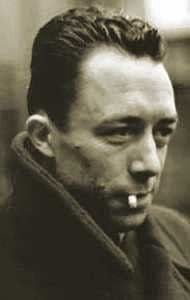
Il y déclara qu’il refusait de partager la satisfaction de la presse bourgeoise à l'idée qu’un crime stalinien compensait l'exécution, la même semaine, des Rosenberg aux États-Unis. «Mais si je crois impossible, dit-il encore, que les émeutes de Berlin fassent oublier les Rosenberg, il me semble bien plus affreux que des hommes qui se disent de gauche puissent essayer de dissimuler dans l'ombre des Rosenberg les fusillés allemands. » Il considérait les émeutes de Berlin comme l'événement le plus grave survenu depuis la libération de la France et il réclamait, avec les organisateurs du meeting, qu'une соmmission syndicale internationale d'enquête fût envoyée en Allemagne de l'Еst.
Le 14 juillet à Paris, au cours d'une manifestation organisée рlace de la Nation par les partisans du Mouvement pour le triomphe de libertés démocratiques (l'organisation de Messali), la police interrompit un défilé d'ouvriers musulmans portant des banderoles réclamant la libération de Messali Hadj (alors incarcéré quelque part dans le sud-ouest de la France). Les bagarres firent sept morts et quarante-quatre blessés du côté des musulmans, et quatre-vingt-deux Ыessés parmi les policiers. Une fois de plus Camus écrivit une lettre à «Monsieur le directeur », cette fois celui du journal le Monde, pour protester contre l'ouverture d'une information contre X pour violences à agents, alors qu'en vérité la violence avait été dirigée contre les Nord-Africains, dans « un racisme qui n'ose pas dire son nom». Il réclamait une enquête pour déterminer qui avait ordonné aux forces de police d'ouvrir le feu et qui, au sein du gouvernement, poursuivait alors «cette très ancienne conspiration du silence et de cruauté qui déracine les travailleurs algériens, les fait vivre misérablement dans des taudis et les désespère jusqu'à la violence pour les tuer à l'occasion». Cette exhortation n'allait pas être écoutée, non plus qu'aucun autre appel en faveur des Algériens musulmans en France métropolitaine où en Afrique du Nord et, en l'espace d'un an, l'escalade des tensions allait déboucher sur l'insurrection armée.
--Herbert R. Lottman, Albert Camus, tr. Marianne Véron
Saturday, November 12, 2005
Battle Cries
At With A Grain Of Salt, Dr Bhaskar Dasgupta reflects on how "the Iraqi insurgents’ video showed how the insurgents shot a downed pilot in cold blood, all the while intoning 'Allah-u-Akbar', in a revenge attack for the marines killing the wounded insurgent in a Fallujah mosque. Quite shocking, no? In another video, somebody was invoking the name of God, while going about lopping an Egyptian’s (accused of being an informer) head off":
The Vikings screamed and imitated animal sounds, during battle, to intimidate their enemies. One of their cries was "Ahoy!" which has now taken on a much kinder meaning in common usage. The other example is from Japanese war history where attacking the kamikaze and ordinary pilots battle cry was "Tora, Tora, Tora!" which means, "Tiger, Tiger, Tiger!". They would also shout “Banzai” as well, which means literally ‘may you live ten thousand years’ and was used in salutation of the emperor and not just as a battle cry. . Battle of Britain pilots would bellow “Tally-ho” as a sign that the enemy has been sighted and battle will commence.Read the whole thing.
The French revolutionaries used “Liberty” as a battle cry. But quite often, “follow me”, “charge”, “after me” were battle cries used by officers wanting to lead by example, we have disparate evidence of this battle cry being used by English Armoured corps officers in the North African Campaign, in various WW II battles, by Palmach in Israel, etc.
But it is crying out God’s name which seems to be the most common. During the Middle Ages, the English Kings use the motto "Dieu et mon droit" ("God and my right") as a battle cry, for example Edward III's rallying cry at the Battle of Crécy. In Spain, during the Reconquista from the Moors, they cried "Santiago", looking for holy protection from St. James, the patron saint of Spain. The French knights of the Middle Ages used "Montjoie! St Denis!", while the Crusaders used the cry “Denique coelum!” (‘Heaven at last!’). At the Battle of Hastings, the Saxon army officers cried "Olicrosse!" and "Godamite!", while the regular foot soldiers cried "Ut! Ut! Ut!" ("Out! Out! Out!"). The Normans' cry was "Dex Aie!" ("God aid us!"). This was last used by the Royal Guernsey Light Infantry during the First World War.
I have already mentioned the cries of ‘Allah-u-Akbar’, but when one sees the other religious ground in India, we see huge examples of battle cries. "Bole So Nihal, Sat Sri Akal" is the battle cry of Sikhs who, by virtue of their religion, and their location in North West India, were involved in many wars and battles against the Muslim invaders, the British etc. The British Indian Army (and its predecessor, the British East India Company Presidency Armies) have a very long history. In addition, these regiments were usually arranged and organised on the basis of religion and region. So you would have Bengal Regiments, Madras Regiments, Sikh Regiment, Mahar Regiment, Maratha Regiment, so on and so forth. You would hear cries such as “Jai Bhavani”, “Jai Durga”, “Jai Kali” and “Jai Jagdamba” (strangely enough, the cries seem to be requests to the Goddesses for safety and protection).
It was a fascinating exercise to read all these collated research snippets about battle cries. If one closed one’s eyes, one could almost hear these cries, the sounds of battle, the screams and groans of the wounded, the ringing of swords or the sounds of explosions, smell the stench and the smoke and feel the horror of war. You could almost hear the battle cries floating over the mass of struggling men, down the ages, who have whipped themselves up into a frenzy, almost berserker rage. I wonder what would have happened at night, when tired, hungry, bloodied men would be sitting around their camp-fires, hearing the hyenas and dogs tearing apart the dead, looking at empty bed rolls, and wondering about the families of the dead soldiers. Not much use for a battle cry at this stage is there? Strange indeed are the ways of men at war. Eleanor Roosevelt talked about war being the worst way to solve a problem saying: "I can not believe that war is the best solution. No one won the last war, and no one will win the next war."
Friday, November 11, 2005
RCFS Under Threat - II
Re. Coordinated Efforts by the Russian Authorities to Close Down the Russian-Chechen Friendship Society (RCFS)
Dear all,
1. Unexpectedly, the judge in the court procedure regarding the de-registration of the Russian-Chechen Friendship Society (RCFS), changed her mind, and fixed the next hearing in this case in Nizhny Novgorod for Monday, 14 November, 10:30 am.
Just ten days before she had decided that the hearing was postponed for an indefinite period of time, until the case isconsidered by the superior body, the Panel of Judges on civil cases at the Supreme Court of the RF.
2. The next, and maybe final, hearing on the criminal case against Stas Dimitrievsky, the head of the RCFS, based on a charge under part 2b of Article 282 ("inciting hatred or enmity on the basis of ethnicity and religion") for having allowed the (re-)publication of two articles on the Chechen conflict, Aslan Maskhadov’s open letter to the European Parliament and Akhmed Zakaev’s appeal to the people of Russia, will take place in Nizhny Novgorod on Wednesday, 16th November, 10:00 am.
If convicted in this criminal case, Stas Dimitrievsky faces up to 5 years imprisonment.
3. The hearing of the Arbitrage Court in Nizhny Novgorod regarding alleged tax evasion of the RCFS will also take place on Wednesday, 16th November, 2:30 pm.
In a very unusual manner, the RCFS had been ordered by the tax inspectorate to pay profit tax for grants to implement specific human rights projects in the period from 2002 to 2004 from three foreign donors, and to pay a fine, totalling 1.001.561 Rubles (around 28.200 Euro).
Additionally, on the basis of the conclusions made by the tax inspectorate, also a criminal case was commenced by the Interior Ministry. Mr. Dimitrievsky is yet not formally indicted, but this could be taken up right after a decision of the Arbitrage Court.
Please find attached the newest statement of the RCFS on the developments.
Sincerely,
Joachim Frank
(International Helsinki Federation for Human Rights)
******************************
INFORMATION CENTER OF THE RUSSIAN-CHECHEN FRIENDSHIP SOCIETY
RUSSIAN-CHECHEN
INFORMATION AGENCY
Press Release #1596 from November 11, 2005
Report from Nizhny Novgorod
URGENT MESSAGE
Court hearing on liquidation of the RCFS have unexpectedly fixed on 14 November. The judge Samartseva has changed her mind, all of a sudden.
11.11.2005. The Russian-Chechen Friendship Society received a notification signed by the judge Samartseva stating that she had scheduled the main hearing of the case concerning the suit lodged by the Ministry of Justice against the RCFS on November 14. Thus, she has overruled her own decision taken on November 1, 2005 to postpone consideration of the case for an indefinite period of time.
As we reported before, on 2 November 2005 the judge of Nizhny Novgorod region Court Samartseva postponed consideration of the suit lodged by the Ministry of Justice against the Russian-Chechen Friendship Society with the demand to close the organization down. The time for the next hearing has not been fixed.
The Russian-Chechen Friendship Society was represented by Alexander Lavrent'ev who appealed not to consider the suit as according to the “Law on Public Associations” the registration body has not right to lodge a suit with the demand to destroy an organization. After the judge made a decision not to comply with the request, the RCFS representatives stated that they were going to appeal this decision in the superior court by submitting a complaint. The judge made a decision to postpone the case hearing for an indefinite period of time until the case is considered by the Panel of Judges on civil cases at the Supreme Court of the Russian Federation.
The judge’s notification was signed on 3 November but sent on 8 November. The RCFS had it delivered only today, in the second half of the day.
The letter from Samartseva says, “I have to inform you that in accordance with parts 1 and 2 of Article 223 of the Civil Code of the Russian Federation, part 1 of Article 371 of the Civil Code the ruling not to comply with the request can’t be an obstacle to hold the main hearing of the case.
Thus, I have to inform you that the date of the main hearing is scheduled now on 14 November 2005 at 10 am”.
According to the RCFS staffers, this sudden decision evidences an assumption that it has been done on purpose in order to create as many obstacles as possible for the RCFS to carry out their defense and to exhaust them by court hearings that follow one another.
From our correspondent
Editor in Chief Stanislav Dmitrievskiy
The publication of this release was made possible by European Union within the framework of the project “Open information about Chechnya in the name of peace and human rights: Russian- Chechen Information Agency” and The National Endowment for Democracy within the framework of the program “Russian-Chechen Information Partnership”
__________________________________________
Joachim Frank, Project Coordinator
International Helsinki Federation for Human Rights
Wickenburggasse 14/7
A-1080 Vienna
Tel. +43-1-408 88 22 ext. 22
Fax: +43-1-408 88 22 ext. 50
Web: http://www.ihf-hr.org
______________________________________
See also in this blog: RCFS Under Threat
Dear all,
1. Unexpectedly, the judge in the court procedure regarding the de-registration of the Russian-Chechen Friendship Society (RCFS), changed her mind, and fixed the next hearing in this case in Nizhny Novgorod for Monday, 14 November, 10:30 am.
Just ten days before she had decided that the hearing was postponed for an indefinite period of time, until the case isconsidered by the superior body, the Panel of Judges on civil cases at the Supreme Court of the RF.
2. The next, and maybe final, hearing on the criminal case against Stas Dimitrievsky, the head of the RCFS, based on a charge under part 2b of Article 282 ("inciting hatred or enmity on the basis of ethnicity and religion") for having allowed the (re-)publication of two articles on the Chechen conflict, Aslan Maskhadov’s open letter to the European Parliament and Akhmed Zakaev’s appeal to the people of Russia, will take place in Nizhny Novgorod on Wednesday, 16th November, 10:00 am.
If convicted in this criminal case, Stas Dimitrievsky faces up to 5 years imprisonment.
3. The hearing of the Arbitrage Court in Nizhny Novgorod regarding alleged tax evasion of the RCFS will also take place on Wednesday, 16th November, 2:30 pm.
In a very unusual manner, the RCFS had been ordered by the tax inspectorate to pay profit tax for grants to implement specific human rights projects in the period from 2002 to 2004 from three foreign donors, and to pay a fine, totalling 1.001.561 Rubles (around 28.200 Euro).
Additionally, on the basis of the conclusions made by the tax inspectorate, also a criminal case was commenced by the Interior Ministry. Mr. Dimitrievsky is yet not formally indicted, but this could be taken up right after a decision of the Arbitrage Court.
Please find attached the newest statement of the RCFS on the developments.
Sincerely,
Joachim Frank
(International Helsinki Federation for Human Rights)
******************************
INFORMATION CENTER OF THE RUSSIAN-CHECHEN FRIENDSHIP SOCIETY
RUSSIAN-CHECHEN
INFORMATION AGENCY
Press Release #1596 from November 11, 2005
Report from Nizhny Novgorod
URGENT MESSAGE
Court hearing on liquidation of the RCFS have unexpectedly fixed on 14 November. The judge Samartseva has changed her mind, all of a sudden.
11.11.2005. The Russian-Chechen Friendship Society received a notification signed by the judge Samartseva stating that she had scheduled the main hearing of the case concerning the suit lodged by the Ministry of Justice against the RCFS on November 14. Thus, she has overruled her own decision taken on November 1, 2005 to postpone consideration of the case for an indefinite period of time.
As we reported before, on 2 November 2005 the judge of Nizhny Novgorod region Court Samartseva postponed consideration of the suit lodged by the Ministry of Justice against the Russian-Chechen Friendship Society with the demand to close the organization down. The time for the next hearing has not been fixed.
The Russian-Chechen Friendship Society was represented by Alexander Lavrent'ev who appealed not to consider the suit as according to the “Law on Public Associations” the registration body has not right to lodge a suit with the demand to destroy an organization. After the judge made a decision not to comply with the request, the RCFS representatives stated that they were going to appeal this decision in the superior court by submitting a complaint. The judge made a decision to postpone the case hearing for an indefinite period of time until the case is considered by the Panel of Judges on civil cases at the Supreme Court of the Russian Federation.
The judge’s notification was signed on 3 November but sent on 8 November. The RCFS had it delivered only today, in the second half of the day.
The letter from Samartseva says, “I have to inform you that in accordance with parts 1 and 2 of Article 223 of the Civil Code of the Russian Federation, part 1 of Article 371 of the Civil Code the ruling not to comply with the request can’t be an obstacle to hold the main hearing of the case.
Thus, I have to inform you that the date of the main hearing is scheduled now on 14 November 2005 at 10 am”.
According to the RCFS staffers, this sudden decision evidences an assumption that it has been done on purpose in order to create as many obstacles as possible for the RCFS to carry out their defense and to exhaust them by court hearings that follow one another.
From our correspondent
Editor in Chief Stanislav Dmitrievskiy
The publication of this release was made possible by European Union within the framework of the project “Open information about Chechnya in the name of peace and human rights: Russian- Chechen Information Agency” and The National Endowment for Democracy within the framework of the program “Russian-Chechen Information Partnership”
__________________________________________
Joachim Frank, Project Coordinator
International Helsinki Federation for Human Rights
Wickenburggasse 14/7
A-1080 Vienna
Tel. +43-1-408 88 22 ext. 22
Fax: +43-1-408 88 22 ext. 50
Web: http://www.ihf-hr.org
______________________________________
See also in this blog: RCFS Under Threat
When East Met West
In his witty and always informative weekly newsletter, Edward Lucas describes the "brainy émigrés" who helped to put the restored democracies of Eastern Europe back on the rails after the collapse of Communism:
I first came across them in the 'Infobiuras' of the Lithuanian pro-independence movement, Sajudis, in early 1990.
Young, bright-eyed Americans, Canadians and Australians, steeped by fervently patriotic parents in the history of countries they hardly knew, bent on fulfilling their historical destiny. They translated documents into English, briefed journalists, advised politicians and generally brought a blast of optimistic, confident radicalism to the nervous, blurry world of collapsing Communism.
Sometimes the results were more spectacular than productive. During one of the hairier moments of the Lithuanian independence struggle, when it seemed as though the West, with the honourable but minor exception of Iceland, was going to abandon Lithuania to the mercies of Soviet stormtroopers, I remember hearing one beefy young Lithuanian émigré bellowing down the phone "Don't be such a f***ing jerk!" I asked him who he'd been talking to. "The American ambassador in Moscow," he replied tersely.
There were grown-ups too. The most impressive, Stasys Lozoraitis, ran, unsuccessfully, for president of Lithuania in 1993. He had spent his whole life as ambassador to the Vatican and United States, in quixotic service to a country that most of the world thought had disappeared in 1940. He was urbane, polyglot, amusing, and charismatic, with an Italian wife who added a rare touch of glamour and sophistication to the drab, stodgy world of Lithuania. Elsewhere, these high-powered émigrés included a deeply impressive Canadian-Latvian professor of linguistics, a forceful young man who ran the Estonian section of Radio Free Europe and an ambitious Polish refugee-journalist, who after studying at Oxford in the early 1980s spent time in Soviet-occupied Afghanistan with the resistance.
The galaxy of talent had some black holes too. There was one adviser to a Baltic foreign ministry whose sole qualification was a diploma in bar management and a hard-drinking old bat in an economics ministry whose previous job was as a junior public relations woman for a theme park. One of the most energetic and engaging Lithuanian émigrés turned out to have been working for both the KGB and the Americans (in what order was never completely clear).
But the presumption then was that even the most modest émigré talent was badly needed. Even the most superficial knowledge of the way the West worked was a big advantage. Knowing how to use a computer, handle phone messages, talk politely to strangers in English and organise travel to faraway places were all rare skills. That changed quickly. But the best émigré talent is still around. The Canadian professor, Vaira Vike-Freiberga, is now president of Latvia and one of the few East European politicians with a claim to world status. The young man from Radio Free Europe, Tom Ilves, is now a leading member of the European Parliament. The Anglo-Polish journalist, Radek Sikorski, has just been sworn in as defence minister. But the political balance has changed. Now the diaspora appears provincial and out of touch. In Toronto, Ealing and the Chicago suburbs, they are still baking the old recipes, learning folk songs, sending children to Saturday school and keeping the church afloat. But the diaspora is no longer the political lungs of nationhood: the source of free ideas and discussion, a constant reminder that the Communist version of the past, present and future was an evil fiction.
In politics, it's the homeland that's humming. But not in economics. A million East Europeans or more have gone abroad in search of jobs and education. That raises a big question for the ex-captive nations: can they ever attract these bright, mobile people back home?
Thursday, November 10, 2005
Kremlinspeak
from Jamestown's Chechnya Weekly:
KREMLIN INSTRUCTS PRESS ON HOW TO DESCRIBE CHECHEN REBELS
The separatist Kavkazcenter website and gazeta.ru reported on November 5 that a "concise glossary" had been handed out to "TV station administrators" the previous day at the Kremlin's regular Friday "gray briefing," during which "members of the presidential staff express their wishes (in the form of demands) as to what they want covered and how they want it to be covered." According to Kavkazcenter, the Kremlin instructions ban identifying the Chechen rebels as "soldiers of God" or "Muslims" and states that it is forbidden to refer to the "war in Chechnya;" "anti-terrorist operation" is the only acceptable term. Akhmed Zakaev, the London-based Chechen rebel emissary, must be described as a "mouthpiece of the militants" rather than an "emissary of the Chechen extremists," and the Chechen rebels must be referred to as "militants or terrorists" rather than "separatists." In addition, the terms "Chechen" and "Islamic" should not be used in reference to rebel actions: instead, their actions should be described as "international terrorism." Other banned words include "jamaat" ("terrorist organization" is suggested as a substitute), "shahid," or martyr ("terrorist" or "suicide bomber" must be used instead), "mujahideen" and "Wahhabi." The terms "emir," "imam," "sheikh" and "field commander" are to be replaced by the term "heads of bandit formations," while "jihad" is to be replaced by the term "subversive-terrorist activity."
Commenting on the glossary, gazeta.ru noted that it is aimed, among other things, at stressing the "international character" of the Chechen rebels in order to "put Russia on the same level as the United States and other countries fighting international terrorism. It is not surprising that one of the favorite pastimes of the Russian soldiers in Chechnya is showing off the foreign citizenship papers they allegedly removed from the bodies of dead rebels. The logic is easy to follow: If civilians are dying in Iraq and no one is shouting about human rights, then the esteemed European liberals should have nothing to say about Chechnya." In addition, according to gazeta.ru, the new terminology is aimed at those Russians "who have forgotten that there never was a war in Chechnya and there is no war there now—only a counter-terrorist operation," and who therefore "must be reminded of this in a subtle way. That is why there cannot be any fronts or brigades or any military operations by the terrorists!"
In the view of gazeta.ru, the glossary was timed to coincide with the Chechen parliamentary elections on November 27. "The Kremlin's demands to show ‘how peaceful life is in Chechnya' have been made before, and each time they have preceded major publicity events—usually an election," the website wrote. "As members of the presidential staff keep asserting, ‘everything is stable' in Chechnya now, and the republic is expecting a ‘good election'…That is the precise reason, for example, that all of the TV channels were instructed a month ago to provide extensive coverage of the party leaders' trips to Chechnya and to announce the start of the election campaign there. In the next few weeks, the channels probably will be showing reports on the lives of the average Chechen builder, farmer, and so forth."
KREMLIN INSTRUCTS PRESS ON HOW TO DESCRIBE CHECHEN REBELS
The separatist Kavkazcenter website and gazeta.ru reported on November 5 that a "concise glossary" had been handed out to "TV station administrators" the previous day at the Kremlin's regular Friday "gray briefing," during which "members of the presidential staff express their wishes (in the form of demands) as to what they want covered and how they want it to be covered." According to Kavkazcenter, the Kremlin instructions ban identifying the Chechen rebels as "soldiers of God" or "Muslims" and states that it is forbidden to refer to the "war in Chechnya;" "anti-terrorist operation" is the only acceptable term. Akhmed Zakaev, the London-based Chechen rebel emissary, must be described as a "mouthpiece of the militants" rather than an "emissary of the Chechen extremists," and the Chechen rebels must be referred to as "militants or terrorists" rather than "separatists." In addition, the terms "Chechen" and "Islamic" should not be used in reference to rebel actions: instead, their actions should be described as "international terrorism." Other banned words include "jamaat" ("terrorist organization" is suggested as a substitute), "shahid," or martyr ("terrorist" or "suicide bomber" must be used instead), "mujahideen" and "Wahhabi." The terms "emir," "imam," "sheikh" and "field commander" are to be replaced by the term "heads of bandit formations," while "jihad" is to be replaced by the term "subversive-terrorist activity."
Commenting on the glossary, gazeta.ru noted that it is aimed, among other things, at stressing the "international character" of the Chechen rebels in order to "put Russia on the same level as the United States and other countries fighting international terrorism. It is not surprising that one of the favorite pastimes of the Russian soldiers in Chechnya is showing off the foreign citizenship papers they allegedly removed from the bodies of dead rebels. The logic is easy to follow: If civilians are dying in Iraq and no one is shouting about human rights, then the esteemed European liberals should have nothing to say about Chechnya." In addition, according to gazeta.ru, the new terminology is aimed at those Russians "who have forgotten that there never was a war in Chechnya and there is no war there now—only a counter-terrorist operation," and who therefore "must be reminded of this in a subtle way. That is why there cannot be any fronts or brigades or any military operations by the terrorists!"
In the view of gazeta.ru, the glossary was timed to coincide with the Chechen parliamentary elections on November 27. "The Kremlin's demands to show ‘how peaceful life is in Chechnya' have been made before, and each time they have preceded major publicity events—usually an election," the website wrote. "As members of the presidential staff keep asserting, ‘everything is stable' in Chechnya now, and the republic is expecting a ‘good election'…That is the precise reason, for example, that all of the TV channels were instructed a month ago to provide extensive coverage of the party leaders' trips to Chechnya and to announce the start of the election campaign there. In the next few weeks, the channels probably will be showing reports on the lives of the average Chechen builder, farmer, and so forth."
France 1951
Tandis qu'il travaillait à la rédaction finale de l'Homme révolté, de janvier à juillet 1951, les motifs d'inquiétude ne manquaient pas à Camus. Les Chinois étaient intervenus dans la guerre de Corée depuis le mois de novembre 1950; en janvier, l'évacuation de Séoul était ordonnée. La fièvre de la guerre s'était emparée de la France.
Les intellectuels français envisageaient l'éventualité d'une invasion soviétique et de l'occupation de leur pays. Simone de Beauvoir rapporte que Francine Camus, comme elles sortaient ensemble d'un concert de Bartok, lui déclara : «Moi, le jour où les Russes entrent dans Paris, je me tue avec mes deux enfants» Dans une classe de lycée, note également Simone de Beauvoir, les élèves avaient conclu entre eux un pacte de suicide collectif en cas d' «occupation rouge ».
Lors d’une conversation au café Balzar, près de la Sorbonne, Camus demanda à Sartre сe qu'il envisageait de faire au сas où les Russes débarqueraient. Il ajouta - d'après la citation de Simone de Beauvoir : «Ne restez pas!» Sartre demanda alors à Camus s'il envisageait lui aussi de partir; Camus répondit qu'il ferait la même chose que sous l’Occupation.
-- Herbert R. Lottman, Albert Camus (tr. Marianne Véron)
Les intellectuels français envisageaient l'éventualité d'une invasion soviétique et de l'occupation de leur pays. Simone de Beauvoir rapporte que Francine Camus, comme elles sortaient ensemble d'un concert de Bartok, lui déclara : «Moi, le jour où les Russes entrent dans Paris, je me tue avec mes deux enfants» Dans une classe de lycée, note également Simone de Beauvoir, les élèves avaient conclu entre eux un pacte de suicide collectif en cas d' «occupation rouge ».
Lors d’une conversation au café Balzar, près de la Sorbonne, Camus demanda à Sartre сe qu'il envisageait de faire au сas où les Russes débarqueraient. Il ajouta - d'après la citation de Simone de Beauvoir : «Ne restez pas!» Sartre demanda alors à Camus s'il envisageait lui aussi de partir; Camus répondit qu'il ferait la même chose que sous l’Occupation.
-- Herbert R. Lottman, Albert Camus (tr. Marianne Véron)
Rounding up the Republic
At Publius Pundit, Kirk H. Stowell has a comprehensive and very useful roundup of British and French media links relating to the recent violence in France. As he points out,
Most Americans who don’t follow affairs in Europe have no idea that the problems existing in American inner cities - rampant violence and indolence - and suburbs - rampant drug use - are widely replicated there.
Wednesday, November 09, 2005
Moscow's Day of Nazi Unity
via EDM:
NEWLY RUSSIAN INVENTED HOLIDAY BECOMES A DAY OF NAZI UNITY
The good Soviet tradition of marching in early November acquired a new and disturbing twist this year. The Communist demonstrations on November 7 were quite unimpressive in Moscow and close to pathetic in most other cities, with the weak praise for the Great Revolution of 1917 and bitter complaints about the cancellation of the state holiday on that date (Vremya novostei, November 8). The Communist Party may attract some curious attention with its emotional rhetoric but generally appears quite harmless. It is the newly established official holiday on November 4 that has turned out to be embarrassingly hollow in most locations and very unpleasant in Moscow (Izvestiya, November 7). Several thousand radical nationalists marched through the streets of the capital under slogans elaborating the main theme, "Russia for the Russians," with many anti-Semitic variations and Nazi symbols (Moskovsky komsomolets, Grani.ru, November 7). The march was accompanied by heavy militia patrols but saw very little protest.
Official justification for celebrating this new holiday is at best unconvincing and for many sober-minded Russians plain ridiculous. The idea is to mark the "liberation" of Moscow from the besieged Polish garrison in 1612, an event that, in the opinion of most historians, was of little strategic significance and cannot be precisely dated (Grani.ru, November). The Orthodox Church celebrates November 4 as the Our Lady of Kazan icon day but that would hardly be a cause for joy for Russia's 20 million Muslims, so a "neutral" name – National Unity Day – was invented (Novaya gazeta, November 7, EDM, November 4). Russian President Vladimir Putin held a reception in the Kremlin for the carefully selected representatives of "civic society" and made a toast for the "victory of patriotic forces" and "the spiritual revival of the Fatherland" (Kommersant, November 7). The fierce speakers who addressed the well-organized Nazi columns in Moscow streets used about the same words..
Political technologists in the Kremlin were caught unprepared by this hijacking of their project, so the tightly controlled TV news did not provide any coverage of the "patriotic" march and state officials were unavailable for comments (Ekho Moskvy, November 4, 8). This silence perhaps indicated a measure of disapproval, but it also betrayed the intention to exploit, certainly in a more "civilized" manner, the same reservoir of nationalistic fervor in the society. Indeed, sociologists assert that the idea of "Russia for the Russians" commands support of about 50% of respondents in a wide variety of polls despite its problematic applicability to the smoldering crisis in the North Caucasus Newsru.com, November 7). Extremism, as always, is a marginal phenomenon, but when it grows out of such a wide base it is often tempting for the authorities to channel it in a "useful" direction. The parallel with the state-sponsored activities of the "black hundreds" in Russia that enriched the international vocabulary with the ugly term pogrom exactly 100 years ago is quite evident (Vedomosti, November 7).
Many commentators in Moscow draw parallels also with the ongoing riots in the ethnic suburbs of Paris and other French cities, dissimilar as these events are on the surface (Polit.ru, November 7). For some, burning French cars illuminate the hypocrisy of European "political correctness" that imposes taboos on discussing certain problems in society (Expert, November 7). Others argue that while thousands of illegal migrants in Moscow are unlikely to revolt, the demonstratively non-violent character of the march could not hide the growing phenomenon of gang violence against "blacks," an ugly racist category that includes people from the Caucasus and Central Asia (Ezhednevny zhurnal, November 8). Yet others point to the similarities between the blind anger of Arab teenagers in France and the desperate uprising of dozens of routinely humiliated and unjustly persecuted Muslims in Nalchik in mid-October (Izvestiya, November 7). All these perspectives focus on particular features of a common diagnosis that Russian society, disoriented by the distorted transformation of the state and irritated by the widening gap between the "haves" and "have-nots," is infected by the virus of ethnic hatred.
Political leaders show more interest in exploiting the situation rather than in addressing the problem but the society itself demonstrates significant healthy resistance to this virus. Opinion polls show that the disapproval towards those who try to instigate ethnic discord is far stronger than suspicions and prejudices towards the "Caucasians" who are consistently on the top of the list of "unwanted migrants" (Vedomosti, November 7). That undermines the claim implicitly advanced by the Kremlin that its control over the media and other techniques of "managed democracy" help to keep the demons of nationalism safely locked. Putin on several occasions skillfully portrayed himself as an "enlightened European" who is simply shocked by the occasional manifestations of racism and anti-Semitism. Visiting the Netherlands last week, he emphasized yet again that Russia was defending not only its own interests but also all-European values in the fight against terrorism in the North Caucasus (Gazeta.ru, November 7).
There are few doubts that it is exactly this war spreading across the region as a brushfire of criminal violence and underground fire of Islamic extremist networks that drives the growth of Nazi-type of organizations, while the human rights NGOs feel the pressure of "attention" from the concerned authorities. It is quite ironic that the Kremlin courtiers have found nothing better than to celebrate the end of the "time of troubles" some 400 years ago, while a new period of turmoil and dislocation was so visible from so many windows in Moscow; it may not even wait for Putin's departure in 2008.
--Pavel K. Baev
NEWLY RUSSIAN INVENTED HOLIDAY BECOMES A DAY OF NAZI UNITY
The good Soviet tradition of marching in early November acquired a new and disturbing twist this year. The Communist demonstrations on November 7 were quite unimpressive in Moscow and close to pathetic in most other cities, with the weak praise for the Great Revolution of 1917 and bitter complaints about the cancellation of the state holiday on that date (Vremya novostei, November 8). The Communist Party may attract some curious attention with its emotional rhetoric but generally appears quite harmless. It is the newly established official holiday on November 4 that has turned out to be embarrassingly hollow in most locations and very unpleasant in Moscow (Izvestiya, November 7). Several thousand radical nationalists marched through the streets of the capital under slogans elaborating the main theme, "Russia for the Russians," with many anti-Semitic variations and Nazi symbols (Moskovsky komsomolets, Grani.ru, November 7). The march was accompanied by heavy militia patrols but saw very little protest.
Official justification for celebrating this new holiday is at best unconvincing and for many sober-minded Russians plain ridiculous. The idea is to mark the "liberation" of Moscow from the besieged Polish garrison in 1612, an event that, in the opinion of most historians, was of little strategic significance and cannot be precisely dated (Grani.ru, November). The Orthodox Church celebrates November 4 as the Our Lady of Kazan icon day but that would hardly be a cause for joy for Russia's 20 million Muslims, so a "neutral" name – National Unity Day – was invented (Novaya gazeta, November 7, EDM, November 4). Russian President Vladimir Putin held a reception in the Kremlin for the carefully selected representatives of "civic society" and made a toast for the "victory of patriotic forces" and "the spiritual revival of the Fatherland" (Kommersant, November 7). The fierce speakers who addressed the well-organized Nazi columns in Moscow streets used about the same words..
Political technologists in the Kremlin were caught unprepared by this hijacking of their project, so the tightly controlled TV news did not provide any coverage of the "patriotic" march and state officials were unavailable for comments (Ekho Moskvy, November 4, 8). This silence perhaps indicated a measure of disapproval, but it also betrayed the intention to exploit, certainly in a more "civilized" manner, the same reservoir of nationalistic fervor in the society. Indeed, sociologists assert that the idea of "Russia for the Russians" commands support of about 50% of respondents in a wide variety of polls despite its problematic applicability to the smoldering crisis in the North Caucasus Newsru.com, November 7). Extremism, as always, is a marginal phenomenon, but when it grows out of such a wide base it is often tempting for the authorities to channel it in a "useful" direction. The parallel with the state-sponsored activities of the "black hundreds" in Russia that enriched the international vocabulary with the ugly term pogrom exactly 100 years ago is quite evident (Vedomosti, November 7).
Many commentators in Moscow draw parallels also with the ongoing riots in the ethnic suburbs of Paris and other French cities, dissimilar as these events are on the surface (Polit.ru, November 7). For some, burning French cars illuminate the hypocrisy of European "political correctness" that imposes taboos on discussing certain problems in society (Expert, November 7). Others argue that while thousands of illegal migrants in Moscow are unlikely to revolt, the demonstratively non-violent character of the march could not hide the growing phenomenon of gang violence against "blacks," an ugly racist category that includes people from the Caucasus and Central Asia (Ezhednevny zhurnal, November 8). Yet others point to the similarities between the blind anger of Arab teenagers in France and the desperate uprising of dozens of routinely humiliated and unjustly persecuted Muslims in Nalchik in mid-October (Izvestiya, November 7). All these perspectives focus on particular features of a common diagnosis that Russian society, disoriented by the distorted transformation of the state and irritated by the widening gap between the "haves" and "have-nots," is infected by the virus of ethnic hatred.
Political leaders show more interest in exploiting the situation rather than in addressing the problem but the society itself demonstrates significant healthy resistance to this virus. Opinion polls show that the disapproval towards those who try to instigate ethnic discord is far stronger than suspicions and prejudices towards the "Caucasians" who are consistently on the top of the list of "unwanted migrants" (Vedomosti, November 7). That undermines the claim implicitly advanced by the Kremlin that its control over the media and other techniques of "managed democracy" help to keep the demons of nationalism safely locked. Putin on several occasions skillfully portrayed himself as an "enlightened European" who is simply shocked by the occasional manifestations of racism and anti-Semitism. Visiting the Netherlands last week, he emphasized yet again that Russia was defending not only its own interests but also all-European values in the fight against terrorism in the North Caucasus (Gazeta.ru, November 7).
There are few doubts that it is exactly this war spreading across the region as a brushfire of criminal violence and underground fire of Islamic extremist networks that drives the growth of Nazi-type of organizations, while the human rights NGOs feel the pressure of "attention" from the concerned authorities. It is quite ironic that the Kremlin courtiers have found nothing better than to celebrate the end of the "time of troubles" some 400 years ago, while a new period of turmoil and dislocation was so visible from so many windows in Moscow; it may not even wait for Putin's departure in 2008.
--Pavel K. Baev
Tuesday, November 08, 2005
A Question of Integration
By George Friedman
For more than a week, France has been torn by riots that have been, for the most part, concentrated in the poorer suburbs of Paris. The rioters essentially have been immigrants -- or the children or grandchildren of immigrants -- most of whom had come to France from its former colonies. They are, in many cases, French citizens by right of empire. But what is not clear is whether they ever became, in the fullest sense of the word, French.
And in that question rests an issue that could define European -- and world -- history in the 21st century.
Every country has, from time to time, social unrest. This unrest frequently becomes violent, but that is not necessarily defining. The student uprisings around the world in the 1960s had, in retrospect, little lasting significance, whereas the riots by black Americans during the same period were of enormous importance -- symptomatic of a profound tension within American society. The issue with the French riots is to identify the degree to which they are, or will become, historically significant.
For the most part, the rioters have been citizens of France. But to a great extent, they are not regarded as French. This is not rooted necessarily in racism, although that is not an incidental phenomenon. Rather, it is rooted in the nature of the French nation and, indeed, in that of the European nation-state and European democracy -- an experience that distinguishes Europe from many other regions of the world.
The notion of the European nation stands in opposition to the multinational empires that dominated Europe between the 17th and 20th centuries. These were not only anti-democratic, dynastic entities, but they were also transnational. The idea of national self-determination as the root of modern democracy depended first on the recognition of the nation as a morally significant category. Why should a nation be permitted to determine its own fate unless the nation was of fundamental importance? Thus, in Europe, the concept of democracy and the concept of the nation developed together.
The guiding principle was that every nation had a right to determine its own fate. All of the nations whose identities had been submerged within the great European empires were encouraged to reassert their historical identities through democratic institutions. As the empires collapsed, the submerged nations re-emerged -- from Ireland to Slovakia, from Macedonia to Estonia. This process of devolution was, in a certain sense, endless: It has encompassed, for instance, not only the restoration or establishment of sovereignty to the European powers' colonial holdings in places like Africa or Latin America, but pressure from groups within the territorial borders of those recognized powers -- such as the Basques in Spain -- that their national identity be recognized and their right to democratic self-determination be accepted.
Europe's definition of a nation was less than crisply clear. In general, it assumed a geographic and cultural base. It was a group of people living in a fairly defined area, sharing a language, a history, a set of values and, in the end, a self-concept: A Frenchman knew himself to be a Frenchman and was known by other Frenchmen to be French. If this appears to be a little circular, it is -- and it demonstrates the limits of logic, for this definition of nationhood worked well in practice. It also could wander off into the near-mysticism of romantic nationalism and, at times, into vicious xenophobia.
The European definition of the nation poses an obvious challenge. Europe has celebrated national self-determination among all principles, and adhered to a theory of the nation that was forged in the battle with dynastic empires. At the heart of its theory of nationalism is the concept that the nation -- national identity -- is something to which one is born. Ideally, every person should be a part of one nation, and his citizenship should coincide with that.
But this is, of course, not always the case. What does one do with the foreigner who comes to your country and wants to be a citizen, for example? Take it a step further: What happens when a foreigner comes to your country and wants not only to be a citizen, but to become part of your nation? It is, of course, difficult to change identity. Citizenship can be granted. National identity is another matter.
Contrast this with the United States, Canada or Australia -- three examples where alternative theories of nationhood have been pursued. If being French or German is rooted in birth, being an American, Canadian or Australian is rooted in choice. The nation can choose who it wants as a citizen, and the immigrant can choose to become a citizen. Citizenship connotes nationality. More important, all of these countries, which were founded on immigration, have created powerful engines designed to assimilate the immigrants over generations. It would not be unreasonable to say that these countries created their theory of nationhood around the practice of migration and assimilation. It is not that the process is not painful on all sides, but there is no theoretical bar to the idea of anyone becoming, for example, an American -- whereas there is a theoretical hurdle to the idea of elective nationalism in Europe.
This obstacle has been compounded by the European imperial experience. France was born of a nationalist impulse, but the nationalism was made compatible with imperialism. France created a massive empire in the 19th century. And as imperialism collided with the French revolutionary tradition, the French had to figure out how to reconcile national self-determination with imperialism. One solution was to make a country like Algeria part of France. In effect, the definition of the French nation was expanded to incorporate wildly different nationalities. It left French-speaking enclaves throughout the world, as well as millions of citoyens who were not French by either culture or history. And it led to waves of immigrants from the former francophone colonies becoming citizens of France without being French.
Adding to this difficulty, the Europeans erected a new multinational entity, the European Union, that was supposed to resurrect the benefits of the old dynastic empires without undermining nationalism. The EU is an experiment in economic cooperation and the suppression of nationalist conflicts, yet one that does not suppress the nations that created it. The Union both recognizes the nation and is indifferent to it. Its immigration policy and the European concept of the nation are deeply at odds.
The results of all of this can be seen in the current riots in France. As evident from this analysis, the riots are far from a trivial event. These have involved, by and large, French citizens expressing dissatisfaction with their condition in life. Their condition stems, to some degree, from the fact that it is one thing to become a French citizen and quite another to become a Frenchman. Nor is this uniquely a French problem: The issue of immigrant assimilation in Europe is a fault line that, under sufficient stress and circumstances, can rip Europe apart. Europe's right-wing parties, and opposition to the EU in Europe, are both driven to a large extent by the immigrant issue.
All societies have problems with immigration. In the United States, there currently is deep concern about the illegal movement of Mexican immigrants across the border. There is concern about the illegality and about the changing demographic characteristics of the United States. But there is no serious movement in the United States interested in halting all immigration. There is a management issue, but in the end, the United States is perpetually changed by immigrants and the immigrants, even more, are changed by the United States. Consider what once was said about the Irish, Italians or Japanese to get a sense of this.
The United States, and a few other nations, are configured to manage and profit from immigration. Their definition of nationhood not only is compatible with immigration, but depends on it. The European states are not configured to deal with immigration and have a definition of nationhood that is, in fundamental ways, incompatible with immigration. Put simply, the Europeans could never quite figure out how to reconcile their empires with their principles, and now can't quite figure out how to reconcile the migrations that resulted from the collapse of their empires with their theory of nationalism. Assimilation is not impossible, but it is enormously more difficult than in countries that subscribe to the American model.
This poses a tremendous economic problem for the Europeans -- and another economic problem is the last thing they need. Europe, like the rest of the advanced industrial world, has an aging population. Over the past generation, there has been a profound shift in reproductive patterns in the developed world. The number of births is declining. People are also living to an older age. Therefore, the question is, how do you sustain economic growth when your population is stable or contracting?
The American answer is relatively straightforward: immigration. Shortages of engineers or scientists? No problem. Import them from India or China, give them advanced education in the United States, keep them there. Their children will be assimilated. Is more menial labor needed? Also not a problem. Workers from Mexico and Central American states are readily available, on a number of terms, legal and illegal. Their children too can be assimilated.
Of course, there have been frictions over immigrants in the United States from the beginning. But there is also a roadmap to assimilation and utilization of immigrants -- it is well-known territory that does not collide with any major cultural taboos. In short, the United States, Australia and Canada have excellent systems for managing and reversing population contractions, which is an underpinning of economic strength. The Europeans -- like the Japanese and others -- do not.
The problem of assimilating immigrants in these countries is quite difficult. It is not simply an institutional problem: A new white paper from Brussels will not solve the issue. It is a problem deeply rooted in European history and liberalism. The European theory of democracy rests on a theory of nationalism that makes integration and assimilation difficult. It can be done, but only with great pain.
It is not coincidental, therefore, that the rates of immigration to European states are rather low in comparison to those of the more dynamic settler-based states. This also places the Europeans at a serious economic disadvantage to the immigrant-based societies. The United States or Canada can mitigate the effects of population shortages with relative ease. The influx of new workers relieves labor market pressures -- encouraging sustained low-inflation economic growth -- and the relative youth of immigrants not only allows for steady population growth but also helps to keep pension outlays manageable. In contrast, the European ideal of nationality almost eliminates this failsafe -- so that while, as a whole, Europe's population is both aging and shrinking, the dearth of young immigrant workers spins its pension commitments out of control.
These are the issues that, over the next few generations, may begin to define the real global divide -- which will be not only between rich and poor nations, but between the rich nations that cannot cope with declining populations and the rich nations that can.
Send questions or comments on this article to analysis@stratfor.com.
For more than a week, France has been torn by riots that have been, for the most part, concentrated in the poorer suburbs of Paris. The rioters essentially have been immigrants -- or the children or grandchildren of immigrants -- most of whom had come to France from its former colonies. They are, in many cases, French citizens by right of empire. But what is not clear is whether they ever became, in the fullest sense of the word, French.
And in that question rests an issue that could define European -- and world -- history in the 21st century.
Every country has, from time to time, social unrest. This unrest frequently becomes violent, but that is not necessarily defining. The student uprisings around the world in the 1960s had, in retrospect, little lasting significance, whereas the riots by black Americans during the same period were of enormous importance -- symptomatic of a profound tension within American society. The issue with the French riots is to identify the degree to which they are, or will become, historically significant.
For the most part, the rioters have been citizens of France. But to a great extent, they are not regarded as French. This is not rooted necessarily in racism, although that is not an incidental phenomenon. Rather, it is rooted in the nature of the French nation and, indeed, in that of the European nation-state and European democracy -- an experience that distinguishes Europe from many other regions of the world.
The notion of the European nation stands in opposition to the multinational empires that dominated Europe between the 17th and 20th centuries. These were not only anti-democratic, dynastic entities, but they were also transnational. The idea of national self-determination as the root of modern democracy depended first on the recognition of the nation as a morally significant category. Why should a nation be permitted to determine its own fate unless the nation was of fundamental importance? Thus, in Europe, the concept of democracy and the concept of the nation developed together.
The guiding principle was that every nation had a right to determine its own fate. All of the nations whose identities had been submerged within the great European empires were encouraged to reassert their historical identities through democratic institutions. As the empires collapsed, the submerged nations re-emerged -- from Ireland to Slovakia, from Macedonia to Estonia. This process of devolution was, in a certain sense, endless: It has encompassed, for instance, not only the restoration or establishment of sovereignty to the European powers' colonial holdings in places like Africa or Latin America, but pressure from groups within the territorial borders of those recognized powers -- such as the Basques in Spain -- that their national identity be recognized and their right to democratic self-determination be accepted.
Europe's definition of a nation was less than crisply clear. In general, it assumed a geographic and cultural base. It was a group of people living in a fairly defined area, sharing a language, a history, a set of values and, in the end, a self-concept: A Frenchman knew himself to be a Frenchman and was known by other Frenchmen to be French. If this appears to be a little circular, it is -- and it demonstrates the limits of logic, for this definition of nationhood worked well in practice. It also could wander off into the near-mysticism of romantic nationalism and, at times, into vicious xenophobia.
The European definition of the nation poses an obvious challenge. Europe has celebrated national self-determination among all principles, and adhered to a theory of the nation that was forged in the battle with dynastic empires. At the heart of its theory of nationalism is the concept that the nation -- national identity -- is something to which one is born. Ideally, every person should be a part of one nation, and his citizenship should coincide with that.
But this is, of course, not always the case. What does one do with the foreigner who comes to your country and wants to be a citizen, for example? Take it a step further: What happens when a foreigner comes to your country and wants not only to be a citizen, but to become part of your nation? It is, of course, difficult to change identity. Citizenship can be granted. National identity is another matter.
Contrast this with the United States, Canada or Australia -- three examples where alternative theories of nationhood have been pursued. If being French or German is rooted in birth, being an American, Canadian or Australian is rooted in choice. The nation can choose who it wants as a citizen, and the immigrant can choose to become a citizen. Citizenship connotes nationality. More important, all of these countries, which were founded on immigration, have created powerful engines designed to assimilate the immigrants over generations. It would not be unreasonable to say that these countries created their theory of nationhood around the practice of migration and assimilation. It is not that the process is not painful on all sides, but there is no theoretical bar to the idea of anyone becoming, for example, an American -- whereas there is a theoretical hurdle to the idea of elective nationalism in Europe.
This obstacle has been compounded by the European imperial experience. France was born of a nationalist impulse, but the nationalism was made compatible with imperialism. France created a massive empire in the 19th century. And as imperialism collided with the French revolutionary tradition, the French had to figure out how to reconcile national self-determination with imperialism. One solution was to make a country like Algeria part of France. In effect, the definition of the French nation was expanded to incorporate wildly different nationalities. It left French-speaking enclaves throughout the world, as well as millions of citoyens who were not French by either culture or history. And it led to waves of immigrants from the former francophone colonies becoming citizens of France without being French.
Adding to this difficulty, the Europeans erected a new multinational entity, the European Union, that was supposed to resurrect the benefits of the old dynastic empires without undermining nationalism. The EU is an experiment in economic cooperation and the suppression of nationalist conflicts, yet one that does not suppress the nations that created it. The Union both recognizes the nation and is indifferent to it. Its immigration policy and the European concept of the nation are deeply at odds.
The results of all of this can be seen in the current riots in France. As evident from this analysis, the riots are far from a trivial event. These have involved, by and large, French citizens expressing dissatisfaction with their condition in life. Their condition stems, to some degree, from the fact that it is one thing to become a French citizen and quite another to become a Frenchman. Nor is this uniquely a French problem: The issue of immigrant assimilation in Europe is a fault line that, under sufficient stress and circumstances, can rip Europe apart. Europe's right-wing parties, and opposition to the EU in Europe, are both driven to a large extent by the immigrant issue.
All societies have problems with immigration. In the United States, there currently is deep concern about the illegal movement of Mexican immigrants across the border. There is concern about the illegality and about the changing demographic characteristics of the United States. But there is no serious movement in the United States interested in halting all immigration. There is a management issue, but in the end, the United States is perpetually changed by immigrants and the immigrants, even more, are changed by the United States. Consider what once was said about the Irish, Italians or Japanese to get a sense of this.
The United States, and a few other nations, are configured to manage and profit from immigration. Their definition of nationhood not only is compatible with immigration, but depends on it. The European states are not configured to deal with immigration and have a definition of nationhood that is, in fundamental ways, incompatible with immigration. Put simply, the Europeans could never quite figure out how to reconcile their empires with their principles, and now can't quite figure out how to reconcile the migrations that resulted from the collapse of their empires with their theory of nationalism. Assimilation is not impossible, but it is enormously more difficult than in countries that subscribe to the American model.
This poses a tremendous economic problem for the Europeans -- and another economic problem is the last thing they need. Europe, like the rest of the advanced industrial world, has an aging population. Over the past generation, there has been a profound shift in reproductive patterns in the developed world. The number of births is declining. People are also living to an older age. Therefore, the question is, how do you sustain economic growth when your population is stable or contracting?
The American answer is relatively straightforward: immigration. Shortages of engineers or scientists? No problem. Import them from India or China, give them advanced education in the United States, keep them there. Their children will be assimilated. Is more menial labor needed? Also not a problem. Workers from Mexico and Central American states are readily available, on a number of terms, legal and illegal. Their children too can be assimilated.
Of course, there have been frictions over immigrants in the United States from the beginning. But there is also a roadmap to assimilation and utilization of immigrants -- it is well-known territory that does not collide with any major cultural taboos. In short, the United States, Australia and Canada have excellent systems for managing and reversing population contractions, which is an underpinning of economic strength. The Europeans -- like the Japanese and others -- do not.
The problem of assimilating immigrants in these countries is quite difficult. It is not simply an institutional problem: A new white paper from Brussels will not solve the issue. It is a problem deeply rooted in European history and liberalism. The European theory of democracy rests on a theory of nationalism that makes integration and assimilation difficult. It can be done, but only with great pain.
It is not coincidental, therefore, that the rates of immigration to European states are rather low in comparison to those of the more dynamic settler-based states. This also places the Europeans at a serious economic disadvantage to the immigrant-based societies. The United States or Canada can mitigate the effects of population shortages with relative ease. The influx of new workers relieves labor market pressures -- encouraging sustained low-inflation economic growth -- and the relative youth of immigrants not only allows for steady population growth but also helps to keep pension outlays manageable. In contrast, the European ideal of nationality almost eliminates this failsafe -- so that while, as a whole, Europe's population is both aging and shrinking, the dearth of young immigrant workers spins its pension commitments out of control.
These are the issues that, over the next few generations, may begin to define the real global divide -- which will be not only between rich and poor nations, but between the rich nations that cannot cope with declining populations and the rich nations that can.
Send questions or comments on this article to analysis@stratfor.com.
Otto Latsis Dead
From
RFE/RL NEWSLINE Vol. 9, No. 208, Part I, 4 November 2005
OTTO LATSIS DEAD...
One of Russia's best-known journalists, Otto Latsis, passed away on 3 November, Russian news agencies reported. Latsis, 72, never recovered from a serious car accident that he was involved in a month ago. Latsis's last place of employment, according to gazeta.ru, was "Moskovskie novosti" where he went after "Russkii kurer" closed shop. Latsis was extremely successful during the Soviet period, writing an economics column for "Izvestiya" from 1964 to 1971. However, his career at "Izvestiya" came to an abrupt end when KGB officers discovered an unpublished manuscript Latsis had written about Stalin during a search of a colleague's office. Latsis was only able to return to journalism again during the beginning of perestroika. From 1987 to 1991, he was first deputy editor of "Kommunist." When the Soviet Union fell apart, Latsis was finally able to return to "Izvestiya," where he stayed until 1997 and then started "Novye izvestiya." JAC
...FOLLOWING LONG CAREER AS CRITIC OF STALIN, PUTIN.
In November 2003, Latsis was attacked near the entrance of his home and sustained a serious concussion. At the time, Igor Yakovenko, general secretary of the Union of Journalists, said he was not excluding the possibility that the attack was connected with Latsis's activities as a journalist (see "RFE/RL Newsline," 12 November 2003). In a commentary for "Novye izvestiya" in 2002, Latsis said the era of President Putin has been characterized by a laudably liberal approach to economic policy combined with a creeping authoritarianism. He added that the "elements of fascism are already a hard fact of life [in Russia], particularly in Chechnya" (see "RFE/RL Newsline," 9 August 2002). JAC
RFE/RL NEWSLINE Vol. 9, No. 208, Part I, 4 November 2005
OTTO LATSIS DEAD...
One of Russia's best-known journalists, Otto Latsis, passed away on 3 November, Russian news agencies reported. Latsis, 72, never recovered from a serious car accident that he was involved in a month ago. Latsis's last place of employment, according to gazeta.ru, was "Moskovskie novosti" where he went after "Russkii kurer" closed shop. Latsis was extremely successful during the Soviet period, writing an economics column for "Izvestiya" from 1964 to 1971. However, his career at "Izvestiya" came to an abrupt end when KGB officers discovered an unpublished manuscript Latsis had written about Stalin during a search of a colleague's office. Latsis was only able to return to journalism again during the beginning of perestroika. From 1987 to 1991, he was first deputy editor of "Kommunist." When the Soviet Union fell apart, Latsis was finally able to return to "Izvestiya," where he stayed until 1997 and then started "Novye izvestiya." JAC
...FOLLOWING LONG CAREER AS CRITIC OF STALIN, PUTIN.
In November 2003, Latsis was attacked near the entrance of his home and sustained a serious concussion. At the time, Igor Yakovenko, general secretary of the Union of Journalists, said he was not excluding the possibility that the attack was connected with Latsis's activities as a journalist (see "RFE/RL Newsline," 12 November 2003). In a commentary for "Novye izvestiya" in 2002, Latsis said the era of President Putin has been characterized by a laudably liberal approach to economic policy combined with a creeping authoritarianism. He added that the "elements of fascism are already a hard fact of life [in Russia], particularly in Chechnya" (see "RFE/RL Newsline," 9 August 2002). JAC
Felgenhauer-Gate
At the eXile, Jake Rudnitsky has more background on the censoring of Moscow Times defence correspondent Pavel Felgenhauer.
Refusal to Acknowledge
On November 1, the Estonian newspaper Postimees published the text of a report containing an interview with Konstantin Kosachev, chairman of the Russian State Duma's International Affairs Committee, by Toomas Sildam. In the interview, Kosachev claims that the Soviet occupation of Estonia "did not exist."
Russia does not acknowledge the occupation of the Baltic States by the USSR because the noncitizen residents in Estonia would then become occupiers, explains Konstantin Kosachev, chairman of the International Affairs Committee of the Lower House of the Russian Parliament, the State Duma.
[Sildam] Dostoyevsky wrote that Russians have two motherlands - Europe and Russia. How should this be understood?
[Kosachev] The dispute - whether Russia is Asia, Europe, or something else - started before Dostoyevsky and continues today, splitting our society. My unconditional support goes to Russia's choice in the direction of Europe, and I do not mean the commercial-economic nuances, but the general values, European intellectuality.
A modern society can consider itself developed if three basic concepts have been established in it: a market economy; democracy, accompanied by consciousness, freedom of the press, an independent judicial branch - and separation of powers in general; and third, the social protection of the people.
[Sildam] What would be Russian society's alternative to the European choice?
[Kosachev] It is pseudo-patriotic to claim that Russia has no friends in the world and that it can only rely on its strength. Do you remember the famous statement by Alexander I, that Russia had only two allies: the army and the navy?
Of course, Russia needs a strong army, navy, and economy, but the pseudo-patriotic attitude will bring us closer to isolationism because it recommends acting according to personal interests. That seems fatal to me.
Sooner or later, cooperation with the surrounding world has to become the only possible project for Russia, in spite of the temptation that opposition may sometimes give better results.
[Sildam] What should be done with the border treaty between Russia and Estonia, which Russia quit?
[Kosachev] I am optimistic here, rather than pessimistic. We - the government and the parliament - feel a little offended, because when we proposed adding a political declaration to the border treaty,Estonia said: Why? The treaty is a technical document.
We agreed, but the Estonian Parliament still attached a political burden to it like a wagon.
The lawyers are now arguing whether the wording of your act of ratification will enable further territorial claims, but lawyers are lawyers. The political side of the case is more important.
[Sildam] What is going to happen?
[Kosachev] Strategically, I have no doubt that political declarations have to be removed from technical agreements, and they must be ratified as technical agreements.
Tactically, a slightly renewed text has to be published. Some political points could even be added to the preamble with mutual approval in order to escape this dead end. This way, the document could be viewed formally, as the basis of new negotiations and of later ratification.
We both have to agree with mutual compromises and maintain our face. It cannot happen with one side making concessions and the other not.
[Sildam] So you are talking about new border negotiations between Estonia and Russia?
[Kosachev] That is the official position of Russia, and I see no reason to reconsider.
[Sildam] How do you view Estonia - is it a country that became independent in 1991 or a country that reestablished the independence that was lost in 1940?
[Kosachev] If we concentrate too much on history, we only get unwanted results. I am categorically against legally describing the Soviet era in Estonia as an occupation. Politically, any evaluation can be given.
In no way do I justify the crimes of the Soviet leaders of that era - Stalin and his companions - against Estonia and other neighbouring countries, as well as against their own nation. But, once again, what happened can be legally called anything but occupation.
[Sildam] Why?
[Kosachev] By not giving Estonian citizenship to one category of residents, you make them hostages of the situation. If we imagine even hypothetically that Russia would acknowledge the occupation, all of those people would become occupiers. It would be absolutely morally unacceptable to Russia.
[Sildam] Still, was Estonia founded in 1991 or 1918?
[Kosachev] I support the approach that the Republic of Estonia was founded in 1991. We may have different opinions about the Soviet period, but any recognition of the unbroken Estonian state would legally mean acknowledging the occupation.
I do not want that. Estonia was not independent during the Soviet era. It lost its independence in 1940, and in 1991 Estonia emerged on the world map as a new country.
[Sildam] Why did United Russia send a congratulatory telegram to the Centre Party after the local elections?
[Kosachev] If we have an agreement to cooperate with them and they do well in the elections, then why should we not do that? There is nothing strange about it.
[Sildam] Where does the historical foundation of Russia lie today - is it, for example, Peter I and the "window to Europe," or Alexander II and the abolition of serfdom?
[Kosachev] For me, it is pre-Revolutionary Russia. The crimes of the Bolshevik Party and ideology against their nation threw us decades back in time, maybe even centuries. The biggest tragedy for Russia is losing the bond with history, because several generations grew up in denial of their history. It is a national trauma that we still have not completely overcome.
[Sildam] How well is Russia doing right now?
[Kosachev] Yes, we are still far from many things that are characteristic of united Europe. But we are no longer standing at one point or hesitating which way to take. We are moving on.
Of course, we are lucky right now for the favourable outward factors - the price of oil helps. But this is not the main thing. The main thing is that we have definitely chosen a market economy, human rights, and have returned to the social protection of the people, which was forgotten in the 1990s and because of which many people take a very cautious attitude towards the ideas of democracy and freedom and are ready to support the authoritarian phenomenon for the sake of stability.
[Sildam] Is everything fine with human rights in Russia?
[Kosachev] No, everything is not fine, if we think of the press and the freedom of entrepreneurship, too.
The problems are known; we just cannot find the best recipe for each case. For example, the excessive use of force by the federal troops in the antiterrorist operation in Chechnya. This is a headache for us. It is difficult to solve this in a way that human rights will be taken into consideration and the operation will not be harmed.
[Sildam] What will Russia be like after Putin?
[Kosachev] I hope Russia will not lose the stability and positive progress that Putin's eight-year term has given to us.
[Sildam] Where will the new president come from?
[Kosachev] From among the people.
Three Thoughts
- The dispute - whether Russia is Asia, Europe, or something else - started before Dostoyevsky and continues today, splitting our society.
- I am categorically against legally describing the Soviet era in Estonia as an occupation.
- The biggest tragedy for Russia is losing the bond with history, because several generations grew up in denial of their history.
Opinion
Vahur Made, Deputy Director of the Estonian School of Diplomacy
It is always useful to know the arguments of your opponent and how he thinks.
If Kosachev refers to moral reasons, it shows that it is a problem of domestic policy, in which moral reasons give and take the votes of the electors.
Estonia has to work within the EU for the sake of the Union reaching a solution on the topic of all of Eastern Europe falling into the sphere of influence of the Soviet Union.
In the new foreign policy yearbook, I propose that the EU should pass a resolution that would condemn the Soviet domination of Eastern Europe, while noting that this will not bring any sanctions for Russia.
If that fails, our problems will stay topical for a very long time, like the problems of Russia and Japan.
Toomas Hendrik Ilves, Vice Chairman of the European Parliament's Committee on Foreign Affairs, Social Democratic Party
Russia's unwillingness to acknowledge the occupation of the Baltics is more of a psychological alarm than anything else.
Such an apology (from Russia) will not come during this regime. For this reason, we have more practical things to tend to. Estonia could talk a lot more in the EU capitals about the things that are important to us. For example, the border treaty with Russia and the German-Russian gas pipeline via the Baltic Sea.
Marko Mihkelson, Deputy Chairman of the Parliament's Foreign Affairs Committee, Res Publica :
If Moscow thinks that the occupation of the Baltic States did not exist, there is no reason to believe that Russia belongs to the European cultural space. Kosachev's concern for his countrymen is unfounded. They are feeling good in the EU. He should be much more concerned about the future of Russia. The more we look into the distorting mirror of history, the greater the danger of incorrectly evaluating the things that are happening now.
(via BBC Monitoring)
Hat tip: Marius
Russia does not acknowledge the occupation of the Baltic States by the USSR because the noncitizen residents in Estonia would then become occupiers, explains Konstantin Kosachev, chairman of the International Affairs Committee of the Lower House of the Russian Parliament, the State Duma.
[Sildam] Dostoyevsky wrote that Russians have two motherlands - Europe and Russia. How should this be understood?
[Kosachev] The dispute - whether Russia is Asia, Europe, or something else - started before Dostoyevsky and continues today, splitting our society. My unconditional support goes to Russia's choice in the direction of Europe, and I do not mean the commercial-economic nuances, but the general values, European intellectuality.
A modern society can consider itself developed if three basic concepts have been established in it: a market economy; democracy, accompanied by consciousness, freedom of the press, an independent judicial branch - and separation of powers in general; and third, the social protection of the people.
[Sildam] What would be Russian society's alternative to the European choice?
[Kosachev] It is pseudo-patriotic to claim that Russia has no friends in the world and that it can only rely on its strength. Do you remember the famous statement by Alexander I, that Russia had only two allies: the army and the navy?
Of course, Russia needs a strong army, navy, and economy, but the pseudo-patriotic attitude will bring us closer to isolationism because it recommends acting according to personal interests. That seems fatal to me.
Sooner or later, cooperation with the surrounding world has to become the only possible project for Russia, in spite of the temptation that opposition may sometimes give better results.
[Sildam] What should be done with the border treaty between Russia and Estonia, which Russia quit?
[Kosachev] I am optimistic here, rather than pessimistic. We - the government and the parliament - feel a little offended, because when we proposed adding a political declaration to the border treaty,Estonia said: Why? The treaty is a technical document.
We agreed, but the Estonian Parliament still attached a political burden to it like a wagon.
The lawyers are now arguing whether the wording of your act of ratification will enable further territorial claims, but lawyers are lawyers. The political side of the case is more important.
[Sildam] What is going to happen?
[Kosachev] Strategically, I have no doubt that political declarations have to be removed from technical agreements, and they must be ratified as technical agreements.
Tactically, a slightly renewed text has to be published. Some political points could even be added to the preamble with mutual approval in order to escape this dead end. This way, the document could be viewed formally, as the basis of new negotiations and of later ratification.
We both have to agree with mutual compromises and maintain our face. It cannot happen with one side making concessions and the other not.
[Sildam] So you are talking about new border negotiations between Estonia and Russia?
[Kosachev] That is the official position of Russia, and I see no reason to reconsider.
[Sildam] How do you view Estonia - is it a country that became independent in 1991 or a country that reestablished the independence that was lost in 1940?
[Kosachev] If we concentrate too much on history, we only get unwanted results. I am categorically against legally describing the Soviet era in Estonia as an occupation. Politically, any evaluation can be given.
In no way do I justify the crimes of the Soviet leaders of that era - Stalin and his companions - against Estonia and other neighbouring countries, as well as against their own nation. But, once again, what happened can be legally called anything but occupation.
[Sildam] Why?
[Kosachev] By not giving Estonian citizenship to one category of residents, you make them hostages of the situation. If we imagine even hypothetically that Russia would acknowledge the occupation, all of those people would become occupiers. It would be absolutely morally unacceptable to Russia.
[Sildam] Still, was Estonia founded in 1991 or 1918?
[Kosachev] I support the approach that the Republic of Estonia was founded in 1991. We may have different opinions about the Soviet period, but any recognition of the unbroken Estonian state would legally mean acknowledging the occupation.
I do not want that. Estonia was not independent during the Soviet era. It lost its independence in 1940, and in 1991 Estonia emerged on the world map as a new country.
[Sildam] Why did United Russia send a congratulatory telegram to the Centre Party after the local elections?
[Kosachev] If we have an agreement to cooperate with them and they do well in the elections, then why should we not do that? There is nothing strange about it.
[Sildam] Where does the historical foundation of Russia lie today - is it, for example, Peter I and the "window to Europe," or Alexander II and the abolition of serfdom?
[Kosachev] For me, it is pre-Revolutionary Russia. The crimes of the Bolshevik Party and ideology against their nation threw us decades back in time, maybe even centuries. The biggest tragedy for Russia is losing the bond with history, because several generations grew up in denial of their history. It is a national trauma that we still have not completely overcome.
[Sildam] How well is Russia doing right now?
[Kosachev] Yes, we are still far from many things that are characteristic of united Europe. But we are no longer standing at one point or hesitating which way to take. We are moving on.
Of course, we are lucky right now for the favourable outward factors - the price of oil helps. But this is not the main thing. The main thing is that we have definitely chosen a market economy, human rights, and have returned to the social protection of the people, which was forgotten in the 1990s and because of which many people take a very cautious attitude towards the ideas of democracy and freedom and are ready to support the authoritarian phenomenon for the sake of stability.
[Sildam] Is everything fine with human rights in Russia?
[Kosachev] No, everything is not fine, if we think of the press and the freedom of entrepreneurship, too.
The problems are known; we just cannot find the best recipe for each case. For example, the excessive use of force by the federal troops in the antiterrorist operation in Chechnya. This is a headache for us. It is difficult to solve this in a way that human rights will be taken into consideration and the operation will not be harmed.
[Sildam] What will Russia be like after Putin?
[Kosachev] I hope Russia will not lose the stability and positive progress that Putin's eight-year term has given to us.
[Sildam] Where will the new president come from?
[Kosachev] From among the people.
Three Thoughts
- The dispute - whether Russia is Asia, Europe, or something else - started before Dostoyevsky and continues today, splitting our society.
- I am categorically against legally describing the Soviet era in Estonia as an occupation.
- The biggest tragedy for Russia is losing the bond with history, because several generations grew up in denial of their history.
Opinion
Vahur Made, Deputy Director of the Estonian School of Diplomacy
It is always useful to know the arguments of your opponent and how he thinks.
If Kosachev refers to moral reasons, it shows that it is a problem of domestic policy, in which moral reasons give and take the votes of the electors.
Estonia has to work within the EU for the sake of the Union reaching a solution on the topic of all of Eastern Europe falling into the sphere of influence of the Soviet Union.
In the new foreign policy yearbook, I propose that the EU should pass a resolution that would condemn the Soviet domination of Eastern Europe, while noting that this will not bring any sanctions for Russia.
If that fails, our problems will stay topical for a very long time, like the problems of Russia and Japan.
Toomas Hendrik Ilves, Vice Chairman of the European Parliament's Committee on Foreign Affairs, Social Democratic Party
Russia's unwillingness to acknowledge the occupation of the Baltics is more of a psychological alarm than anything else.
Such an apology (from Russia) will not come during this regime. For this reason, we have more practical things to tend to. Estonia could talk a lot more in the EU capitals about the things that are important to us. For example, the border treaty with Russia and the German-Russian gas pipeline via the Baltic Sea.
Marko Mihkelson, Deputy Chairman of the Parliament's Foreign Affairs Committee, Res Publica :
If Moscow thinks that the occupation of the Baltic States did not exist, there is no reason to believe that Russia belongs to the European cultural space. Kosachev's concern for his countrymen is unfounded. They are feeling good in the EU. He should be much more concerned about the future of Russia. The more we look into the distorting mirror of history, the greater the danger of incorrectly evaluating the things that are happening now.
(via BBC Monitoring)
Hat tip: Marius
Monday, November 07, 2005
March Against Hate
RFE/RL's Russian Service reports that some 300 people participated in a march in St Petersburg on Sunday to call for an end to hate crimes. Those who took part included a number of African students and representatives from Yabloko and other political parties.
Why?
From an RFE/RL report on the violence in Paris:
Witnesses say attackers repeatedly hurled homemade fire bombs at one sports gym in suburban Paris from the top of a nearby residential building -- fueling the blaze even as firefighters tried to extinguish it.And from the New York Times:
A woman who lives in that neighborhood called the destruction a senseless act of hooliganism: "It is something horrible. We don't understand. We are in shock. When we see something like this, we are completely beside ourselves with anger about such senselessness. It is true that this gymnasium was a golden opportunity for all the youths [in this neighborhood] -- and for all the people who were using it. It had very modern facilities. So we just don't understand."
Many politicians have warned that the unrest may be coalescing into an organized movement, citing Internet chatter that is urging other poor neighborhoods across France to join in. But no one has emerged to take the lead like Daniel Cohn-Bendit, known as Danny the Red, did during the violent student protests that rocked the French capital in 1968.
Though a majority of the youths committing the acts are Muslim, and of African or North African origin, the mayhem has yet to take on any ideological or religious overtones. Youths in the neighborhoods say second-generation Portuguese immigrants and even some children of native French have taken part.
In an effort to stop the attacks and distance them from Islam, France's most influential Islamic group issued a religious edict, or fatwa, condemning the violence. "It is formally forbidden for any Muslim seeking divine grace and satisfaction to participate in any action that blindly hits private or public property or could constitute an attack on someone's life," the fatwa said, citing the Koran and the teachings of Muhammad.
Sunday, November 06, 2005
What's a Record Company?
John Naughton, writing about "a business model that technology has rendered obsolete."
via On An Overgrown Path
via On An Overgrown Path
Friday, November 04, 2005
Right Turn

The BBC notes that in Russia, the far right has claimed the new national holiday:
More than 1,000 ultra-nationalists have marched through central Moscow to mark a new national holiday that has left many Russians bewildered.
The Day of People's Unity was created last year after the parliament scrapped the 7 November public holiday marking the 1917 Bolshevik uprising.
The new 4 November holiday marks the end of Polish occupation in 1612.
The Moscow demonstrators used the occasion to chant "Russia against occupiers!" and "Russia for Russians!"
Lidiya Yusupova

Via RFE/RL:
Russia: 2005 Rafto Laureate Says First Step Toward Chechen Peace Must Come From Moscow
Lidiya Yusupova, a lawyer from the Chechen capital Grozny, on 6 October is set to receive this year's prestigious Rafto human-rights prize. Yusupova has spent the last five years heading the Grozny office of Russia's Memorial rights-watchdog group. During that time, she has documented numerous atrocities against civilians committed by both Russian and Chechen security forces, including disappearances, summary executions, torture, and rape. She has also helped victims navigate the republic's nascent, and largely dysfunctional, judicial system in hopes of bringing to justice the perpetrators of violence. She told RFE/RL that it is the Kremlin -- and not the Chechens -- who must take the first step toward peace.
Prague, 4 November 2005 (RFE/RL) -- It has been nearly 11 years since Russia launched the first of its two wars in Chechnya. In that time, Memorial has estimated that up to 75,000 civilians have died, both Russian and Chechen.
Yusupova has headed Memorial's Grozny office since 2000, following the beginning of the second Chechen war in 1999. Since she took the position, Russia has declared a formal end to hostilities and ushered in what it called a postconflict stage of "normalization," with elections and the adoption of a new constitution.
But in fact, according to Yusupova, very little has changed.
"The situation has moved a little in another direction," Yusupova said. "But the effect has stayed the same. The human-rights violations and state-level terror is still there. There's an outer shell where they've created certain state institutions in the republic -- we now have a judicial system, a system of law enforcement. But beyond all that, there's been no stabilization in the republic."
Yusupova was speaking from Bergen, Norway, where on 6 October she will become the 19th recipient of the Rafto Prize for human rights.
Past recipients of the award include Burmese democracy activist Aung San Suu Kyi and Iranian rights lawyer Shirin Ebadi, both of whom went on to become Nobel Peace Prize laureates. In 1995, the Rafto Prize went to the Committee of Soldiers' Mothers, whose work defending human rights within the Russian military took on special urgency during the first Chechen war (1994-96).
Ten years later, Chechnya has devolved from an official military conflict to a guerrilla war involving Russian troops, pro-Moscow Chechen forces, criminal bands, and separatist groups whose agendas have grown increasingly extremist.
Yusupova -- who also won the 2004 Martin Ennals Award for human rights -- said some of the players have changed, but the violence remains the same.
"All the methods we've seen from the federal forces -- I mean Russian -- still exist: mopping-up operations, extrajudicial executions, illegal detentions, robbery, harassment," Yusupova said. "But today it is done, at some level, jointly -- I emphasize, jointly -- by representatives of the Russian forces and Chechens who have been selected from a number of local Chechens, people who now get their directives from the federal center. So the people involved have changed to a certain degree."
Rafto Foundation Chairman Arne Lynngard said this year's award will serve to remind the world that, at a time when Iraq and Afghanistan have diverted much media attention, Chechnya remains one of the world's most entrenched and devastating conflicts.
Lynngard praised Yusupova and Memorial for continuing their work under nearly impossible conditions. The rights group is one of very few still operating in Chechnya.
"I think it's Russia that needs to act, to ensure the security of the population of the North Caucasus and the population of Russia. It should take that first step to put in place the measures that could create some stability, through political means, peaceful means, and not through state terror against the population." -- Yusupova
"We think that Lidiya is a very brave woman," Lynngard said. "She felt, in the year 2000, that since she was an educated person, she had a special responsibility to stay behind and use her resources to help the situation for the civilian population of Chechnya. So she was one of those who remained, and didn't escape from Chechnya."
Lynngard said the choice of Yusupova is also important because it comes at a time when many governments that were once critical of the Chechen conflict have come to accept the argument of Russian President Vladimir Putin that Chechnya is part of the global war on terror.
Europe has continued to express concern about Russia's brute force in the republic, but Putin this week used strong language to rebuke EU leaders for being "soft" on terrorism.
In a press conference in Amsterdam on 2 November with Dutch Prime Minister Jan Peter Balkenende, Putin referred to separatist fighters as "beasts in the guise of human beings," and said European leaders who defend them "want to be more Muslim than the Prophet Muhammad."
Yusupova said Putin's rhetoric shows the Kremlin's sense of impunity regarding Chechnya. And, she added, the West is unlikely to answer back.
"His statement says it all. It says everything about the position Muslims hold in Russia, particularly in the North Caucasus, and how they are regarded by the government," Yusupova said. "This should be enough for the West to understand what's going on. In fact, I think the West understands perfectly what's going on. But there's another aspect to it -- there are common economic and political interests."
The conflict appears intractable. Chechen separatist leader Abdul-Khalim Sadullaev said on 3 November that Russia's policy of violence was impelling all the peoples of the North Caucasus to respond in kind, and militant operations like last month's attacks in Nalchik, the capital of Kabardino-Balkariya, were only set to spread further afield. He also said there was now no chance the separatists would be the first to step up to the table for peace talks.
Yusupova said that -- as the dominant power in the conflict -- it is Russia that should make the first move toward peace.
"And today the strong side, the side with the power, should make the offer, make the first step toward negotiations," Yusupova said. "In this situation, I think it's Russia that needs to act, to ensure the security of the population of the North Caucasus and the population of Russia. It should take that first step to put in place the measures that could create some stability, through political means, peaceful means, and not through state terror against the population."
Yusupova said that until such a resolution, violence will likely continue to grow -- in Chechnya, the North Caucasus, Russia, and beyond. "Anywhere in the world," she said, "the response to terror is terror."
Daisy Sindelar
New Directions
Andrew McGregor,writing in Jamestown's Terrorism Monitor, has an interesting article about Ichkerian President Abdul-Khalim Sadulayev and his influence on the new military-oriented strategy of the Chechen resistance, first instanced in the major confrontation with Russian-backed forces at Nalchik:
When Abdul-Khalim Sadulaev succeeded the late Aslan Maskhadov as the leader of the Chechen resistance, he was initially described by Russian sources as an Arab and a representative of al-Qaeda. Even after it was shown that the new President was a Chechen, many observers suggested that the presidency of the Islamic scholar would function merely as a rubber-stamp for the terrorist ambitions of warlord Shamil Basaev, Arab fighter Abu Hafs and others. Contrary to these expectations, the young President has moved the Chechen resistance away from terrorism and any potential association with al-Qaeda. Military operations are the order of the day, and expansion of the conflict is the long-term strategy. While Maskhadov was never able to assert complete control over extremist factions in the resistance, the raid on Nalchik suggests that Sadulaev is ready to pursue a unified military solution to the Chechen conflict (unless Russia offers terms for peace). Recent events also demonstrate the growing influence of Chechen field commanders like Doku Umarov, who have respectable military records relatively untainted by charges of terrorism.Read the whole thing.
Thursday, November 03, 2005
Wednesday, November 02, 2005
Rebuilding the Gulag
RFE/RL has an interview with Robert Amsterdam, one of Mikhail Khodorkovsky's lawyers:
RFE/RL: Firstly, what can you tell us about Khodorkovskii's condition? It's now been more than two weeks since Khodorkovskii was taken to the Krasnokamensk penal colony. We know his wife Inna and some of his lawyers were able to see him last week. What did they have to say about Khodorkovskii's state of mind, and about the physical conditions at the prison?
Robert Amsterdam: I've spoken to the family. I can tell you that he's lost a tremendous amount of weight. I think it's very clear that all of us are shocked that the Russian Federation has been so transparent as to demonstrate to the world the resuscitation of the gulag. Vladimir Putin, who will be leading the G-8, is rebuilding the gulag. We really in the West need to understand the message that Mr. Putin is sending us. It isn't just that he wants to steal the oil and then send it to us, it is that he is prepared to be grotesquely obvious in his willingness to subvert democracy and to attack those who are viewed as even a possible source of opposition to him.
RFE/RL: Krasnokamensk is the site of a uranium-processing facility, and environmental and health standards are considered extremely low in the region. One human rights group put the average lifespan in the area at 42 years. Are you concerned about Khodorkovskii's ability to withstand the conditions of the prison for the next six years?
Amsterdam: Clearly, it is the intent of the Kremlin to continue to destroy his health in this sentence. The entire area is considered to be environmentally unsafe. We intend to bring this before every possible authority. His being placed there violates internal Russian law, it violates Article 3 of the European Convention, and it violates morality. So we intend to take steps to deal with it. But I certainly am not going to telegraph in advance any steps we may take to the Russians.
RFE/RL: As we know, Khodorkovskii is located over 6,000 kilometers away from Moscow; it takes a six-hour flight and a seven-hour drive to reach him. With this distance, it seems extremely difficult for him to maintain contact with his lawyers, and to maintain public awareness of his case. What are Khodorkovskii's visitation rights? Does he have access to any other form of communication?
Amsterdam: There's a difference between what he's allowed under the law and what he will be given. So if I tell you what the legal availability is, that isn't in any way reflective of what will happen to him. He is allowed a phone call frequently, but that hasn't been experienced yet. So we have to look at the track record before we can, in fairness, comment. I certainly want to avoid commenting about his prison or his prison authorities. I think that would be dangerous for him.
RFE/RL: Last week Khodorkovskii communicated for the first time from Krasnokamensk, through a very defiant, resolute statement posted on his website. Now, in the 2 November edition of the "Financial Times," there is a full-page ad from Khodorkovskii's associates, including Leonid Nevzlin, the majority shareholder of Menatep, which in turn holds a majority share in Yukos. The ad accuses the Kremlin of trying to "physically destroy" him and calling on supporters to help create a new political elite in Russia. Who is this advertisement meant to target? What kind of reaction are you hoping for from the West?
Amsterdam: This is not an ad taken out by Mr. Khodorkovskii. This is an ad taken out by friends of his, such as Mr. Nevzlin, who does not reside in the Russian Federation. I am sure that watching his close friend go through what he has has been extraordinarily painful for Mr. Nevzlin and for his colleagues who are now in Israel. I would gather that placing this ad is an attempt by them to demonstrate to the world that as long as they are living and breathing, Mr. Khodorkovskii will not be forgotten. Because I am sure that it is their great fear, as it is mine, that the moment the attention of the West turns away from him, something even more dramatic than being put into an environmentally unhealthy area will happen.
RFE/RL: All of these traumatic events have forced Khodorkovskii's associates and friends to adopt a kind of clan logic, supporting each other no matter what happens. We know that Berezovskii adopted the same approach. The Kremlin does the same. Do you feel that Russian politics or the Russian state is forcing Khodorkovskii's group to adopt this kind of clan logic?
Amsterdam: I don't think that's the case. In fact, to be fair, I think that's frankly very much not the case. I think Mr. Nevzlin and his folks have a very independent view, as is their right. I think Khodorkovskii's people are quite independent. But we have to be very careful in our mindset not to be too black-and-white about certain issues. Because there are people in the presidential administration who are aghast at what has happened to Khodorkovskii and Lebedev, and who recognize this is a violation of fundamental principles, and who want to make things right."
RFE/RL: Lawyers for Khodorkovskii's associate, Platon Lebedev, say they will appeal his six-year sentence at the Kharp high-security prison colony, in the Polar Urals. Is there a similar appeal under way for Khodorkovskii?
Amsterdam: I will not make that announcement here. It will be made at the appropriate time.
RFE/RL: Last week, while Russian Industry and Energy Minister Viktor Khristenko was in the United States, he was served a subpoena to appear in a U.S. court in connection with a lawsuit filed by minority shareholders of Yukos who say they collectively lost $3 million after the de facto renationalization of the oil giant. On the face of it, the lawsuit is potentially quite serious -- it targets the Russian government, four state-owned energy companies, and a number of government officials. But Khristenko, for one, doesn't seem to be taking it particularly seriously, and has suggested the case should be tried by a Russian court, and that it's Yukos that should be sued, not the government. How is this lawsuit likely to develop?
Amsterdam: What I can tell you is that Mr. Khristenko and others who have been involved in Yukos had better take the case seriously, because they will ultimately pay the price. And whether it's this year, it's next year, or it's 10 years, when you engage in criminal conduct, and when you steal assets, you can never make it right. And I have every belief there will be a day of reckoning for all of these officials who engaged in this theft, for all of these officials who have illegally imprisoned Khodorkovskii and Lebedev. They will all meet the ends they deserve.
RFE/RL: Russia is arguing that the United States has no jurisdiction in the shareholders' lawsuit because Yukos is a Russian company. Is this a viable argument?
Amsterdam: No, it's not. I'm not talking specifically about this case; I'm speaking generally. What the Russians are attempting to do in this case is pretend we're 50 years behind the times. We are in a new era of international law, we are in a new era of international human rights. They have signed the agreements; they need to read them.
Left and Left Again
At Engage, David Hirsh has posted a complete new edition of Steve Cohen's 1984 book on Anti-Semitism and the Left.
RCFS Under Threat
The International Helsinki Federation for Human Rights notes that the Russian-Chechen Friendship Society (RCFS) is under severe risk of being destroyed by Russian authorities. Its Director Stas Dimitrievsky faces a prison term. In its statement, the Federation includes a reminder that
In March and April 2004, the Russian-Chechen Friendship Society (RCFS), together with the Nizhny Novgorod Society for Human Rights (NNSHR) (re-)published two articles on the Chechen conflict, Aslan Maskhadov’s open letter to the European Parliament and Akhmed Zakaev’s appeal to the people of Russia. Both articles advocated a peaceful settlement of the conflict.
In January 2005, in the aftermath of the Beslan tragedy, the authorities initiated criminal and administrative procedures against the RCFS, carried out by the prosecutor’s bodies, the Ministry of Interior, the tax inspection and the Ministry of Justice. These measures were clearly politically motivated and aimed at destroying the RCFS, one of the few independent and critical voices in Russia vis-à-vis the policy of the Government in the North Caucasus.
The main target of the campaign of the Russian authorities is once again the freedom of speech, particularly on topics like Chechnya. It shall serve as a warning against all NGOs that they too could be persecuted any time, if they act in a way not liked by the Kremlin, for example by accepting foreign money for what the Kremlin regards as “political activities”. Russian President Vladimir Putin has again warned this summer that this is not tolerable for him.
Photos

A couple of Helsinki snapshots, taken with a Nokia 9500, hence the low resolution: the Mannerheim statue, with Kiasma in the background, and Karmela Bélinki being interviewed by Cita Reuter at the book fair, with photo poster of Edith Södergran.
Tuesday, November 01, 2005
The Conservative Card
At the opening of his official state visit to the Netherlands today, Vladimir Putin seemed to be talking to American conservatives rather than to his European hosts. RFE/RL notes that
In remarks to journalists before his arrival, Putin accused Europeans of being soft on terrorism, with what he called a traditional tendency to appease.RFE/RL correspondent Breffni O'Rourke wonders:
Do Putin’s comments have merit, or could he be seeking to deflect criticism of Russia's human rights record in Chechnya?Update: Jeremy Putley has presented some excerpts from Putin's October 31 interview for the Dutch media, and has added some comments of his own, here.
Kirjamessut

The Helsinki Book Fair (Kirjamessut) was a substantial event this year, with some 350 exhibitors, over 700 presenters, and 550 presentations by authors and publishers. The focus was mainly on Finnish and Finland-Swedish publications, but there were also 40 international contributors, and visiting authors included Ruth Rendell, Jonathan Carroll and Conn Iggulden. Like last year, the fair was held over 4 days at the vast Messukeskus, or Fair Centre, in the northern suburb of Pasila, which is easily reached from downtown Helsinki by streetcar or metro.
My main interest in visiting the fair was to catch up with current developments in Finnish and Finland-Swedish fiction, poetry and non-fiction. The great advantage of the way the event is structured, with 30-minute presentations running on about a dozen different platforms throughout the day, is that one can move from one event and book, or series of books, to another, and hear the authors themselves describe the content of their work, usually in a concise form. This makes it possible to decide if one wants read all or part of the work, and is also simply an engaging way of bringing the books themselves to life.
Since as a translator I’ve mostly been involved with Finland-Swedish literature, I found that I spent relatively more time at the “Edith Södergran” section, where a very large photo of Södergran herself surveyed the proceedings from hour to hour. Among this year’s highlights were Finland-Swedish author Karmela Bélinki – herself from a Lithuanian Jewish family background – talking about her book Det gröna apoteket (The Green Pharmacy, Sahlgrens), which describes the fate of Baltic Jews from a personal perspective; novelist and poet Bo Carpelan, discussing his new novel Berg – an evocation of the wartime summer of 1944, when the Finnish front was collapsing, and the great movement of civilians fleeing westward from the advancing Red Army was beginning; critic and author Merete Mazzarella, outlining the issues and arguments in here new book Den goda beröringen (The Good Touch, Söderströms), which concerns the modern culture of the body and the new attitudes towards healthcare that it has brought about, as well as new modes of verbalization in the discussion of the “dark side” of life: sickness, aging and death; and a quite extraordinary reading of translations of Edith Södergran’s poems into the Khmer language by a young Cambodian translator in conjunction with Swedish poet and critic Johan Rahm. In all cases, the interviews were skilfully and sensitively done, and particular praise must go to Cita Reuter, Ann-Christine Snickars and Katarina Gaddnäs for the clarity and energy of their questioning and guidance.
Other notable books with a Finland-Swedish background this year were Fredrik Lång’s Mitt liv som Pythagoras (My Life As Pythagoras, Schildts), a remarkable and at times moving journey into the life and reality of the Greek mathematician and philosopher. Lång’s contention is that while it’s impossible to go backwards in time and hope to understand the phenomenon of Pythagoras’s discoveries as they must have appeared in his own lifetime – in order to do so, the reader would have to reverse some two millennia of history and cultural development – this is precisely the task that must be achieved, and this is what Lång has set out to do in this long and fascinating novel. The whole of the second part of the book is narrated by Pythagoras’s slave – in the world of ancient Greece, philosophers and mathematicians don’t do their writing themselves, they have slaves to do it for them. Pythagoras’s slave functions as a kind of Sancho Panza figure to his master, and much of the book’s dry humour derives from the sardonic asides of this scribe and onlooker, who in trying to serve a human being with many weaknesses, is also serving the future development of thought and science. This is not a novel for the fainthearted or those in search of an easy read. In fact, the book probably makes more demands on the reader than most would be willing to fulfil. However, it belongs to a long and noble tradition of historical fiction, and as such does pretty well, though it might have been a good idea to leave out some of the rather lengthy and erudite footnotes.
And then there is Juha Ruusuvuori’s Muukalainen Muumilaaksossa (A Foreigner in Moomin Valley, WSOY). Written in Finnish by a Finnish writer (also of historical novels) who likes to characterize himself as a “Ugro-Finn” (ugri-suomalainen), this unusual book – the first of its kind to appear in Finland – essentially consists of a comparative study of Finnish and Finland-Swedish culture. Born and raised in the Northern Finnish city of Oulu, the author moved some four hundred kilometres to the south – to the Swedish-speaking Finnish town of Taalintehdas, and found himself in a cultural environment that was entirely new to him. He writes:
As far as I know, there have never been any Swedish-speakers in my family. I'm a Finnish-language writer and mainly follow Finland's Finnish-language culture when I can manage to follow it. In the mornings, it's true, I listen to the Finland-Swedish Radio Vega, because the tunes it plays are more cheerful than the lugubrious flow of minor keys on the Finnish-language stations. My children go to a Swedish-language school here, and outside the home our family generally speaks Swedish. I consider it polite to speak Swedish, as the coastal Swedes were here before I was. In addition, Swedish is spoken by more than three-quarters of the people in our home borough of Dragsfjärd.
I could perhaps start to consider myself bilingual - after all, many Finland-Swedes boast of being bilingual. I don't see why they should have an exclusive right to that. Also, there seems little point in leaving the discussion about Finland-Swedishness to them alone, when only five percent of the nation discusses the matter.
The new social environment brings some unexpected insights and comparisons:
Trust between people is important for the development of society. In Northern Italy mutual trust and sociability have led to economic prosperity and democracy. Some Northern Italian towns are even famous for their social nature and gentle virtues, and shortage of money does not seem to be a problem there. In Southern Italy, on the other hand, people have never trusted the state, local government or one another, but only their own clans and mafia families. In other words, everything there is founded on lack of trust, which is directed at the greater family of people outside.***
If a society has plenty of social capital. people trust one another. Old-fashioned moral values are respected, promises are kept, the truth stands and mutual solidarity is shown. In Taalintehdas this can be seen among other things from the fact that our family has never had problems when requesting small services. Not even from people who are relative strangers. If the flowers need watering, the cats need feeding or the children need to be suddenly fetched from somewhere, everything is taken care of. The catchphrase in the neighbourhood is DET ORDNAR SIG: 'It wiil be ok.' The problems are those of solution, not possibility. If you ask for a service, you are also prepared to do the same for the other person later on. In this way social capital accumulates as in a bank. The starting point here is not that each person looks after their own affairs. The starting point is that one helps others to look after their affairs, and can then oneself receive help when it’s needed.
The conclusions at this stage are approximately these: there is a conspicuously greater amount of social capital in Finland-Swedish society than there is in Finnish society within the same area. Social capital is linked to people's health. Swedish-speakers keep their working ability for noticeably longer and live to be older than Finnish-speakers. And it really has little to do with language: people with many interests live longer than those with few.
All in all, I found the week I spent in town and at the book fair both enlightening and relaxing. It’s encouraging to see so much interest in books and reading. In particular, the range of subjects, issues and concerns was fascinating. At one moment I found myself sitting in a leather-upholstered armchair in the Kirjakahvila (book café) listening to an interview with Anne Sivuoja-Gunaratnam, author of a new book about the work of Finnish composer Kaija Saariaho – not some learned technical analysis, though the book’s author is a trained musicologist, but rather a study of Saariaho’s music from a cross-cultural point of view, encompassing different aspects of the work in its relation to psychoanalysis, feminism, music technology, and so on. At another, I was listening to Kai Ekholm and Timo Wuori discussing the new project for the digitalisation of the Finnish sound archives currently in progress under the auspices of the National Library. There were discussions of books with a political flavour: Jussi Pekkarinen and Juha Pohjonen talked about their study of returnees to the Soviet Union, while Lasse Lehtinen, Hannu Rautakallio and others engaged in a debate about the trials of Finnish war criminals in 1944. At Kiasma there’s a whole room devoted to the Soviet base at Hanko, and its history, with photographs and exhibits. It’s heartening to see these subjects at last being discussed in an open context in Finnish society – Finland is joining the rest of Europe in reassessing and criticizing the past, even if the results are still only partial.
The city itself was as lively as ever – I was struck, though, by the effects of new construction and planning on the city centre, which now resembles a synthesis of something resembling London’s West End with London’s Docklands. The omnipresence of technology is also striking: practically every building seems to have a wi-fi hotspot, and in some music stores it’s now possible to download music via Bluetooth.
So I had a pleasant and interesting week. Thank you, FILI.
Subscribe to:
Posts (Atom)