Monday, February 13, 2006

Iran: Desperate Women


Via RFE/RL:

Iran: Self-Immolation Of Kurdish Women Brings Concern
By Golnaz Esfandiari

An unidentified Iranian woman immolating herself (file photo)
(gooya.com)

The Kurdistan Human Rights Organization is expressing concern over the self-immolation of Kurdish women in Iran's Western Azerbaijan Province. The organization has published the name of more than 150 Kurdish women who have committed suicide in the past nine months, the majority of them by setting themselves on fire. Observers and activists say self-immolation of women is also happening in some other Western provinces of Iran that have large Kurdish populations, such as Ilam, Kermanshah, and Kurdistan. Domestic violence, social injustice, and discrimination are cited as the main reasons for self-immolation among women.


PRAGUE, 8 February 2006 (RFE/RL) -- Nasrin Mohammadi is a member of a women's NGO in Marivan in Iran's western province of Kurdistan. She says the number of women who attempt to kill themselves through self-immolation is growing in her city.

One of the recent cases involves a woman who set herself on fire to protest her husband's decision to marry another woman.

"I know this woman who is illiterate; her husband became very rich in a very short time and he forced his wife to sign a letter of consent so he could marry another woman," she said. "She didn't know what she was signing. Since then she has attempted to commit suicide by self-immolation; 80 percent of her body is burned and considering her condition I think she will die [soon]."

"We should at least boost the women's morale; we should give them some hope for the future so that they don't feel that they are totally alone and defenseless."Little Hope And A Grim Future

Mohammadi tells RFE/RL that due to conservative traditions and social restrictions, women in her region have little hope in life and often a grim future.

"Desperation is the main reason for the self-immolation [of women]," she continued. "Women face more pressure in a traditional society and in our region because of deprivations and the rule of [old] traditions this pressure has become much stronger. Women in our region are seen as 'second class' citizens. The economic situation of women is a main factor; they are totally dependent on men and also the laws of our country are such that the courts never protect women."

The Kurdistan Human Rights Organization has said that for many women in the region, burning oneself is an outcry against the "patriarchal system" that rules the society and also against the abuse of their basic rights.

Mohammad Sadegh Kabudvand says violence against women is one of the main reasons for suicide among Kurdish women.

Subjected To Violence

"It is certain that pressure and domestic violence and religious prejudice is causing this problem," he said. "In the Kurdish regions men have more [rights] at home and in the society and women are considered inferior."

Kabudvand told RFE/RL that all the documented cases of self-immolation of women in Iran's Western Azerbaijan Province involve young women -- between the ages of 14 to 30 years old -- with little education. He says his organization is planning to document cases of self-immolation in other provinces such as Ilam and Kermanshah where self-immolation is reportedly common.

Mohsen Janghorbani is a professor of epidemiology at Isfahan University of Medical Sciences who has done some research on attempted suicides in Ilam. He believes easy access to flammable materials such as petrol makes self-immolation the most common method of suicide in Ilam. Professor Janghorbani told RFE/RL that self-immolation is not just a way to end life, but also a way to send a message to their families and to the society.

"I think that women do not want to really commit suicide but they want, in fact, to make their cry for help to be heard and say that they are facing injustice," he said. "They use this means, [even though] it is the worst form of suicide. Most of them are young women who are suffering in forced marriages or have some other family-related problems."

Education Needed

He believes better protection of women's rights and economic development in the region could help tackle the problem. He adds that a woman's access to a better education would make them more aware of their rights and help them express their despair in other ways.

Nasrin Mohammadi from the Cultural Society of Marivan's Women agrees. "Laws should be changed in a way that they will protect women," she said. "[The mentality] of the families should change and also the culture of the society [should change]. It needs a long time. Currently we can't do much but we should at least boost the women's morale; we should give them some hope for the future so that they don't feel that they are totally alone and defenseless."

Experts believe the availability of family mental-health centers and psychological programs may reduce the rate of self- immolation in the region.

The Human Rights Organization of Kurdistan has called on media and NGOs to help raise people's awareness about women's issues in an effort to help change social and cultural patterns relating to men's behavior. The organization has also called on the Iranian government to join international agreements and conventions that guarantee equal rights for women such as the UN Convention On The Elimination Of All Forms Of Violence Against Women.

Copyright (c) 2006. RFE/RL, Inc. Reprinted with the permission of Radio Free Europe/Radio Liberty, 1201 Connecticut Ave., N.W. Washington DC 20036. www.rferl.org

Cartoons: The Family Connection

“ Russia closes the door of the North Caucasus ”

Interview with Musayev Ilias, Copenhagen spokesperson of the Ministry of Foreign Affairs of the Independent Chechen Republic of Ichkeriya (ICR).

Interviewed by Aslan BARANETS

- How many refugees from Chechnya live in Europe nowadays, and what is their social structure?

- According to the last information, we have about 200,000 Chechen emigrants. The majority are persons who support the Chechen Movement for Independence and cannot, or do not want to stay in our home republic under Russian occupation. They represent all social groups, but mostly they are intelligent people: journalists, writers, and surgeons - our best professionals in their area. It is really sad that they do not have the possibility to work and express themselves in Chechnya now. Their only blame is love to their motherland.

- The new president of ICR Abdul-Halim Sadulayev closed the Ministry of Foreign Affairs for a short period of time earlier this year, what would you say about it?

- After the closure of the ministry, the president made a new staff end established it again. So today many more active professionals serve us in the politicial arena. If in the past there were only 3-4 representative in Europe , now we have 20. And we are planning to send new representatives to the other European countries where are don’t have any diplomats yet. Unfortunately I cannot tell you now the names of those persons or countries where they will be sent for understandable reasons.

- From where do you get financial resources for your activity?

- There are many political movements all over the world. Some of them are situated in West European countries and a couple of non-politicial Middle Eastern organisations support us in every way they can. For example also the Chechen community in Copenhagen - people from different parts of Denmark endow us their money.

- How are your relations with the Danish government?


- They are definitely good and friendly. If they were not so, I do not think that we could have the possibility to lead such a way of life as we do now. The Danish government practically helps us in all kinds of conflicts with Russian authorities by supporting the Chechen community here.

- I am sure that you have heard about the scandal of the published Muhammad drawings in the Danish newspaper Jyllands-Posten. What is the position of the Chechen community on this issue?

- Definitely, we consider the drawings to be scandalous but I think there is one very interesting point in this story: I realized Jyllands-Posten’s editor of culture is married to the daughter of a FSB general. And he had been working in Moscow as Jyllands-Posten’s correspondent. I suppose that this scandal is nothing else than another regular provocation of the Russian Special Services. Why did they do this? That’s another question. We all know very well that Russian authorities for a long time have been trying to close the North Caucasus' door for western humanitarian organisations, which have a good experience of supporting the Chechen population and also collected a large data archive about war crimes permitted in Chechnya. Of course, they do not want this information to be used by international human rights prosecutors. And the present situation with the Danish Refugee Council is not surprising. Of course the official position of our government in exile is that we would like the Danish Refugee Council to remain in Chechnya. Ramzan Kadirov, the prime minister of Chechnya, only has a 3rd grade education, and he is only a Kremlin mafia's puppet. He never had his own opinion. And he cannot do such kind of steps without the Kremlin's special edict. Also it is a possibility for FSB to create in Denmark the same massive phobia that we have now in Russia. It is the same dirty business, they only changed the picture of the public enemy. If in Russia it is Chechens blasting Russian buildings, in America and, now in Denmark , it is warlike Muslims burning the Danish flag. Using their own agent in Jyllands-Posten, they felicitously prepared the world for the 3rd World War. War between two civilisations – East against West. And I do not really think that Russia will take sides in such a war.

http://www.chechensociety.net/

World Chechnya Day


From: World Chechnya Day <info@worldchechnyaday.org>


Dear Friends,

On Thursday 23rd February 2006 individuals and organisations around the world will commemorate World Chechnya Day. The Day will be a means of bringing together organisations and individuals sympathetic to the people of Chechnya and their historic tribulations. In particular the Day is intended to raise awareness of the genocide that occured in 1944 when Stalin deported the entire Chechen people.

Sixty two years ago, on 23 February 1944, Stalin ordered the forcible deportation of the Chechen, Ingush and other nations of the NorthCaucasus to Central Asia. More than half of the people who were to be forcibly transported died in transit or in massacres committed by Soviet troops. Those who survived the journey were left facing starvation and disease in the harsh winters of Siberia and Central Asia. In 2004 the European Parliament passed a motion formally recognising this tragedy as a genocide.

World Chechnya Day is being commemorated to:

* Recognise the suffering and genocide of the Chechen people as a
human catastrophe of historic significance
* Respect all victims of Stalinist deportations
* Raise awareness and understanding of the Chechen genocide as an
issue of importance to humanity
* Ensure that the horrendous crimes, racism and victimisation that
were committed during the Chechen genocide will never be forgotten
or repeated, in Europe or elsewhere in the world
* Reflect on contemporary atrocities that raise similar issues
* Educate subsequent generations about the genocide and the
continued relevance of the lessons that can be learnt from it
* Assert a continuing commitment to oppose racism, victimisation and
genocide
* Support shared aspirations for the ideals of justice, security,
dignity and peace for all

To learn more about World Chechnya Day, its history, its supporters and
other events taking place worldwide, please visit:
www.worldchechnyaday.org <http://www.worldchechnyaday.org>. The website
is intended to be a portal for Chechnya commemoration events worldwide.
Also attached is an overview document on the Day.

How can you help?
Organise Event
We are encouraging people and organisations all around the world to
organise film showings and talks locally, to sell and wear the World
Chechnya Day wristbands and, generally, to raise awareness of the Day
and the issues concerned.

If you are already commemorating the Deportations in any way then we
would be grateful if you could let us know by submitting details online
at: http://www.worldchechnyaday.org/page/add_event.

If you are interested in participating, then please feel free to contact
us at info@savechechnya.org <mailto:info@savechechnya.org> for
documentaries, speeches, wristbands and any other support you may require.

Buy a wrist band
Please do submit any events you organise locally on the WCD events page,
http://www.worldchechnyaday.org/page/add_event as
If you should be interested in purchasing World Chechnya Day wristbands
(£1/wristband), please email us at info@savechechnya.org
<mailto:info@savechechnya.org> with the number of wristbands you
require, your contact number and the delivery address. Please follow
this shortly with a cheque or postal order made payable to 'Save
Chechnya Campaign' of the correct amount, sent to 'Save Chechnya
Campaign, 27 Old Gloucester Street, London, UK WC1N 3XX'.

Translate World Chechnya Day Document
We are translating the attached document into as many languages as
possible to publish on the World Chechnya Day website. Currently we are
still seeking translations into the following languages:

* Greek
* Hindi
* Italian
* Japanese
* Korean
* Persian/Farsi
* Portugese
* Spanish
* Swedish

The translation should be of high literary standard and will be checked
prior to publishing.

Thank you for your time. I hope to hear from many of you very soon,

World Chechnya Day
...a day that few are aware of and yet none should forget...
www.worldchechnyaday.org

The Context of the Cartoons

Rodolfo at México desde fuera has an interesting take on the Muhammad cartoon controversy, considering it in the wider context of Al Qaeda, the military occupation of Iraq and Afghanistan, and the important but rarely-discussed aspects of the later Cold War era in which these phenomena have their historical roots:
El hecho que las minorías que dirigen Arabia Saudí, los Emiratos Árabes Unidos y otras naciones árabes actúen guiadas por una doble moral (parte del reclamo original de Osama bin Laden a sus parientes en Arabia Saudí) ha alentado también, ya desde los setenta, movimientos como el que se hizo del control de Irán luego de derrocar a la familia Reza Pahlevi, títere a su vez de los intereses británicos y estadounidenses.

No sólo eso, es necesario tomar en consideración los efectos perversos de la invasión soviética de Afganistán en la década de los setenta. Por una parte, los soviéticos representaban, desde la lógica del Islam, la versión más radical y secularizada del "Occidente". Los abusos perpetrados por Stalin en algunas de las naciones anexadas a la Unión Soviética (Kazajastán, Kirguiztán, etc.), hacían prever una situación similar para el futuro de Afganistán. Sin embargo, una coalición de fundamentalistas islámicos entre los que destacaba Osama bin Laden y operativos de la CIA, hicieron de Afganistán una pesadilla para las fuerzas armadas soviéticas y garantizaron la sobrevivencia y financiamiento de distintos grupos vinculados en mayor o menor medida a Bin Laden. Éste, a su vez, desarrolló otras estrategias de financiamiento en el así llamado Triángulo de Oro, el área de Afganistán en la que se producen las mayores cantidades de opio para el consumo europeo.

Creo que querer entender el efecto de las imágenes de Westergaard al margen de este contexto complejo es sumamente difícil, díría yo que imposible.

Diverting Questions

Vladimir Putin's official visit to Spain last week was "not a great success", writes Pavel K. Baev in EDM. Putin's bombshell announcement about his invitation to Hamas to visit Moscow, following close on the heels of his remarks about Hamas "not being a terrorist organization", was apparently intended as a diversion: the questions of Spanish journalists, media representatives, human rights workers and senators were simply too direct, intrusive and hard to duck. Issues of energy politics were not really relevant, as Spain does not import any significant amount of Russian gas, and although Spain has aspirations to join the G-8, Moscow is opposed to them, as it doesn't want any further competition in that body. So some other issue had to be brought to the fore, in order to channel attention away from the unwelcome public relations "black spots", Putin
apparently rushed the invitation in order to escape from a tight diplomatic corner, and it took all concerned parties by surprise. The Spanish hosts politely acknowledged Russia's key role in the Middle East peace process but refused to comment on the legitimacy of Hamas. The reaction in Washington was sharper, since the "Quartet" (UN, EU, US, and Russia) was supposed to stick to the common position that had been agreed upon during the January round of negotiations, during which Moscow did not mention any plans of this sort (Gazeta.ru, February 10). Israel has been simply outraged by the invitation, interpreting it as a step toward international acceptance of the Hamas government without any conditions focused on denouncing terrorism and revising its charter, which calls for the destruction of the Jewish state (Kommersant, February 11). Russian Foreign Minister Sergei Lavrov had some explaining to do in the telephone conversation with Secretary of State Condoleezza Rice, but Defense Minister Sergei Ivanov had a much harder time at an emergency meeting in Italy with Israeli Defense Minister Shaul Mofaz (Gazeta.ru, February 11).

Clearly disconcerted by this barrage of criticism, Moscow could only stick to its position that Hamas was democratically elected by the clear majority of Palestinians and so "sooner or later" must be accepted by all parties as a fact of political life (Polit.ru, February 7). While references to democracy coming from the Kremlin may appear not entirely convincing, its initiative could be interpreted as a pragmatic step aimed at scoring a few points by taking on a necessary job that nobody else wants to do. Indeed, Russia often positions itself as a communicator between the West and the regimes it finds too unpleasant to deal with, like North Korea (Ekho Moskvy, February 10). By establishing a dialogue with Hamas, Moscow might expect to improve its very marginal position in the "Quartet" and become an important player in the "major league" of Middle Eastern politics instead of merely "pulling chestnuts out of the fire," as Putin bitterly noted. His very strong condemnation of the publication of "blasphemous" cartoons in European newspapers was also clearly aimed at gaining a bit of extra credibility in the Muslim world (Kommersant, February 10).

This "pragmatic" policy might appear simply unscrupulous and shortsighted, but there is a deeper layer of quasi-ideological aspirations beneath the readiness to embrace the "untouchables." This layer was momentarily revealed in Putin's remark at his annual press conference last month, when he characterized the Hamas victory as "an important setback for American efforts in the Middle East." It was more than quiet satisfaction that the U.S. drive in promoting democracy had brought results directly opposite to those desired in that repetitive statement; it was also the perception that a U.S. setback meant a Russian victory.

From this "realist" perspective, the success of the European "troika" (France, Germany, and the UK) and the United States in convincing the International Atomic Energy Agency (IAEA) to refer the Iranian "case" to the UN Security Council was a setback for Russia's policy of forging a "strategic partnership" with Iran. The maneuver of opening a channel of direct communications with Hamas is seen as compensation for that forced concession, which still can be withdrawn during the debates in New York among the "veto" holders, and also as a way to exempt Russia from the brewing confrontation between the West and Islam. It comes as no surprise that Hamas has enthusiastically accepted the invitation, announcing that Russia, which has shown readiness to talk without any conditions, would replace the United States as the key peace broker in the Middle East (Vedomosti, February 10; Newsru.com, February 12). The delegation led by Khaled Mashal, the head of the Hamas "political bureau" in Damascus, could rush to Moscow in a few weeks, defying the travel ban maintained by Israel.
In this context, Baev also raises one important question in relation to Russia's attitude to the conflict in its home region of Chechnya:
Why is the Kremlin ready to negotiate with the Palestinian terrorists but not with the Chechen separatists? (Kommersant, February 10). Apparently, the answer has been prepared well in advance: The only possible partner for such negotiations could have been Chechen President Aslan Maskhadov, and he was murdered last March. The new leadership of the Chechen resistance is professing more hardline views than his predecessor, so Moscow can ask with sincere indignation: Who could possibly negotiate with the likes of Shamil Basaev? Offering the West the unsolicited advice "not to go the easy way of burning bridges" in the Middle East, Putin has determinedly burned his own bridges in Chechnya (Vremya novostei, February 10). He may still discover that a small domestic war could make an irreducible stain on his reputation -- and cause great deformities in the politics of the state that still refuses to accept responsibility for its choices.


Violins on VOA - II

Sunday's French-language portion of the VOA music show devoted to AB Fable's newly-released I Like Be I Like Bop double CD is now online at this Real Audio URL. There are early bebop violin tracks by Joe Kennedy, Paul Nero, Odd Wentzel Larsen, Svend Asmussen and André Hodeir (Claude Laurence), among others. I haven't yet succeeded in locating the English-language version of the show, but it should be around somewhere on the labyrinthine VOA website.

See also in this blog: Violins on VOA

Sunday, February 12, 2006

Snow Leopard

They come out at dusk, flat
shadows across the fields. They are composed in equal
parts of pig, badger, fox. Helplessness
is their principal distinguishing mark. They root in the snow
for something to eat. We find them unnatural:
their aimless wandering, their hunger, their obscene
lack of protection. At the first sign of danger the racoon dog
lies down and pretends to be dead. We find such behaviour
pitiful, we find the pitiful repulsive, we
are outraged by the hungry shadows of
this sugar-beet field, so unlike the snow leopard that silently
pursues its prey six thousand metres
above sea-level.

- Tua Forsström [my tr.]

Saturday, February 11, 2006

61

I'm 61 today. Time doesn't stop.

Friday, February 10, 2006

Hellfighters

I'm currently reading Reid Badger's informative and vivid biography of early jazz composer, violinist and bandleader James Reese Europe, and I'd been looking for some recordings of Europe's music. Now I have found them, both on a CD, and on a website written by Tim Graczyk. On the website it's possible to listen to Europe's World War I compositions "On Patrol In No Man's Land", "All Of No Man's Land Is Ours", and a couple of dozen others. These vigorous, robust, syncopated arrangements from the very dawn of jazz - beautifully played, with warm, brilliant tone, by the African-American 369th Infantry "Hellfighters" Band of 1918-19 - give a whole new meaning to the term "big band". There is even a Russian Rag.

Berlusconi on Putin

On chechnya-sl, Marco Masi has posted some excerpts from the transcript of an Italian TV show which illustrates Italian prime minister Silvio Berlusconi's continuing advocacy of Vladimir Putin as a "truly democratic" world leader. There is something about Berlusconi's attitude to Putin that is eerily and disturbingly reminiscent of an earlier era:
Chechnya: "Russians guarantee order"

(ANSA) - ROME, 9 FEB

"In Chechnya there is the presence of the Russian Federation which guarantees public order", Berlusconi said. "There is a Chechen resistance that resorts to violence", added the Prime Minister, "and in no way does it want to open itself to a dialogue after Chechen citizens had the chance to open parties and to participate in free elections".

According to the premier "Putin is a democratic and reasonable person".

-----------------------

These nice words came during a TV show where he also added: "Putin did everything that was possible to transform Russia into a true democracy."

Thursday, February 09, 2006

Putin on Khodorkovsky

During his interview to the Spanish media in Madrid on February 7, Vladimir Putin had this to say about the fate of former YUKOS CEO Mikhail Khodorkovsky, now serving a 9-year sentence in a Siberian prison camp (via kremlin.ru):
QUESTION: Mr President, you held a big press conference a few days ago where you gave detailed answers to many different questions. I would like to ask a question that was not raised on that occasion but that interests the public and the media nevertheless.

Some people here say that what is happening to [Mikhail] Khodorkovsky is revenge. I would not like to think this. Nevertheless, putting someone in an isolation cell just because he had a document detailing his rights: is this routine behaviour or is this an exceptional case? Did the prison authorities have particular orders in this regard or were they advised to take this line of behaviour?

VLADIMIR PUTIN: To be honest, I don't actually know what you are talking about. What I know is that there was a court decision, that the court passed a guilty verdict and that Khodorkovsky was convicted and sent to prison.

QUESTION: His lawyer said that he was put in an isolation cell because the Justice Ministry documents did not state what his rights are, and that is not to mention the fact the he was sent to Chita, which is a long way from home.

VLADIMIR PUTIN: Prison is not a rest home. Prisoners are sent where it is deemed necessary to send them. People who have been convicted by the courts do not get to choose where they will carry out their sentence. It is the Justice Ministry that makes this decision.

To be honest, this is the first that I have heard of Mr Khodorkovsky being put in an isolation cell. As for whether this could be some kind of revenge. I don't understand who could want this, and for what reason? If he broke a rule, then the prison authorities would have reacted in accordance, but I don't actually know anything about this.

QUESTION: Nezavisimaya Gazeta wrote about it, his lawyers wrote about it. I read about it in your press.

VLADIMIR PUTIN: It's good that our press is writing about all these things, but the fact of the matter is that I simply do not get time to read everything. Now that you have brought this matter to my attention, however, I will certainly ask the Justice Ministry what is going on here, where he has been sent and for what?

But the prison system, the prison colony, this is not the corporation where he was the one in charge and the one who gave the orders. Now he has to obey the rules of the establishment where he has been sent.

A Mixed Balance

In Maidan, Taras Kuzio has drawn up a balance sheet on Ukrainian President Viktor Yushchenko's first year in office. Kuzio is at pains to point out to Western readers the nuances of the Orange Revolution protest, noting that
A large proportion of the Orange Revolution protestors sought to block a Yanukovych victory. Others did so in disgust at the crude tactics employed by the Leonid Kuchma regime. Some younger Orange protestors wanted to see their Ukraine become a 'normal' European country rather than Belarus-Lite under the educationally challenged Yanukovych. Others still protested because of a mixture of these different factors.

These nuances are important to grasp as Western commentary (particularly in the USA) has tended to gloss over the varied reasons why protestors joined the Orange Revolution. The Orange Revolution did not just take place because Ukrainians hit the streets to defend 'democracy' or a free market. These concerns included five key areas that will now be highlighted and their progress, or otherwise, during Yushchenko's first year in office will be discussed.
Kuzio lists the five key areas as

- democratic rights and the rule of law

- market economic business practices

- oligarchs and corruption

- the threat from the Donetsk clan

- away from Russia to Europe

and provides detailed background to each group of concerns. Noting that
while prior to the energy conflict, Washington insiders believed that Ukraine's membership in NATO was only likely after the next election cycle in 2009-2011... NATO officials are now stating that Ukraine is likely to be included in the next wave of NATO enlargement in 2008
in conclusion, Kuzio delivers the assessment that
There has been some important progress in Ukraine's democracy under Yushchenko. But, this could be undermined if Yanukovych takes power in the more powerful new parliament. If Yushchenko had early on installed Holovatiy as Justice Minister and removed Piskun as prosecutor they, together with Interior Minister Lutsenko, could have followed through on many of the demands and hopes of the Orange Revolution protestors. Yushchenko may well rue the day that he failed to find the political will to follow through on his election pledge of 'Bandits to Prison!'

No More Deaths

BBC World Service Radio's Outlook programme has highlighted the plight of humanitarian aid workers Shanti Sellz and Daniel Strauss, who face trial for aiding and abetting illegal immigration, after they attempted to take to hospital three Mexicans who were trying to cross the border into the United States.

No More Deaths, the organization to which Shanti and Daniel belong, has some background information on the case:


No More Deaths volunteers, Shanti Sellz and Daniel Strauss, both 23, were arrested by the U.S. Border Patrol for medically evacuating 3 people in critical condition from the 105-degree Arizona desert in July 2005.

Shanti and Daniel were following the protocol of NMD training (acknowledged by NMD and US Border Patrol) by consulting medical professionals who advised them to evacuate the critically ill men to a medical facility, and then consulting a NMD attorney who approved the evacuation.

Their arrest and subsequent prosecution for providing humanitarian aid has shocked people of conscience around the world. These young humanitarians are facing prosecution by the US government which could result in a 15 year prison sentence.

We urgently need your help and support to stop this prosecution.

Violins on VOA

Anthony Barnett writes:
Dear Colleagues

Voice of America (VOA) radio has interviewed AB Fable about our Violin (or should that now be Voalin) Improvisation Studies CDs. This Friday and Saturday they will broadcast two separate programs playing tracks from all our CDs mixed in with comment. I think and hope they will play more music than comment. The programs will then be available on the web all week.

The two different programs will go out on Saturday FEBRUARY 11 and Sunday FEBRUARY 12

Matthew Lavoie producer of the programs has sent me the following message about difficulties that might be encountered negotiating the VOA website:

*

Our website is a confusing mess. It is damn near impossible for most of us in the building to figure it out. The program will air in French and English. The easiest place to hear it is (I know this page works!)

http://www.voanews.com/french/music.cfm

I don't think the programs are broadcast in real time on the web but they are put on the site immediately after radio broadcast.

The Saturday evening program is broadcast at 19.00 UTC
The Sunday evening program at 20.00 UTC

In short by late afternoon Saturday the program should be on the website and the same goes for the program on Sunday evening. The programs will be on the site all week, until they are replaced by the following weekend's Blues and Jazz programs.

Interested listeners should just click on the link under Du Blues au Jazz.

I will try and get you the link to the other [English] page as well.

*

Thank you for allowing me to post this message and happy listening.

Anthony
http://www.abar.net

Wednesday, February 08, 2006

Kosovo: All Eyes on London

Again in EDM, Vladimir Socor notes that the post-Soviet secessionist leaderships are making a cautious assessment of the London meeting of the Contact Group, which launched the negotiations toward defining Kosovo's status.

See also in this blog: Frozen Conflicts

Ice-Flower


An ice-flower from Finland.

(courtesy of SL, Helsinki)

An Orange-Blue Coalition?

Oleg Varfolomeyev, writing in EDM, points out that
current realities make quite possible a coalition between Yushchenko's Our Ukraine and Yanukovych's Party of Regions (PRU) after the March parliamentary election. This is because of the constitutional amendments that came into force on January 1, according to which a majority in parliament, rather than President Yushchenko, will appoint the cabinet after the election. Our Ukraine and PRU may well form the majority, unnatural as it may seem.

Putin: Denmark Should Apologize

In an interview published in Spanish newspapers today, Russian president Vladimir Putin urges Denmark to apologize to Muslims for the controversial cartoons of Muhammad. RFE/RL has the details.

Chechen underground government reshuffle

An article I just translated for the Prague Watchdog:

Changes in the underground Chechen government

By Ruslan Isayev

There has been another series of replacements in the government of the Chechen Republic of Ichkeria (ChRI), the underground establishment representing the once independent Chechnya. Four ministers who are currently abroad have been relieved of their posts by a decree of President Abdul Khalim Sadulayev, which stipulates that heads of ministries and departments must be located in Chechnya.

The only minister of the four to receive a new post is Movladi Udugov. He will head the National Information Service of the State Defence Committee (GKO) of the ChRI, a body created by another decree.

Akhmed Zakayev has been retained as Culture Minister. However, the fact that he resides abroad may possibly deprive him of that post.

After the death last year of Aslan Maskhadov, President of Independent Chechnya, the differences of opinion between the radical and moderate representatives of the hechen resistance were obvious, but almost no one expected them to be manifested so soon.

In the view of a source close to the Chechen government in exile, the formal pretext for the sackings was a discussion between Udugov and Zakayev about the ChRI’s political system which appeared on the Chechenpress website. The real reasons, however, lie in a split in the leadership of the Ichkerian government and parliament.

The main point at issue is that a large section of the parliament, together with Akhmed Zakayev, consider that relations with international organizations should not be severed over the matter of regulating relations with Russia. The other section, composed of Islamic radicals, to which Movladi Udugov and, to some degree, warlord Shamil Basayev belong, consider that in war all methods are acceptable. In short, it can now be boldly asserted that the radicals are winning this struggle.

On the other hand, it is possible but not very likely that in these decrees Sadulayev is attempting to bring round the Ichkerian politicians in exile who are discussing “incontrovertible truths” such as the nature of Chechen statehood without consulting the top leadership.

It is also quite possible that all these changes were planned simply in order to remove Akhmed Zakayev from the political arena. Many observers note that the hand of Movladi Udugov, a master of political intrigues, can be glimpsed behind the changes.

For Movladi Udugov, to whom, not without foundation, the "information victory" in the first Chechen war was attributed, the removal of Akhmed Zakayev from the political scene signifies his own renaissance as an Ichkerian politician abroad. And it is most likely he who will draw up the ChRI’s foreign policy.

In this manner, Udugov has returned to his natural element, and it is perfectly possible that the information component of the Chechen resistance will undergo change in the direction of radicalism.

Commenting on the decrees for the Chechen desk of Radio Svoboda, Udugov welcomed them, expressing the view that the changes will be of benefit to the fight with the Russian aggressor, and that they are even long overdue. “The war will not end today, and it will not end tomorrow. We must be ready to continue the struggle,” he noted.

Akhmed Zakayev, the now former leader of the foreign policy bloc in the Ichkerian government which contained the four ministries, believes that the matter will not end with the new changes. He is apparently referring to the possibility that he may be sacked, i.e. that he will be relieved of his ministerial post.

It is unlikely that any of the sacked Ichkerian government ministers will return to Chechnya in order to try to retain their posts, and particularly not in a government that exists in the deep underground.

In fact, it is most probable that the decrees were not even aimed at this. This is now the third and most far-reaching change in the Chechen government since the post of ChRI President passed to Sadulayev, and it can indicate only one thing - that the Chechen resistance, whose activity has already gone beyond the limits of Chechnya alone, is now making long-term plans and that there is no place in its government for supporters of democratic values. This is the character that this unequal and unjust war has acquired.

www.watchdog.cz

Tuesday, February 07, 2006

Letter from Gil-Robles to Russian NGOs

Council of Europe Commissioner for Human Rights:
Letter to Russian NGOs on new NGO legislation (31 January 2006)

IHF, Joachim Frank <frank@ihf-hr.org>


COUNCIL OF EUROPE

THE COMMISSIONER FOR HUMAN RIGHTS
_____________________

LE COMMISSAIRE AUX DROITS DE L´HOMME


Strasbourg, 31st January 2005

Dear Friends,

I write in reply to your letter of 23rd December 2005, in which you expressed your concerns about the Draft Law on Non-Profit Organisations that had just been adopted by the Duma. My Office obtained a copy of the legislation on its publication following its signature by the President of the Russian Federation and I have since been able to examine the final text and consider your views and those of other experts.

I was, indeed, somewhat concerned when I first heard about the plans to revise the legislative framework for NGOs in Russia. During my six years in Office, I have had the opportunity to witness the important contribution made by charitable and human rights organisations such as yours to the enjoyment of social and civil rights by ordinary Russian citizens and my resulting impression was that the existing legislation worked well. Whilst respecting the legitimate interest of the Russian authorities to regulate the functioning of domestic and international NGOs, I did not particularly see the need for changes in this area.

An analysis of the initial draft law and subsequent contacts with Mr. Vladimir Lukin, Commissioner for Human Rights of the Russian Federation and Mrs. Ella Pamfilova, Chair of the Civil Society Institutions and Human Rights Council under the President of the Russian Federation, revealed a number of specific difficulties.

I was encouraged, therefore, that the Minister of Justice, Mr. Chaika, should travel to Strasbourg to request the views of the Council of Europe on the draft legislation. My own concerns, which I was able to transmit to Mr. Chaika directly on this occasion, were broadly reflected in the resulting Council of Europe opinion and I can only welcome the fact that the finally adopted text has been significantly altered in the light of it.

A number of concerns do, however, remain – particularly, it seems to me, in respect of the state’s powers to attend NGO meetings and in the vague wording of a few remaining provisions granting discretionary powers to administrative entities. I recall, in this context, that many of the human rights problems I observed during my 2004 visit to the Russian Federation and reported on in my report of last year resulted not so much from the inadequacy of the legislation in place, but from its poor or arbitrary implementation. It is essential, therefore, that provisions of the new NGO legislation, in particular those requiring further interpretation, be
applied in practice in a manner consistent with the freedom of expression and association.

The implementing regulations and the guidelines given to the public authorities referred to in the Law will consequently be of particular importance and I have contacted the Ministry of Justice to express my hope that they will, with their scope for greater clarity than Parliamentary Acts, provide sufficient direction to exclude the abusive or arbitrary use of administrative powers. I have also requested that the legislation’s application be carefully monitored. I shall, for my part, continue to observe and, when necessary, comment on developments in this area for the remaining months of my mandate.

I cannot, in conclusion, sufficiently stress the importance of NGOs of all types to the health and development of socially conscious, democratic societies. Within the broad spectrum of organised civil society, human rights NGOs have a special and essential role to play. It is for them to measure governments against their obligations and to hold them publicly accountable for their failings. Such criticism must often be trenchant, but, if objective and expressed in good faith, can only contribute to the protection of the fundamental rights of all.

Allow me to take this opportunity, as my mandate draws to a close, to express my respect and gratitude for the work that you have done and the cooperation we have enjoyed over the last six years.

Kind regards,

Alvaro Gil-Robles
Commissioner for Human Rights


Oleg Orlov, Director, “Memorial” Human Rights Centre
Yuri Dzhibladze, President, Centre for the Development of Democracy and
Human Rights
Ludmila Alexeeva, Chair, Moscow Helsinki Group
Svetlana Gannushkina, Director, “Civic Assistance” Committee, member of the
Board, “Memorial” Human Rights Centre
Alexander Auzan, Chair of the Board, Institute of National Project “Social
Contract”
Tatiana Lokshina, Chair of the Board, “Demos” Centre
Arseny Roginsky, Chair of the Board, International Human Rights, Historical
and Educational
Society “Memorial”
Natalya Taubina, Director, “Public Verdict” Foundation
Svyatoslav Zabelin, Chair of the Board, Socio-Ecological Union
Alexey Simonov, President, Glasnost Defence Foundation

__________________________________________
Joachim Frank, Project Coordinator
International Helsinki Federation for Human Rights
Wickenburggasse 14/7
A-1080 Vienna
Tel. +43-1-408 88 22 ext. 22
Fax: +43-1-408 88 22 ext. 50
Web: http://www.ihf-hr.org
______________________________________

Monday, February 06, 2006

Reaction: Negative

Today's summary by RFE/RL's Newsline of current developments in Russian government foreign policy and thinking on democracy leaves little room for doubt as to where Moscow's attitude to the countries of the West is headed:
RUSSIAN DEFENSE MINISTER WANTS UN TO LEAD ANTITERROR FRONT... Defense Minister and Deputy Prime Minister Sergei Ivanov told an international security conference in Munich on 5 February that there is an urgent need for an international front against international terrorism under the aegis of the United Nations, RFE/RL reported. Ivanov said such an organization should press the international community and individual countries to remove loopholes in international law and domestic legislation that allow terrorists and their allies to operate. He said the UN should also eliminate what he called double standards in evaluating the terrorist threat, arguing that attacks on military forces in Iraq are defined as terrorism while similar actions by militants in Russia are frequently presented as a struggle by the Chechen people for freedom and independence. Ivanov also criticized Western governments for delaying ratification of the Treaty on Conventional Forces in Europe. Western countries are reluctant to ratify the treaty until Russia withdraws all its military forces from Georgia and Moldova's breakaway Transdniester region. PM

...WHILE BEING VAGUE ON NATO... Defense Minister Ivanov said in Munich on 5 February that Russia has no plans to join NATO at present, Interfax reported. "Russia is not thinking about applying for NATO membership.... [Russia is] a Eurasian state, which develops relations with China, India, Korea, and other countries in that region," he noted. Ivanov argued that future relations between his country and the Atlantic alliance, if it expands further to the east, "will depend on the future image of NATO. If the alliance remains a purely military organization, it will pose a certain threat to Russia." PM

...AND CALLING FOR TALKS WITH IRAN. Russia continues to favor a diplomatic approach to dealing with Iran, Defense Minister Ivanov said in Munich on 5 February, arguing that "nothing beats the IAEA mechanism," Russian news agencies reported. He argued that it nonetheless would be "a very bad sign" if international inspectors were expelled from the country. "Iran is our neighbor, and we are not interested in aggravating the situation in that region, which is already explosive," Ivanov stressed. When asked by the "Frankfurter Allgemeine Zeitung" whether he agrees with U.S. Defense Secretary Donald Rumsfeld's observation that Iran is the foremost sponsor of terrorism, Ivanov replied that this is a matter for debate. He argued that it was not Iranian nationals who carried out the 11 September 2001 terrorist attacks in the United States, and that Iran does not sponsor "terrorist activities" in Chechnya, as some other, unnamed countries in the Middle and Near East do. Meanwhile, unnamed sources close to Russian-Iranian negotiations told Interfax in Moscow that Federal Atomic Energy Agency head Sergei Kiriyenko will visit Iran in late February. An Iranian delegation is expected in Moscow on February 16 to discuss Russia's uranium-enrichment proposal. PM

IVANOV PRAISES LUKASHENKA... Defense Minister Ivanov said in Munich on 5 February that he has no doubt that Belarusian President Aleksandr Lukashenka will win reelection in the upcoming vote, Interfax reported. "Does anybody doubt...that [Lukashenka] is the most popular candidate for president in Belarus? This is a fact, like it or not. I am convinced that he will win." Asked if unrest is a possibility in connection with the Belarusian vote, Ivanov replied: "We should do all we can so that this does not happen. This is important." He added that Russia "will react negatively, of course," in case of unrest. PM

God's Floating Orchestra

Garrison Keillor, on professionalism in musical life.
Sometimes she grits her teeth. The trumpets were bad, or the baritone dropped a wine glass on the stage, and it rolled into the pit and almost creamed the harpist. Often she has something pithy to say about the conductor or the soloist. If she says, "I thought he was very unprofessional," it's a real slap. A famous soloist who is haughty towards the commoners backstage -- that's unprofessional -- it's just not done! A conductor who glares at someone who just played a bad note -- unprofessional! Worse than the bad note. Orchestra professionalism is a world apart from mine prizes attitude and a rakish hat, and star quality, and interesting underwear. And this concept of professional(alism), prizes ensemble playing, and precision, and a sort of selflessness -- and this concept of professionalism can be expressed in certain principles. You won't find this list posted backstage, but, my wife tells me, that's because everybody knows this stuff right out of music school.

(Via Andrew Homzy)

Electrifying the Audience

In the current issue of Melbay's FiddleSessions bimonthly webzine, Anthony Barnett has the first in a three-part series of articles on "Electric Violins and Jazz Violinists 1930s-50s". The article contains many fascinating details of early amplification and amplified string instruments, particularly as used by the great Black jazz violinist Stuff Smith, and there is also speculation on the identity of a certain A. Baux of Toulon.

Sunday, February 05, 2006

Highway

It's a highway, mmm mmm mmm mmm mm
Its' a highway to heaven yeah, and oh but none can walk up there
None but the pure, the pure in heart, yes

It's a highway (highway)...
It's an uphill journey, but I'm walking
I'm walking up the Kings's ... (highway, highway)
And I'm walkin... (walkin, walkin, I'm walkin)
Oho oh oh oh oh yeah
I'm walkin up the King's Highway... Yes

You see the reason why we sings this song
Cause we know how it is to cry all night long
And still not see the light of day
But we won't give up up now (Oh No)
Til' we receive our crown
But it's a highway (highway, ooh, ooh, ooh, ooh, ooh, ooh, ooh)
And I'm walking up the King's highway (highway, highway)
And I'm walkin'

Wakin, walkin.. I'm walkin...
Movin, movin.. I'm movin
Pressin, Pressin.. I'm....

Chorus
Walking up the King's highway

-------------------------
Trinitee 5:7

Saturday, February 04, 2006

Young Men Have To Serve

Masha Gessen has a moving and thought-provoking piece on her blog (and in the Moscow Times) about her 8-year-old son, the Russian conscription laws, and Russian army hazing rituals.

Gas Deal: Doubts and Questions

RFE/RL's Newsline (February 3) on the apparently imminent Russia-Ukraine gas deal:

KYIV CLAIMS TO HAVE SECURED GAS PRICE FOR FIVE YEARS... Naftohaz Ukrayiny and the Swiss-based RosUkrEnergo on 2 February signed an accord on creating a joint venture to sell gas in Ukraine, as they were obliged to do under a framework agreement concluded between them and Gazprom on 4 January (see "RFE/RL Belarus, Ukraine, and Moldova Report," 10 January 2006), Interfax-Ukraine reported. The joint venture, named UkrGazEnergo, has a charter capital of 5 million hryvnyas ($1 million) with stakes shared evenly between its founders. Naftohaz Ukrayiny spokesman Eduard Zanyuk told journalists in Kyiv that neither gas-storage facilities nor gas pipelines in Ukraine will be included in UkrGazEnergo's charter fund. He also revealed that RosUkrEnergo and UkrGazEnergo signed a five-year contract on gas supplies to Ukraine. Under the contract Ukraine is to receive 34 billion cubic meters of gas in 2006 and some 60 billion cubic meters annually in 2007-10. "The gas price defined in this contract is fixed for five years and is $95 for 1,000 cubic meters," Zanyuk noted. RosUkrEnergo's managers, Konstantin Chuichenko and Oleg Palchikov, who attended the news conference along with Zanyuk, refused to answer questions from journalists and reportedly left the conference room to continue talks with Naftohaz Ukrayiny. JM

...BUT GAS TRADER CASTS SOME DOUBT. RosUkrEnergo executive director Konstantin Chuichenko told Interfax-Ukraine in Kyiv on 2 February that his company may revise the price of gas supplies to Ukraine under the contract it signed with UkrGazEnergo earlier the same day. "The price may be changed -- it depends on the price of Russian gas for RosUkrEnergo," Chuichenko said. "There is a procedure [for changing the price] written down in the contract, and it is a typical procedure in international contacts of such a type," he added. Another RosUkrEnergo manager, Ivan Palchikov, told Interfax-Ukraine that there is no "price formula" in the gas contract signed with UkrGazEnergo. According to Palchikov, the effective gas price for Ukraine will depend on the price of Central Asian gas in the total gas volume supplied to the country. Meanwhile, Andriy Halushchak from the UkrGazEnergo supervisory board, told Interfax-Ukraine that the contract includes no "mean tricks" regarding the gas price. "If one side wants to change the price, it proposes to conclude a relevant agreement to the other side. If both sides cannot agree on this, they resort to court," Halushchak explained. JM

Friday, February 03, 2006

An Inside Job

In EDM, Vladimir Socor notes Moscow's change of tactics in its efforts to undermine the achievements of Ukraine's Orange Revolution. Since the clumsy and adversarial "gas war" did not work, the Kremlin is now trying to influence and co-opt Ukrainian power structures from within instead:
From the Kremlin's standpoint, the crisis of governance in Ukraine opens a strategic opportunity to roll back the Orange Revolution's democratic gains and re-assert Russia's economic and political influence in the country. While advancing that strategic goal in the run up to the March parliamentary elections in Ukraine, Moscow has changed its tactics in mid-stream.

Initially, Moscow envisaged a prolonged cutoff in gas supplies. This was to hit hard at Ukraine's economy, discredit President Viktor Yushchenko and his Our Ukraine bloc irreparably with the electorate, turn Europe against Ukraine by charging that Kyiv was "stealing" Europe's gas from the transit pipelines, and set the stage for transferring those pipelines from Ukrainian to shared Russian-Ukrainian jurisdiction. Kremlin-controlled media and the officially licensed punditry laid those goals bare and rejoiced in anticipation of the "punishment" to Yushchenko's team at the parliamentary elections.

Those tactics changed markedly, however, on the advice of several Kremlin consultants, preeminently Gleb Pavlovsky, Sergei Markov, and Vyacheslav Nikonov. Although these consultants were partly responsible for the defeat of Moscow's policy in the 2004 Ukrainian presidential election, they now argued that policy must not be guided by considerations of revanche or "punishing" Yushchenko. In articles and interviews during late December and January -- and undoubtedly in internal channels to the Kremlin -- they argued that the initial choice of tactics was bound to misfire: Ukrainian voters would blame Russia for excessive price hikes and supply cuts; a rally-around-the-flag syndrome would ensue in Ukraine; Orange political fortunes would be lifted by a second wind from their slump; Ukraine's eastern regions, strongholds of Russia-oriented parties, would be the hardest hit by the "gas attack;" Europe would ultimately side with Ukraine against Russia; and, the longer the confrontation, the higher the political costs to Russia and its allies in Ukraine.

These consultants called for resuming gas supplies to Ukraine at prices fixed in Moscow and working flexibly with several political forces in Ukraine. They anticipate that Yushchenko and Our Ukraine would have to contend with stronger oligarchic and pro-Russia groups in the new parliament. Accordingly, these Kremlin consultants recommended political accommodation with a weakened Yushchenko and using this relationship in the post-election period to advance Russia's objectives in Ukraine. This tactic corresponds with Yushchenko's own attempts to reach out to the Kremlin for support to his embattled presidency.

AI: Statement on Dmitrievsky Verdict

AMNESTY INTERNATIONAL

Public Statement

AI Index: EUR 46/006/2006 (Public)
News Service No: 031
3 February 2006


Russian Federation: Amnesty International calls for guilty verdict against Stanislav Dmitrievskii to be overturned


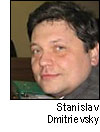
Amnesty International is deeply disappointed by today’s conviction of human rights defender Stanislav Dmitrievskii on “race hate” charges, for publishing non-violent articles by Chechen separatist leaders.

Amnesty International considers that the conviction of Stanislav Dmitrievskii is a blow to independent civil society in Russia and will have a stifling effect on the right to freedom of expression. Stanislav Dmitrievskii has been convicted for the peaceful exercise of his right to freedom of expression and should not have faced trial in the first place. Amnesty International considers that the conviction should be quashed.

The Sovietskii district court in Nizhnii Novgorod imposed a two-year suspended sentence and a four-year probationary period on Stanislav Dmitrievskii. During this four-year period, Stanislav Dmitrievskii will have to inform the authorities as to any change of residence or travel plans, and will have to report regularly to the local authorities. Any violation of these conditions or a further criminal conviction could result in him being imprisoned for two years.

Following the verdict, Stanislav Dmitrievskii thanked Amnesty International for the organization’s support and expressed his determination to challenge the court’s decision through the Russian courts and if necessary at the European Court of Human Rights. Reportedly, the prosecution also intends to appeal the verdict. Amnesty International will continue to campaign for justice for Stanislav Dmitrievskii and will monitor closely the progress of the case.

Background

Stanislav Dmitrievskii is Executive Director of the Russian-Chechen Friendship Society (RCFS) and editor-in-chief of the Pravo-zashchita newspaper (Rights defence, a human rights-oriented newspaper), which is published jointly by RCFS and another Nizhnii Novgorod-based human rights organization. Amnesty International is concerned that the criminal prosecution is a violation of his right to freedom of expression, and seems to be part of a campaign of harassment aimed at closing down the work of the RCFS.

Stanislav Dmitrievskii was convicted for publishing in the April-May 2004 edition of Pravo-zashchita an appeal by the late Chechen separatist leader Aslan Maskhadov to the European Parliament calling for international recognition of the current Chechen conflict as “an act of genocide by the Russian government against the Chechen people”, and an appeal in the March 2004 edition of Pravo-zashchita by Aslan Maskhadov's envoy Akhmed Zakaev to the Russian people not to re-elect President Vladimir Putin. He was convicted under Article 282.2 of the Russian Criminal Code which criminalizes:

"...incitement of hatred or enmity, and likewise demeaning human dignity with regard to indicia of sex, race, nationality, language, origin, attitude towards religion, and likewise affiliation to any social group, committed publicly or with the use of the mass media... and with the use of his professional position."

However, Amnesty International considers that the two articles published do not contain any incitement to hatred or enmity, or any form of violence.

Amnesty International is concerned that such prosecutions have a chilling effect on freedom of expression in Russia and in this case has been part of a wider campaign against the RCFS. For several months, Amnesty International has expressed its concern at an apparent campaign of harassment and prosecution aimed at members of the RCFS, reportedly in response to the organization’s work on human rights.

As well as the criminal prosecution of Stanislav Dmitrievskii, the organization has simultaneously been subjected to legal action by the tax authorities and by the registration department of the Ministry of Justice. At the same time, both Stanislav Dmitrievskii and another staff member, Oksana Chelysheva, have been the subject of threatening leaflets which have been distributed this year in Nizhnii Novgorod, where the organization is based. Oksana Chelysheva is deputy Executive Director of the RCFS, editor of the Russian Chechen Information Agency, and editor of the Pravo-zashchita newspaper. The leaflets have accused the human rights defenders of being “traitors” and supporters of “terrorists”. Police investigations into the leaflets have been opened but no one responsible has yet been identified.


(via IHF)

Thursday, February 02, 2006

Dead End

Andrei Illarionov, who last month resigned as an economic advisor to Vladimir Putin in protest at government policies, had an interesting article in the International Herald Tribune on January 25.

From just one section of Illarionov's commentary and analysis:
It is not only economic freedom that has left Russia. Political freedom is also gone. Political prisoners are back. The international organization "Freedom House," which monitors political and civil freedoms in 150 countries, reported a qualitative change in 2005: Russia moved from the group of "partly free" countries to the "not free" group. Others in the group are Rwanda, Sudan, Afghanistan.

"Corporatism" plays a central role in civil society as well. Freezing normal political life has eliminated the social structures that identify, formulate and protect the political interests of the public. Instead, society is structured along different interests - professional, religious, regional.

The corporate ideology may seem unclear at first glance. It does not look communist, or liberal, or socialist, or nationalistic, or imperial. But it does exist: It is an ideology of "nash-ism" - "ours-ism." It is an ideology of offering privileges, subsidies, credits, powers and authority to those who are "nashy," "ours."

It is handing out all sorts of state-owned and national resources to members of the corporation, both current and prospective. "Ours-ism" is an ideology of protecting "our own" not because they're right, but because they're "ours." It is an ideology of aggression to "others." It is a return to barbarism.

"Ours-ism" does not know national or ethnic boundaries. The former chancellor of a foreign country is made a member of the corporation and becomes "our man in Europe." Meanwhile, a Russian businessman who created a company that brought billions into the national treasury turns out to be an "other" and is exiled to the depths of Siberia.

The entire might of the Russian State is thrown behind "our" members of the corporation, whether this means refusing to transit Kazakhstan oil to Lithuania, switching off electricity to Moldova or waging a "gas war" against Ukraine. Russian imperialism has taken a distinctly corporate image.

The point of the new model is to redistribute resources to "our own." The rule of law is only for civilized countries. Fair business practices are only for countries that want to catch up with the developed world. Good relations with foreign neighbors are necessary only if Russia is interested in long-term development. The corporation has other goals.

What's wrong with that? What is so awful if state corporations become the driving force of the economy? If private companies carry out the wishes of the government? If the authorities inflate the non-market sector, strengthen state controls, set restrictions for "strategic" reasons? If state capitalism displaces a market economy? If the primacy of law and equality before law are absent, and inequality and discrimination triumph?

Is it only in Russia that this model exists?

Is it really not viable?

Yes, there are other countries like this. Libya and Venezuela, Angola and Chad, Iran and Saudi Arabia, Syria and Iraq. Russia is one of them now.

And yes, this politico-economic model can last for quite some time. In some OPEC countries it has survived for a third of a century; in Venezuela, for half a century. It can survive even without high prices for energy. Cuba and South Korea have even more impressive models, and that without any energy resources. There was also the Soviet political, economic and social model.

So from a historical point of view, there's nothing particularly novel about the new Russian model. This country and this nation can take a lot. The current model can last a long time.

There's just one thing. Choosing this model today, at the outset of the 21st century, is nothing other than deliberately choosing the third-world model. More precisely, the model of a very specific group in the third world, whose long-term prospects are well known, no matter how much money they get from oil, no matter how many pipelines they control at home and abroad, and no matter what saccharine stories they tell on TV.

The current politico-economic model of Russian development is a historical dead end. No country that has set off on this road has become richer or stronger or more developed. Nor will Russia. It will fall farther behind. And the price will be paid, as usual, by Russian citizens.
Hat tip: BH

Dmitrievsky: A Fair Trial?

Via Joachim Frank,
Project Coordinator
International Helsinki Federation for Human Rights
Wickenburggasse 14/7A-1080 Vienna
Tel. +43-1-408 88 22 ext. 22
Fax: +43-1-408 88 22 ext. 50
Web: http://www.ihf-hr.org/


A Fair Trial for Stas Dmitrievsky?

Trial against Russian-Chechen Friendship Society Head Stas Dmitrievsky - Prosecutor Demands a Four Years Colony-Settlement Term

Vienna, 2 February 2006. The International Helsinki Federation for Human Rights (IHF) is concerned about apparent restrictions on the independence of the court in the criminal trial against Stas Dmitrievsky, Executive Manager of the Russian-Chechen Friendship Society (RCFS), which suggest that the trial is mainly political. The Prosecutor and Deputy Prosecutor of the Nizhny Novgorod region founded their accusation on a shallow expert opinion, while an alternative opinion was rejected by the court; put the judge under pressure; and committed numerous other breaches of the law during the investigation and indictment.

It is expected that the court session in Nizhny Novgorod on Friday, 3 February 2005 will be the last when the defendant can make his final statements, after which the court will pronounce the sentence on the case.

Prosecutor and Deputy Prosecutor of the Nizhny Novgorod Region Try to Put the Judge under Pressure

A.N. Maslova, deputy prosecutor of the Sovetsky district of Nizhny Novgorod and dealing with the case against Dmitrievsky, in the 18 January 2006 hearing expressed her conviction that, “Dmitrievsky is dangerous for the society … all his actions can be regarded as extremist activities aimed at undermining state security”, and she also referred to “the extremely tense situation in the country when accidents like the recent crime in a Moscow synagogue happen more and more often”, which in her opinion make it necessary that publications like those of the RCFS are inadmissible. She demanded a 4-year colony-settlement term for him.

A week earlier, the prosecutor of Nizhny Novgorod Region, Vladimir Demidov, expressed his certainty both about the conviction of Stas Dmitrievsky and the inevitable term of imprisonment, stating “I am sure that Dmitrievsky will be put to prison and, being on the side that supports the accusation, we are going to press for his criminal responsibility,” further stating “it is important for our multinational society, which supports a positive attitude towards all nationalities, that calls made by bandits inciting to ethnic hatred be not published by newspapers”, pointing out that “we mustn’t allow any attempts to destabilise the situation”.

As this can be regarded as imposing pressure upon the court, contrary to the Guidelines on the role of Prosecutors[i], the lawyers of Dmitrievsky lodged a complaint.

Additionally, the IHF has received credible reports that staff members of the Prosecutors Office are under pressure to make sure that Stas Dmitrievsky is indeed convicted and sentenced to a colony-settlement term. They were summoned to work late hours and informed that should they fail to win the case, some of them would be fired.

Accusation is Founded on a Shallow Expert Opinion, While Alternative Opinion is Rejected by the Court

The accusations are based on an expert opinion of Larisa Teslenko, expert of the Privolzhsky Regional Center of Legal Expertise at the Ministry of Justice, who asserted that Dmitrievsky’s actions were aimed at inciting animosity by taking advantage of his official position. While firmly insisting that the incriminated materials raise racial, national and social enmity “between Russian and Chechens”, Teslenko refused to answer most of the 50 questions raised by the defense, explaining that they were beyond her competence. She refused, for example, to define the terms “race”, “nationality” and “social group”, declaring that on these questions the sociologist, instead of the linguist should answer.

Judge Bondarenko refused to attach an alternative expertise conducted by Galina Vronskaya, senior lecturer at the journalism department of the Chuvash State University and president of the Chuvash Guild of Linguists and stated that the reason was that “it had been carried out not by the court’s request and for money”, and therefore was biased. This expert said that in her estimation the statements by Maskhadov and Zakaev contained no degrading descriptions, negative appraisals or statements in relation to racial, ethnic or social groups or individuals representing them. Additionally, the articles contained factual statements that in themselves cannot be regarded as inciting any hostility unless proven untrue.

In the framework of preparing the grounds for opening a criminal case, on 29 December 2004, the office of Nizhny Novgorod Region’s Prosecutor requested an analysis of RCFS publications from Olga Khokhlysheva, professor at Nizhny Novgorod State University.[ii] The analysis, which was delivered quickly, in January 2005, stated that “the publications in Pravo-zaschita can be regarded as serious violations of the Russian Criminal Code and undermining of the Constitutional order”, also contain xenophobic statements that violate Russian law and humiliate people according to their nationality.[iii] This analysis, predictably, was not used in the criminal proceedings but read during the trial on the demand of the defense.

Prosecutor's Office Committed Numerous Breaches of the Law During the Investigation and the Bringing of Charges

Dmitrievsky's lawyer Leyla Khamzaeva called the attention of the court to numerous breaches of law perpetrated by the prosecutor's office in the process of investigation and bringing charges against him. She pointed out that such cases have always been considered in administrative legal proceedings, not in criminal ones. There is a list of expressions that are regarded to be extremist and if they are published, a media venue receives a warning. The RCFS case started immediately with bringing charges under Article 280 and then under Article 282. The lawyer insists there is a clear breach of legal procedure and that Dmitrievsky has the right to demand that charges against him be considered in administrative legal proceedings.

Ombudsman, Head of Human Rights Council and Human Rights Defenders Reject the Accusation

In a statement from 1 February 2006, the Russian Ombudsman, Vladimir Lukin, and the head the Human Rights Council under the President of the RF, Ella Pamfilova, not only expressed their conviction, that in the incriminated texts there were no appeals to any, including interethnic enmity[iv], but they also criticized the prosecutor’s demand for a 4-year colony term as disproportionate, particularly given the (non-)persecutions of extreme nationalists and ideologists of pogroms.

Ludmilla Alexeyeva, head of the Moscow Helsinki Group commented,
“The case against Stas Dmitrievsky is politically motivated. The real aim of those who are behind the charges against the editor of the anti-war newspaper is to close down an independent source for information on Chechnya. I have known Dmitrievsky for many years as a person who has always defended the right of people to live in peace, and when he encountered among his Chechen acquaintances mistrust against the Russian people as such he was always rejecting accusations of their common responsibility for what happens in Chechnya. Stas always fought for human rights and condemned discrimination on racial or ethnic basis. The Moscow Helsinki Group always supported RCFS activities and often used the information of RCFS about the situation in the republic while drafting its annual reports.”

In a 15 November 2005 statement, Amnesty International declared that they would consider Stas Dmitrievsky to be a prisoner of conscience if imprisoned on these charges.

The IHF agrees with Russian human rights defenders who believe that the government’s assault upon the RCFS shall set a precedent for a wider campaign against civil society. It is especially important in the context of the new NGO law. Yuri Dzhibladze, President of the Center for Development of Democracy and Human Rights, regards the trial as an attack on the human rights movement as a whole, and commented,
“In case Dmitrievsky is convicted and even if the sentence will be suspended, he loses the right to establish an NGO, be a member of a board of any NGO or even simply be a member of an any NGO. Moreover, the Russian-Chechen Friendship Society and Dmitrievsky will face renewed attack in an arbitration process where the tax authorities claim that profit taxes should have been paid for grants received by the RCFS. Finally, foreign donors who supported RCFS (the European Commission and the National Endowment for Democracy in Washington, DC) will also be under attack: it will be widely publicized that they were funding not legitimate human rights work but extremist activity. Very much like in the “spy scandal” that happened in Russian last week, the verdict against Dmitrievsky will be used against independent NGOs and their foreign donors. This may have very serious implications for freedom of association in Russia.”

Background:

Particularly since January 2005, the RCFS was subject to a series of different forms of harassment, includingcriminal proceedings against the RCFS. A criminal investigation was conducted originally by the FSB, after it had been commenced by the Prosecutors Office in January 2005, referring to article 280 of the Criminal Code (“public calls to extremist activities”). Later, it was reclassified and transferred to the prosecutor’s office of Nizhny Novgorod Region. On 2 September 2005, Stas Dmitrievsky was officially charged under paragraph b, of part 2 of Article 282 of the Criminal Code (“inciting hatred or enmity on the basis of ethnicity and religion”), offences which carry a maximum penalty of five years in prison, for allowing the re-publication of two appeals by Chechen leaders Aslan Maskhadov and Akhmed Zakaev, in the newspaper Pravo-zashchita (‘Rights Defense’), in March and April 2004, urging the international community to help end the war in Chechnya, and calling on Russians not to vote for Putin and thus help end the conflict.

Simultaneously, starting in March 2005, the Federal Tax Inspectorate commenced an audit of the accounts of the RCFS for the past three years, and in June 2005 issued “order Nr. 25”, claiming that the RCFS has violated the Tax Code and has to pay profit tax and a fine totaling 1.001.561 Rubles (around 28.200 Euro). They claim that foreign grants the RCFS is receiving amount to profit. The RCFS appealed this decision with the arbitration court. This procedure is still ongoing, but the arbitration court complied with the petition of the tax inspection to postpone the consideration of the case until a decision by the criminal court in the case against Dmitrievsky is taken. The tax authorities claim that if Dmitrievsky is found guilty on extremist charges, it will be a proof that the grant money was used for illegal purposes and not according to the grant agreement, and that therefore the money cannot be considered tax-exempt anyway and a profit tax and penalty should be paid. As a result, the organisation may be destroyed. Parallel to these proceedings, in September 2005, the Nizhny Novgorod Department of the Ministry of Interior commenced a criminal case on the basis of the conclusions made by the tax inspection for “evading payment of taxes or dues in a big scale” (Article 199, Part I of the Criminal Code) and interrogated Dmitrievsky and both present and former accountants of the organization.

A third form, the civil action by the Justice Ministry Registration Department to deregister the RCFS, which had begun in April 2005 (after an off-schedule control in February) because of RCFS’s “failure to provide the Federal Registration Service with required documents” (that had to be handed over to the Tax Inspectorate at the same time), stopped after a court turned down this request on 14 November 2005.

The criminal and legal cases are accompanied by campaigns in the media against the organization and its heads, threatening leaflets and phone calls, and an burglary into the flat of Dmitrievsky.

See also:
IHF statement, “Legal Harassment Against the Russian-Chechen Friendship Society – Another Update”, 10 January 2006
IHF statement, “Legal Harassment Against the Russian-Chechen Friendship Society - An Update”, 29 November 2005
IHF statement, “British Lawyer Barred From Entering Russia to monitor trial of the Russian-Chechen Friendship Society in Nizhny Novgorod, 15 November 2005
IHF statement, “The ‘Russian-Chechen Friendship Society’s Under Severe Risk of being Destroyed by Russian Authorities. Its Director Stas Dmitrievsky Faces a Prison Term, 2 November 2005
IHF statement, "Russian Federation: Nizhny Novgorod Authorities Launch Final Crackdown on Russian-Chechen Friendship Society. Today’s Protest Picket Dissolved after Five Minutes – Participants Detained", 2 September 2005.
IHF statement, “Continuing Persecution of the Russian-Chechen Friendship Society. Its Partner Organisation Nizhny Novgorod Human Rights Society Closed Down by Authorities”, 10 June 2005
IHF statement, “We Fear for the Safety of our Colleagues in the Russian-Chechen Friendship Society… Russian Human Rights Organization Threatened”, 19 March 2005
IHF statement, “FSB Raids the Russian-Chechen Friendship Society”, 20 January 2005
For further information:
International Helsinki Federation for Human Rights
In Vienna: Aaron Rhodes, IHF Executive Director, +43-1-408 88 22 or +43 -676-635 66 12; Henriette Schroeder, IHF Press Officer, +43-676-725 48 29
In Moscow: Tanya Lokshina, +7 -916-624 19 06
Russian-Chechen Friendship Society, Stas Dmitrievsky, Oksana Chelysheva, +7-8312-171 666

Endnotes:

[i] These guidelines were adopted by the 8th United Nations Congress on the Prevention of Crime and the Treatment of Offenders in Cuba (1999), and state that “in the performance of their duties, prosecutors shall “perform their duties fairly, consistently”, “carry out their function impartially”, and “act with objectivity, take proper account of the position of the suspect and the victim, and pay attention to all relevant circumstances, irrespective of whether they are to the advantage or disadvantage of the suspect”.
[ii] This request from 29.12.2004 was signed by the prosecutor with the department on protecting constitutional rights and freedoms at the prosecutor’s office A.V. Malyugin and bears the № 7/2-31-04.
[iii] It casts her doubts on the existence of the Chechen, Jewish and Arab nations, justifies the deportation of the Chechen people in 1944 on Stalin’s orders by “the historic circumstances and the objective necessity that had emerged by that time”. Therefore, these conclusions contradict with the Russian Law “On Rehabilitation of the Repressed Peoples” from 1991 according to which Stalin’s repressive acts against different peoples of Russia, including their deportation, were “unlawful and criminal” (Article 1). The law also defines these acts as cases of genocide (Article 2) and establishes criminal responsibility “for agitation and propaganda aimed at preventing from rehabilitation of the repressed peoples” as well as for inciting to such actions (Article 4).
[iv] At the same time they said that it did contain a not always adequate judgment of the actions of the Russian Federation in the North Caucasus.

__________________
Endnotes:

[1] These guidelines were adopted by the 8th United Nations Congress on the Prevention of Crime and the Treatment of Offenders in Cuba (1999), and state that “in the performance of their duties, prosecutors shall “perform their duties fairly, consistently”, “carry out their function impartially”, and “act with objectivity, take proper account of the position of the suspect and the victim, and pay attention to all relevant circumstances, irrespective of whether they are to the advantage or disadvantage of the suspect”.
[1] This request from 29.12.2004 was signed by the prosecutor with the department on protecting constitutional rights and freedoms at the prosecutor’s office A.V. Malyugin and bears the № 7/2-31-04.
[1] It casts her doubts on the existence of the Chechen, Jewish and Arab nations, justifies the deportation of the Chechen people in 1944 on Stalin’s orders by “the historic circumstances and the objective necessity that had emerged by that time”. Therefore, these conclusions contradict with the Russian Law “On Rehabilitation of the Repressed Peoples” from 1991 according to which Stalin’s repressive acts against different peoples of Russia, including their deportation, were “unlawful and criminal” (Article 1). The law also defines these acts as cases of genocide (Article 2) and establishes criminal responsibility “for agitation and propaganda aimed at preventing from rehabilitation of the repressed peoples” as well as for inciting to such actions (Article 4).
[1] At the same time they said that it did contain a not always adequate judgment of the actions of the Russian Federation in the North Caucasus.

Frozen Conflicts

Behind-the-scenes negotiations that have lasted for years are probably about to be resolved in a new deal on the future status of Kosovo. Britain, France and the United States - the international powers with a direct interest in the issue - have reached a partial consensus on the need to grant Kosovo "conditional independence". This would separate it from Serbia and Montenegro, but also make it possible for an international mission to supervise the country's fledgling status.

Moscow, however, regards Serbia (in its eyes, head of the "Serb Federation") as a political ally, and has had other plans for Kosovo. The British, French and U.S. deal is not the one that Moscow wanted, but Moscow still sees a way to impose its will via a quid pro quo arrangement that would validate its imperial ambitions in parts of the former Soviet Union. As Vladimir Putin began to hint at his marathon press conference yesterday, in return for agreeing to grant full independence to Kosovo, Moscow might ask in return that the countries of the West recognize the independence of pro-Moscow republics such as those of Abkhazia or South Ossetia, thus putting further pressure on Georgia.

Interviewed by RFE/RL, Economist commentator Edward Lucas has some observations that reach to the central point of this dubious search by the Kremlin for "universal principles" for solving frozen conflicts:

"There's two conflicting principles here, of self-determination and territorial integrity. But I think the key thing is that there is no one outside power that is backing Kosovo," Lucas said. "Kosovo is not the client of a powerful neighboring state the way that Abkhazia, South Ossetia, and Transdniester are. So I think the first thing we would have to say if one were trying to find a common standard would be that no neighboring country should exercise a big unilateral blockade or support for one of these frozen conflicts and that, of course, would put Russia in a very difficult position."

Russia might also find itself treading on very thin ice. The principle of self-determination in particular cuts both ways. "And there's also Chechnya," Lucas said. "If you accept that there's the right to self-determination, or at least that it has to be taken into account, and one doesn't only deal with inviolable territorial integrity, then it does of course raise the question of Chechnya now and, perhaps at some other date in the future, some other bits of Russia that are there more by coincidence that by historical right like, for instance, Karelia or Tatarstan."

Amplifying the Silence


I've been reading Joel Glassman's Amplify Your Violin again - it's still the best and most comprehensive study of the subject on the Web, in my opinion. But it's useful to read it now in the light of Chris Howes' recent clinic at the IAJE conference, which was also most informative. I'm particularly interested in the topic of the best use of preamps with acoustic and electric instruments. Having for some time used a Beringer Ultra-DI with a Yamaha SV-200 (Silent Violin), I'm now considering purchasing a Fishman GII, which looks as though it must have more control features. Though the Yamaha has two built-in equalization modes, I'm convinced that it must be possible to improve the signal output by the use of the Fishman.

The whole field of violin amplification in a jazz setting is a thorny one, in my experience. Just plugging the instrument - whether electric or acoustic+piezo pickup - directly into an electric guitar amp is liable to produce a harsh, un-violinistic tone that's really cruel to others! On the other hand, the sound of an electric violin is palpably different from that of an acoustic instrument - the question in the end is probably one of taste.

Wednesday, February 01, 2006

The Prague Watchdog Weekly Newsletter

------------------------------------------------------------------------------------------------
THE PRAGUE WATCHDOG WEEKLY NEWSLETTER, No. 5/2006 (January 31)
------------------------------------------------------------------------------------------------

1) THE WEEK IN BRIEF (January 23 - January 29)
January 25 - The Parliamentary Assembly of the Council of Europe (PACE) adopted a resolution in which it condemned the harsh behaviour of security forces operating in Chechnya, the continuation of human rights abuses, and the passivity of the Committee of Ministers.
January 25 - The Russian-Chechen Information Agency, established by the Nizhny Novgorod-based NGO Society of Russian-Chechen Friendship (ORChD), announced it won the "Free Press of Russia 2006" award granted by the Freedom of Expression Foundation (Norway) and ZEIT-Stiftung Ebelin und Gerd Bucerius (Germany).
January 26-28 - Some areas of Chechnya, including a part of Grozny, were out of gas due to a large failure on the Aksay-Grozny pipeline near Gudermes.
January 29 - Gas supplies from Russia to Georgia, which were halted by two blasts on the Mozdok-Tbilisi pipeline on January 22 and threw Georgia into a severe energy crisis, resumed.
--------------------------------------------------------------------------------------
2) UPCOMING EVENTS

February 1 - Moscow (Russia): Top representatives of leading Russian NGOs will hold a news conference on how the Russian leadership and authorities attack civil society. The event will take place at 11:30 a.m. at the Independent Press Center (Tverskoi Boulevard 20).

February 3 - Nizhny Novgorod (Russia): The local court will pronounce its verdict on the case of human rights defender and journalist Stanislav Dmitriyevsky, who was accused of inciting ethnic and racial hatred after his paper published Chechen resistance leaders' peace appeals.

For more upcoming Chechnya-related events go to http://www.watchdog.cz/calendar.

--------------------------------------------------------------------------------------
3) SURVEY

Majority of Stavropol residents give negative assessment of work of Stavropolsky Region's governor (by Caucasus Times, January 31)
Results of a survey of residents of Stavropol carried out by the "Caucasus Times" agency. http://www.watchdog.cz/index.php?show=000000-000002-000001-000171&lang=1

--------------------------------------------------------------------------------------
4) POLITICS

PACE's resolution and recommendation on human rights violations in the Chechen Republic (by PACE, January 25)
During the debate on human rights violations in Chechnya at the Parliamentary Assembly of the Council of Europe on January 25, PACE adopted a resolution and a recommendation.
http://www.watchdog.cz/index.php?show=000000-000004-000003-000119&lang=1

--------------------------------------------------------------------------------------
5) SPECIAL EVENT: Support Stanislav Dmitriyevsky!

Join an action in support of a Russian human rights activist and journalist of Nizhny Novgorod who faces four years in prison because of his organization's independent coverage of Chechnya and promotion the idea of peace talks. More at http://www.cjes.ru/actions/action.php?p_id=1&l=en.

--------------------------------------------------------------------------------------
6) LATEST ADDITION TO OUR LINKS LIBRARY:

Nana: http://nana-journal.org/

For more Chechnya-related links go to our Links library ( http://www.blogger.com/ ), which is being continuously updated.

--------------------------------------------------------------------------------------
Prague Watchdog Weekly Newsletter is a publication of Prague Watchdog. If you wish to subscribe (unsubscribe) to it, please send us an e-mail to mail@watchdog.cz. The newsletter is usually sent out on Monday evenings.

Prague Watchdog launched its website in August 2000 and its aim is to collect and disseminate information on the ongoing conflict in Chechnya, focusing on human rights, media coverage, political situation and relief aid.

Visit us at http://www.watchdog.cz/. For the Russian version, go to http://www.watchdog.cz/russian.

Via Rescue Chechnya: Dmitrievsky Appeal


Russian Defender Faces Prison: Your Support Needed Now!

On February 3, a Russian court will decide whether human rights activist Stanislav Dmitrievsky committed a crime when he published articles calling for peace in Chechnya. If he is convicted, not only could he face up to five years in prison, but a dangerous precedent will be set for all Russians - including human rights defenders and independent journalists - who exercise their right to question and criticize government policies.

This is a critical moment in Russia as a conviction would have a chilling effect on open public debate nationwide. Please support Mr. Dmitrievsky and take a stand against the further erosion of human rights in Russia.

Recent developments indicate that this trial is part of a concerted campaign against independent organizations in Russia.

Earlier this week, several well-respected human rights groups were falsely accused of accepting money from British secret services (read our statement below). On January 10, President Vladimir Putin signed into effect a harsh new law that gives government agencies power to close non-governmental organizations under vague terms.

Human rights activists in Russia are asking for our support. Please take action and tell a friend about this case.

Click Here to Take Action

Click here to learn more about the case of Stanislav Dmitrievsky

Human Rights First Condemns False Accusations against Russian Human Rights Organizations


--------------------------------------------------------------------------------


About Rescue Chechnya

The Canadian Committee for Peace in Chechnya aims to create a broad base of members with diverse backgrounds; no special knowledge about Chechnya or experience of any sort are required.

You can get involved as much as you want, from simply receiving our email updates to signing petitions, from learning about Chechnya to organizing events and fundraisers, starting a local group. We believe that our strength lies in numbers, especially when it comes to influencing government decision-making related to Chechnya.

Website: http://rs6.net/tn.jsp?t=6qg6lsbab.0.thu6lsbab.8ipwlsbab.5&p=http%3A%2F%2Fwww.rescuechechnya.com

Mr Nice Guy

Today Russia's president, Vladimir Putin, held a very lengthy press conference at which he presented himself as a friend to all the world, championing democracy, free markets, Chechens, Poland, Georgia - the list goes on and on. AFP's correspondent notes that
He heralded the "freedom" enjoyed by Russians since the end of the Soviet Union. He vowed to "guarantee the independence of the press." He also promised to support non-governmental organisations (NGOs) as a "control on the activities of the state."

He even told an anecdote that involved joking "with my Chechen friends."

All this from a president under increasing Western attack for what critics see as his campaign to crush civil society and manipulate energy supplies as a weapon against pro-Western ex-Soviet republics such as Ukraine.

Not to mention his record in curtailing independent television reporting or what human rights groups say are mass war crimes in Chechnya.

In the latest expression of Western disillusionment with Putin, the influential British think tank the Foreign Policy Centre questioned Tuesday whether Russia should have been allowed chairmanship this year of the Group of Eight (G8) industrialized democracies, given mounting "authoritarianism."

But Putin, a judo black belt, used his three hours-and-26-minutes meeting with the press to throw his critics.

He flatly denied there was opposition to Russia's G8 role and promised investors spooked by growing state control of Russia's energy sector that renationalization was not on the cards.
(via chechnya-sl)

The Clef Club, 1910-11


He also began to effect major changes in the working conditions for black musicians. It was a common practice, heretofore, for the large hotels and restaurants in the city and by out-of-town resorts like the Poinciana Hotel in Palm Beach not to pay black musicians and singers for their services directly. As Tom Fletcher remembered it, they would be hired for some menial job, like dishwasher or floor sweeper, with the expectation that they also perform for the guests for tips. Europe began to require the employers of Clef Club musicians to pay them a fixed salary and to include nothing other than entertaining in their duties. Moreover, if an engagement were out of the city, then the musicians were to receive their salaries plus transportation, room, and board. To increase name recognition, he also encouraged club members who had their own established combinations to bill themselves as "So-and-So and his Clef Club Orchestra and Entertainers." A standard dress code was instituted stipulating tuxedos for engagements booked in advance and dark suits, white shirts, and bow ties for pick-up dates. "No one is sent on a job if not dressed correctly," Fletcher recalled. By the early spring of 1911, Europe was leading a Clef Club dance orchestra himself.
From A Life in Ragtime: A Biography of James Reese Europe, by Reid Badger, Oxford, 1995.