There were several events around this anniversary, including a conference at the Gorbachev Foundation, but Russian President Vladimir Putin chose to ignore it. He covered a great many topics at his extended press conference on January 31, found time to congratulate every Russian Olympic champion, issued special decrees to commemorate composer Dmitry Shostakovich and scholar Dmitry Likhachev, but did not say a word about that remarkable watershed, much the same way that he never mentions the coup of August 1991.
There is certainly more to this silence than just the political gut feeling to avoid issues that remain divisive and might damage his popularity in some marginal groups. The main guideline of the "de-Stalinization" campaign launched by the 20th Congress was against the super-concentration of power in one pair of hands -- and that is exactly what Putin has been doing since arriving at the Kremlin. A carefully orchestrated PR campaign has sought to prove that this style of governance suits Russia the best, so now 57% of Russians are sure that the country needs a determined leader who could rule with a "firm hand" (Newsru.com, February 25). This opinion ties logically with others: 47% of respondents have a generally positive view of Stalin and 21% perceive him as a "wise statesman" (Vedomosti, February 14).
Tuesday, February 28, 2006
Speech and Silence
Pavel K. Baev, on the background to Vladimir Putin's silence about the 50th anniversary of Khrushchev's Secret Speech:


Monday, February 27, 2006
No Problem
The United States and the 'Problem' of Venezuela
By George Friedman
Venezuela has become an ongoing problem for the Bush administration, but no one seems able to define quite what the issue is. President Hugo Chavez is carrying out the Bolivarian revolution in Venezuela and feuding with the United States. He has close ties with Cuba and has influenced many Latin American countries. The issue that needs to be analyzed, however, is whether any of this matters -- and if it does, why it is significant.
Chavez came to power in 1999 through a democratic election. He unseated a constellation of parties that had dominated Venezuela for years. Chavez, an army officer, had led a failed coup attempt in 1992 and spent time in prison for that. He sought the presidency without any clear ideology other than hostility to the existing regime. There was a vague belief at the time of his election that Chavez would be simply another passing event in Latin America. Put a little more bluntly, there was an assumption that Chavez rapidly would be corrupted by the opportunities opened to him as president, and that he would proceed to enrich himself while allowing business to go on as usual.
The business of Venezuela, however, is oil. Not only is the country a major exporter, but the state-owned oil company, Petroleos de Venezuela SA (PDVSA), also owns the American refiner and retailer Citgo Petroleum Corp. Venezuela has tried to diversify its economy many times, but oil has remained its mainstay. In other words, the Venezuelan state is indistinguishable from the Venezuelan oil industry. Chavez, therefore, has faced two core issues: The first was how income from the oil would be used, and the second was the degree to which foreign oil companies could be allowed to influence that industry.
Chavez was able to win the presidency because he promised the Venezuelan masses a bigger cut of the oil revenues than they had seen before. More precisely, he promised a series of social benefits, which could be financed only through the diversion of oil revenues. From Chavez's point of view, the problem was that the Venezuelan upper class and the foreign oil companies were pocketing the oil money that could be used to pay for the social services upon which his government rested and his political future depended. From his fairly simple populist position, then, he proceeded to move against the technical apparatus of PDVSA and against the foreign oil companies, most of which opposed him and threatened to undermine his plans.
But there was yet a further dilemma. In order to support his political base, Chavez had to have oil revenues. In order to generate oil revenues, he had to have investment into the oil sector. But diverting revenues and building up the oil sector were competing goals. Given the political climate, foreign oil companies were not inclined to make major investments in Venezuela, and PDVSA -- minus its technical experts -- was not capable of maintaining operations and existing output levels. There was, then, a terrific problem embedded in Chavez's political strategy. In the long term, something would have to give.
Two things saved him from his dilemma. The first was a short-lived coup by his opposition in April 2002. This coup was truly something to behold. Having captured Chavez and sent him to an island, the coupsters fell into squabbling with each other over who would hold what office and sort of forgot about Chavez. Chavez flew back to Caracas, went to the Miraflores presidential palace, and took over, less than 48 hours after it all began. The coupsters headed out of town.
The coup gave Chavez a new, credible platform: anti-Americanism. He was never pro-American, but the brief coup allowed him to claim that the United States was trying to topple him. It would be a huge surprise to us if it turned out that the CIA was utterly unaware of the coup plans, but we would also be moderately surprised if the CIA planned events as Chavez charged. Even on its worst day, the CIA couldn't be that incompetent. But Chavez's claim was not implausible. It certainly was believed by his followers, and it expanded his support base to include Venezuelan patriots who disliked American interference in their affairs. What the coup did was flesh out Chavez's ideology a bit. He was for the poor and against the United States.
Chavez got lucky in a second way: rising oil prices. The appetite of his government for cash was enormous. Someone once referred to Citgo as "Chavez's ATM." With Venezuela's oil production declining, Chavez's government likely would have collapsed under social pressure if world oil prices had remained low. But oil prices didn't remain low -- they soared. Venezuela still had substantial economic problems and its oil industry was suffering from lack of expertise, investment and exploration, but at $60 a barrel, Chavez had room for maneuver.
All of this led him into an alliance with Cuba. When you're anti-U.S. in Latin America, Havana welcomes you with open arms. Cuba needed Venezuela as well: After the fall of the Soviet Union, the Cubans were cut off from subsidized oil supplies, and their ability to pay world prices wasn't there. Chavez could afford to provide Castro with oil to sustain the Cuban economy. It could be argued that without Chavez, the Castro regime might have collapsed once faced with soaring oil prices.
In return for this support, Chavez benefited from Cuba's greatest asset: a highly professional security and intelligence apparatus. Arguing, not irrationally, that the United States was not yet through with Venezuela, Chavez used Cuban expertise to build a security system designed to protect his regime. His government -- though not nearly as repressive as Cuba's is at the popular level -- nevertheless came under the protection not only of Cuban professionals, but of cadres of Venezuelan personnel trained by the Cubans. The relationship with the Cubans certainly predated the coup in Caracas, but it kicked into high gear afterwards. Both sides benefited.
Chavez's rise to power also intersected with another process under way in Latin America: the anti-globalization movement. From about 1990 onward, Latin America was dominated by an ideology that argued that free-market reforms, including uncontrolled foreign investment and trade, would in the long run lift the region out of its chronic misery. The long run turned out to be too long, however, because the pain caused in the short run began forcing advocates of liberalization out of office. In Brazil, Argentina and Bolivia, economic problems created political reversals.
The old Latin American "left," which had been deeply Marxist and always anti-American, had gone quiet during the 1990s. It recently has surged back into action -- no longer in its dogmatic Marxist style, but in a more populist mode. Its key tenets now are state-managed economies and, of course, anti-Americanism. For the leftists, Chavez was a hero. The more he baited the United States, the more of a hero he became. And the more heroic he was in Latin America, the more popular in Venezuela. He spoke of the Bolivarian revolution, and he started to look like Simon Bolivar to some people.
In reality, Chavez's ability to challenge the United States is severely limited. The occasional threat to cut off oil exports to the United States is fairly meaningless, in spite of conversations with the Chinese and others about creating alternative markets. The United States is the nearest major market for Venezuela. The Venezuelans could absorb the transportation costs involved in selling to China or Europe, but the producers currently supplying those countries then could be expected to shift their own exports to fill the void in the United States. Under any circumstances, Venezuela could not survive very long without exporting oil. Symbolizing the entire reality is the fact that Chavez's government still controls Citgo and isn't selling it, and the U.S. government isn't trying to slam controls onto Citgo.
Washington ultimately doesn't care what Chavez does so long as he continues to ship oil to the United States. From the American point of view, Chavez -- like Castro -- is simply a nuisance, not a serious threat. Latin American countries in general are of interest to Washington, in a strategic sense, only when they are being used by a major outside power that threatens the United States or its interests. The entire Monroe Doctrine was built around that principle.
There was a fear at one point that Nazi U-boats would have access to Cuba. And when Castro took power in Cuba, it mattered, because it gave the Soviets a base of operations there. What happened in Nicaragua or Chile mattered to the United States because it might create opportunities the Soviets could exploit. Nazis in Argentina prior to 1945 mattered to the United States; Nazis in Argentina after 1945 did not. Cuba before 1991 mattered; after 1991, it did not. And apart from oil, Venezuela does not matter now to the United States.
The Bush administration unleashes periodic growls at the Venezuelans as a matter of course, and Washington would be quite pleased to see Chavez out of office. Should al Qaeda operatives be found in Venezuela, of course, then the United States would take an obsessive interest there. But apart from the occasional Arab -- and some phantoms generated by opposition groups, knowing that that is the only way to get the United States into the game -- there are no signs that Islamist terrorists would be able to use Venezuela in a significant way. Chavez would be crazy to take that risk -- and Castro, who depends on Chavez's cheap oil, is not about to let Chavez take crazy risks, even if he were so inclined.
From the American point of view, an intervention that would overthrow Chavez would achieve nothing, even if it could be carried out. Chavez is shipping oil; therefore, the United States has no major outstanding issues. A coup in Venezuela, even if not engineered by the United States, would still be blamed on the United States. It would increase anti-American sentiment in Latin America, which in itself would not be all that significant. But it also would increase hostility toward the United States in Europe, where the Allende coup is still recalled bitterly by the left. The United States has enough problems with the Europeans without Venezuela adding to them.
Taken in isolation, Venezuela can't really hurt the United States. If all of South America were swept by a Bolivarian revolution, it wouldn't hurt the United States. Absent a significant global power to challenge the United States, Latin America and its ideology are of interest to Latin Americans but not to Washington. The only real threat that Venezuela poses to the United States would be if its oil production becomes so degraded that the United States has to seek out new suppliers and world prices rise. That would matter to Washington, and indeed it may eventually occur -- Venezuelan output has dropped about 1 million bpd below pre-Chavez highs -- but it would matter a thousand times more to Venezuela.
This explains the strange standoff between Venezuela and the United States, and Washington's basic indifference to events in Latin America. Venezuela is locked into its oil relationship with the United States. Latin America poses no threat on its own. The chief geopolitical challenge to the United States -- radical Islam -- intersects Latin America only marginally. Certainly, there are radical Islamists in Latin America; Hezbollah in particular has assets there. But for them to mount an attack against the United States from Latin America would be no more efficient than mounting it from Europe. The risk is a concern, not an obsession.
For the United States, its border with Mexico matters. For the Venezuelans, high oil prices that subsidize their social programs and buy regional allies matter. Both want Venezuelan oil to keep pumping. Aside from the one issue that they agree on, the United States can live and is living with Chavez, and Chavez not only lives well with the United States but needs it -- both as a source of cash, through Citgo, and as a whipping boy.
Sometimes, there really isn't a problem.
Send questions or comments on this article to analysis@stratfor.com.
This report may be distributed or republished with attribution to Strategic Forecasting, Inc. at www.stratfor.com. For media requests, partnership opportunities, or commercial distribution or republication, please contact pr@stratfor.com.
By George Friedman
Venezuela has become an ongoing problem for the Bush administration, but no one seems able to define quite what the issue is. President Hugo Chavez is carrying out the Bolivarian revolution in Venezuela and feuding with the United States. He has close ties with Cuba and has influenced many Latin American countries. The issue that needs to be analyzed, however, is whether any of this matters -- and if it does, why it is significant.
Chavez came to power in 1999 through a democratic election. He unseated a constellation of parties that had dominated Venezuela for years. Chavez, an army officer, had led a failed coup attempt in 1992 and spent time in prison for that. He sought the presidency without any clear ideology other than hostility to the existing regime. There was a vague belief at the time of his election that Chavez would be simply another passing event in Latin America. Put a little more bluntly, there was an assumption that Chavez rapidly would be corrupted by the opportunities opened to him as president, and that he would proceed to enrich himself while allowing business to go on as usual.
The business of Venezuela, however, is oil. Not only is the country a major exporter, but the state-owned oil company, Petroleos de Venezuela SA (PDVSA), also owns the American refiner and retailer Citgo Petroleum Corp. Venezuela has tried to diversify its economy many times, but oil has remained its mainstay. In other words, the Venezuelan state is indistinguishable from the Venezuelan oil industry. Chavez, therefore, has faced two core issues: The first was how income from the oil would be used, and the second was the degree to which foreign oil companies could be allowed to influence that industry.
Chavez was able to win the presidency because he promised the Venezuelan masses a bigger cut of the oil revenues than they had seen before. More precisely, he promised a series of social benefits, which could be financed only through the diversion of oil revenues. From Chavez's point of view, the problem was that the Venezuelan upper class and the foreign oil companies were pocketing the oil money that could be used to pay for the social services upon which his government rested and his political future depended. From his fairly simple populist position, then, he proceeded to move against the technical apparatus of PDVSA and against the foreign oil companies, most of which opposed him and threatened to undermine his plans.
But there was yet a further dilemma. In order to support his political base, Chavez had to have oil revenues. In order to generate oil revenues, he had to have investment into the oil sector. But diverting revenues and building up the oil sector were competing goals. Given the political climate, foreign oil companies were not inclined to make major investments in Venezuela, and PDVSA -- minus its technical experts -- was not capable of maintaining operations and existing output levels. There was, then, a terrific problem embedded in Chavez's political strategy. In the long term, something would have to give.
Two things saved him from his dilemma. The first was a short-lived coup by his opposition in April 2002. This coup was truly something to behold. Having captured Chavez and sent him to an island, the coupsters fell into squabbling with each other over who would hold what office and sort of forgot about Chavez. Chavez flew back to Caracas, went to the Miraflores presidential palace, and took over, less than 48 hours after it all began. The coupsters headed out of town.
The coup gave Chavez a new, credible platform: anti-Americanism. He was never pro-American, but the brief coup allowed him to claim that the United States was trying to topple him. It would be a huge surprise to us if it turned out that the CIA was utterly unaware of the coup plans, but we would also be moderately surprised if the CIA planned events as Chavez charged. Even on its worst day, the CIA couldn't be that incompetent. But Chavez's claim was not implausible. It certainly was believed by his followers, and it expanded his support base to include Venezuelan patriots who disliked American interference in their affairs. What the coup did was flesh out Chavez's ideology a bit. He was for the poor and against the United States.
Chavez got lucky in a second way: rising oil prices. The appetite of his government for cash was enormous. Someone once referred to Citgo as "Chavez's ATM." With Venezuela's oil production declining, Chavez's government likely would have collapsed under social pressure if world oil prices had remained low. But oil prices didn't remain low -- they soared. Venezuela still had substantial economic problems and its oil industry was suffering from lack of expertise, investment and exploration, but at $60 a barrel, Chavez had room for maneuver.
All of this led him into an alliance with Cuba. When you're anti-U.S. in Latin America, Havana welcomes you with open arms. Cuba needed Venezuela as well: After the fall of the Soviet Union, the Cubans were cut off from subsidized oil supplies, and their ability to pay world prices wasn't there. Chavez could afford to provide Castro with oil to sustain the Cuban economy. It could be argued that without Chavez, the Castro regime might have collapsed once faced with soaring oil prices.
In return for this support, Chavez benefited from Cuba's greatest asset: a highly professional security and intelligence apparatus. Arguing, not irrationally, that the United States was not yet through with Venezuela, Chavez used Cuban expertise to build a security system designed to protect his regime. His government -- though not nearly as repressive as Cuba's is at the popular level -- nevertheless came under the protection not only of Cuban professionals, but of cadres of Venezuelan personnel trained by the Cubans. The relationship with the Cubans certainly predated the coup in Caracas, but it kicked into high gear afterwards. Both sides benefited.
Chavez's rise to power also intersected with another process under way in Latin America: the anti-globalization movement. From about 1990 onward, Latin America was dominated by an ideology that argued that free-market reforms, including uncontrolled foreign investment and trade, would in the long run lift the region out of its chronic misery. The long run turned out to be too long, however, because the pain caused in the short run began forcing advocates of liberalization out of office. In Brazil, Argentina and Bolivia, economic problems created political reversals.
The old Latin American "left," which had been deeply Marxist and always anti-American, had gone quiet during the 1990s. It recently has surged back into action -- no longer in its dogmatic Marxist style, but in a more populist mode. Its key tenets now are state-managed economies and, of course, anti-Americanism. For the leftists, Chavez was a hero. The more he baited the United States, the more of a hero he became. And the more heroic he was in Latin America, the more popular in Venezuela. He spoke of the Bolivarian revolution, and he started to look like Simon Bolivar to some people.
In reality, Chavez's ability to challenge the United States is severely limited. The occasional threat to cut off oil exports to the United States is fairly meaningless, in spite of conversations with the Chinese and others about creating alternative markets. The United States is the nearest major market for Venezuela. The Venezuelans could absorb the transportation costs involved in selling to China or Europe, but the producers currently supplying those countries then could be expected to shift their own exports to fill the void in the United States. Under any circumstances, Venezuela could not survive very long without exporting oil. Symbolizing the entire reality is the fact that Chavez's government still controls Citgo and isn't selling it, and the U.S. government isn't trying to slam controls onto Citgo.
Washington ultimately doesn't care what Chavez does so long as he continues to ship oil to the United States. From the American point of view, Chavez -- like Castro -- is simply a nuisance, not a serious threat. Latin American countries in general are of interest to Washington, in a strategic sense, only when they are being used by a major outside power that threatens the United States or its interests. The entire Monroe Doctrine was built around that principle.
There was a fear at one point that Nazi U-boats would have access to Cuba. And when Castro took power in Cuba, it mattered, because it gave the Soviets a base of operations there. What happened in Nicaragua or Chile mattered to the United States because it might create opportunities the Soviets could exploit. Nazis in Argentina prior to 1945 mattered to the United States; Nazis in Argentina after 1945 did not. Cuba before 1991 mattered; after 1991, it did not. And apart from oil, Venezuela does not matter now to the United States.
The Bush administration unleashes periodic growls at the Venezuelans as a matter of course, and Washington would be quite pleased to see Chavez out of office. Should al Qaeda operatives be found in Venezuela, of course, then the United States would take an obsessive interest there. But apart from the occasional Arab -- and some phantoms generated by opposition groups, knowing that that is the only way to get the United States into the game -- there are no signs that Islamist terrorists would be able to use Venezuela in a significant way. Chavez would be crazy to take that risk -- and Castro, who depends on Chavez's cheap oil, is not about to let Chavez take crazy risks, even if he were so inclined.
From the American point of view, an intervention that would overthrow Chavez would achieve nothing, even if it could be carried out. Chavez is shipping oil; therefore, the United States has no major outstanding issues. A coup in Venezuela, even if not engineered by the United States, would still be blamed on the United States. It would increase anti-American sentiment in Latin America, which in itself would not be all that significant. But it also would increase hostility toward the United States in Europe, where the Allende coup is still recalled bitterly by the left. The United States has enough problems with the Europeans without Venezuela adding to them.
Taken in isolation, Venezuela can't really hurt the United States. If all of South America were swept by a Bolivarian revolution, it wouldn't hurt the United States. Absent a significant global power to challenge the United States, Latin America and its ideology are of interest to Latin Americans but not to Washington. The only real threat that Venezuela poses to the United States would be if its oil production becomes so degraded that the United States has to seek out new suppliers and world prices rise. That would matter to Washington, and indeed it may eventually occur -- Venezuelan output has dropped about 1 million bpd below pre-Chavez highs -- but it would matter a thousand times more to Venezuela.
This explains the strange standoff between Venezuela and the United States, and Washington's basic indifference to events in Latin America. Venezuela is locked into its oil relationship with the United States. Latin America poses no threat on its own. The chief geopolitical challenge to the United States -- radical Islam -- intersects Latin America only marginally. Certainly, there are radical Islamists in Latin America; Hezbollah in particular has assets there. But for them to mount an attack against the United States from Latin America would be no more efficient than mounting it from Europe. The risk is a concern, not an obsession.
For the United States, its border with Mexico matters. For the Venezuelans, high oil prices that subsidize their social programs and buy regional allies matter. Both want Venezuelan oil to keep pumping. Aside from the one issue that they agree on, the United States can live and is living with Chavez, and Chavez not only lives well with the United States but needs it -- both as a source of cash, through Citgo, and as a whipping boy.
Sometimes, there really isn't a problem.
Send questions or comments on this article to analysis@stratfor.com.
This report may be distributed or republished with attribution to Strategic Forecasting, Inc. at www.stratfor.com. For media requests, partnership opportunities, or commercial distribution or republication, please contact pr@stratfor.com.
Musings - II
A few more notes on Gunther Schuller's groundbreaking volume of essays, papers and addresses, Musings (1986).
The contents of the book are as relevant to the issues of music education now in the 2000s as they were at the time of publication. In fact, in some ways Schuller's analysis of the problems in this wide and variegated sphere of cultural activity is if anything even more acute - now that an attempt has been made to incorporate some of the directions, tendencies, practices and visions he invokes in the volume, which in itself represents more than forty years' experience of composition and practical music-making. It's possible now to see the results obtained by the manner - sensitive or otherwise - in which those ideas have been implemented in education systems,not only in America, but also in the wider world.
When, as one of America's foremost composers, conductors and instrumentalists, Schuller took the Presidency of the New England Conservatory in 1967, he was characteristically modest. "Forgive me for becoming autobiographical for a moment," he said, "but I do it only to make a point."
While rejecting the concept of "interpretation" in favour of what he terms "realization", Schuller suggests that the evaluation of a work or a performance depends much more on the observer and the evaluator than it does on the work itself, "or its performance". To explain this, Schuller points to the fact that the degree of an audince's appreciation and understanding of a work is inextricably connected with its level of musical education. Yet the criteria involved in such judgments are not fixed or absolute: they may vary from one historical period to another, they rest on a tenuous balance between subjective perception and objective knowledge, a balance, Schuller says, "between knowns and unknowns". Ultimately, however, education is the only sure basis for the making of such judgments: the only alternative, he points out, is "suspending judgment entirely".
Our culture, Schuller suggests, has been corrupted by a process of excessive visualization: we go to "see" a concert or performance, not to hear it:
A way out of the impasse, Schuller suggests, may be achieved by our taking a more critical and skeptical attitude towards the relentless pressure for quantification that exists in our society:
All of Gunther Schuller's remarks are, of course, applicable in the widest musical sense, and are certainly relevant to issues of jazz education. In a future posting I want to return to that particular subject, again in the context of Musings.
See also: Musings
The contents of the book are as relevant to the issues of music education now in the 2000s as they were at the time of publication. In fact, in some ways Schuller's analysis of the problems in this wide and variegated sphere of cultural activity is if anything even more acute - now that an attempt has been made to incorporate some of the directions, tendencies, practices and visions he invokes in the volume, which in itself represents more than forty years' experience of composition and practical music-making. It's possible now to see the results obtained by the manner - sensitive or otherwise - in which those ideas have been implemented in education systems,not only in America, but also in the wider world.
When, as one of America's foremost composers, conductors and instrumentalists, Schuller took the Presidency of the New England Conservatory in 1967, he was characteristically modest. "Forgive me for becoming autobiographical for a moment," he said, "but I do it only to make a point."
I stand before you as one of the original dropouts. I do not have any degrees; I do not have even a high school diploma. Now, I'm not advocating this necessarily as a road to education, and I am aware of the fact that times have changed tremendously in the twenty-four years since I left high school. But I have the feeling I would not have been a very good music student in, for example, the rigid programs which allow for almost no electives which some of our schools demand. What I am trying to say is that we must develop a new flexibility in our music education, in our programs, in our curriculi, to make room for the tremendous range in student and faculty types. We seem to be in the process of doing the opposite.Criticizing universities as "mammoth institutions with mammoth organizational problems", little more than factories with an educational process resembling that of the assembly line, Schuller pointed to the smaller-scale, more intimate surroundings of the conservatory as a hope for the future of music education. However, he also takes care to draw attention to the heart of the problem: institutions, like individual human beings, must remain flexible, or they will rigidify and atrophy. He sees the real test not in the creation of new structures, but in the assessment and evaluation of quality:
quality of faculty, quality of student. And here there is no room for compromise. Idealism does not thrive on compromise, nor does quality. And to extent that it is possible for me to achieve this quality in a human way, I will pursue that goal.In his talk entitled "Qualitative Evaluation in the Arts", delivered in a symposium at New York University in 1980, Schuller reflected on his experience at the Conservatory, and on the subject of criticism and assessment in the arts, particularly the art of music. The subject, he noted, is "profoundly complex and unyielding of easy answers".
While rejecting the concept of "interpretation" in favour of what he terms "realization", Schuller suggests that the evaluation of a work or a performance depends much more on the observer and the evaluator than it does on the work itself, "or its performance". To explain this, Schuller points to the fact that the degree of an audince's appreciation and understanding of a work is inextricably connected with its level of musical education. Yet the criteria involved in such judgments are not fixed or absolute: they may vary from one historical period to another, they rest on a tenuous balance between subjective perception and objective knowledge, a balance, Schuller says, "between knowns and unknowns". Ultimately, however, education is the only sure basis for the making of such judgments: the only alternative, he points out, is "suspending judgment entirely".
Our culture, Schuller suggests, has been corrupted by a process of excessive visualization: we go to "see" a concert or performance, not to hear it:
Look around you at the next concert and see if you find anyone who is just listening to the music, perhaps with eyes closed or head bent. You won't. What you will see is a hall full of people appreciating and evaluating the performance primarily (and perhaps totally) in relation to the gestures and movements of the conductor.Schuller also takes the example of someone who knows little about the background to a work of "program music" (he selects Richard Strauss's tone poem Till Eulenspiegel) versus one who does know the origin and background of the work. The latter type of listener is is much more widely-encountered, and will probably account for the majority of the audience in a concert hall. The two types have vastly different experiences of the work, and those experiences and reactions may all be valid. Where the queston of evaluation is concerned, however, they cannot be considered equal.
A way out of the impasse, Schuller suggests, may be achieved by our taking a more critical and skeptical attitude towards the relentless pressure for quantification that exists in our society:
We trust nothing but numbers any more. In education we do not trust the content of a thing, the substance. We quantify it, numericalize in some primitive way - not much higher than the Nielsen rating in television in intent or content. And all that is particularly lamentable in the arts, for they are the least quantifiable of all of humans' endeavors and strivings.It's in an essence-directed, more life-attuned apprehension of the realities of musical composition and performance, Schuller implies, that we may seek the possibility of overcoming this "number-oriented" approach, and of escaping the trap set by mediocre evaluations and classifications that are the product of a quantifying education system and are in themselves responsble for producing mediocre performances, artistry and training.
All of Gunther Schuller's remarks are, of course, applicable in the widest musical sense, and are certainly relevant to issues of jazz education. In a future posting I want to return to that particular subject, again in the context of Musings.
See also: Musings
Sunday, February 26, 2006
Saturday, February 25, 2006
Stopping the Virus - II
London's Mayor Ken Livingstone has been suspended for four weeks.
I think this is a positive decision - though I wish the suspension had been for longer, if not for ever.
See also in this blog: Stopping The Virus
I think this is a positive decision - though I wish the suspension had been for longer, if not for ever.
See also in this blog: Stopping The Virus
Armoured Killers
Armoured Killers
Collisions between BTR armoured vehicles and cars in Grozny, as a result of which civilians frequently die, have become systematic. Meanwhile, those at fault – the drunken drivers of BTRs from the federal forces – as a rule get away with a meaningless disciplinary reprimand.
By Ruslan ZHADAEV
On 15th February there was an accident on Grozny’s Staropromyslovskoe highway,near the village of Butenko. An armoured personnel carrier with soldiers from the Interior Troops of the Ministry of Interior Affairs of Russia, driving in a military convoy, crashed into a “Zhiguli”, Mark 7. The driver of the “Zhiguli”, Ali Zaipulaev, was seriously wounded and was taken to hospital. The passenger, Salavdi Murtazaev, the head of the Cardiology Centre from municipal hospital number 3 in Grozny, died ot the scene of the accident.
Witnesses maintain that the armoured vehicle unexpectedly veered out of the convoy of vehicles and ran into the “Mark 7” , which was parked on the side of the road. The soldiers tried to get away from the scene of the accident but they were blocked by people [at the scene], which meant that members of the Chechen police service arrived in time to take the BTR and its crew to the regional branch of the interior affairs authorities (ROVD).
As usually happens in this type of case, the military quickly came to the defence of its colleagues. At the military prosecutor’s office (whose staff had also been to the scene of the accident), they announced that the accident was the fault of the driver of the “Zhiguli”. “My colleagues have informed me that the BTR was driving along on its own side of the road but the doctor’s car drove right at it”, said Maksim Toporikov, the Military Prosecutor of the United Group of Forces in the Northern Caucasus, in an interview to “Kommersant” newspaper.
Neither did the prosecutor fail to note that it was far too early to come to any firm conclusions on who was to blame for the accident. “There was such a lot of fuss going on, that it was almost impossible to follow up on any fresh leads, as you should”, he said.
The opinion of the witnesses and the members of the regional police force who arrived first at the scene of the accident, are obviously of no interest at all to the military. Plus, they do not bear any relation to the version given by the prosecutor. “The BTR was driving in a convoy, and in the middle of the convoy too, so it was impossible for it to be able to veer out into the Zhiguli, as the military said”, a “Kavkazskii Uzel” correspondent was told in the regional branch of the interior affairs authorities (ROVD).
The police also maintain that the driver of the armoured vehicle was very drunk. “Their (the military’s) drunken escapades cost us dearly”, we were told in the duty room of the regional branch of the police. “It is completely obvious that the military will deny everything and do everything they can to shield yet another soldier with military shoulder straps, guilty of killing someone. As well as trying to blame the driver of the ill-fated “Zhiguli”, the military have also come out with a version that the mechanic-driver of the armoured vehicle ‘could not manage the steering’”.
This is also a fairly widespread and well-developed way of making sure a soldier is not held responsible. And there is quite a lot of evidence to support this. In October last year a BTR carrying Russian fighters crushed 24 year old Eliza Ismailova to death (she also worked as a doctor). The armoured vehicle, which was driving at high speed down Mayakovskii Street in the Leninskii area of town, crashed into a traffic light and knocked down Eliza, who was standing at the bus stop. The “military car” crew, who were extremely drunk, were detained by fighters from the special forces brigade of the Ministry of Interior Affairs of Chechnya. The military announced at once that the driver of the BTR was completely sober, that he had tried to avoid colliding with a “Gazelle” minibus that was driving towards him and he simply could not manage the steering. As a result the garrison military court of Grozny sentenced Dmitry Vasil’ev, the driver-mechanic of the armoured vehicle, practical ly the direct killer of the girl, to just one year of service in a disciplinary battalion. (Those who have served in the army probably know what a disciplinary battalion is, or “disbat” as it is usually known”. “Disbat” is part of themilitary but with significantly stricter conditions of service. Usually soldiers who have committed serious misdemeanours in the course of their military service end up there, such as beating up or mocking other soldiers. Service in the “disbat” does not count towards your time in the army and after they have served out their punishment, most soldiers return to their unit. But the “disbat” is also not a usual correctional institution for criminals and the time spent there is not considered a prison sentence). In order to sentence any person guilty of killing a girl, even a soldier, to one year’s service in a “disbat” you would have to have a very rich imagination.
Some time after the death of Ismailova, this time in the Oktyabr’skii region of Grozny, another BTR rammed into two cars (a “Volga” and a “Zhiguli”), which were driving along in the other direction. Thankfully, there were no deaths that time, although the driver of the “Volga” was seriously injured. The mechanic-driver of this armoured vehicle was also extremely drunk.
In May 2005 on the highway near the village of Starye Atagi, an armoured vehicle carrying infantry (BMP) with soldiers from the military commandant’s office from the Itum-Kalinskii region, drove into a “Volga” GAZ-Z110 car. A 14 year old girl died at the scene of the accident and her mother, her younger brother and the driver were taken to hospital in a critical condition.
“What is happening in our republic, including what is happening on the roads, never mind the kidnappings and murders, clearly illustrates that the Russian military are behaving as though they are on enemy territory here. And correspondingly, all the inhabitants of the republic are seen as enemies, people who can be oppressed, burnt, shot and taken hostage without fear of any kind of consequences for yourself”, according to Usman Baisaev from the Memorial Human Rights Centre.
“The most offensive thing about the Murtazaev case is that because of the actions of some drunken scum, an educated, intelligent man has died. A man who has needed by the republic and its people and who saved other people’s lives. And the good-for-nothing who is guilty of his death will laugh about it later and boast that he “got one”. I can even tell you approximately what kind of “punishment” this latest killer in military uniform will get. He will get a year at most suspended with no right to occupy any commanding post. Sergeants, for example, are demoted to the ranks”.
According to human rights defenders, in the last few months, the Russian military have been responsible for several serious road accidents, as a result of which five people have died. And in almost all of this type of case the soldiers who have committed the crime against the civilians of Chechnya get away with a scare or they get a meaningless punishment. And there are many examples that prove this.
For example, on 25th April 2000, on the Alkhan-Yurt- Urus-Martan highway, a “Ural” military wagon drove onto the other side of the road and deliberately crashed into a “Zhiguli” car, driven by Agabiev, a local resident. Apart from the driver, there were three women, a young child and a man in the car. They were all seriously wounded and injured and were hospitalised. Members of the Chechen police detained the soldiers who tried to escape the scene of the accident. The criminal case against the soldier who engineered the accident was closed “due to the expiration of the time period in a long-standing criminal investigation”.
On 9th June 2000, in the regional centre, Shali, an officer of the Russian army driving an armoured vehicle carrying infantry (BMP) whilst under the influence of alcohol, drove into two local women: Kurmagaeva and Dakhaeva. The latter died later from the injuries she sustained. A military court ruled that the officer was guilty of the crime and sentenced him …. to a three year suspended sentence, with a one year probation period and banned him from driving for one year.
Further comment is unnecessary.
Or let’s take another case. On 6th October 2000 in the Khankala settlement, a soldier from the Russian army driving a self-propelled artillery installation (SAU) crashed into a car. As a result of the accident two women died. A military court again found the soldier guilty and sentenced him to a five year sentence with a deferment of implementing the sentence of four years, meaning he was given a suspended sentence. This makes you think involuntarily of the film “Kavkazskaya Plennitsa” (the Prisoner from the Caucasus) and want to cry out: “Long live our courts! The most humane courts in the world”!
“The military prosecutor’s office has many ways of letting soldiers get away without punishment. Often this takes the form of deliberately dragging out the enquiry for a long period of time after which the guilty party is usually cleared due to “the expiration of the time period in a long-standing criminal investigation”. However, the most widespread method of saving soldiers from punishment is awarding a sentence with a deferment of implementation (i.e. a suspended sentence, or a ban from taking up a commanding post and service in a “disbat”)”, says Baisaev.
Why the commanding officers of the Russian military group pay practically no attention to the arbitrariness of those under their command on the roads of the republic, is not at all clear. After all every soldier has a huge number of direct commanders and superiors: the commander of the platoon, company, battalion, unit, brigade, division, army and region. Why do they take no responsibility for the criminal actions of those under their command? If an officer cannot control those under his command, he is a criminal. If he can control them but he is not taking any action, then he is a criminal twice over.
And his place is in a prison along with his soldier. Especially if someone is guilty of the murder of a civilian, however the crime was committed or the conditions under which it was committed.
If the war in Chechnya really did end a long time ago (as they love to repeat in Moscow), then the military should be in their barracks studying military tactics, and not drinking large amounts of alcohol and careering round the streets. Otherwise, it will not be an army at all, but a pale imitation of one, more like a band of anarchists from the time of the Civil War in the last century.
Translated by Claire C.RIMMER
"Chechen Society" newspaper, #04, 22-25 February 2006
http://www.chechensociety.net
Collisions between BTR armoured vehicles and cars in Grozny, as a result of which civilians frequently die, have become systematic. Meanwhile, those at fault – the drunken drivers of BTRs from the federal forces – as a rule get away with a meaningless disciplinary reprimand.
By Ruslan ZHADAEV
On 15th February there was an accident on Grozny’s Staropromyslovskoe highway,near the village of Butenko. An armoured personnel carrier with soldiers from the Interior Troops of the Ministry of Interior Affairs of Russia, driving in a military convoy, crashed into a “Zhiguli”, Mark 7. The driver of the “Zhiguli”, Ali Zaipulaev, was seriously wounded and was taken to hospital. The passenger, Salavdi Murtazaev, the head of the Cardiology Centre from municipal hospital number 3 in Grozny, died ot the scene of the accident.
Witnesses maintain that the armoured vehicle unexpectedly veered out of the convoy of vehicles and ran into the “Mark 7” , which was parked on the side of the road. The soldiers tried to get away from the scene of the accident but they were blocked by people [at the scene], which meant that members of the Chechen police service arrived in time to take the BTR and its crew to the regional branch of the interior affairs authorities (ROVD).
As usually happens in this type of case, the military quickly came to the defence of its colleagues. At the military prosecutor’s office (whose staff had also been to the scene of the accident), they announced that the accident was the fault of the driver of the “Zhiguli”. “My colleagues have informed me that the BTR was driving along on its own side of the road but the doctor’s car drove right at it”, said Maksim Toporikov, the Military Prosecutor of the United Group of Forces in the Northern Caucasus, in an interview to “Kommersant” newspaper.
Neither did the prosecutor fail to note that it was far too early to come to any firm conclusions on who was to blame for the accident. “There was such a lot of fuss going on, that it was almost impossible to follow up on any fresh leads, as you should”, he said.
The opinion of the witnesses and the members of the regional police force who arrived first at the scene of the accident, are obviously of no interest at all to the military. Plus, they do not bear any relation to the version given by the prosecutor. “The BTR was driving in a convoy, and in the middle of the convoy too, so it was impossible for it to be able to veer out into the Zhiguli, as the military said”, a “Kavkazskii Uzel” correspondent was told in the regional branch of the interior affairs authorities (ROVD).
The police also maintain that the driver of the armoured vehicle was very drunk. “Their (the military’s) drunken escapades cost us dearly”, we were told in the duty room of the regional branch of the police. “It is completely obvious that the military will deny everything and do everything they can to shield yet another soldier with military shoulder straps, guilty of killing someone. As well as trying to blame the driver of the ill-fated “Zhiguli”, the military have also come out with a version that the mechanic-driver of the armoured vehicle ‘could not manage the steering’”.
This is also a fairly widespread and well-developed way of making sure a soldier is not held responsible. And there is quite a lot of evidence to support this. In October last year a BTR carrying Russian fighters crushed 24 year old Eliza Ismailova to death (she also worked as a doctor). The armoured vehicle, which was driving at high speed down Mayakovskii Street in the Leninskii area of town, crashed into a traffic light and knocked down Eliza, who was standing at the bus stop. The “military car” crew, who were extremely drunk, were detained by fighters from the special forces brigade of the Ministry of Interior Affairs of Chechnya. The military announced at once that the driver of the BTR was completely sober, that he had tried to avoid colliding with a “Gazelle” minibus that was driving towards him and he simply could not manage the steering. As a result the garrison military court of Grozny sentenced Dmitry Vasil’ev, the driver-mechanic of the armoured vehicle, practical ly the direct killer of the girl, to just one year of service in a disciplinary battalion. (Those who have served in the army probably know what a disciplinary battalion is, or “disbat” as it is usually known”. “Disbat” is part of themilitary but with significantly stricter conditions of service. Usually soldiers who have committed serious misdemeanours in the course of their military service end up there, such as beating up or mocking other soldiers. Service in the “disbat” does not count towards your time in the army and after they have served out their punishment, most soldiers return to their unit. But the “disbat” is also not a usual correctional institution for criminals and the time spent there is not considered a prison sentence). In order to sentence any person guilty of killing a girl, even a soldier, to one year’s service in a “disbat” you would have to have a very rich imagination.
Some time after the death of Ismailova, this time in the Oktyabr’skii region of Grozny, another BTR rammed into two cars (a “Volga” and a “Zhiguli”), which were driving along in the other direction. Thankfully, there were no deaths that time, although the driver of the “Volga” was seriously injured. The mechanic-driver of this armoured vehicle was also extremely drunk.
In May 2005 on the highway near the village of Starye Atagi, an armoured vehicle carrying infantry (BMP) with soldiers from the military commandant’s office from the Itum-Kalinskii region, drove into a “Volga” GAZ-Z110 car. A 14 year old girl died at the scene of the accident and her mother, her younger brother and the driver were taken to hospital in a critical condition.
“What is happening in our republic, including what is happening on the roads, never mind the kidnappings and murders, clearly illustrates that the Russian military are behaving as though they are on enemy territory here. And correspondingly, all the inhabitants of the republic are seen as enemies, people who can be oppressed, burnt, shot and taken hostage without fear of any kind of consequences for yourself”, according to Usman Baisaev from the Memorial Human Rights Centre.
“The most offensive thing about the Murtazaev case is that because of the actions of some drunken scum, an educated, intelligent man has died. A man who has needed by the republic and its people and who saved other people’s lives. And the good-for-nothing who is guilty of his death will laugh about it later and boast that he “got one”. I can even tell you approximately what kind of “punishment” this latest killer in military uniform will get. He will get a year at most suspended with no right to occupy any commanding post. Sergeants, for example, are demoted to the ranks”.
According to human rights defenders, in the last few months, the Russian military have been responsible for several serious road accidents, as a result of which five people have died. And in almost all of this type of case the soldiers who have committed the crime against the civilians of Chechnya get away with a scare or they get a meaningless punishment. And there are many examples that prove this.
For example, on 25th April 2000, on the Alkhan-Yurt- Urus-Martan highway, a “Ural” military wagon drove onto the other side of the road and deliberately crashed into a “Zhiguli” car, driven by Agabiev, a local resident. Apart from the driver, there were three women, a young child and a man in the car. They were all seriously wounded and injured and were hospitalised. Members of the Chechen police detained the soldiers who tried to escape the scene of the accident. The criminal case against the soldier who engineered the accident was closed “due to the expiration of the time period in a long-standing criminal investigation”.
On 9th June 2000, in the regional centre, Shali, an officer of the Russian army driving an armoured vehicle carrying infantry (BMP) whilst under the influence of alcohol, drove into two local women: Kurmagaeva and Dakhaeva. The latter died later from the injuries she sustained. A military court ruled that the officer was guilty of the crime and sentenced him …. to a three year suspended sentence, with a one year probation period and banned him from driving for one year.
Further comment is unnecessary.
Or let’s take another case. On 6th October 2000 in the Khankala settlement, a soldier from the Russian army driving a self-propelled artillery installation (SAU) crashed into a car. As a result of the accident two women died. A military court again found the soldier guilty and sentenced him to a five year sentence with a deferment of implementing the sentence of four years, meaning he was given a suspended sentence. This makes you think involuntarily of the film “Kavkazskaya Plennitsa” (the Prisoner from the Caucasus) and want to cry out: “Long live our courts! The most humane courts in the world”!
“The military prosecutor’s office has many ways of letting soldiers get away without punishment. Often this takes the form of deliberately dragging out the enquiry for a long period of time after which the guilty party is usually cleared due to “the expiration of the time period in a long-standing criminal investigation”. However, the most widespread method of saving soldiers from punishment is awarding a sentence with a deferment of implementation (i.e. a suspended sentence, or a ban from taking up a commanding post and service in a “disbat”)”, says Baisaev.
Why the commanding officers of the Russian military group pay practically no attention to the arbitrariness of those under their command on the roads of the republic, is not at all clear. After all every soldier has a huge number of direct commanders and superiors: the commander of the platoon, company, battalion, unit, brigade, division, army and region. Why do they take no responsibility for the criminal actions of those under their command? If an officer cannot control those under his command, he is a criminal. If he can control them but he is not taking any action, then he is a criminal twice over.
And his place is in a prison along with his soldier. Especially if someone is guilty of the murder of a civilian, however the crime was committed or the conditions under which it was committed.
If the war in Chechnya really did end a long time ago (as they love to repeat in Moscow), then the military should be in their barracks studying military tactics, and not drinking large amounts of alcohol and careering round the streets. Otherwise, it will not be an army at all, but a pale imitation of one, more like a band of anarchists from the time of the Civil War in the last century.
Translated by Claire C.RIMMER
"Chechen Society" newspaper, #04, 22-25 February 2006
http://www.chechensociety.net
Burning-Point Of Oceans
Burning-Point Of Oceans
by Pia Tafdrup
(my translation from Danish)
Pia Tafdrup
by Pia Tafdrup
“No Fishing”
   it says there on the sign beside the curved ocean,
but I have just caught
               a whale
without being swallowed ―
it’s the words that hold the whale in my mouth now.
In the light,
which is grey like human ashes,
I think about the whale’s being
–  realize,
while the earth is kissed
by metal-hot rain,
that nothing is what I have expected.
There is no other centre in a seasick world
than everything that freely moves ...
What did the whale’s
eye catch?
From the primordial sea it threatened me
with a crater’s joy,
                with holy shamelessness.
To my relief it fills
infinitely more than my own life,
when I dream about it
– or in order to exhaust the realm of the possible
encounter it fever-naked
            and notice
as the miraculous glows and hurts,
that I’m losing my soul in its soul,
            because it is losing its in mine.
(my translation from Danish)
Pia Tafdrup
Friday, February 24, 2006
Arbour in Chechnya - III
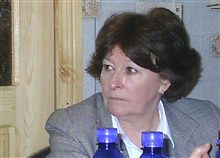
Louise Arbour, the U.N. commissioner for human rights, has now completed her tour of the North Caucasus. At a press conference in Moscow today, she said that
rights abuses remain rampant in Chechnya, and suggested the republic's pro-Kremlin government has a vested interest in maintaining, in her words, "a society ruled by force:" "Two phenomena, in my view, are particularly disturbing. One is the prevalence of the use of torture to extract confessions and information. And the second one is the intimidation of those who make complaints against public officials. In my opinion, there's no doubt that these phenomena are more than mere allegations, and that they have in fact considerable basis in reality."
Helsinki - Chechnya

Helsingin Sanomat has a report on yesterday's demonstration in Helsinki, Finland in protest against Russian military operations in Chechnya.
(via chechnya-sl)
"Friendly" Visits
A new article I just translated for Prague Watchdog:
Chechen human rights workers believe authorities may soon increase pressure on NGOs
By Liza Osmayeva
CHECHNYA / INGUSHETIA - Representatives of local NGOs working in Chechnya and Ingushetia note that regional authorities and law enforcement agencies have recently begun to show an increased interest in their activity.
According to them, officials of various power ministries and agencies have begun to use all kinds of pretexts in order to call on representatives of human rights organizations and independent media active in the region. As a rule, such visits are made for purposes of familiarization and so far no concrete complaints about the work of the NGOs have been presented.
Taisa Isayeva, head of the Information Centre of the Council of Non-governmental Organizations (SNO), said a "friendly" visit of this kind was recently made to her office which is located in the town of Nazran, Ingushetia. The other day a man arrived there introducing himself as an official of one of the law enforcement agencies and demanded to be given data on volunteers and also on all other sources from which the Centre’s information is drawn.
"While the talk was of a preventive kind, the ‘visitor’ none the less hinted that if he so wished, he would be legally authorized to seal up the office and stop the work of the organization. I think they are simply letting us know that our activity is being closely watched by the law enforcement agencies. In addition, I know of several other cases in which the taxation services and other inspecting authorities have been used in order to exert pressure on this organization or that, and also on the media. It is possible that this pressure will soon increase, especially on those NGOs which are monitoring the human rights situation in Chechnya,” Isayeva told PW’s correspondent.
This opinion is shared by the well-known Chechen human rights worker Ruslan Badalov, chairman of the Chechen National Salvation Committee (ChKNS). In a conversation with PW’s correspondent he also expressed fears that the local authorities may interpret the new federal law on NGOs as the signal for an offensive.
"The law gives officials a big opportunity to stiffen control over NGOs, all the way to liquidating them. I think they will make use of this. Take the Dmitrievsky trial and the recent ‘spy scandal’, which involved a trustworthy human rights organization. These events show that today no NGO is safe from such accusations and suspicions,” he observed.
In this connection it should also be noted that during the last week of February the hearings of the case concerning the Chechen National Salvation Committee are due to resume in Nazran, Ingushetia. The republic’s prosecutor’s office has perceived an “anti-constitutional and anti-Russian" direction in the Committee’s activity and for the past year and a half has been trying to have the organization’s information materials branded as extremist.
Badalov categorically disagrees with such conclusions and assesses the proceedings as an attempt to forbid the activity of the organization. "There is no anti-Russian or anti-constitutional direction in any of our statements and press releases. On the contrary, we inform the Russian and world community about cases we know of where the law has been violated. In this instance I see the actions of the prosecutor’s office as an attempt to liquidate our organization. But we nevertheless hope that the judicial inquiry will be fair and objective, and that all the charges against the Committee will be dropped,” Ruslan Badalov said in this regard.
Chechen human rights workers fear that pressure on NGOs in the region may intensify soon. In their opinion, the accusations against Russian human rights activists, the ban on the activity of the Danish Refugee Council (DRC) in Chechnya, the legal proceedings against the ChKNS are all links in the same chain, and this cannot really be explained simply as an excess on the part of the authorities.
The Stranger
Excerpts from Finnish author Juha Ruusuvuori's A Stranger in Moominvalley (Muukalainen Muumilaaksossa, 2005) in my translation are now online at the Books From Finland website, in the latest issue of the magazine. There's also an essay on Ruusuvuori by Finland-Swedish critic Pia Ingström.
I wrote some comments on Ruusuvuori's pamphlet - on the complex theme of crossing from one Finnish culture to another - in a report from the Helsinki Book Fair last November.
I wrote some comments on Ruusuvuori's pamphlet - on the complex theme of crossing from one Finnish culture to another - in a report from the Helsinki Book Fair last November.
Thursday, February 23, 2006
A Thoroughbred Night
 A Thoroughbred Night
by Apti Bisultanov
(my tr.)
So bright
That a dog barks at its shadow
That one can see the breath of the sleeping grass
So pure
Go blind
From rain of shooting stars
Go mute
From poems
Die
From beauty
A thoroughbred night
Or
A mountain range is growing in my heart
1983
_________________________________________________________________________________________________________
Apti Bisultanov was born in 1959 in Goichu, Chechnya. He studied philology and worked as a lecturer, editor, publisher, and partisan. He was Minister for Social Protection in the government of President Aslan Maskhadov. In 1992 he received the Chechen National Award for his poem "Written in Chaibach". Since 2002 he has lived in Berlin. He received the award of the Netherlands-based Poets of All Nations Foundation (PAN) in 2003. In 2004, a collection of his poems in German translation, Schatten eines Blitzes, was published.
'Bisultanov goes on to say that it is only when children are killed that the world takes an interest in the conflict; a fact demonstrated by the hostage-taking in Beslan. He adds, however, that no-one is interested in the Chechen victims; even when these victims are children. Human rights organisations estimate that at least 40,000 children have died in the fighting over the past five years.
'"But regardless of how many die - be it 30,000, or 1,000, or one - it is still children that are dying,“ says Bisultanov, himself a father. “Beslan was the most horrific, gruesome mirror image of the Chechen war to date. Beslan is Chechnya".'
Chechnya: Deportation Day

Today is World Chechnya Day, which is being held in order to
• Recognize the suffering and genocide of the Chechen people as a human catastrophe of historic significance
• Respect all victims of Stalinist deportations
• Raise awareness and understanding of the Chechen genocide as an issue of importance to humanity
• Ensure that the horrendous crimes, racism and victimisation that were committed during the Chechen genocide will never be forgotten or repeated, in Europe or elsewhere in the world
• Reflect on contemporary atrocities that raise similar issues
• Educate subsequent generations about the genocide and the continued relevance of the lessons that can be learnt from it
• Assert a continuing commitment to oppose racism, victimisation and genocide
• Support shared aspirations for the ideals of justice, security, dignity and peace for all
History:
On the 23 February 1944 the Soviet Union set in motion the immediate deportation of the entire Chechen and Ingush peoples to the steppes of Central Asia. In the depths of winter they were subjected to summary massacres and food shortages: it was a solution no less final or less brutal that the one being inflicted at the same time in Europe on the Jews. By conservative estimates half of the population died; the proportion that perished is probably much greater.
In early January 1944, tens of thousands of NKVD troops had started to arrive in the tiny mountainous republic, and fanned out to almost every settlement in the region. On Red Army Day, February 23, in every town and village the men were summoned to meetings in the local Soviet building. None suspected the calamity that was about to befall them; all came willingly. Instead of commemorating the Day, the crowds were read the Decree of the Presidium of the Supreme Soviet, which announced the complete deportation of the Chechen and Ingush people for treason and collaboration with the German enemy.
There was no evidence to support the claim of Chechen collaboration with the Nazis, which Stalin used as a pretext for disposing of a population that had continually refused to submit to Moscow's will. In fact, the German advance had never reached Chechen soil, stopping just short of the border. Moreover, Chechen soldiers had distinguished themselves in major actions throughout the Second World War, and been awarded a larger number of medals than was proportional to their numerical weight in the Soviet army. However, in the end even soldiers were not spared: they were removed from their units and sent directly to the deportation camps in Central Asia.
In each town Studebaker trucks (provided by the United States to her wartime ally under lendlease) rolled up to be loaded with Chechen men, women and children at gunpoint. The trucks transported their cargoes to the nearest railway points, where the people were crammed into bare cattle-trucks with no food and utterly inadequate clothing. Villagers from the remote mountain settlements were forced to march down to the plains. Stragglers were shot, as was anyone who resisted. Pregnant women, elderly people and others deemed to require too much effort to transport were killed. One documented example of this is the instance of 700 women, children and old people who were burnt alive in the mountain village of Khaibakh.
However, massacres like this took place all over the republic, and the Aûls (mountain villages) smouldered for weeks after.
Within days, with ruthless efficiency, an entire people had been erased from the land of their ancestors. Overnight Chechnya and Ingushetia were entirely depopulated; cartographers were instructed to expunge all references to them from official maps, records and encyclopaedias.
On February 29 Lavrentii Beria, Chief of the NKVD Secret Police, wrote to Stalin: "I report the results of the operation of resettling Chechens and Ingushi. The resettlement was begun on February 23rd in the majority of districts, with the exception of the high mountain population points... 478,479 persons were evicted and loaded onto special railway cars, including 91,250 Ingush. One hundred and eighty special trains were loaded, of which 159 were sent to the new designated place."
For almost half a million Chechen and Ingush people on their black odyssey across the frozen tundra, an ordeal of monumental suffering had just begun. The sealed trucks were crammed with families – men, women and children of all ages – in freezing, cramped conditions with no toilet or washing facilities. Typhoid epidemics swept through the crammed cattle-trucks, killing many in scenes that must have resembled those of Buchenwald and Auschwitz. Little food was provided; the weak and ill were finished off by hunger and cold.
Along the way they were treated with contempt and abuse by the local people, who had been told that the people in the trucks were being punished for collaboration with the enemy.
At one of the railroad stations Dimitri Gulia, the prominent Abkhazian educator, witnessed a scene of surreal despair: "… an unbelievable sight: an extremely long train… jammed full of people who looked like Caucasian Mountaineers. They were being sent off somewhere east, women, children, old people, all. They looked terribly sad and woebegone… These are the Chechen and Ingush and they were not travelling of their own free will. They were being deported. They had committed `very serious crimes against the Motherland'…"
The trucks were frequently searched for corpses, which were simply thrown to the side of the rail tracks and left. To avoid this fate for their relations, the Chechens tried desperately to disguise or hide the corpses in the hope of giving them an Islamic burial at their journey's end. After several weeks of travel the Chechens were scattered in remote locations across present-day Kazakhstan, Uzbekistan and Kyrgyzstan. Little or no provision was made for food or shelter for the hundreds of thousands of deportees, who were mostly left to fend for themselves.
As a historian at Moscow State University wrote two decades later: "…The most fearful and irremediable blow to the Chechen-Ingush people was struck in the first two or three years, when starvation and the most dreadful diseases obliged them to bury tens of thousands of their fellow tribespeople in the steppes of Central Asia."
In the years that followed thousands were to die of pneumonia and hunger. It was a dark episode in the tumultuous history of the Chechens, who had already suffered a long war against the full military might of the Russian Empire in the mid-nineteenth century, followed by large-scale forced emigration. Many families were scattered and were never able to reunite.
The settlements of the deportees were in effect large penal colonies. The most trivial infringements of the rules were punished by imprisonment or hard labour. Yet as the Russian writer and dissident Alexander Solzhenitsyn described in The Gulag Archipelago, the Chechens' will to survive endured.
"There was one nation which would not give in, would not acquire the mental habits of submission -- and not just individual rebels among them, but the whole nation to a man. These were the Chechens... I would say that of all the special settlers, the Chechens alone showed themselves unbroken in spirit. They had been treacherously snatched from their home, and from that day they believed in nothing... The Chechens never sought to please, to ingratiate themselves with the bosses; their attitude was always haughty and indeed openly hostile... And here is the extraordinary thing: everyone was afraid of them. No one could stop them from living as they did. The regime which had ruled the land for thirty years could not force them to respect its laws."
Conditions for the Chechens remained harsh until after the death of Stalin in 1953. Soon afterward Chechens were making official representations in Moscow for permission to return to their homeland; indeed, a trickle of Chechens had already started to return to their homes. In 1956, at the 20th Party Congress, the Soviet leader Nikita Khrushchev acknowledged the wrongs that had been done the Chechens and the other exiled peoples. The trickle had by this time become a flood, despite the authorities' best efforts to prevent the Chechens returning -- often bringing with them the bones of their kindred in order to bury them in their ancestral graveyards. But their lives could never really return to what they had been before 1944. The evil of the deportations lived on in memories, poverty, ill-health, and the bitterness spawned by these sufferings. Returning Chechens also found that their homes had been given to Russian and Dagestani settlers, from whom they had to be bought back; few were able to do so.
The deportations were not only a personal catastrophe for each of the Chechens; they were also a collective disaster for the Chechen nation as a whole. Many of the ancient mountain Aûls were in ruins and uninhabitable, forcing most of the Chechen people to live in the plains for the first time in their history, and irrevocably altering their mountain ways. Moreover, the massive loss of life among the elderly disrupted a rich oral tradition stretching back through many centuries,inflicting grave damage on Chechen culture.
The trauma and disruption inflicted by the genocide and the Chechens' subsequent ordeals cannot be overestimated, and the memories and grief of those terrible years are keenly felt by the Chechen people to this day.
Wednesday, February 22, 2006
Arbour in Chechnya - II
The Telegraph, reporting on Louise Arbour's North Caucasus tour:
THE United Nations High Commissioner for Human Rights, Louise Arbour, said today she was deeply disturbed by accounts of torture and kidnappings in Chechnya, where the Russian military has for over a decade been engaged in the bloody repression of militant separatists.Read the rest.
Ms Arbour said that while she did not underestimate the task facing the Russian forces in restoring order in the war-torn republic, she was deeply worried by reports from numerous human rights organisations of abuse at their hands, Russia news agencies reported.
She made the comments during a meeting in the Chechen capital Grozny with the public prosecutor for the region, Valery Kuznetzov, the agencies said.
Ms Arbour cited accounts of civilians disappearing, interrogators using force to extract information and pressure being exerted on witnesses who reported abuse by members of the security forces.
She recommended the creation of an independent body to investigate crimes committed during the Russian military's attempts to restore Moscow rule over the breakaway republic.
But Mr Kuznetzov dismissed her suggestion.
Self-Immolation
I just translated the following report for Prague Watchdog:
Ukrainian woman attempts self-immolation in protest at expulsion of her Chechen husband
By Aslanbek Dadayev
KIEV – A Ukrainian woman made an attempt at self-immolation in Kiev on Tuesday. Natalya Tretyak, a 48-year-old resident of Poltava Oblast, poured petrol over herself and set light to it in front of the Presidential administration building, in protest at the authorities’ decision to expel her Chechen husband Ruslan Bagayev from the country.
The building’s guards were able to douse the flames. Natalya Tretyak was taken to hospital with light burns. The doctors assess her condition as satisfactory.
The story of her husband, Ruslan Bagayev, began 11 years ago, when he left Chechnya during the First Chechen War. Since then, the refugee has not been able to acquire a residence permit that would enable him to live legally in Ukraine. Not even his marriage to a Ukrainian woman has helped him to remain in the country on a generally accepted basis. A few years ago he was even deported from the country by the Ukrainian authorities, and managed to return only after persistent efforts by his wife.
Last week a court issued a judgement on Ruslan Bagayev’s deportation to Russia and it was this that impelled his wife to such a radical step.
Aslanbek Dadayev is a Kiev correspondent of Radio Svoboda and irregular contributor to Prague Watchdog.
Tuesday, February 21, 2006
Arbour in Chechnya
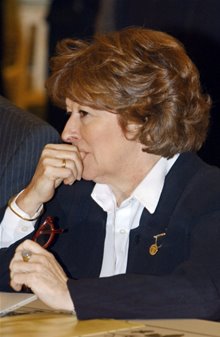
U.N. Human Rights Commissioner Louise Arbour visits Chechnya today as part of a week-long tour of the North Caucasus, AP reports (via RFE/RL):
On 21 February, Arbour was in the North Caucasus republic of Ingushetia, where she held talks with the regional President Murat Zyazikov and met with Ingush refugees of the 1992 conflict in North Ossetia.
On 22 February, Arbour heads to North Ossetia where she will visit Beslan, the site of the bloody school siege in 2004 that left more than 330 people dead, many of them children.
Before ending her stay, Arbour will meet with Russian President Vladimir Putin, who is expected to raise what Russia sees as the "politicization of human rights" and "double standards" in the international community's approach to such issues.19.30: There is a fairly full report on Louise Arbour's visit to Ingushetia yesterday at this link.
****
Some OHCHR documents on Chechnya can be found here.
Monday, February 20, 2006
Stopping the Virus
At RFE/RL, senior correspondent Jeffrey Donovan writes about the David Irving Holocaust Denial case, which went to trial in Vienna today (Irving received a three-year prison sentence):
Amid the recent storm over the Muhammad cartoons, many Europeans have supported their publication as a free-speech right -- even though the cartoons, like Irving's opinions, are offensive to many people:
“[Irving’s] actual thoughts, and views, are actually a deep affront to those who actually survived or lost loved-ones in the Holocaust," says David Dadge, who studies freedom of expression issues at the Vienna-based International Press Institute.
Dadge says free societies must allow freedom of expression, even when it offends, such as the Muhammad cartoons. He says the free exchange of information lets the public challenge questionable ideas and facts -- and that, in turn, helps marginalize them.
“You cannot, with views and ideas, keep them from being discussed," Dadge says. "And such laws as the ones that Austria actually has, tries to prevent that. But of course, through the Internet, people are going to be able to access those types of views; you can get on a train and go to another country in Europe to hear the likes of David Irving actually give speeches on those subjects. So having laws that locally try and prevent that kind of discussions is in essence kind of pointless, because it doesn’t prevent those discussions and those views from actually getting out.”
Some in the Muslim world criticize Europe for being hypocritical on free speech. That is, while some in Europe may clamor for the right to publish the Muhammad cartoons, at the same time people like Irving face the prospect of jail for simply expressing their opinions about the Holocaust.
Dadge doesn’t agree with the Holocaust denial laws in Austria, Germany, and some other European countries. But he says they were put in place in hopes of preventing a repeat of what happened during World War II and the Holocaust.
“These laws were put there to stop the virus of Nazism from spreading," Dadge says. "You can see that from a historical point of view; there’s a kind of fear about that.”
Mozart Again
For years the string group I play in has been using Volume One of the Peters edition of the Mozart String Quintets. Perhaps strangely - though we've never thought to question it - the first volume includes quintets "4-8", though these are listed as "1-5" in the parts themselves. Recently we decided we wanted to look at the rest of the quintets, so I got hold of Volume Two, which contains quintets "1-3" and "9-10", numbered "6-10" in the printed parts. Volume One contains the best-known of the quintets (K.406, K.515, K.516, K. 593 and K. 614), while Volume Two has two early quintets (K. Anh. 179 and K. 46) which are only attributed to Mozart and may not have been written by him, the Quintet in B flat K. 174, and then two versions of the Clarinet Quintet K. 581 - one in the original scoring for clarinet and string quartet, and another in which the clarinet part is played by the first viola. The series is completed by the Horn Quintet K.407, with a first viola part that can accomodate the horn part.
So Volume Two is definitely something a mixed bag. I feel that there must be some more rational way of organizing the music, but there don't appear to be any other performing editions available. The Henle Urtext editions haven't got round to producing one yet. The Breitkopf edition does present the works in a more logical order, but there is apparently no commercially available set of parts to accompany it. Perhaps I'm wrong about this - would be grateful for information on the subject from anyone who knows.
So Volume Two is definitely something a mixed bag. I feel that there must be some more rational way of organizing the music, but there don't appear to be any other performing editions available. The Henle Urtext editions haven't got round to producing one yet. The Breitkopf edition does present the works in a more logical order, but there is apparently no commercially available set of parts to accompany it. Perhaps I'm wrong about this - would be grateful for information on the subject from anyone who knows.
Sunday, February 19, 2006
Chechnya: Shaking Off The Apathy
At caucaz.com, correspondent Thibault Courcelle writes about how the Parliamentary Assembly of the Council of Europe is at long last shaking off its apathy with regard to the issue of Chechnya:
(via chechnya-sl)
On 25 January 2006, after much inaction, the Parliamentary Assembly of the Council of Europe, in its debate on the Chechen situation, finally passed a resolution condemning the methods employed by Russian security forces in Chechnya and harshly criticised the Committee of Ministers, the Council of Europe's executive body, for its passivity in the face of the continuing human rights abuses in the province. The resolution, accompanied by a recommendation, has yet to be approved by the Council of Ministers, but will probably bring about little change.Read the whole thing.
(via chechnya-sl)
Violins on VOA - III
For those who have been trying to locate the English-language versions of those VOA/AB Fable broadcasts, Anthony Barnett writes:
It seems that although the VOA programs were broadcast over the radio in both English and French, only the French were posted online. Saturday’s has now gone, and Sunday’s will go after tonight’s new program.A limited dedication to violins on the part of VOA, it appears. Once again, the all-consuming commercial factor in the music world - see this post - takes its toll.
The Secrets of the System
Carl Bildt posts a link to the text of Nikita Khrushchev's secret speech to the 20th Congress of the Communist Party of the Soviet Union, delivered just 50 years ago. Bildt considers the effects of its contents on the Communist world:
Riots in Poznan in Poland were just the beginning. In October of 1956 Hungary exploded and literally threw the Communists out - only to be brutally surpressed by the Soviet invasion some weeks later. In China, Mao Zedong refused to accept the verdict on Stalin, and quietly the beginning of the rift between the Soviet Union and China began.Read it all.
Saturday, February 18, 2006
Mozart in Estonian
For students of Estonian who also like Mozart, Estonian Radio's Klassikaraadio has a series of interviews with world-renowned interpreters of Mozart, including Alfred Brendel, Christopher Hogwood, Cecilia Bartoli, Andras Schiff, Maria João Pires, Anne Sofie von Otter and Colin Davis. The interviews are in English, but there is an interpretation into Estonian after each few sentences - and the method works surprisingly well.
See also in this blog: A Rap For Mozart
See also in this blog: A Rap For Mozart
Friday, February 17, 2006
World Chechnya Day: Memorial Service

Via worldchechnyaday.org
London, United Kingdom
World Chechnya Day Memorial Service
Date: Thursday 23 February 2006
Time: 12 - 1pm
Venue: Yalta Memorial, Cromwell Gardens, South Kensington (behind the Ismaili Centre).
Nearest tube station: South Kensington (District, Circle and Piccadilly Line)
As part of World Chechnya Day, you are invited to attend the Save Chechnya Campaign remembrance service at the Yalta Memorial in South Kensington from 12-1pm on Thursday 23rd February to commemorate the Deportations and Genocide of the Chechen people in 1944.
Sixty two years ago, on 23 February 1944, Stalin ordered the forcible deportation of the Chechen, Ingush and other nations of the North Caucasus to Central Asia. The people who were were transported with little or no provision in cattle trucks and more than half died in transit or in massacres committed by Soviet troops. Those who survived the journey were left facing starvation and disease in the harsh winters of Siberia and Central Asia. In 2004 the European Parliament passed a motion formally recognising this tragedy as a genocide.
Speaking at the Memorial will be:
* Professor George Hewitt - Professor of Caucasian Languages (SOAS), Trustee of MARCCH
* Mrs. Saida Sherif - Chairperson, Save Chechnya Campaign
* Vanessa Redgrave - Actress and Human Rights Activist
* Ahmed Zakayev - (Late) President Maskhadov's Representative in Europe
* Rabbi Jacqueline Tabick - North West Surrey Synagogue
* Revd Father Frank Gelli - Former Curate of St Mary Abbots, Kensington Parish Church. Founder of Arkadash Network for Religious Dialogue.
* Abdur Raheem Green - London Central Mosque
Schedule:
12.00 Gather at the Yalta Memorial
12.15 Opening: Mrs. Saida Sherif
12.20 Vanessa Redgrave
12.25 Professor George Hewitt
12.30 Ahmed Zakayev
12.35 Rabbi Jacqueline Tabick
12.40 Revd Father Frank Gelli
12.45 Abdur Raheem Green
12.50 Recital of Memories
13.00 Prayer
13.09 Minutes Silence
13.10 Balloon Release
Directions:
The Yalta Memorial is situated in South Kensington, London SW7 in public gardens between Cromwell Gardens and Thurloe Place:
Map
For further details, please contact Hajira Qureshi on hajira@cantab.net
See also in this blog: World Chechnya Day
The NAK
Yesterday February 16 Vladimir Putin created by decree a new National Counterterrorism Committee (NAK), which will coordinate all federal-level antiterrorism policies and operations. RFE/RL notes that "the committee will be headed by Federal Security Service Director Nikolai Patrushev (FSB) and includes members such as Foreign Minister Sergei Lavrov and Sergei Lebedev, the director of the Foreign Intelligence Service (SVR)."
Until now, the Federal Antiterrorism Commission -- created in 2002 and led by Prime Minister Mikhail Fradkov -- was the top federal organ responsible for the coordination of counterterrorism activity. The new decree not only replaces this commission with the NAK, but also creates a new "antiterrorism vertical" that will act in parallel with existing federal and regional executive powers.
Indeed, the proposed new network -- regional counterterrorism commissions led by regional administration chiefs, territorial operative staffs led by territorial FSB heads -- bears considerable resemblance to the Soviet system, which had power in any given province concentrated in the hands of the local Communist Party secretary and the head of the regional KGB.
Musings
I’ve been reading a fascinating and searching volume of essays by the scholar, composer, conductor and teacher Gunther Schuller, whose contribution at the recent Mingus seminar at the IAJE 2006 conference was in my opinion one of the most telling of the whole 4-day event. The collection, entitled Musings, was published as long ago as 1986 – yet its analysis of the fields of musical activity and inquiry it encompasses is if anything even more actual and topical today than it was twenty years ago.
Schuller is in some ways unique among contemporary musicologists in not only having a background in routine instrumental playing – he served as a player of the French horn in American symphony orchestras for some fifteen years – but also in possessing an almost encyclopedic knowledge of all the world’s different musics: from “classical”, through jazz, to all the many other musical languages of America and far beyond. In the late 1950s and early 1960s he was one of the prime movers in the founding of the Third Stream movement, which aspired to create a new musical polarity that would include classical and jazz modes of musical expression, without being confined to either.
As a composer, Schuller has always sought to bridge the gap that exists in music between the “popular” and the cerebral, the mainstream and the avant-garde. As an educator, exasperated by the onslaught of commercialism which has characterized the musical scene, dominating it and appropriating the label of “popular” for music of the least imaginative kind, he has engaged in combat. The struggle has been primarily with those who would try to narrow the discussion of contemporary music to the “elitism-versus-populism” debate, which seeks to pit the “advantaged” against the “disadvantaged”, attempting to make people “who cherish quality music look like autocrats, snobs and eggheads, insinuating that there is something anti-democratic and un-American about considering Duke Ellington superior to the Plasmatics or Mozart greater than John Lennon.” As Schuller points out, this debate is a spurious one. It avoids the central issue: “namely, that quality, creativity, and high craftsmanship can and do exist in all forms and categories of music. So can and do their opposites: mediocrity and absence of quality. No form of musical expression is either inherently blessed with quality or intrinsically devoid of it.”
In future posts I want to look at some of Schuller’s arguments in more detail, considering in particular the ways in which they apply to music education – increasingly one of the most important areas of human civilisation now.
Thursday, February 16, 2006
Double Standards
An editorial from today's Moscow Times:
A Question of Double Standards
President Vladimir Putin's decision to invite the leaders of Hamas for talks in Moscow has angered Israel and raised many eyebrows in the international community. Such a reaction should come as no surprise to Moscow, given that Hamas has carried out nearly 60 suicide bombings in Israel since 2000, killing hundreds of people.
Israel and the United States have classified Hamas as a terrorist organization, refusing to make a distinction between its political and militant wings. Just as the Kremlin has refused to make a distinction between Chechens such as Shamil Basayev, who has ordered the most horrendous terrorist attacks in Russia's history, and separatist envoys like Akhmed Zakayev, who has been granted political asylum in Britain. Both are terrorists in Putin's eyes.
Even Aslan Maskhadov, who won a popular election to become president of Chechnya in 1997, was branded a terrorist following the Dubrovka hostage-taking in 2002. Notably, Maskhadov denied any involvement in the seizure of the Moscow theater. He condemned terrorism and more than once suggested he would seek the prosecution of Basayev over the attack.
Yes, Maskhadov said his willingness to bring terrorists to justice was conditional upon the withdrawal of troops from Chechnya and restoration of his presidential rule. But even if his words were only empty rhetoric, Maskhadov, who was killed last March, did say these things. The Hamas leadership, on the other hand, has shown no willingness to condemn its militants for their suicide bombings.
Moscow has called for a united international front against terrorism, arguing that there should be no double standards and that one man's terrorist should not be another man's freedom fighter.
The invitation to Hamas has weakened Russia's argument, and the Kremlin is playing a risky game if it is betting on its capacity to influence Hamas in spite of having lost its clout as a global superpower.
But Putin -- who met Wednesday with an envoy of the Quartet of Middle East peace mediators, former World Bank President James Wolfensohn -- will still come out ahead if he unequivocally demands that Hamas renounce terrorism and acknowledge Israel's right to exist. He will then have to be ready to cut all ties with the Palestinian organization if it refuses to meet these demands.
Otherwise, Moscow will no longer be able to complain about double standards. Its only hope will be that the United States and other members of the international community turn their backs on whatever is left of the moderate wing of Chechen separatism.
The Great Firewall of China - II
Via Wired, AP's report on the shaming of Yahoo, Google, Cisco and Microsoft that took place yesterday in the House of Representatives. An excerpt:
See also in this blog: The Great Firewall of China
The BBC's report is here.Lawmakers blasted four U.S. tech giants Wednesday, accusing them of willingly helping China suppress dissent in return for access to a booming internet market.
Representatives from Microsoft, Yahoo, Cisco Systems. and Google defended themselves at a House International Relations subcommittee hearing, but a Google official acknowledged that figuring out China's internet market "has been a difficult exercise."
Lawmakers, however, were skeptical of what several saw as the companies' efforts to explain their business practices in China only after a recent crush of negative media and government attention.
Rep. Tom Lantos, the full committee's top Democrat, told the company officials that they had amassed great wealth and influence "but apparently very little social responsibility."
"Your abhorrent actions in China are a disgrace," Lantos said at the hearing. "I simply don't understand how your corporate leadership sleeps at night."
See also in this blog: The Great Firewall of China
Wednesday, February 15, 2006
Harassment of Mari Activists
"Escalating Harassment of Mari National Activists"
issued by the International Helsinki Federation for Human Rights (IHF) today.
For further information, please contact Henriette Schroeder
schroeder@ihf-hr.org
__________________________________________
Press and Public Information, Henriette Schroeder
International Helsinki Federation for Human Rights
Wickenburggasse 14/7, A-1080 Vienna, Austria
Tel. +43-1-408 88 22; Mobile: ++ 43 - 676 - 725 48 29
Fax: +43-1-408 88 22-50
Internet: http://www.ihf-hr.org
Escalating Harassment of Mari National Activists
Vienna/Moscow, 15 February 2006. The International Helsinki Federation for Human Rights (IHF) and the Moscow Helsinki Group (MHG) are concerned about reports of escalating harassment of Mari national activists in the Republic of Mari El, one of Russia's so-called ethnic regions.
According to information available to the IHF and the MHG, the authorities of Mari El have recently stepped up their efforts to stifle the activities of two local organizations committed to promoting the rights of the Mari minority, Mari Ushem and Mer Kanash. An investigation has been opened to consider grounds for closing down the two organizations and leading members of the organizations, as well as their family members, have been subject to pressure. The chair of Mari Ushem, Nina Maksimova, has been threatened by dismissal from her position as a teacher at a children's center.
There are indications that the problems faced by Mari activists may have intensified after the publication of a joint IHF-MHG report about the Mari minority of Mari El on 1 February 2006. This report shows that members of the Mari national movement have been the targets of a growing crack-down on their activities during the period in office of the current president of Mari El, Leonid Markelov. Involved in peaceful efforts to communicate their concerns about the protection of the Mari minority and to challenge official policies of the republic, members of the movement have been ridiculed and denigrated in state-controlled media and have been subject to intimidation, arrest, prosecution, dismissal and violent attacks.
The new developments in Mari El take place in the context of an ongoing broader assault on civil society groups in the Russian Federation, which includes the adoption of a highly restrictive NGO law and efforts to silence leading human rights groups working at the federal level.
The IHF and the MHG call on the authorities of Mari El, as well as the Russian Federation, to immediately stop all forms of harassment against civil society organizations involved in efforts to publicize and address problems with respect to minority and other areas of human rights protection and to instead work together with such organizations toward ensuring compliance with international human rights standards.
The recent IHF-MHG report - The Human Rights Situation of the Mari Minority of the Republic of Mari El - is available, in English and Russian, at
http://www.ihf-hr.org/documents/doc_summary.php?sec_id=3&d_id=4185
A Finnish summary can also be found at the IHF website.
Fore more information:
Vienna: Aaron Rhodes, IHF Executive Director, +43-1-408 88 22, +43-676-635
66 12; Henriette Schroeder, IHF Press Officer, +43-1-408 88 22; +43-676-725
4829; Ann-Sofie Nyman, IHF Researcher, +43-1-408 88 22
Moscow: Irina Sergeeva, MHG Project Coordinator, +7-495-207 0769
(via MAK)
issued by the International Helsinki Federation for Human Rights (IHF) today.
For further information, please contact Henriette Schroeder
schroeder@ihf-hr.org
__________________________________________
Press and Public Information, Henriette Schroeder
International Helsinki Federation for Human Rights
Wickenburggasse 14/7, A-1080 Vienna, Austria
Tel. +43-1-408 88 22; Mobile: ++ 43 - 676 - 725 48 29
Fax: +43-1-408 88 22-50
Internet: http://www.ihf-hr.org
Escalating Harassment of Mari National Activists
Vienna/Moscow, 15 February 2006. The International Helsinki Federation for Human Rights (IHF) and the Moscow Helsinki Group (MHG) are concerned about reports of escalating harassment of Mari national activists in the Republic of Mari El, one of Russia's so-called ethnic regions.
According to information available to the IHF and the MHG, the authorities of Mari El have recently stepped up their efforts to stifle the activities of two local organizations committed to promoting the rights of the Mari minority, Mari Ushem and Mer Kanash. An investigation has been opened to consider grounds for closing down the two organizations and leading members of the organizations, as well as their family members, have been subject to pressure. The chair of Mari Ushem, Nina Maksimova, has been threatened by dismissal from her position as a teacher at a children's center.
There are indications that the problems faced by Mari activists may have intensified after the publication of a joint IHF-MHG report about the Mari minority of Mari El on 1 February 2006. This report shows that members of the Mari national movement have been the targets of a growing crack-down on their activities during the period in office of the current president of Mari El, Leonid Markelov. Involved in peaceful efforts to communicate their concerns about the protection of the Mari minority and to challenge official policies of the republic, members of the movement have been ridiculed and denigrated in state-controlled media and have been subject to intimidation, arrest, prosecution, dismissal and violent attacks.
The new developments in Mari El take place in the context of an ongoing broader assault on civil society groups in the Russian Federation, which includes the adoption of a highly restrictive NGO law and efforts to silence leading human rights groups working at the federal level.
The IHF and the MHG call on the authorities of Mari El, as well as the Russian Federation, to immediately stop all forms of harassment against civil society organizations involved in efforts to publicize and address problems with respect to minority and other areas of human rights protection and to instead work together with such organizations toward ensuring compliance with international human rights standards.
The recent IHF-MHG report - The Human Rights Situation of the Mari Minority of the Republic of Mari El - is available, in English and Russian, at
http://www.ihf-hr.org/documents/doc_summary.php?sec_id=3&d_id=4185
A Finnish summary can also be found at the IHF website.
Fore more information:
Vienna: Aaron Rhodes, IHF Executive Director, +43-1-408 88 22, +43-676-635
66 12; Henriette Schroeder, IHF Press Officer, +43-1-408 88 22; +43-676-725
4829; Ann-Sofie Nyman, IHF Researcher, +43-1-408 88 22
Moscow: Irina Sergeeva, MHG Project Coordinator, +7-495-207 0769
(via MAK)
Much Ado
A recent post on chechnya-sl
Much Ado About (Almost) Nothing
Here in Israel there were over the years some claims of Chechen Aid to the Palestinians, and i can testify that not one had any ground to it (BTW, Maskhadov's Government alway denied this alleged link; as far as i know, most of the time the Chechens wanted nothing to do with the Israeli-Palestinian Conflict). Those Hamas "links" are a Poster showing the faces Of Khattab, Hamas Leader Akhmed Yassin and Bassayev and Bin-Laden - all portrayed as heros of Islamic Struggle, see the links - some other Anti-Russian material, and a Fatwa (Islamic Ruling) from 2001 byMahmed Ibn Abdullah El-Seif (Do I spell it correctly?), the so-called "mufti of the Chechen Islamic fighters", sanctioning Suicide attacks agains the infidels. this last fatwa was Published on the Hamas Website in 2001. I Personally know the material is Original, and the army captured more than one Hamas CD-Rom and Poster that endorses theChechens' struggle against Russia, trying to portray it as part of as worldwide Islamic Struggle. However, I'm quite Sure That Russia knows that already. for twoyears they have been getting this material, and i don't think thatPutin has any Illusions about the Hamas, or really believes it is not a terrorist organization. he does it for his political reasons, perhaps to get himself back into middle east Bussiness, and I believe he's fully aware of the Hamas Covenant and Anti-Russian propaganda. Therefore the Israeli effort is unlikely to bring any change in Russian attitude towards the Hamas.
Links:
1. Khattab, Yassin, Bassayev, Bin-Laden:
http://www.intelligence.org.il/sp/9_04/img/chech_1.gif
2. "Hamas - we don't believe in Talks". map of Chechnya on the left.
http://www.intelligence.org.il/sp/9_04/img/chech_3.jpg
3. "The Commander of the Mujaheedin In Chechnya, The Shaid Commander Kahttab":
http://www.intelligence.org.il/sp/9_04/img/chech_4.jpg
4. Obituary for Khattab:
http://www.intelligence.org.il/sp/9_04/img/chech_6.jpg
5. From the CD "Russian Hell in Chechnya" (available through Emule. i used it for research):
http://www.intelligence.org.il/sp/9_04/img/chech_7.jpg
ok, i think this is enough. Those who read russian can find the review by the Israeli center for Intelligence and Terrorism Studies here:
http://www.intelligence.org.il/ru/ru_n/pdf/hamas_moscow_r.pdf
Much Ado About (Almost) Nothing
Here in Israel there were over the years some claims of Chechen Aid to the Palestinians, and i can testify that not one had any ground to it (BTW, Maskhadov's Government alway denied this alleged link; as far as i know, most of the time the Chechens wanted nothing to do with the Israeli-Palestinian Conflict). Those Hamas "links" are a Poster showing the faces Of Khattab, Hamas Leader Akhmed Yassin and Bassayev and Bin-Laden - all portrayed as heros of Islamic Struggle, see the links - some other Anti-Russian material, and a Fatwa (Islamic Ruling) from 2001 byMahmed Ibn Abdullah El-Seif (Do I spell it correctly?), the so-called "mufti of the Chechen Islamic fighters", sanctioning Suicide attacks agains the infidels. this last fatwa was Published on the Hamas Website in 2001. I Personally know the material is Original, and the army captured more than one Hamas CD-Rom and Poster that endorses theChechens' struggle against Russia, trying to portray it as part of as worldwide Islamic Struggle. However, I'm quite Sure That Russia knows that already. for twoyears they have been getting this material, and i don't think thatPutin has any Illusions about the Hamas, or really believes it is not a terrorist organization. he does it for his political reasons, perhaps to get himself back into middle east Bussiness, and I believe he's fully aware of the Hamas Covenant and Anti-Russian propaganda. Therefore the Israeli effort is unlikely to bring any change in Russian attitude towards the Hamas.
Links:
1. Khattab, Yassin, Bassayev, Bin-Laden:
http://www.intelligence.org.il/sp/9_04/img/chech_1.gif

2. "Hamas - we don't believe in Talks". map of Chechnya on the left.
http://www.intelligence.org.il/sp/9_04/img/chech_3.jpg

3. "The Commander of the Mujaheedin In Chechnya, The Shaid Commander Kahttab":
http://www.intelligence.org.il/sp/9_04/img/chech_4.jpg

4. Obituary for Khattab:
http://www.intelligence.org.il/sp/9_04/img/chech_6.jpg

5. From the CD "Russian Hell in Chechnya" (available through Emule. i used it for research):
http://www.intelligence.org.il/sp/9_04/img/chech_7.jpg

ok, i think this is enough. Those who read russian can find the review by the Israeli center for Intelligence and Terrorism Studies here:
http://www.intelligence.org.il/ru/ru_n/pdf/hamas_moscow_r.pdf
The Great Firewall of China
The "Great Firewall of China" open hearing in the U.S. House of Representatives is currently going out live at this link.
(Via Bildt Comments)
The session is proving to be quite telling, and is revealing some real weaknesses in State Department and Administration policies towards China. Yahoo, Google, Cisco and Microsoft, all of which have official representatives present and testifying, are not doing too well in justifying their practices, either. They sound angry and defensive, and are falling back on the threadbare "imperfect world" and "constructive engagement" arguments that were so familiar during the - pre-Internet - detente debates of the Cold War.
What's becoming clear as the hearing continues is that the U.S. Internet companies are essentially doing the Chinese government's work for it, and are co-operating in the persecution and detention - often leading to torture and death - of Chinese citizens accused of anti-government activity. As Tom Lantos most eloquently pointed out, the argument that the companies have been following legal orders of the U.S. government is not valid - IBM was following legal orders when it worked in Nazi Germany during the 1930s and helped to create the technology that made the Holocaust possible.
It all adds up to another example of how some of the world's most repressive governments are increasingly trying to turn the elements of Western democracy against it - and having some success, something that didn't really happen during the Cold War. Someone has been studying and learning some lessons.
(Via Bildt Comments)
The session is proving to be quite telling, and is revealing some real weaknesses in State Department and Administration policies towards China. Yahoo, Google, Cisco and Microsoft, all of which have official representatives present and testifying, are not doing too well in justifying their practices, either. They sound angry and defensive, and are falling back on the threadbare "imperfect world" and "constructive engagement" arguments that were so familiar during the - pre-Internet - detente debates of the Cold War.
What's becoming clear as the hearing continues is that the U.S. Internet companies are essentially doing the Chinese government's work for it, and are co-operating in the persecution and detention - often leading to torture and death - of Chinese citizens accused of anti-government activity. As Tom Lantos most eloquently pointed out, the argument that the companies have been following legal orders of the U.S. government is not valid - IBM was following legal orders when it worked in Nazi Germany during the 1930s and helped to create the technology that made the Holocaust possible.
It all adds up to another example of how some of the world's most repressive governments are increasingly trying to turn the elements of Western democracy against it - and having some success, something that didn't really happen during the Cold War. Someone has been studying and learning some lessons.
The Middle East and Russia's New Game
By George Friedman
Last Thursday, Feb. 9, Russian President Vladimir Putin invited the leadership of Hamas, the Islamist political party that won the recent Palestinian elections, to visit Moscow. Hamas quickly accepted, and the meeting is expected to take place later this month. As with many things diplomatic, the fact that the invitation was extended and that the meeting will take place is infinitely more important than what is said during the meeting.
The invitation has little to do with Hamas and less to do with Israel. On the whole, anything that strengthens the radical Islamist movement -- which would certainly include Hamas -- ought to be anathema to Moscow, given the trouble that the Russians are having in Chechnya. But Russia has bigger problems: namely, its own role in the world, and the United States. The invitation is not about Israelis and Palestinians. It is entirely about U.S.-Russian relations -- and as such, it represents a significant moment.
Backdrop: Russia's Strategy Reversal
On Sunday, Feb. 12, U.S. Secretary of State Condoleezza Rice repeated what has now become a constant American theme on Russia, saying, "We are very concerned, particularly about some of the elements of democratization that seem to be going in the wrong direction." She went on to note, "I think the question is open as to where Russia's future development is going." To say that this theme irritates the Russians vastly understates the situation.
The Russians are, in fact, redefining their geopolitical position. Since the mid-1980s, the Russians have been of the opinion that abandoning a geopolitical confrontation with the United States would result in economic benefits. Put another way, the Russians were prepared to learn from the West and took their bearings from the West. Western advice and lectures were expected and, in some ways, even welcomed.
Today, the Russians' view of this strategy is divided. There are those who think that this arrangement has been a catastrophe for Russia. Then there are those who would argue that the process has been bad but can be redeemed. Finally, there is a very small minority who believe that the reforms would work if they would only go farther and faster. This faction has become irrelevant in Moscow. The debate is between those who want a complete reversal in policy -- a large minority -- and those who acknowledge that massive readjustments must be made on all levels but say the basic idea of private property and markets should not be completely abandoned.
What is going on, therefore, is a struggle over how far democracy should be curtailed and to what extent market reforms should be reined in. Overlaying this is a deep suspicion about the intentions of the United States. The dominant view is that Rice's demands for increased democratization are an attempt to weaken Russia further. Those who hold this opinion point to what they see as the behavior of U.S. intelligence in the areas of the former Soviet Union that they regard as being properly part of Russia's sphere of influence. In particular, they view events in Ukraine as evidence that the United States is committed to causing Russia's implosion, by forcing harmful reforms within it and then by surrounding Russia with hostile clients of the United States.
At the V-E Day celebrations in May 2005, U.S. President George W. Bush went out of his way to push both themes -- first by visiting Latvia and Georgia, two countries regarded as hostile to Russian interests, and then by publicly criticizing the failure of the Russians to democratize. Washington made it clear that it did not intend to relieve the pressure, and the Russians believed that. As a result, the Russians have been on an offensive, on multiple levels, to challenge U.S. influence in what they call "the near abroad." Since Jan. 1, shutting off natural gas flows to Ukraine and Georgia has been part of this process.
And this brings us to Moscow's invitation to Hamas. There are a number of reasons to make the invitation -- the single most important of which was that the United States did not want it to be done. The Russians also reached out to the Israelis, albeit belatedly: On Saturday, Feb. 12, Russian Defense Minister Sergei Ivanov invited his Israeli counterpart, Shaul Mofaz, to Russia in a gesture designed to show that the Russians were not tilting toward Hamas. But between the lines, the Russians wanted to deliver two messages to Washington.
The first was that Moscow no longer regards itself as a junior partner to the United States in foreign policy -- and, in fact, doesn't regard itself as a partner at all. Second, they wanted to make it clear that, just as Washington is making trouble for Russia in its own periphery, the Russians are equally capable of making trouble in areas that are of fundamental interest to the United States. Moscow's message is this: Do not assume that the failure of Russia to exercise its foreign policy options means that the Russians have no foreign policy options. Nothing Russia is getting from the United States in economic relations compensates for the geopolitical harm the United States is doing to Russia. In other words, this is about 2005, not 1995. A lot happened in the last decade, most of it not good for the Russians. The rules are changing.
There is another, more directly strategic reason for the move. Russia has, and has always had, strategic interests in the Middle East. Given the decay of Russia's strategic position in the formerly Soviet region, these interests -- which today include ties to Syria and a potential partnership with Iran on nuclear enrichment -- have become more important rather than less. The U.S. penetration of Central Asia, the Baltics and Ukraine cannot simply be countered in these areas; it is only by challenging the United States in the Middle East that Moscow can divert American attention from areas of great interest to the Russians. It is not just a matter of bandwidth -- meaning that the more trouble the United States has in the Middle East, the less time it has for the former Soviet Union. It is also the case that if Russia is to contain the American presence along its southern frontier, having influence and a presence to the rear of this region -- in the Middle East -- gives it leverage over some of the former Soviet republics.
Russia also sees a major diplomatic opening. The United States backed a political process in the Middle East that has resulted in the election of a government unacceptable to Washington. The United States does not have the means for negotiating with Hamas, given the rules of the game that Washington has defined. In some ways, Israel has expressed a less rigid view of Hamas than the United States has. The Russians, however, have no problem talking to Hamas, nor do they have a problem talking to the Israelis. The Israelis do not want the United States to change its position on Hamas; they welcome the rigid U.S. position. But they do recognize the need to deal with Hamas on some level. The Russians represent a useful intermediary. Thus, Russia could emerge as a critical mediator, at least for a time.
A New Dynamic
Russia's willingness to speak to Hamas creates a new dynamic in the Muslim world. Syria and Iran are seeking "great power" support against the United States. Indeed, we could expect an evolution in which the Iraqi government also would be looking for counterweights to American power. By inviting Hamas and possibly opening a channel between Hamas and the Israelis, Russia is positioning itself to become a mediator in other disputes, and to walk away with relationships that the United States has been unable to manage.
Given the robustness of Russia's arms industry, which is much more vital and advanced than is generally understood, the Russians could return to their role as arms provider to the region and patron of governments that are hostile to the United States. The situation from 1955 to 1990 was a much more natural geopolitical dynamic than the current situation, in which Russia is really not present in the region. Russia is a natural player in the Middle East.
Remember also that Hamas is very close to Saudi Arabia, with which Russia has an intensely competitive relationship in the energy markets. And then there is Chechnya. The Russians have long charged that "Wahhabi" influence was behind the Chechen insurgency as well as insurgencies in Central Asia. In the Russian mind, "Wahhabi" is practically a code word for "Islamist militants," including al Qaeda. The Russians also feel that, while the Americans have forced the Saudis to provide intelligence on al Qaeda, they have not elicited similar aid on the issue of the Chechens. In other words, Moscow perceives the United States not only as having neglected to help Russia on Chechnya, but as actually hindering it.
The Russians badly want to bring the Chechen rebellion under control without allowing Chechnya to secede. They believe that the Chechen insurgents, and particularly the internationalized jihadist faction among them, would not survive if outside support dried up. They believe that the United States is not displeased to see the Chechen war bleeding Russia, and that Washington has discouraged Saudi collaboration with Moscow. All things considered, this is probably true. In reaching out to Hamas, Russia is also reaching out to the Saudis. The Saudis cannot control the Chechens, but they may have some means of determining the level of operations the Chechens are able to maintain.
Conclusion
Of course, many of these things are amorphous, and some are certainly dubious. Nevertheless, the Hamas affair is of substantial significance, for several reasons. First, the Russians are clearly signaling that they intend to get back into the Middle East game. Second, they are aware that this will make the United States extremely uncomfortable. Third, that is exactly what they intend to achieve. Creating problems for the United States in strategic areas is what the Russians think is in their national interest right now.
Washington has been trying to get its arms around the evolution in Moscow for months now. Given everything on the Bush administration's plate, it is not clear that there has been time to look deeply at the emerging situation. At least publicly, the administration continues to maintain the same attitude toward Moscow that has been evident since Mikhail Gorbachev: The Russians are the students, and Washington the teacher. Washington is concerned about the Russian evolution, but at this point has no policy response.
Washington will have to choose one of two courses. First, it can try to close the noose on Moscow -- consolidating the U.S. position on Russia's periphery, blocking Russian counters and encouraging secessionist tendencies within the Russian Federation itself. In other words, the United States can go in for the kill and be prepared to live with the consequences of failure. Alternatively, it can accept that it has reached the high-water mark of U.S. influence in the Russian sphere, and then manage the return of most of that region to Moscow's orbit. In turn, it can then deal with Russia's re-emergence as a potential superpower in a generation or two.
What is not a strong option is what the United States is now doing. Wounding a bear without killing it is the most dangerous game of them all. Nothing the United States is doing now will kill the bear. It is, however, guaranteed to irritate him enormously and convince him that in due course, he will be killed. There are no good outcomes from this strategy.
In the end, Moscow's invitation to Hamas is intended to be a warning that Russia can make life increasingly difficult for the United States -- and that Russia plans to do just that.
Send questions or comments on this article to analysis@stratfor.com.
Distribution and Reprints
This report may be distributed or republished with attribution to Strategic Forecasting, Inc. at www.stratfor.com.
Last Thursday, Feb. 9, Russian President Vladimir Putin invited the leadership of Hamas, the Islamist political party that won the recent Palestinian elections, to visit Moscow. Hamas quickly accepted, and the meeting is expected to take place later this month. As with many things diplomatic, the fact that the invitation was extended and that the meeting will take place is infinitely more important than what is said during the meeting.
The invitation has little to do with Hamas and less to do with Israel. On the whole, anything that strengthens the radical Islamist movement -- which would certainly include Hamas -- ought to be anathema to Moscow, given the trouble that the Russians are having in Chechnya. But Russia has bigger problems: namely, its own role in the world, and the United States. The invitation is not about Israelis and Palestinians. It is entirely about U.S.-Russian relations -- and as such, it represents a significant moment.
Backdrop: Russia's Strategy Reversal
On Sunday, Feb. 12, U.S. Secretary of State Condoleezza Rice repeated what has now become a constant American theme on Russia, saying, "We are very concerned, particularly about some of the elements of democratization that seem to be going in the wrong direction." She went on to note, "I think the question is open as to where Russia's future development is going." To say that this theme irritates the Russians vastly understates the situation.
The Russians are, in fact, redefining their geopolitical position. Since the mid-1980s, the Russians have been of the opinion that abandoning a geopolitical confrontation with the United States would result in economic benefits. Put another way, the Russians were prepared to learn from the West and took their bearings from the West. Western advice and lectures were expected and, in some ways, even welcomed.
Today, the Russians' view of this strategy is divided. There are those who think that this arrangement has been a catastrophe for Russia. Then there are those who would argue that the process has been bad but can be redeemed. Finally, there is a very small minority who believe that the reforms would work if they would only go farther and faster. This faction has become irrelevant in Moscow. The debate is between those who want a complete reversal in policy -- a large minority -- and those who acknowledge that massive readjustments must be made on all levels but say the basic idea of private property and markets should not be completely abandoned.
What is going on, therefore, is a struggle over how far democracy should be curtailed and to what extent market reforms should be reined in. Overlaying this is a deep suspicion about the intentions of the United States. The dominant view is that Rice's demands for increased democratization are an attempt to weaken Russia further. Those who hold this opinion point to what they see as the behavior of U.S. intelligence in the areas of the former Soviet Union that they regard as being properly part of Russia's sphere of influence. In particular, they view events in Ukraine as evidence that the United States is committed to causing Russia's implosion, by forcing harmful reforms within it and then by surrounding Russia with hostile clients of the United States.
At the V-E Day celebrations in May 2005, U.S. President George W. Bush went out of his way to push both themes -- first by visiting Latvia and Georgia, two countries regarded as hostile to Russian interests, and then by publicly criticizing the failure of the Russians to democratize. Washington made it clear that it did not intend to relieve the pressure, and the Russians believed that. As a result, the Russians have been on an offensive, on multiple levels, to challenge U.S. influence in what they call "the near abroad." Since Jan. 1, shutting off natural gas flows to Ukraine and Georgia has been part of this process.
And this brings us to Moscow's invitation to Hamas. There are a number of reasons to make the invitation -- the single most important of which was that the United States did not want it to be done. The Russians also reached out to the Israelis, albeit belatedly: On Saturday, Feb. 12, Russian Defense Minister Sergei Ivanov invited his Israeli counterpart, Shaul Mofaz, to Russia in a gesture designed to show that the Russians were not tilting toward Hamas. But between the lines, the Russians wanted to deliver two messages to Washington.
The first was that Moscow no longer regards itself as a junior partner to the United States in foreign policy -- and, in fact, doesn't regard itself as a partner at all. Second, they wanted to make it clear that, just as Washington is making trouble for Russia in its own periphery, the Russians are equally capable of making trouble in areas that are of fundamental interest to the United States. Moscow's message is this: Do not assume that the failure of Russia to exercise its foreign policy options means that the Russians have no foreign policy options. Nothing Russia is getting from the United States in economic relations compensates for the geopolitical harm the United States is doing to Russia. In other words, this is about 2005, not 1995. A lot happened in the last decade, most of it not good for the Russians. The rules are changing.
There is another, more directly strategic reason for the move. Russia has, and has always had, strategic interests in the Middle East. Given the decay of Russia's strategic position in the formerly Soviet region, these interests -- which today include ties to Syria and a potential partnership with Iran on nuclear enrichment -- have become more important rather than less. The U.S. penetration of Central Asia, the Baltics and Ukraine cannot simply be countered in these areas; it is only by challenging the United States in the Middle East that Moscow can divert American attention from areas of great interest to the Russians. It is not just a matter of bandwidth -- meaning that the more trouble the United States has in the Middle East, the less time it has for the former Soviet Union. It is also the case that if Russia is to contain the American presence along its southern frontier, having influence and a presence to the rear of this region -- in the Middle East -- gives it leverage over some of the former Soviet republics.
Russia also sees a major diplomatic opening. The United States backed a political process in the Middle East that has resulted in the election of a government unacceptable to Washington. The United States does not have the means for negotiating with Hamas, given the rules of the game that Washington has defined. In some ways, Israel has expressed a less rigid view of Hamas than the United States has. The Russians, however, have no problem talking to Hamas, nor do they have a problem talking to the Israelis. The Israelis do not want the United States to change its position on Hamas; they welcome the rigid U.S. position. But they do recognize the need to deal with Hamas on some level. The Russians represent a useful intermediary. Thus, Russia could emerge as a critical mediator, at least for a time.
A New Dynamic
Russia's willingness to speak to Hamas creates a new dynamic in the Muslim world. Syria and Iran are seeking "great power" support against the United States. Indeed, we could expect an evolution in which the Iraqi government also would be looking for counterweights to American power. By inviting Hamas and possibly opening a channel between Hamas and the Israelis, Russia is positioning itself to become a mediator in other disputes, and to walk away with relationships that the United States has been unable to manage.
Given the robustness of Russia's arms industry, which is much more vital and advanced than is generally understood, the Russians could return to their role as arms provider to the region and patron of governments that are hostile to the United States. The situation from 1955 to 1990 was a much more natural geopolitical dynamic than the current situation, in which Russia is really not present in the region. Russia is a natural player in the Middle East.
Remember also that Hamas is very close to Saudi Arabia, with which Russia has an intensely competitive relationship in the energy markets. And then there is Chechnya. The Russians have long charged that "Wahhabi" influence was behind the Chechen insurgency as well as insurgencies in Central Asia. In the Russian mind, "Wahhabi" is practically a code word for "Islamist militants," including al Qaeda. The Russians also feel that, while the Americans have forced the Saudis to provide intelligence on al Qaeda, they have not elicited similar aid on the issue of the Chechens. In other words, Moscow perceives the United States not only as having neglected to help Russia on Chechnya, but as actually hindering it.
The Russians badly want to bring the Chechen rebellion under control without allowing Chechnya to secede. They believe that the Chechen insurgents, and particularly the internationalized jihadist faction among them, would not survive if outside support dried up. They believe that the United States is not displeased to see the Chechen war bleeding Russia, and that Washington has discouraged Saudi collaboration with Moscow. All things considered, this is probably true. In reaching out to Hamas, Russia is also reaching out to the Saudis. The Saudis cannot control the Chechens, but they may have some means of determining the level of operations the Chechens are able to maintain.
Conclusion
Of course, many of these things are amorphous, and some are certainly dubious. Nevertheless, the Hamas affair is of substantial significance, for several reasons. First, the Russians are clearly signaling that they intend to get back into the Middle East game. Second, they are aware that this will make the United States extremely uncomfortable. Third, that is exactly what they intend to achieve. Creating problems for the United States in strategic areas is what the Russians think is in their national interest right now.
Washington has been trying to get its arms around the evolution in Moscow for months now. Given everything on the Bush administration's plate, it is not clear that there has been time to look deeply at the emerging situation. At least publicly, the administration continues to maintain the same attitude toward Moscow that has been evident since Mikhail Gorbachev: The Russians are the students, and Washington the teacher. Washington is concerned about the Russian evolution, but at this point has no policy response.
Washington will have to choose one of two courses. First, it can try to close the noose on Moscow -- consolidating the U.S. position on Russia's periphery, blocking Russian counters and encouraging secessionist tendencies within the Russian Federation itself. In other words, the United States can go in for the kill and be prepared to live with the consequences of failure. Alternatively, it can accept that it has reached the high-water mark of U.S. influence in the Russian sphere, and then manage the return of most of that region to Moscow's orbit. In turn, it can then deal with Russia's re-emergence as a potential superpower in a generation or two.
What is not a strong option is what the United States is now doing. Wounding a bear without killing it is the most dangerous game of them all. Nothing the United States is doing now will kill the bear. It is, however, guaranteed to irritate him enormously and convince him that in due course, he will be killed. There are no good outcomes from this strategy.
In the end, Moscow's invitation to Hamas is intended to be a warning that Russia can make life increasingly difficult for the United States -- and that Russia plans to do just that.
Send questions or comments on this article to analysis@stratfor.com.
Distribution and Reprints
This report may be distributed or republished with attribution to Strategic Forecasting, Inc. at www.stratfor.com.
Parallel Worlds
Yulia Latynina, writing in the Moscow Times, has some observations about Russia's spin doctors (who include the country's president) which make disturbing reading, as they indicate that Russia's "security services" actually work against the country's security. An excerpt:
In his speech to the FSB brass, Putin commended the border guards for shoring up the country's borders and making it harder for terrorists to enter. Judging by Putin's speech, you'd have thought Shamil Basayev was hiding out in Mexico, like Trotsky. But when Basayev gave an interview to Andrei Babitsky last summer, he met the Radio Free Europe/Radio Liberty reporter in Ingushetia. Earlier, the authorities had nearly captured Basayev and his wife on the outskirts of Nalchik, the capital of Kabardino-Balkaria.Commenting on the recent explosion at an army barracks in Chechnya which killed 13 and injured more than 20, Latynina points to the absurdity of the government's spin on this, which suggested that the explosion had been caused by propane gas tanks - which turned out to be intact. She adds:
When it became clear that cops had driven Basayev around Nalchik, the Interior Ministry needed to save face. Not long after, the cops entered a mosque belonging to the Jamaat of Kabardino-Balkaria in the village of Volny Aul and beat up hundreds of people. After several years of similar beatings, the Muslims of Nalchik rose up in armed rebellion on Oct. 13, 2005. And they were destroyed. In his speech last week, Putin singled out the operation in Nalchik as "an example of successful work by the Russian law enforcement agencies as a whole and by FSB employees in particular."
Two parallel worlds exist in this country. In one world, the military, law enforcement and the security services have turned into an enormous supermarket that offers its services to criminals and terrorists alike. The siloviki release hard-core extremists for cash and provide a taxi service for Basayev.The article can also be read here.
In the other world, terrorists are wasted in outhouses and caves, and when Defense Ministry barracks explode, propane is the culprit.
What astounds me about the propane story is that they showed the intact gas tanks on television. Any explosives expert will tell you that when a propane tank explodes, the metal pretty much vaporizes.
Then again, any spin doctor worth his salt will tell you that if you want people to believe that a propane tank explosion destroyed an army barracks, you'd better show them some tanks.
Subscribe to:
Posts (Atom)