In January 1995, Iran signed an $800 million contract with the Russian Ministry of Atomic Energy to complete reactors at Bushehr. This included a 1,000 megawatt reactor plant. This was scheduled to finish in 2005, but the revelation in 2002 about Iran’s uranium enrichment facility at Natanz and heavy-water reactor at Arak led to further scrutiny of Iran’s nuclear program. The Russian President, Vladimir Putin, promised the US and the EU3 that Moscow would not provide Iran with the reactor unless it complies with the IAEA safeguards. The concern, however, is that Iran would use the technology and the reactors provided by Russia to advance its “covert” nuclear program.
In spite of the perceived concealment activities by Iran, however, Moscow and Tehran signed a fuel supply deal in early 2005 that paved the way for Bushehr to come online in late 2006.
In June 2005, Russian President, Vladimir Putin said that Russia would continue its nuclear cooperation with Iran’s new president, Mahmoud Ahmadinejad. In addition, the head of the Russian Atomic Energy Agency, Alexander Rumyantsev, announced that, “Tehran intends to build another six nuclear reactors,” and that Russia would be willing to help.
Russian engineers continue their work on the Bushehr reactor. The Iranian-Russian negotiations regarding the Bushehr reactor and uranium enrichment continued through the referral of Iran to the UNSC. The US, the EU3, the IAEA, and the UN Secretary General have publicly voiced their backing of the Russian plan, but privately, officials in France, Germany, the UK, and the US have voiced skepticism about the chance of success.
Wednesday, April 12, 2006
Nuclear Iran
From Anthony H. Cordesman and Khalid R. Al-Rodhan, Iranian Nuclear Weapons? The Options If Diplomacy Fails (Center for Strategic and International Studies):


Dmitrievsky Conviction Upheld

A Nizhny Novgorod court has upheld the conviction of human rights activist Stanislav Dmitrievsky, Human Rights First reports.
“It is regrettable that in today’s Russia, the right to speak out peacefully on human rights will not be upheld by the courts,” said Maureen Byrnes, Executive Director of Human Rights First. “This court decision will further disrupt the work of the RCFS and send a chilling message to anyone in Russia who dares to speak out against human rights violations in Chechnya and the North Caucasus.”See also in this blog:
Dmitrievsky Trial
Dmitrievsky: Politkovskaya Testifies
Update: In a related development, the Moscow City Court today upheld a decision by a lower court to seize the bank accounts of Open Russia, the charity run by Mikhail Khodorkovsky, former chief executive of the Yukos oil company, who is now serving a 9-year sentence in a Siberian labour camp.
Tuesday, April 11, 2006
Both Ways
It's interesting, and instructive, to observe how Putin's government and its backers continue to attempt to manipulate Western public opinion over the matter of Russia's supposed participation in the international war on terror. On April 5, the Financial Times carried a comment article by two US-based Kremlin apologists, Nikolas Gvosdev and Dimitri Simes, who claimed that "America cannot have it both ways with Russia" - in other words that the US must decide whether "pursuing a new containment of Russia in Eurasia" is a higher priority than "forging an effective coalition of the permanent five members of the Security Council on Iran's nuclear programme." After all, the article's authors commented,
even though Russia and the US both have been targeted by al-Qaeda, the post-1999 chill on relations precluded any joint action in dealing with the Taliban in Afghanistan prior to September 11 2001 - as Mr Putin himself had proposed.The assertion that Russia has been "targeted by Al Qaeda" is slipped into the discourse unobtrusively, and without an attempt at substantiation. As Jeremy Putley has noted, Russia has indeed suffered at the hands of terrorists, but there are no proper grounds for saying al-Qaeda was involved.
Monday, April 10, 2006
Gearing Up
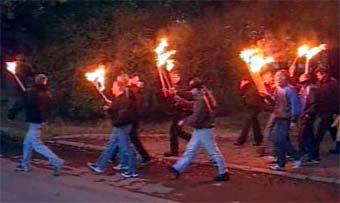
Has the Prosecutor General’s Office grown tired of the incessant campaign against it for effectively covering for fascists by opening criminal cases that are not based on the “ethnic” statutes? Or are we starting to see a realization of that political scenario which has long been mentioned as one of the most probable during 2007-2008 – the government against the fascists?Ivan Grushin in Lenta.ru, on the ongoing series of racially-motivated attacks on the streets of Russia's cities, and the government's response.
Unfortunately, it’s hard to give much credit to the theory that the government has addressed this problem simply because it has decided not to disgrace itself.
Lukashenko Takes the Oath
From the Newsline:
BELARUSIAN PRESIDENT TAKES OATH OF OFFICE. President Alyaksandr Lukashenka took the oath of office in the Palace of the Republic in Minsk on April 8, thus formally beginning his third presidential term, Belarusian and international media reported. In a speech after the swearing-in ceremony, Lukashenka said the March 19 presidential election, in which he officially won 83 percent of the vote, demonstrated "the unity of the authorities and the people" in Belarus. The president blasted his opponents both at home and abroad for what he said was their desire "to humiliate Belarus -- this islet of stability -- and turn it into another testing ground for color revolutions." He stressed that "certain countries" are seeking to export "foreign techniques of destruction, total chaos, poverty, and spiritual degradation" to Belarus. "Unfortunately, this crusade against Belarus is being spearheaded by our neighbors -- newcomers to the European Union," Lukashenka added. After the speech, Lukashenka donned a military uniform to hear an oath of allegiance that Defense Minister Leonid Maltseu read in front of several thousand troops on October Square, where the opposition staged a series of antipresidential protests last month. JM
Recovering the Music
I've just come back from York, North Yorkshire, where I was visiting Eva and Tony Fox-Gál, and listening to more of the remarkable and growing collection of recordings of compositions by the Austrian composer and musicologist Hans Gál (1890-1987). I was particularly struck by the new recording of the Serenade for clarinet, violin and piano Op. 93 by members of the Berganza Quartet - this hasn't yet been released on CD. It was also interesting to hear and discuss the constantly developing issues of how Gál's prodigious output of compositions can best be presented to a contemporary audience. While the focus on the suppressed music of the Nazi era reflects an important aspect of the work, care needs to be taken not to let this become too much emphasized, as it has a tendency to deflect attention from the intrinsic qualities of the music itself. None the less, the fine series of Wigmore Hall recordings - from the 2002 "Continental Britons" festival - which include a complete performance of Gál's First Violin Sonata of 1920, played by Konstantin Lifschitz and Nurit Pacht, gives an important guide to the background and context of Gál's development as a composer.
I also had a chance to listen to the new recording by the Edinburgh Quartet of Gál's String Quartets Nos. 1 and 4 - very achieved performances, given with great precision and intellectual warmth.
See also in this blog: Hans Gál
Music Behind Barbed Wire
I also had a chance to listen to the new recording by the Edinburgh Quartet of Gál's String Quartets Nos. 1 and 4 - very achieved performances, given with great precision and intellectual warmth.
See also in this blog: Hans Gál
Music Behind Barbed Wire
Saturday, April 08, 2006
Belarus Protest
RFE/RL noted on April 7 that
Belarusian police broke up a demonstration by some 50 opposition activists in central Minsk today, detaining at least two people.
Holocaust Note
Via Reuters:
Nazi Germany planned to expand the extermination of Jews beyond the borders of Europe and into British-controlled Palestine during World War Two, two German historians say.
In 1942, the Nazis created a special "Einsatzgruppe," a mobile SS death squad, which was to carry out the mass slaughter of Jews in Palestine similar to the way they operated in eastern Europe, the historians argue in a new study.
The director of the Nazi research center in Ludwigsburg, Klaus-Michael Mallman, and Berlin historian Martin Cueppers say an Einsatzgruppe was all set to go to Palestine and begin killing the roughly half a million Jews that had fled Europe to escape Nazi death camps like Auschwitz and Birkenau.
- - - - - - - - - - - - - - - - - - - - - - - - - - - - -
As they did in eastern Europe, the plan was for the 24 members involved in the death squad to enlist Palestinian collaborators so that the "mass murder would continue under German leadership without interruption."
Friday, April 07, 2006
Maszkiewicz Released
From RFE/RL:
Mariusz Maszkiewicz, who was hospitalized with heart problems soon after his arrest, says he was beaten in detention.
Stalin and Us
On April 1, the Washington Post published an opinion editorial by Anna Politkovskaya entitled "Stalinism Forever", in which she wrote about the hundreds of cases involving alleged Islamic terrorism which are currently passing through Russia's courts. This is a subject that is now forbidden in the Russian press and media, and Politkovskaya gave this as her reason for publishing her article in a U.S. newspaper. She stated that most of the "Islamic terrorism" cases "have been fabricated by the government so that the special services can demonstrate how ‘effective' Russia is in fighting terrorism and so that President Vladimir Putin has something with which to impress the West."
Politkovskaya focused on the case of two Grozny college students, Musa Lomayev and Mikhail Vladovskikh, who were accused by the police and the prosecutor's office of "all small, previously unsolved acts of terrorism" that had occurred about six months before in a district of Grozny, and described the treatment they received at the hands of the police and special services:
Politkovskaya focused on the case of two Grozny college students, Musa Lomayev and Mikhail Vladovskikh, who were accused by the police and the prosecutor's office of "all small, previously unsolved acts of terrorism" that had occurred about six months before in a district of Grozny, and described the treatment they received at the hands of the police and special services:
A former neighbour of the Vladovskikh family, Muslim Chudalov, was also implicated in the alleged terrorism.
As a result, Vladovskikh is now severely disabled: Both his legs were broken under torture; his kneecaps were shattered; his kidneys badly damaged by beating; his genitalia mutilated; his eyesight lost; his eardrums torn; and all of his front teeth sawed off," Politkovskaya wrote. "That is how he appeared before the court. To get Lomayev to sign - and he did sign confessions for five acts of terrorism—they inserted electrical wires in his anus and applied current. He would lose consciousness, and they would pour water on him, show him the wires again, turn him around backward—and he would sign confessions that he belonged to a gang with Vladovskikh. This despite the fact that the two defendants were first introduced to one another by their prison torturers.
Within 48 hours of being jailed, he produced confessions to 15 crimes, after which the torturers dragged him as a witness to testify at the Lomayev-Vladovskikh trial. The left side of his face was burned, his arms and legs were swollen, and he had bruises and bloodstains all over his body. He could neither walk nor stand—security personnel had to carry him in. Responding to the prosecutor's demand, his tongue faltering, Chudalov confirmed all of his testimony against Lomayev and Vladovskikh. And certainly against himself.Politkovskaya writes that
The plight of those sentenced for "Islamic terrorism" today is the same as that of the political prisoners of the Gulag Archipelago. They receive long terms -- 18 to 25 years in strict security camps in Siberian swamps and woods, with virtually all communication with the outside forbidden. Even the Red Cross is not admitted.
Russia continues to be infected by Stalinism. But it seems to me that the rest of the world has been infected along with it, a world shrunken and frightened before the threat of terrorism. I recall the words of one torture victim at his trial: "What will become of me? How will I be able to live in this country if you sentence me to such a long prison term for a crime that I did not commit, and without any proof of my guilt?"
He never received an answer to his question. Indeed, what will become of all the rest of us, who tolerate this? What has become of us already?
And Another
From RIAN:
RFE/RL has a report here.
A student from Senegal has been shot to death in an apparently racially motivated killing in St. Petersburg, local law-enforcement officials said Friday.According to kasparov.ru, the murdered student was a member of the Nashi ("Ours") young people's organization, where he led a "Lessons of Friendship" program. He was also a member of the "African Unity" organization, which represents the interests of St Petersburg's African emigre community.
The student, Samba Lanzar, was making his way home from a nightclub with a group of fellow African students when the group was fired upon on a street in the south of the city center, a representative of local student organization African Unity said.
RFE/RL has a report here.
Belarus
RIAN reports that 600 people have been charged over the Belarus "election" protests. Meanwhile Alexander Kozulin's defence lawyer says that his client will have to wait months in prison before his case goes to trial.
(via ML)
(via ML)
Another Attack
Via AP, an account of yet another racially-motivated attack in a Russian city - St Petersburg. A nine-year-old girl was stabbed in the neck by two young men.
Drinking tea in a cafe outside the hospital where Liliana is recovering, Katya recalls how she met Liliana's father Fomkan, a young musician from Mali. They soon married and had a child.The end of the report gives an indication that such attacks are being orchestrated for political reasons:
"Of course it's unusual in Russia to have a mixed race child. Even my parents were against it at the start. But I was proud of my marriage and my child," she says.
Four years later the couple divorced and Fomkan returned to Mali. Liliana's life took a turn for the worse. Children began insulting her at school and the stares became ever more insistent.
"It's monstrous to say this but sometimes I'm ashamed to have a mixed race child and I avoid telling people," Katya says.
The three stab wounds on Liliana's neck and ear are healing. But the trauma remains. "She talks only about that, she asks 'why me?'"
Katya, in tears, says she is thinking of sending Liliana to her father in Mali to protect her.
"Liliana has told me 'I don't want to live without you, but I don't want to die here either.'"
A Russian neo-Nazi website with a Saint Petersburg contact address this week carried a report of the attack on Liliana calling her a "nine-year-old monster" under a headline reading: "The Clean-Up of the City Continues."
Thursday, April 06, 2006
Coalition Offer Rejected
RFE/RL:
...both Tymoshenko and Moroz today rejected the offer. Addressing reporters at a joint press briefing with the Socialist Party leader, Tymoshenko accused the pro-presidential party of dragging its feet for political purposes.
"I know for sure that these guys would rather eat their own hands than sign a memorandum under which our political force would have the right to form a government," Tymoshenko said.
Our Ukraine Agrees to Coalition
UNIAN reports that
Ukrainian President Viktor Yushchenko`s Our Ukraine party will team up in parliament with an alliance led by former premier Yulia Tymoshenko and the Socialists, said Our Ukraine spokesman Valentyn Mondrievsky.
The Regions Party, led by Viktor Yanukovych, which won the most votes in March 26 elections, will remain in opposition, Mondrievsky said in a telephone interview today in Kiev, according to Bloomberg. Our Ukraine party was third in the elections, behind Tymoshenko’s bloc and the Regions Party.
"It is not the forming of a coalition itself," Mondrievsky said. "But we have signed just a general document to show our intention to form a coalition. We reiterate that the elections were free and fair and our main intention is to sustain economic growth, build a civil society and defend human rights."
Mass Grave Discovered in Chechnya
Another recent report I translated for Prague Watchdog:
April 5th 2006 · Prague Watchdog
Mass grave discovered in Grozny contains bodies of guerrillas and civilians
By Umalt Chadayev
CHECHNYA - In early April it was reported that a mass grave had been discovered in the grounds of Kirov Park, in Grozny’s Leninsky district. The remains of a total of 57 people have been extracted from the place.
According to representatives of the law enforcement agencies, six bodies have not yet been identified. It is planned to send their remains to the South Russian city of Rostov-on-Don for forensic medical examination.
One of the inhabitants of Grozny who was an eyewitness of the sad events told Prague Watchdog’s correspondent that the burial of people in the grounds of Kirov Park took place in the winter of 2000, when Russian soldiers stormed the Chechen capital.
"Someone was buried there almost every day,” says 44-year-old Adlan. "After all, it was precisely in January-February 2000 that Grozny underwent the most intensive shelling and air raids. Among the people killed were both guerrillas and civilians.”
"There was almost no possibility of transporting the bodies to the villages, as is usually done. The city was completely blockaded, and it was subjected to continuous bombing and shelling with all kinds of weaponry. Like many tens of thousands of Grozny’s inhabitants, I found myself in the blockaded city. It was a terrible time. There was no heat and no light, and the shortage of food supplies and water constantly made itself felt. It was impossible to evacuate the sick and wounded, and many of them died because they did not receive aid in time," he asserts.
"I also took part several times in the burials of those who had been killed. I even had a list of the surnames of everyone who was buried there, but later on I lost it. In addition, we placed a note (usually in jars or bottles) in each grave, showing the surnames and first names of the victims. As far as I know, in April-May of 2000 nine graves were uncovered in Kirov Park, and the relatives took away the remains for burial in cemeteries,” Adlan says.
“I can’t speak with certainty today, but I think that many more people were buried there. As for the bodies which could not be identified, they were most probably buried as unknowns,” the respondent believes.
As is now known, a criminal case has been opened by the Leninsky district Prosecutor’s Office concerning the discovery of the mass grave in the Chechen capital. However, local residents express doubt that the Russian soldiers who are to blame for the deaths of people in the winter of 2000 will ever be punished.
"As a result of non-selective artillery fire, which included the use of multiple-launch rocket systems such as ‘Grad’, ‘Uragan’ and ‘Smerch’, and of vacuum, needle and other bombs, thousands of innocent civilians perished in Chechnya, and in particular the city of Grozny, during 1999-2000," says Alikhan Isayev, who teaches at one of Grozny’s institutions of higher education.
"The responsibility for this lies first and foremost with the high Russian military command, including Yeltsin and Putin as commanders-in-chief," he is convinced.
"I would like to see them charged with criminal responsibility. For that reason, I consider the opening of a criminal case concerning the discovery of a mass grave in Kirov Park to be a pure formality.".
On the site of the former Kirov Park the local authorities plan to build a large entertainment centre which will bear the name of Akhmat-Khadji Kadyrov, the late Moscow-backed Chechen leader.
April 5th 2006 · Prague Watchdog
Mass grave discovered in Grozny contains bodies of guerrillas and civilians
By Umalt Chadayev
CHECHNYA - In early April it was reported that a mass grave had been discovered in the grounds of Kirov Park, in Grozny’s Leninsky district. The remains of a total of 57 people have been extracted from the place.
According to representatives of the law enforcement agencies, six bodies have not yet been identified. It is planned to send their remains to the South Russian city of Rostov-on-Don for forensic medical examination.
One of the inhabitants of Grozny who was an eyewitness of the sad events told Prague Watchdog’s correspondent that the burial of people in the grounds of Kirov Park took place in the winter of 2000, when Russian soldiers stormed the Chechen capital.
"Someone was buried there almost every day,” says 44-year-old Adlan. "After all, it was precisely in January-February 2000 that Grozny underwent the most intensive shelling and air raids. Among the people killed were both guerrillas and civilians.”
"There was almost no possibility of transporting the bodies to the villages, as is usually done. The city was completely blockaded, and it was subjected to continuous bombing and shelling with all kinds of weaponry. Like many tens of thousands of Grozny’s inhabitants, I found myself in the blockaded city. It was a terrible time. There was no heat and no light, and the shortage of food supplies and water constantly made itself felt. It was impossible to evacuate the sick and wounded, and many of them died because they did not receive aid in time," he asserts.
"I also took part several times in the burials of those who had been killed. I even had a list of the surnames of everyone who was buried there, but later on I lost it. In addition, we placed a note (usually in jars or bottles) in each grave, showing the surnames and first names of the victims. As far as I know, in April-May of 2000 nine graves were uncovered in Kirov Park, and the relatives took away the remains for burial in cemeteries,” Adlan says.
“I can’t speak with certainty today, but I think that many more people were buried there. As for the bodies which could not be identified, they were most probably buried as unknowns,” the respondent believes.
As is now known, a criminal case has been opened by the Leninsky district Prosecutor’s Office concerning the discovery of the mass grave in the Chechen capital. However, local residents express doubt that the Russian soldiers who are to blame for the deaths of people in the winter of 2000 will ever be punished.
"As a result of non-selective artillery fire, which included the use of multiple-launch rocket systems such as ‘Grad’, ‘Uragan’ and ‘Smerch’, and of vacuum, needle and other bombs, thousands of innocent civilians perished in Chechnya, and in particular the city of Grozny, during 1999-2000," says Alikhan Isayev, who teaches at one of Grozny’s institutions of higher education.
"The responsibility for this lies first and foremost with the high Russian military command, including Yeltsin and Putin as commanders-in-chief," he is convinced.
"I would like to see them charged with criminal responsibility. For that reason, I consider the opening of a criminal case concerning the discovery of a mass grave in Kirov Park to be a pure formality.".
On the site of the former Kirov Park the local authorities plan to build a large entertainment centre which will bear the name of Akhmat-Khadji Kadyrov, the late Moscow-backed Chechen leader.
Wednesday, April 05, 2006
Condemning the West
The Russian Orthodox Church has once again questioned the validity of the concept of universal human rights.
Bad Talk
In Yezhednevnyi Zhurnal, Leonid Radzikhovsky writes with unconcealed distaste and irony about a recent edition of Vladimir Pozner’s news and analysis program ("Vremena") on the de facto state-controlled ORT television channel, devoted to the issue of racism and racially-motivated attacks:
And Radzikhovsky wonders:
There are more accounts of new racist attacks, this time in Siberia, here.
For the broadcast discussion Pozner invited Krutov (the letter about the "prohibition of Jewish organizations"), Prokhanov and Zhirinovsky. From "the other side" there were a number of sane persons about whose appearances I will not write here - not my theme. Zhirinovsky, as always, shone. With his small town accent, witticisms and temperament, he explained with relish that a) the father of the murdered Tajik girl dealt in narcotics and the brother of the adolescent who killed the girl died of an overdose (the law court decreed that no killer was found), b) that the whole of Russia belongs to the Jews, c) that the poorest and most oppressed people in Russia are Russians d) that the former director of the CIA Allen Dulles issued a call to destroy Russian people and that the skinheads are fighting (with 9-year-old Tajik girls, agents of the deceased Dulles) for the survival of the Russian people. He also explained a few more things, just as interesting, but I was no longer able to take them in.
And Radzikhovsky wonders:
But to invite him on to the air - why?
And why do our pop singers - Khazanov and Galkin, Vinokur and Kobzon, Pugacheva and Gazmanov – invite him to all their get-togethers? As a table decoration? And – aren’t they ashamed?
There are more accounts of new racist attacks, this time in Siberia, here.
Release Maszkiewicz

Poland's Prime Minister Kazimierz Marcinkiewicz has demanded that Alexander Lukashenko "immediately release" former Polish ambassador to Belarus Mariusz Maszkiewicz, writes Gazeta Wyborcza's correspondent:
"I demand this not only because he's a former Polish ambassador, but also because he's a man who needs some medical care at this moment" - said Marcinkiewicz after the meeting with Maszkiewicz's father - who has begun a hunger strike in front of the Ministry of Foreign Affairs.Marius Labentowicz writes that "there was an interview published in Rzeczpospolita with Pavel Sheremyet - a Belorussian journalist with Russian passport who was also jailed, later released but spent a few days in same cell with Maszkiewicz. He said that the Georgians and Poles are treated the worst in jails. In the cell he and others played chess (made from bread) with Maszkiewicz, who was telling stories to his cellmates about Solidarity and gen. Jaruzelski."
The chief of government has given assurances that the Polish side has taken all "necessary actions" and will work more for the release of the former Polish ambassador.
RFE/RL has a report here.
Tuesday, April 04, 2006
Back from Nowhere

President Alexander Lukashenko of Belarus has reappeared. There's a web news clip from Belarus TV here.
Meanwhile, President Vladimir Putin of Russia has announced that the first package of 38 documents which are to form the basis of the Single Economic Space are to be signed by Russia, Belarus and Kazakhstan "in the very near future".
Subscribe to:
Posts (Atom)