A Step At A Time

Reflections on the new world order. The blog can also be accessed here

Sunday, April 30, 2006


Mass Arrests in Nalchik


Kasparov.ru cites an Ekho Moskvy report of mass searches and arrests which began on April 27 in the southern Russian town of Nal'chik, capital of the Kabardino-Balkar republic. Those detained included people who had earlier been marked on "blacklists", and also widows of the guerrillas - two thirds of whom were local residents - who died in the attack on Nal'chik on October 13 2005.

Fatima Tlisova, editor-in-chief of IA Regnum's Caucasus division, is quoted as saying that her parents' house was searched by the authorities, and that she connects the search with her activities as a journalist.

Saturday, April 29, 2006


Solzhenitsyn Self-Defined

In Western circles where a special knowledge of the history of Russia and the Soviet Union is not a feature of social and political discussion, the name of Alexander Solzhenitsyn is often mentioned alongside those of prominent Soviet era dissidents and writers such as Andrei Sakharov, Joseph Brodsky, Vladimir Bukovsky And others who resisted Soviet power and influenced Western perceptions of the USSR. As the author of The Gulag Archipelago, a massive study of the system of labour camps which existed throughout the Soviet Union, Solzhenitsyn achieved global fame and renown - it is largely thanks to his efforts that the word "gulag" entered the English vocabulary and became a metaphor for political repression the world over.

To those who have looked somewhat more closely at Soviet history and its aftermath,and who have studied Solzhenitsyn's public statements since his forced exit to the West in 1974, the picture that emerges of this writer and publicist is, however, far from being an unambiguous one. In particular, there is the question of Solzhenitsyn's views on Russian history and society, and his unconcealed hostility towards the values and realities of Western Europe and the United States - a seeming paradox, since it was the West which gave him shelter and support after his exile. In particular, there is is his negative view of Western democracy and democratic procedures, and his unwillingness to accept them as a basis for Russia's future. His antisemitism - the 1917 revolution is seen through the perspective of his writings primarily as a "Jewish terror" - and his admiration of Great Russian imperialism sit uneasily with the image of a pro-democracy hero that was, and still is, cultivated in the West.

Solzhenitsyn's opposition to the Russian authorities' actions in Chechnya, and his proposal that Chechnya be granted independence, expressed a few years ago in an Argumenty i fakty interview, has been based mainly on his apprehension that continuing the war might result in a Russian confrontation with the entire Muslim world, which, he said, should be avoided at all costs. After the 1991 declaration of an independent Chechen republic, he suggested, Russia should have cut its subsidies to Chechnya, sealed its borders, and deported all Chechens residing in Moscow and other Russian cities or treated them as foreigners.

Now, at the age of 87, Solzhenitsyn has made another public statement in the form of an extended interview published in Moskovskie novosti. Here his anti-Western and anti-democratic position is clearly outlined for all to see. "Though it is clear that present-day Russia poses no threat to it, NATO is methodically and persistently building up its military machine into the east of Europe and surrounding Russia from the south," he says. "This involves open material and ideological support for 'colour revolutions' and the paradoxical forcing of North Atlantic interests on Central Asia." The actions of NATO and the United States are more or less indistinguishable, he claims, alluding to the mostly US-run air base at Bishkek in Kyrgyzstan. He accuses Mikhail Gorbachev of capitulating to the West, and extends the accusation to Boris Yeltsin. Putin he praises for making efforts to restore Russia's statehood.

Friday, April 28, 2006


Racism and Xenophobia in Russia - II

Via RFE/RL, Daniel Kimmage discusses the recent - and continuing - series of racist murders and attacks in Russian cities:
POLITICS ENTERS THE MIX IN OFFICIAL RUSSIAN RESPONSE TO MURDERS.

Russian officialdom has now thrown itself into the fight against racist violence. Against a mounting backdrop of xenophobic murders and attacks, authorities have sought to beat back the hate. But the campaign has a political subtext that raises questions about its real goals. Moreover, the most widespread abuses that afflict ethnic and other minorities in Russia are continuing unabated.

This year has seen a rash of racially motivated incidents. On January 11, 20-year-old Aleksandr Koptsev stabbed eight people in a Moscow synagogue. On February 5, a man from Mali was stabbed to death in St. Petersburg, where in late 2005 a student from Cameroon and an antifascist activist suffered the same fate in separate attacks. On March 25, assailants beat and stabbed a 9-year-old mixed-race girl in St. Petersburg. On April 1, Zaur Tutov, a cultural official from Russia's North Caucasus region, was beaten in Moscow by a group of young men shouting nationalist slogans. And on April 7, Samba Lampsar Sall, a Senegalese student, was shot to death in St. Petersburg by an unknown attacker who left a shotgun emblazoned with a swastika at the scene of the crime.

The attacks garnered high-profile coverage in the Russia media. And officials, who frequently downplay the dangers of racist violence, have taken action.

On March 22, a jury in St. Petersburg found seven defendants guilty only of "hooliganism" in the 2004 stabbing death of a 9-year-old Tajik girl, Khursheda Sultonova, acquitting an eighth defendant. But this time, prosecutors appealed what critics derided as a typical example of lax prosecution of hate crimes in Russia. In the Tutov case, federal prosecutors stepped in to request that hate-crime charges be filed despite the initial assessment by Moscow prosecutors that it was a run-of-the-mill incident. Members of the recently created consultative body, the Public Chamber, warned at an April 14 meeting that "the problem of racial intolerance in the country has recently acquired particular urgency," Channel One reported.

Mixed Messages

But some official actions in the fight against violent xenophobia have sent an oddly mixed message.

Some in the opposition have dismissed as a publicity stunt an "antifascist pact" signed by a number of political parties in February. Signatories had included Vladimir Zhirinovsky's Liberal Democratic Party (LDPR), which has effectively mixed xenophobic rhetoric in the public arena with pro-Kremlin votes in parliament for years. Opposition Yabloko First Deputy Chairman Sergei Ivanenko said that another signatory -- -- the pro-Kremlin Unified Russia party -- had not taken "any concrete steps aimed at combating fascism and xenophobia."

Meanwhile, seemingly sanctioned "antifascist" rhetoric -- particularly as trumpeted by the Kremlin-sponsored youth movement Nashi (Us) -- has tended to fixate on vocal foes of the Kremlin. That has deepened doubts about the campaign's sincerity. A May 2005 brochure published by Nashi charged that "bankrupt 'liberals and democrats' today support avowed Nazis," citing as examples the well-known liberal politician Irina Khakamada, head of the Our Choice party, and Yabloko. Nashi implied a similar linkage in a March 2006 brochure. Asked by "Novye izvestia" on April 17 why Nashi described her as a fascist, Khakamada responded, "That's the PR concept Nashi is working with. They're fascists themselves, but so that no one notices this, they accuse people with democratic views of this and label them. It's aimed at idiots."

Nashi itself has been linked to football hooligan organizations noted for their street-fighting proclivities and ties to avowedly xenophobic skinhead groups. Gazeta.ru reported on April 4 that Nashi organizer Aleksei Mitryushin was the leader of the Gallant Steeds fan club (affiliated with Moscow's CSKA football team), while fellow Nashists Roman Verbitsky and Vasily Stepanov headed the Gladiator fan club (affiliated with Moscow's Spartak football team). According to gazeta.ru, all three were present at a meeting of Nashi "commissars," as the movement dubs its ringleaders, and Vladislav Surkov, a close Putin aide, in July 2005. At the same time, Mitryushin, Verbitsky, and Stepanov were on file with the Moscow militia unit charged with keeping track of football hooligans and skinheads, gazeta.ru stated.

The Nashi-football ties may be more than incidental. Nashi opponents charged that the movement used its connections with the soccer thug underworld to mobilize two dozen bat-wielding heavies for an August 29, 2005, attack on anti-Kremlin youth activists, including members of the radical National Bolshevik Party (itself no stranger to fascist leanings, particularly in the 1990s). For their part, official representatives of Nashi denied any link to the attack.

Nevertheless, Nashi leader Vasily Yakemenko told provincial youth in 2005 that he would have enlisted soccer thugs to "sort out" the political demonstrations that rocked Kyiv in late 2004, "Moskovsky komsomolets" reported on August 31, 2005. Yakemenko said, "I would have contacted my colleagues in the Spartak soccer fan movement and they would have assembled 5,000 of their supporters with those blue plastic seats that they bang in the stadiums...and they would have used the seats to chase the 100,000 who came out on the Maidan [central square in Kyiv] to the Dnepr [River]."

'A Democratic Antifascist Movement'

Yakemenko's reported comment reflects the Kremlin's allergic reaction to Ukraine's Orange Revolution, and skeptics charge that Nashi, which bills itself as a "democratic antifascist movement," and the official antifascist campaign in general are really intended as a prop for the Kremlin's political designs. Sova Center, which tracks xenophobic and extremist attacks and sentiments in Russia, wrote in an analytical note on April 4 that the official antifascist campaign's aim is "to distract Russian society from a mood of social protest and to discredit the political opposition in the lead-up to elections." Nikita Belykh, the head of the liberal party Union of Rightist Forces, told "Novye izvestia" on March 3: "The authorities today need fascists. They need them so that in 2007 and 2008 they can offer the country a simple choice: black or white, us or them, the 'right party' or the 'fascists.'"

Dangerous Divides

Political maneuvering aside, Russia is a richly multiethnic society with a potentially dangerous capacity for xenophobic conflicts. One divide runs between Christian ethnic Russians and the primarily Muslim peoples of the North Caucasus, where the Chechen conflict continues to simmer at a low boil. Another sizable, identifiable minority comprises migrants -- most of them from Central Asia and the Caucasus. A recent UN study released found that Russia in 2005 was home to the second-largest number of migrants in the world -- 12.1 million.

Racist violence is one of many perils that face migrant workers in Russia. The murder of 9-year-old Sultonova in what many believe was a racist attack garnered considerable media attention despite the St. Petersburg court's "hooliganism" verdict. But as Davlat Khudonazarov, a filmmaker and former presidential candidate in Tajikistan, wrote in "Izvestia" on March 24, hundreds of Tajik migrant workers in Russia each year "die on construction sites, the roads, [or] fall victim to skinheads, crime, and the police."

Statistics vary on the numbers of deaths. Tajikistan's Interior Ministry stated that 246 Tajik citizens died in Russia in the first 11 months of 2005, utro.ru reported on December 3, 2005, with 115 succumbing to illness, 99 killed in accidents, 36 murdered, and six cases unresolved. Khudonazarov put the number of Tajiks who die in Russia each year at 600-700. An April 5 report by Russia's TV-Tsentr claimed that "each year more than 2,000 migrant workers return to Tajikistan in coffins." Karomat Sharipov, head of the Tajik League, told TV-Tsentr: "On the way from Domodedovo Airport in Moscow in 2003, 125 Tajiks vanished. Look at the distance -- it's 22 kilometers. This is real. It happens every day."

The collapse of a Moscow market on February 23 vividly illustrated the prevalence of migrant labor in the lower echelons of the Russian economy. After the disaster, the Emergency Situations Ministry announced that the 66 dead included 45 Azerbaijanis, eight Georgians, six Tajiks, three Uzbeks, and three Russian citizens, globalrus.ru reported on February 26. Earlier that month, 12 Tajiks died in two separate fires in Russia, RFE/RL's Tajik Service reported.

Migrants and minorities are vulnerable communities, and recent events indicate that this is especially true in Russia. Racism and xenophobia may be the most disturbing of the threats they face, but police corruption, spotty medical care, inadequately defended rights, and an aging infrastructure take a heavier toll.

Official efforts to raise awareness of hate crimes are a positive development, despite the subtext of political chicanery. If these efforts are genuine, perhaps they will extend to the less media-friendly -- but more pervasive -- ills that pose as great a danger to the Russian majority as they do to the migrants and minorities who are targeted by racists and xenophobes.

(By Daniel Kimmage. Originally published on April 24.)
See also: Racism and Xenophobia in Russia


Iran's Missiles Can Hit Europe

Haaretz notes that
Iran has purchased surface-to-surface missiles from North Korea with a range of 2,500 kilometers, the head of the Israel Defense Forces Intelligence Branch, Major General Amos Yadlin, said Wednesday.

While Iran already possessed missiles capable of reaching Israel, the new weapons pose a threat for countries in Europe and parts of the Middle East that have now come into Iranian range.

Some of the missiles have already arrived in Iran, Yadlin said in a lecture in memory of Israel's sixth president Haim Herzog, who was also head of the IDF Intelligence Branch.

Thursday, April 27, 2006


Milinkevich Sentenced to 15 Days

Belarusian opposition leader Alexander Milinkevich has been sentenced to 15 days' imprisonment for organizing an "illegal" protest on April 26 (the day of the Chernobyl remembrance). br23 in Minsk writes:
If this arrest of the leader produces big enough outcry in the West and strong enough reaction inside the country, we’ll be able to say that Belarus has a new alternative leader. Otherwise, he’ll probably rot in jail (together with mister Kazulin), and Belarus will rot and decompose for another five years at least.


BBC Belarusian broadcasts - II

In response to my letter concerning the possibility of BBC Belarusian language broadcasts I've received the following reply:

Dear Mr McDuff,

Thank you for your email of 20 April to the Rt. Hon. Douglas Alexander about Belarusian language broadcasts on Russian/Ukrainian language service from the BBC. Your letter was passed on to the relevant department dealing with Belarus. I have been asked to reply.

The BBC World Service broadcasts in Belarus in the Russian, Ukrainian and English languages via its shortwave transmitters. A key issue facing the World Service in Belarus is the practicality of reaching its audience. Shortwave transmission is not as audible in some regions as FM transmissions, which are broadcast locally and produce a strong signal. Ideally, the World Service would like to work with FM partners to deliver its product in Belarus, but the media market is tightly controlled and regulated. Given the current political situation, there is no possibility of the World Service or any other western broadcaster getting air time on an existing FM frequency within the country. Therefore, the World Service offering remains shortwave only in a market that is largely FM-dominated. We are aware of no jamming issues.

On several occasions in recent years, the World Service has examined the possibility of special programming for Belarus. The problem surrounding delivery of the product into the region remains the key stumbling block. The World Service is available on-line, but again, access in Belarus is difficult, as home internet usage is low. On-line facilities are mostly available in work places or in public internet cafes.

Yours sincerely,

Daniele Marzocchi

See also in this blog: BBC Belarusian Broadcasts


Chechnya Wants Control of Oil Resources

Another PW article (my tr.):

Chechen government demands to gain control of oil resources

By Liza Osmayeva

GROZNY, Chechnya (April 26, 2006) – In the near future Grozny plans to present an updated version of the agreement on power sharing between the federal centre and the Chechen Republic. Within the framework of the document that is being prepared, the Chechen government intends to gain unprecedented economic privileges for the republic, including a transfer to local authorities of control over oil resources.

The Chechen side believes that the income from oil sales must be spent on the restoration of the republic. But they consider that in order for this to be possible Chechnya must be given the right to the independent use of natural resources, including oil production. It should be noted that this question has already been raised by the Chechen side on several occasions. In particular, it was something on which the now deceased Moscow-backed Chechen President Akhmat Kadyrov insisted.

Under his leadership, the first draft of an agreement on power sharing was prepared and presented for debate at the end of 2003. According to its provisions, the Chechen side would be allowed to control the income from oil. However, the assassination of Akhmat Kadyrov on May 9, 2004 prevented the realization of these plans.

In the middle of the last century the Chechen Republic was one of the main suppliers of petroleum products in the Soviet Union. In the 1970s Chechnya gave the country more than 20m tons of oil per year. Three oil refineries operated on the republic’s territory, and their power made it possible to process up to 30m tons of crude per year. However, in the course of the first military campaign in Chechnya these enterprises were completely destroyed, and the remaining equipment misappropriated. As a result Chechnya was left without the possibility of independent oil refining, and all crude oil obtained here is exported beyond the republic’s borders.

In the opinion of specialists, the chemical composition of Chechen oil makes it one of the best in Russia and even in the world. At present up to a hundred wells are exploited on the territory of the Chechen Republic. In the last two years, oil production has increased to 2m tons per year. But this is not yet the limit, specialists believe. With a competent approach to the output and development of the existing strata, it can be increased several times. Since no geological study has been undertaken in the Chechen Republic during the last twenty years, it is rather difficult to talk of new reserves of hydrocarbon raw material. Today’s predicted reserves are assessed at 83.2m tons, oil industry workers say.

At present oil production in Chechnya is undertaken by the joint stock company Grozneftegaz, which is a daughter enterprise of the Rosneft oil company. The licence rights for production rest with Rosneft. Rosneft also owns 51 per cent of Grozneftegaz’s shares. The remaining 49 per cent belongs to the Chechen government.

"This means that the entire profit from the sale of Chechen oil belongs to the monopoly company, while Grozneft is in this case merely a hired employee paid for services as an operator. This state of affairs cannot suit Chechnya, as the republic’s budget only receives 8-10 per cent of the general profit on the oil. The republic’s government insists that a minimum of half the oil income should go into the Chechen budget," one of Chechnya’s independent experts told PW’s correspondent.

According to him, several solutions for this are being proposed. "The first, in my view very radical one, is to transfer the license rights for oil production to Grozneft. The second is more of a compromise - to conclude a joint operation agreement between Grozneft and Rosneft." In this case, the republic’s income from each ton of the oil sold would be 535 rubles. Even with the present volumes of oil output that are entering the republic’s budget of republic it will amount to several billion rubles per year. In a situation where almost the entire republic is lying in ruins, I think this would significantly help in its restoration. But again, it’s not certain that these funds will be used for what they’re intended for," he thinks.

"However that may be, it’s at present unlikely that the people at Rosneft will listen to the proposals of Grozny. Considering the fact that over the long term it’s planned to export Chechen oil in its pure form, without mixing it, let’s say, with Bashkir or Tatar oil, which is of considerably lower quality, Rosneft’s income may grow by several million dollars a year. It would be foolish to reject a profit of that size," the expert noted.

At the same time, the problem of the illegal production and embezzlement of oil and petroleum products remains no less urgent for Chechnya’s oil complex. In the last year the law-enforcement agencies have been able to achieve definite results in the struggle with this phenomenon. However, in spite of the efforts that have been made, the law-enforcers have not so far succeeded in putting a complete stop to the misappropriation and primitive processing of petroleum products.

According to the law-enforcement agencies, 600k tons of oil are misappropriated each year on the territory of the republic. The real scale of this illegal business is hard to judge, but according to preliminary data, in the past year alone more than 700k tons of petroleum products were misappropriated.

The situation is further aggravated by the fact that some representatives of the republic’s power structures and law-enforcement agencies have been drawn into this shady business. "As far as I know, several dozen centres of illegal oil production are operating in the Zavodskoy district of Grozny alone. Members of the local power structures are involved in protecting them. I’ve heard that the owners of such ‘wells’ pay the law-enforcers from 500 to 1000 rubles a month", says Mayrbek R., a law-enforcement official.

Wednesday, April 26, 2006


Young Belarusian Faces 7-12 Year Prison Term

Maidan has an item about Artur Finkevich, a young Belarusian activist who faces a prison sentence of between 7 and 12 years for having written graffiti on the wall of a building in Minsk.
This is the most complicated of all the criminal cases brought on political grounds. Artur was detained in Minsk during the night of 30 January this year and charged with writing graffiti on the wall of a building – the words “We want something new!” At first he was charged with malicious hooliganism, and he has been held since January in a pre-trial detention centre (CIZO) in Minsk. However he was recently also charged under Paragraph 3 of Article 218 (deliberate destruction or damage to property on a particularly large scale). The communal services estimated the damage which he had supposedly caused the city as mounting to 17000 dollars.

He now faces imprisonment for a period of between 7 and 12 years, and this is for “political” graffiti. Even in Belarus this is absolutely unprecedented.

What makes matters worse is that with this Article there is no provision for suspended sentences, and even voluntary repayment of the (alleged) damages would not free him from criminal liability.
Maidan has organized a campaign to draw attention to Artur's case, and gives contact details and suggestions for possible international action.


The Geopolitics of China

The Geopolitics of China

By George Friedman

Chinese President Hu Jintao visited Washington last week for a meeting that diplomatically might be called "nonproductive" -- or, realistically, "disastrous." Not only was nothing settled, but a series of incidents -- ranging from a reporter shouting insults at Hu and being permitted to continue doing so for three minutes, to an announcement that the national anthem of "The Republic of China" (also known as Taiwan) was being played -- marred the visit, to say the least.

It is hard for us to believe that the admission of a Falun Gong member to the White House press pool would go unnoticed by the White House staff, or that it would take three full minutes to silence her. We are, sad to say, cynical people, and it is plausible that the insults were deliberate. The American side had been leaking for weeks that Hu would try to use the visit for his own political ends in China, and wanted to be granted every honor conceivable during the trip. The White House appeared irritated by this hubris, although it would, on the surface, appear quite natural for the United States and China to exchange full diplomatic courtesies.

Obviously, something serious is going on in Sino-U.S. relations. The United States has openly discussed a hedge strategy on China, under which economic relations would proceed while the United States increased its military presence in the region as a hedge against future trouble. China, for its part, has been more than a little troublesome in areas where the United States does not want it to be, particularly during the current confrontation with Iran.

China and the United States are bound together economically. That is one of the major problems, since they need very different things. The Chinese economy, as we have argued in the past, is not doing nearly as well as its growth rate would indicate. We won't rehash our views on that. However, the economic reality creates an obvious tension. Chinese exports are surging at very low or nonexistent profit margins in order to sustain a financial system that has accrued a nonperforming loan burden that is, by some measures, as high as 60 percent of gross domestic product. The United States is addicted to Chinese imports, and China is addicted to exporting to the United States. The United States wants China to revalue the yuan in order to raise the price of Chinese exports. The Chinese, eager to maintain and increase exports, have no intention of allowing a meaningful rise in the yuan.

There are other forces binding the two countries together as well. The most important is Chinese money -- which is flowing out to other countries precisely because China is no longer a particularly attractive place for Chinese investment. There is serious capital flight under way, as money is redeployed to safer havens. The safest haven from the Chinese point of view is the United States -- thus, Chinese investment there is surging. And the United States needs this money. In this sense, both countries are in a death-lock. There is no other economy that is as large, liquid and safe as the American economy. Chinese investors need their funds to be in the United States. And there is no larger pool of cash than China's to finance U.S. debt.

This means that there is no divorce looming in Sino-U.S. relations. But at the same time, it must be noted that, despite very close connections between China and Japan, Sino-Japanese relations have deteriorated remarkably -- and it is China that has driven the estrangement. The reasons are political: China's government has domestic problems, and patriotic fervor will tend to buttress Beijing's power. Japan is still deeply hated for its behavior in World War II, and attacking Japanese behavior is good politics. The Chinese have strained relations with Japan nearly to the breaking point.

What is important here is this: It must not be assumed that China is driven purely by economic considerations. In the case of Japan, Beijing clearly has subordinated the economic advantage of having smooth relations with Tokyo to its own domestic considerations. Now, Japan is not the United States -- it is a significant country for China, but not economically decisive in the way that the United States is. The Chinese have more room for maneuver there. At the same time, it must be understood that China is playing a complex game, and while making money is up there on the priority list, it is not the only thing up there. Preserving national unity in the face of centrifugal forces and foreign power also matters a great deal to the Chinese.

It is therefore time to stop to consider China's national strategy in the long run, and therefore, to consider China's geopolitics.

The Geography Factor

Beginning, as is necessary, with the outlines of China's national boundaries, we are immediately struck by the fact that China is, in many ways, an island. To the east are the South and East China Seas. To the northeast is Siberia, thinly inhabited and to a great extent uninhabitable. Some limited military expansion in that direction is possible, but a large population could not be sustained. To the direct north is Mongolia -- occasionally part of China, occasionally the ruler of China, but currently a fairly unimportant area, not worth projecting force into. To the southwest are the Himalayas. There is frequent talk of India as balancing China, but this is, in fact, meaningless. They are as much separated as if there were a wall. There can be skirmishes along the dividing line in the Himalayas, but no massive movement of armies.

In the southeast, there is Indochina. China could expand there, but the last time there were land-based skirmishes, in 1979, Vietnam beat the Chinese soundly (though both sides claimed victory). Jungles and mountains stretching from eastern India to the South China Sea make that region impassable, even without the need for self-defense. Finally, there are the western approaches into Central Asia, through Kazakhstan. This has been the traditional, and in some ways only, route for Chinese aggression. China is certainly deeply involved in Central Asia, but its own region of Xinjiang is both Muslim and hostile to Beijing. It does not provide a base for launching invasions, even if one was wanted.

For these reasons, China must be viewed as one of the most insular great powers in the world. It has occupied most of the terrain that is accessible to it; what remains is either inaccessible, undesirable or quite able to defend itself. China's great interest, therefore, should be the oceans. Over the past 20 years, China has become a major exporter and thus should have a great interest in securing its sea lanes. But China's coastal waters are effectively controlled by the U.S. 7th Fleet. Constructing a navy that could challenge the U.S. Navy would take a fortune, which China probably has, but also one or two generations would be needed -- not only for construction, but for establishing a military culture suitable for an aggressive naval force.

Most important, challenging the U.S. Navy with a Chinese navy cannot be done regionally. The United States has fleets other than the 7th Fleet, and if the U.S. Navy were concentrated against China, the Chinese could not fight a defensive battle. They would have to take the fight to the Americans, and that would mean fielding a global naval force. China might one day have that, but they do not have it now. In this sense, the standard concerns about a Chinese invasion of Taiwan are not realistic. China does not have a naval force capable of taking control of the Taiwan Strait, nor the amphibious force needed to gain significant lodgment in Taiwan, nor therefore -- and this is the key -- the ability to sustain a multidivisional force in Taiwan.

The Internal Divide

China does not have many regional options with conventional forces nor, for that matter, does it face a conventional threat from within the region. China's primary geopolitical problem, and thus its chief military mission, is domestic. China is a highly diverse and fragmented country; maintaining control of the current extent of the country is the major strategic problem. Unlike most nations, whose external geopolitical problems define their military thinking, China's internal geopolitical problems drive its military planning.

There are two dimensions to these problems. The first is ethnic: China occupies areas like Xinjiang, Tibet and Manchuria that are ethnically distinct and sometimes restive. The other and deeper problem, however, is not ethnic but regional. China has a large coastal plain. It also has a vast interior that is mountainous. The tension between those two regions historically has been a great challenge that China has faced.

The interior is heavily driven by agriculture -- subsistence agriculture. It is extraordinarily poor, and arable land is minimal. The coastal regions are relatively better off, to the extent to which they conduct international trade through coastal ports. Thus, China has had two realities. In one, the coastal regions were cut off from the rest of the world, and there was a rough equality between the regions. Until the British showed up in the 19th century, for example, trading with foreigners had been illegal. After the British forced China open, the coastal regions boomed, and the country fragmented; the coastal regions, manipulated by foreigners who were in turn manipulated, turned outward to the ocean, while the interior stagnated. Mao tried to create a revolution in Shanghai and failed. Instead, he went on his Long March to Yenan in the interior, raised a peasant army from there, and came back to conquer the coast. He also closed off China from the world, creating poverty but relative unity.

Deng gambled with the idea that he would be able to have his cake and eat it too. He opened China to the world, thereby enriching the coastal regions and recreating the tension that Mao had sought to abolish. For 30 years, Deng's gamble worked. Now it is breaking down. Beijing is urgently trying to shift resources from the wealthy coastal regions to the restive interior. The coastal provinces naturally are resisting. The great question is whether Beijing will be able to juggle the two realities, whether China will again turn inward to maintain geopolitical integrity or if it will fragment further into warring regions.

Balancing the two indefinitely is the least likely outcome. But China does have one other card to play, which is patriotism. The Communist Party has little legitimacy at this point, but the idea of China -- particularly among ethnic Chinese of whatever region -- is not a trivial driver. In order to generate patriotic fervor, however, there must be a threat and an enemy. At this point, the Chinese are using the Japanese in order to sustain patriotism. Reclaiming Taiwan would stir the spirits and reduce regional tensions, but this, as we have pointed out, would be militarily difficult in any conventional way. Moreover, it would bring a confrontation with the United States.

Priorities and Options

If we accept the idea that maintaining the territorial integrity of China is its greatest geopolitical imperative and that regional prosperity comes second for Beijing, it follows that the government will attempt to impose its will on the coast, and trade and economic concerns will come second. Beijing's interest in having smooth trade relations wanes, both because the wealth gap exacerbates tensions between the regions and because the interest runs counter to its need for external confrontation. It follows from this that China's primary interest -- and ability -- would be to maintain security in China, and that foreign adventures would be avoided except under circumstances in which they would have a high probability of success and would serve internal political interests.

A secondary goal would be to protect China's coast from foreign encroachment. Imagine the following scenario: Business and Party interests in the coastal region are resisting Beijing's efforts to bring them under control and impose taxes. The situation becomes unstable, and Western interests, investments and the expatriate community living there are jeopardized. Through some political contrivance, these local leaders position themselves as the regional authority and ask for American intervention. The United States decides to intervene. Given that this is roughly what happened in the late 19th and early 20th centuries in China -- during which time there was a major American presence in Shanghai -- it is not as far-fetched as it might seem.

Under these circumstances, the government in Beijing would be forced to resist or abdicate. So, if the primary interest of China is the maintenance of internal security, a secondary interest would be deterring foreign interventions in the event of instability. The tertiary interest would be some form of force projection in the region, particularly against Taiwan -- which not only could be regarded as an internal security matter but would provide the regime with patriotic credibility.

If we accept the premises that China's major resources will go to the army for security purposes, and that China is at least a generation away from having a significant naval force, then what military options do the Chinese have? Obviously, one is its nuclear force. That is a serious deterrent; nations have attacked nuclear powers (Egypt and Syria against Israel in 1973) but not for the fairly marginal reasons the United States might have to get involved in China at some hypothetical future date. But given that deterrence runs both ways, nuclear stalemate always leaves opportunities for subnuclear threats.

The prime military lever within China's reach is not sea-lane control, but rather sea-lane denial. Using anti-ship missiles, the Chinese could impose heavy attrition on the sea-lanes leading to Taiwan and even potentially interdict Japan's sea-lanes. This would not guarantee China control of the sea-lanes, and that is a problem if China is importing oil by sea. However, in extremis, it would hurt Taiwan and Japan more than China. And if the Chinese had systems that could threaten to overload U.S. Aegis and follow-on systems designed to protect warships, then it could force the 7th Fleet to retreat as well. The tactic would serve as a deterrent against intervention and as a suitable secondary system to supplement the army. It would also serve as a threat to the interests, if not the survival, of Taiwan.

All of this is of course hypothetical and speculative. It assumes that the current trends in Chinese relations with Japan and the United States are merely road bumps rather than fundamental shifts in China's pattern. But given that China does shift its pattern every 30 years or so, and that the stresses on China make it reasonable to expect some shift -- and finally, given that there is a trend toward increased tensions in play -- it is not unreasonable to think of China in a different way than has been customary. China has been seen by Americans as a giant money factory. It is that, but it is both less than that and more. It is a great power facing other great powers, and a superpower. And while the scenarios here are extreme, thinking about the extremes can be useful.


Send questions or comments on this article to analysis@stratfor.com.

This report may be distributed or republished with attribution to Strategic Forecasting, Inc. at www.stratfor.com. For media requests, partnership opportunities, or commercial distribution or republication, please contact pr@stratfor.com.


Tuesday, April 25, 2006


The Terror Centre

Via J.R. Nyquist:

In July 2005 the Polish newspaper FAKT contacted Alexander Litvinenko in London.
FAKT: Alexander, who, in your opinion, is the originator of this [London] terrorist attack?

A. Litvinenko: You know, I have spoken about it earlier and I shall say now, that I know only one organization that has made terrorism the main tool of solving political problems. It is the Russian special services. The KGB was engaged in terrorism for many years, and mass terrorism. At the special department of the KGB they trained terrorists from practically every country in the world. These courses lasted, as a rule, for a half-year. Specially trained and prepared agents of the KGB organized murders and explosions, including explosions of tankers, the hijacking of passenger airliners, strikes on diplomatic, state and commercial organizations worldwide.

FAKT: Could you name ... some of the terrorists prepared at the "special courses" of the KGB-FSB?

A. Litvinenko: The bloodiest terrorists in the world were or are agents of the KGB-FSB. These are well-known, like Carlos Ilyich Ramiros, nicknamed "the Jackal," the late Yassir Arafat, Saddam Hussein, Adjalan (he is condemned in Turkey), Wadi Haddad, the head of the service of external operations of the Popular Front for the Liberation of Palestine, Hauyi, the head of the communist party of Lebanon, Mr. Papaionnu from the Cyprus, Sean Garland from Ireland and many others. All of them were trained by the KGB, received money from there, weapons and explosives, counterfeit documents and a communication equipment for carrying out of acts of terrorism worldwide.

FAKT: Some may object that each of the listed figures, and the forces supporting them, were engaged in solving their own political problems.

A. Litvinenko: Certainly, all these figures and movements operated under their own slogans; however, none of them especially hid their "intimate" ... relationship with the Kremlin and Lubyanka. There is a simple question: whether the Russian special services would train and finance people and groups that were not supervised by Lubyanka and did not serve the interests of the Kremlin? You understand perfectly, they would not. Each act of terrorism made by these people was carried out as an assignment and under the rigid control of the KGB of the USSR. And [the terrorism] ... is not casual after the disintegration of the USSR and [reform of the KGB]....

FAKT: Every terrorist you have named is from 'the old staff' of the KGB. Could you name someone from recent history?

A. Litvinenko: Certainly, here it is. The number two person in the terrorist organization al Qaeda, who they are crediting with the series of explosions in London, Ayman al-Zawahiri, is an old agent of the FSB. Being sentenced to death in Egypt for terrorism and hunted by Interpol, Ayman al-Zawahiri, in 1998, was in the territory of Dagestan, where for half a year he received special training at one of the educational bases of the FSB. After this training he was transferred to Afghanistan, where he had never been before and where, following the recommendation of his Lubyanka chiefs, he at once ... penetrated the milieu of bin Laden and soon became his assistant in al Qaeda.

FAKT: Could you hint at least, where this data comes from?

A. Litvinenko: I can. During my service in one of the most secret departments of the FSB, top officials from the UFSB of Dagestan, who had directly worked with Ayman al-Zawahiri ... were called to Moscow and received high posts.

FAKT: What can you say concerning the acts of terrorism in London ? From what region and with what forces was this strike directed?

A. Litvinenko: In reply to this question I can definitely say that the center of global terrorism is not in Iraq, Iran, Afghanistan or the Chechen Republic. The terrorist infection is spread worldwide from Lubyanka Square and the Kremlin cabinet. And until the Russian special services are outlawed, dispersed and condemned, the terrorism will never stop: bombs will blow up and blood will be shed. Terrorism has no expiration date.... I would like to repeat, that all the terrorists, whom I have named, were supported by the heads of the Soviet and Russian special services - Yuri Andropov, Vladimir Putin, Nikolay Patrushev and others. These people are the main terrorists.... And until we condemn them ... global terrorism will continue.


Russia Confirms Missile Sales To Iran

Via RFE/RL:
April 24, 2006 -- Russian Defense Minister Sergei Ivanov has confirmed that Moscow will go ahead and supply Iran with sophisticated antiaircraft missiles.

Ivanov, who is visiting Beijing, was quoted by Russian news agencies today as saying that the sale to Iran will go ahead "unless there are some circumstances beyond our control."

Russia's Defense Ministry had previously said that Moscow would supply 29 sophisticated TOR-M1 air-defense missile systems to Iran for $700 million.

The United States last week called on all countries to stop all arms exports to Iran and to end all nuclear cooperation with it to put pressure on Tehran to halt uranium-enrichment activities.

Monday, April 24, 2006


Dubrovka and Beslan - II

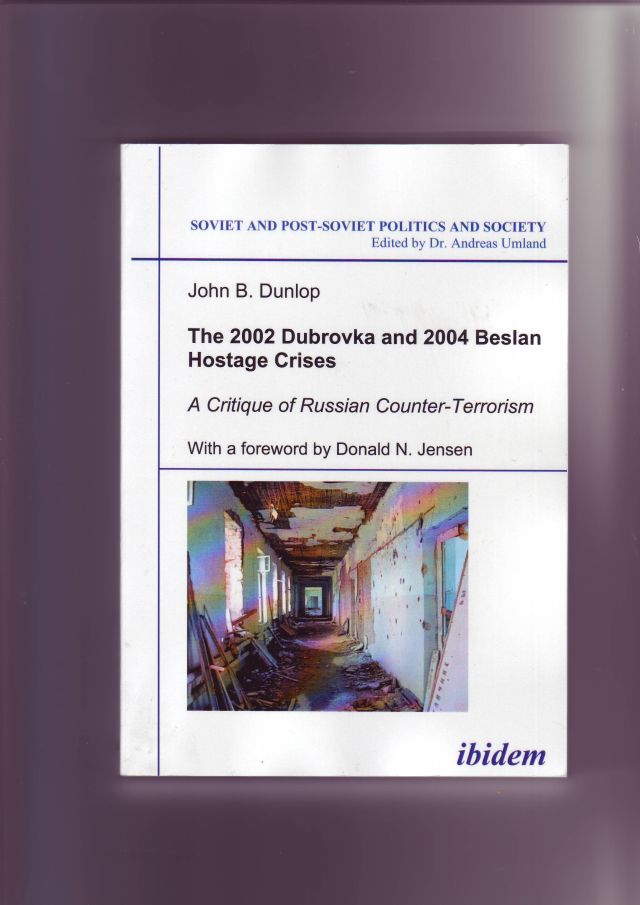
More on The 2002 Dubrovka and 2004 Beslan Hostage Crises, by Hoover Institution Senior Fellow and Stanford University Russian, East European and Eurasian Studies academic John B. Dunlop (ibidem, 2006 - ISBN 3-89821-608-X).

This is the most up-to-date, detailed and thoroughly-researched survey of the two crises currently available in English. What it makes clear, beyond reasonable doubt, is that both tragic events were aggravated - and their consequences made considerably worse in terms of loss of human life - by Russian federal state intervention, and that Russian special services, above all the FSB, were involved in collaboration with the terrorists.

Of Dubrovka, the study concludes:
Elements among both the Russian leadership and the power ministries and among the Chechen extremists obtained their principal goals in the assault on the theater at Dubrovka: namely, an end was put to the negotiation process while Aslan Maskhadov's reputation was besmirched, and the terrorists, for their part, had an opportunity to stage a grandiose fund-raiser. The Russian authorities, moreover, were now able to demonstrate to the entire world that Moscow, too, had been a victim of an Al-Qaeda-style Chechen terrorist act. As in 1999, the chief victims of these terrorist acts were the average citizens of Moscow. The bulk of the evidence, as we have seen, points to significant collusion having occurred on the part of the Chechen extremists and elements of the Russian leadership in the carrying out of the Dubrovka events.

Sunday, April 23, 2006


Katyn

Families of Polish soldiers massacred by Soviet troops in 1940 are to lodge a complaint against Moscow before the European Court of Human Rights in Strasbourg.

Polish President Lech Kaczynski has given an exclusive interview on the subject of Polish-Russian relations with the Interfax news agency, in which he states that
Poland will seek to clarify "the fates of all Polish citizens whose lives were taken based on decisions by the supreme Soviet authorities of March 5, 1940, find out their names and their burial sites, and have the crime committed against them appropriately qualified in legal terms," Kaczynski said, adding that he expects assistance and businesslike cooperation from Russia in this issue.

"We expect that the Katyn issue will be brought to a conclusion, but we need to know the whole truth, because it is the only thing that can become a fundament of our bilateral relations and positive ties between the Poles and the Russians," Kaczynski said.
(via Marius)

Saturday, April 22, 2006


The Presidents of Chechnya

A Prague Watchdog article I recently translated:
The Presidents of Chechnya

by Ruslan Isayev

For the Chechen Republic the last fifteen years have probably been among the most shattering (in their events and essence) in the recent history of the Chechen people. Over this period the Chechens have experienced (and continue to experience) very powerful upheavals the origins of which date from the moment of the disintegration of the USSR.

The most commonly-heard answer, or one of them, to the question of why blood constantly flows in this small territory is “Chechen oil”. A second version, most frequently encountered in reports of Kremlin analysts, is that Chechnya is a bridgehead for the special services of foreign governments, who aim to detach the North Caucasus from Russia, and thus destroy the Russian state.

The situation is so confused that a sense is created of war in the Caucasus being a natural state of affairs. From one angle this is indeed so.

The Caucasus has always been a source of problems for Russia, and enormous forces, both financial and human, have been deployed in the struggle with them. Meanwhile in Chechnya children have continued to be born, and their grandchildren have subsequently experienced the same things their grandfathers had to survive. And this has gone on for a period of several hundred years.

Fifteen hard years

This is now no longer a paradox, but an everyday historical fact both for Russia and for Chechnya. For the former it means “pacification”, while for the latter it is liberation. Yes, liberation, since it was under this slogan that on coming to power in 1991 Dzhokhar Dudayev was able to unite the Chechen people, which had hitherto then been locked up in itself. He gave release to an energy the slightest signs of which had for long years been suppressed both by self-censorship and by the authorities.

For a time at least, the Chechens were actually free. That time was not 1996-1999 (Chechens are reluctant to recall those years), but the beginning of the 1990s, when independence was declared. And for the Chechens the First War, in the opinion of many of those who took part in it, including even those who came over from the federal side, was really a patriotic war.

Strange and tragic times always give birth to leaders who correspond to them. And in Chechnya, each of those leaders considered and considers himself as at the very least the hero Danko, leading his people into a "bright future" which on inspection frequently proves to be very doubtful, or simply doesn’t turn out as planned.

It is not for me to judge the political leaders of Chechnya – tomorrow’s historians will do that, but the period of those leaders’ governance coincided precisely with the years when I was growing up, and I can at least offer some theories of my own as to why everyone in Chechnya wants to be President, despite the fact that this post has so far failed to bring longevity to anyone, whether in a political or a literal sense.

Dokka Zavgayev, Dzhokhar Dudayev, Zelimkhan Yandarbiyev, Aslan Maskhadov, Akhmad Kadyrov, Alu Alkhanov, and now Sadullayev – for specific periods of time, by the will of fate, and sometimes possibly against it, these men have ended up at the head of the Chechen republic. For four of them this post proved to be a death sentence.

Dudayev

Dzhokhar Dudayev was killed as a result of rocket fire from a Russian fighter plane near the Chechen foothill village of Gekhi-Chu on April 21 1996. The location of the former Soviet general, who had commanded a division of strategic bombers, was calculated as he talked on a satellite phone with Russian politician Konstantin Borovoy.

The detail that General Dudayev’s location was calculated so simply, together with the basic fact that he did not withdraw to a safe distance from the source of the phone signal, made his death a mysterious one, inflaming the minds of many fanatical supporters who believed that he was still alive.

In Grozny long afterwards rallies continued to be held at which the participants awaited his appearance. In such a soil, some people’s minds were literally "touched”. The two officer-pilots who fired the rocket at Dudayev were presented with the highest state award in the land – the title of Hero of Russia.

Dudayev’s distinguishing feature was his ability to immediately analyse a situation. Almost without ever having lived in Chechnya, in a short space of time he actually mastered the native language, and his ironic manner of speech still gives rise to false rumours in public life.

Today it is possible to confirm that the saying attributed to him – that in the course of the liberation struggle Chechnya would lose many people, and only the remaining thirty per cent would find freedom – has proved to be prophetic, apart from the attainment of independence.

Yandarbiyev

After Dudayev’s death, in accordance with the constitution of the Chechen Republic of Ichkeria, the post of President was taken by Vice President Zelimkhan Yandarbiyev. A well-known Chechen poet, Yandarbiyev occupied the post for less than a year, until a new President was elected.

Although Yandarbiyev did not sit in the President’s chair for long, and even then with the prefix “Acting”, he did not avoid a tragic death. His move with his family to distant Qatar at the beginning of the Second War did not save him, either. He and his teenage son were the victims of a bomb attack on his car as he returned from Friday prayers at a mosque.

Zelimkhan Yandarbiyev died, but his son survived. The Qatar authorities exposed this crime. Three members of Russian foreign intelligence were arrested, but after prolonged negotiations were sent back to Russia to serve their sentences.

Yandarbiyev is remembered by Chechens for his skirmish with Yeltsin in the Kremlin, when he refused to sit down opposite Dokka Zavgayev during the negotiations. In a TV broadcast, one of his advisers, probably trying to make himself inconspicuous in the face of the looming scandal, could be heard in the background saying to him in whispered Chechen: "Sit down, there’s nothing to worry about!.” "No, I won’t,” was the answer.

Maskhadov

On January 27 1997, Chechnya held a presidential election which many observers still call one of the most democratic in the post-Soviet space at that time. Aslan Maskhadov was elected President, beating his rival companions-in-arms Basayev, Udugov and Yandarbiyev by a large margin.

For Chechens who were tired of the war, confidence in Maskadov indicated only one thing – a hope for peace and calm. After the beginning of the second Chechen campaign, Maskhadov led the resistance from underground..

On March 8 2005, it was announced that he had been killed as a result of a special operation by Russian special services in the settlement of Tolstoy-Yurt, not far from the Chechen capital. There is a version of the story which says that Maskhadov was enticed under the pretext of planned negotiations with the Russian side and that the OSCE and the President of Poland stood as guarantors.

The version has no basis in proof, but the Polish foreign ministry did call Maskhadov’s killing an act of political stupidity and a major error, which caused a nervous reaction on the part of the Russian authorities. With Maskhadov's death, the last tenuous hope for negotiations disappeared.

Aslan Maskhadov was considered a weak President, but a brilliant soldier. Many political analysts note this even now. After becoming the President of a destroyed republic which had won a war and practically become independent, he essentially lost his fellow companions-in-arms at the most critical moment in Chechen history. However, he boldly entered it as the President who signed the peace agreement with Russia.

Kadyrov

Akhmad Kadyrov, the former mufti of Chechnya who declared a jihad against infidels in the first Chechen war, moved over to the side of his former enemies in the second. The Kremlin appointed him as head of its Chechen administration, and then within the space of two years, by means of elections too dubious to be called an expression of free will, he became President of Chechnya.

During this time he acquired his political manner and with it his charisma as leader. Akhmad Kadyrov was a supporter of the greatest possible degree of autonomy for the republic from Moscow, and of the monopoly on managing its natural resources, including oil, for its internal needs.

On May 9 2004, Kadyrov died as a result of an explosion at the central stadium during the Victory Day parade. The question of how it was possible for his attackers to bring in the explosives – an item under constant guard – and especially to brick them up directly under the platform where Kadyrov would be sitting, is one that has remained unanswered.

Kadyrov’s role has not yet been given much study. Historians will do that. But the fact remains that Kadyrov was able to change the course of events in Chechnya. Taking advantage of his wide powers within Chechnya, he was able to convince many guerrillas of the futility of resistance to Russia, thus actually saving the lives of many hundreds of former resistance soldiers.

Many will say: and what good is a life on those terms? That is another question. He was not a supporter of driving the guerrillas into a corner, but rather of giving them a final chance to preserve their lives. For a short time, Kadyrov became a political figure on a Russian scale. The fact is that he died precisely at the moment when people had begun to look to him with hope.

Who’s next?

The chain of fateful deaths of Chechen leaders has not been broken, it has merely frozen for the time being. At present there are again two presidents in Chechnya. Alu Alkhanov, who is pro-Moscow, and Abdul-Khalim Sadullayev, who is President of Ichkeria, i.e. independent Chechnya.

According to the laws, both can be considered legal, since one has been elected according to Russian legislation, and the other according to the Constitution of Ichkeria and a resolution of the State Defence Committee. Perhaps destiny will again choose between them?

The fate which pursues the leaders of Chechnya will last for as long as the Chechen war endures, a war that is mistakenly thought to be over. Here it is possible to say with certainty that Chechnya’s leaders share its destiny, the only difference being that while they depart, Chechnya remains.


Ruslan Isayev is Prague Watchdog's North Caucasus correspondent
.

Friday, April 21, 2006


Dubrovka and Beslan


I've started to read John Dunlop's study of the Dubrovka theatre siege and the Beslan hostage crisis. As the book's publicity points out, it contains by far the most complete reports available in English on the two major terrorist incidents. The issues examined are:
• the backgrounds of the Muslim extremists who carried out these acts including the de facto leaders of the terrorist assaults, ethnic Chechen Ruslan Elmurzaev and Ingush Ruslan Khuchbarov;
• the failure of Russian law-enforcement to prevent these two incidents, documenting both the massive corruption of the Russian security services and police and the absence of the rule of law;
• the storming of the Moscow theatre building and of the school at Beslan by Russian police, aided by the military, elucidating the reasons for the very large loss of life in both incidents;
• the use by the Russian police of a special gas at Dubrovka and of tanks and flamethrowers at Beslan;
• the evident fixation of the Putin leadership with portraying these two assaults as incidents of international Islamic terrorism linked to the Al-Qaeda network;
• and the repeated attempts on the part of the Russian authorities at the time of these incidents to weaken the influence of moderate Chechen separatists headed by the late Asian Maskhadov.

Thursday, April 20, 2006


Chechnya: Relatives to be Taken Hostage

From Prague Watchdog:

Shatoysky district: Relatives of guerrillas may be subjected to reprisals

By Umalt Chadayev

CHECHNYA - The new command of the Shatoysky district police department plans to take relatives of guerrillas hostage, claim the local people.

"In early March [the Moscow-backed Chechen Premier] Ramzan Kadyrov replaced the district administration and police leadership and immediately began to purge the district police," says Shatoysky resident Adam Musayev.

"As far as I know, the police did make an attempt to round up the guerrillas of the top guerrilla commander Dokka Umarov, but they were ambushed and four of them were captured by the guerrillas," Musayev stated.

"Afterwards, a large meeting of law enforcers took place here. And two weeks ago, in a mosque during Friday prayers, members of the new police command announced that all guerrillas hiding in the Shatoysky district must lay down their arms and surrender by April 15. They promised amnesty and assistance in finding jobs, but warned that anyone who refused, would see his relatives be taken as hostage," Musayev added.

"With the arrival of the new command everything started changing, mostly for the worse,” says a local policeman. "A huge number of Kadyrov's forces were deployed here demanding to know who is a guerrilla, who helps the guerrillas, etc." he said, adding that over the last couple of weeks six of his colleagues have lost their jobs on suspicion of sympathizing and assisting the guerrillas.

When visiting the Shatoysky district on March 10, Ramzan Kadyrov sharply criticized the district administration and police department, accusing them of being totally passive. "In this district there are a lot of troops and police, but no results," he said. "During the past years only a few guerrillas have been detained or liquidated. And this is taking place against the backdrop of information about an inflow of forces into guerrilla groups in Chechen districts. No one is working with the residents; no one is carrying out raids or special operations."

Kadyrov's visit resulted in replacing the district administration and police heads. The new police chief, Adam Arsaliyev, is a former battalion commander serving in the Chechen Interior Ministry. Locals says that the intention of reprisals against the relatives of guerrillas might well lead to dire consequences.

The practice of taking relatives of Chechen resistance leaders and field commanders as hostages began during the second Chechen war. The best known cases included the relatives of Magomed Khambiyev, former Defense Minister of the Chechen Republic of Ichkeria, in the spring of 2004; then father, brother, wife and baby son of field commander Dokka Umarov in 2005; and the brothers, elderly sister and cousins of the late President of the Chechen Republic of Ichkeria, Aslan Maskhadov.


Getting to the Truth

Andrei Smirnov, on Moscow's reaction to the recent Jamestown Foundation conference on the North Caucasus:
Clearly, the Kremlin was enraged just by the title of the discussion: "Sadullaev's Caucasian Front." Unlike in the United States, where the government encourages public research on terrorism issues and open analysis of al-Qaeda statements and publications on websites belonging to Islamic radicals, in Russia such topics are the exclusive prerogative of the authorities.

The Kremlin is not interested in providing either Russian society or the international community with detailed information about the Caucasian insurgency. Instead, officials in Russia use vague terms like "international terrorism" or "dark forces" to describe the source of instability in the south of the country. Sometimes some "unknown Arabs" are mentioned, but never actual insurgency leaders such as Abdul-Khalim Sadullaev. Nor does official Moscow recognize the existence of the Caucasian front, preferring to speak about "the criminal underground in the North Caucasus."

The Russian authorities do not want to focus on Sadullaev, as his presence proves that the insurgency across the North Caucasus is directed from Chechnya by Chechen separatists, not by terrorists from Saudi Arabia or Afghanistan, as official propaganda claims. The authorities were even angrier about the fact that Vachagaev called Sadullaev the "Chechen president," trying to present the rebel leader as a legitimate figure in the eyes of the Americans. Since Abdul-Khalim Sadullaev succeeded Maskhadov after the latter's death last year, the Kremlin has used a number of devices to hide his name from the West, fearing that one day Western governments will start to persuade Moscow to initiate a dialogue with him. Previously they had called on Russia to negotiate with Maskhadov.


BBC Belarusian broadcasts

br23 blog in Belarus notes that the BBC has rejected the idea of a Belarusian-language service. In view of the corporation's recent cutbacks in European language services, this is hardly surprising. However, given the fluctuations in BBC World Service practices over the years, it may be too soon to dismiss the possibility of at least a Belarusian language component in the still-surviving Russian and Ukrainian service. br23 discusses the recent initiative by Gary Streeter, and gives some contact details both for him and for the British Minister of State for Europe, Douglas Alexander.

Wednesday, April 19, 2006


Yukos Lawyer Given 7-Year Sentence


Yukos lawyer Svetlana Bakhmina has been sentenced by a Moscow court to seven years imprisonment in a labour camp. She denies any wrongdoing.

Gazeta.ru quotes Boris Nemtsov as saying that Bakhmina does not deserve the sentence, which he calls an act of repression, considering it part of a campaign by the Kremlin aimed at intimidating business employees in order to prevent them from expressing independent views on society in Russia.

The Svetlana Bakhmina web site is here.

Kasparov.ru has a report (in Russian), which describes how at today's trial the judge made an error while reading out the sentence, saying that the 7 years were to be spent in a "general regime" [obchschii rezhim] labour camp, and then correcting this to "strict regime" [strogii rezhim]. Ironically, the sentence was announced on the same day that the State Duma approved an amnesty for several categories of prisoners, including the very young, the very old, and mothers with children. There is no sign, however, that Bakhmina's sentence is affected by the amnesty.

She is also still denied access to her young children, whom she has not seen since 2004.


Manifestoes

Groupings of intellectuals can, in certain cases, and particularly when the liberty of the masses and of the spirit is mortally threatened, constitute a strength and exert an influence; Hungarian intellectuals have just proved this. However, it should be pointed out for our own guidance in the West that the continual signing of manifestoes and protests is one of the surest ways of undermining the efficacy and dignity of the intellectual. There exists a permanent blackmail that we all know and that we must have the often solitary courage to resist.

Subject to these reservations, we must hope for a common rallying. But first our Leftist intellectuals, who have swallowed so many insults and may well have to begin doing so again, would have to undertake a critique of the reasonings and ideologies to which they have hitherto subscribed, which have wreaked the havoc they have seen in our most recent history. That will be the hardest thing.
Camus, Hungary: Socialism of the Gallows [interview] (1957) [tr. Justin O'Brien]

Tuesday, April 18, 2006


False Reporting By ORT

FOR RELEASE: April 18, 2006
CONTACT: Glen E. Howard, +1 202.483.8888


JAMESTOWN DENOUNCES MOSCOW'S DISTORTED
ACCOUNTS OF NORTH CAUCASUS CONFERENCE

Russian State Television, Foreign Ministry Falsely
Manipulate Coverage of North Caucasus


WASHINGTON, DC (4/18/06)--The Jamestown Foundation today denounced a Russian state-owned television report on a conference examining instability in the North Caucasus, calling the coverage distorted, manipulative and patently false. The April 14th conference, entitled "Sadullaev's Caucasian Front: Prospects for the Next Nalchik" assembled independent experts from around the world to assess Russian policy and Muslim separatist movements in the region.

"ORT's false reporting on The Jamestown Foundation is a throw-back to Soviet-style manipulation and propaganda," declared Jamestown Foundation President Glen E. Howard. "Far from advocating terrorism, Jamestown's publications and public events provide American and Russian policy makers with the insights they need to prevent catastrophes like the September 2004 hostage crisis in Beslan and the October 2002 Moscow theatre siege."

The report, which ran April 15th on Kremlin-controlled ORT Television, falsely alleged that the Jamestown Foundation is advocating future terrorist attacks in the North Caucasus and incorrectly implied that the United States government is supporting Muslim separatists in the region. The report also speculated wildly about the role of U.S. Vice President Richard Cheney, a long time friend and supporter of the Jamestown Foundation.

"The Jamestown Foundation produces five publications, including Eurasia Daily Monitor and Chechnya Weekly, which covers developments in Chechnya and the North Caucasus," explained Howard. "The Jamestown Foundation is a leader in providing independent, fact-based analysis about instability in Eurasia and global terrorist activities. The notion that Jamestown and the U.S. government are promoting terrorism in Russia is not just absurd, it also shows just how paranoid the Kremlin's repressive regime has become."

The ORT report also featured prominently in today's formal protests to the U.S. Embassy in Moscow, in which the Russian Foreign Ministry alleged U.S. support for terrorist attacks in Russia. The Jamestown discussion did not feature terrorists, but included a group of independent experts to discuss recent developments in the North Caucasus. The participants included two Americans, a Canadian, a Paris-based Chechen historian and an independent journalist from Russia.

"The Russian Foreign Ministry's protests come at a time when the Kremlin is shuttering independent media, systematically repressing human rights organizations and funding the Palestinian terrorist organization Hamas," argued Howard. "Accusing Jamestown and the U.S. government of promoting terrorism in Chechnya and the North Caucasus is not just ironic, but blatantly hypocritical."

Founded in 1984, The Jamestown Foundation is an independent, non-partisan research institution dedicated to providing timely information concerning critical political and strategic developments in China, Russia, Eurasia and the Greater Middle East. Jamestown produces five periodic publications: Eurasia Daily Monitor, Terrorism Monitor, Terrorism Focus, Chechnya Weekly and China Brief. Jamestown research and analysis is available to the public free of charge via the Jamestown website, www.jamestown.org.


The Jamestown Foundation
4516 43rd St. NW Washington, DC 20016
tel(202) 483-8888 fax(202) 483-8337
www.jamestown.org


Voice of Beslan Offices Seized


A statement by Ella Kesayeva, spokesperson for the "Voice of Beslan" NGO and support group for the victims of the 2004 Beslan tragedy, is published today on the Kasparov.ru web site. She describes how the organization has been subverted by the authorities, who have infiltrated their representatives into it in an attempt to destroy it. Now the officially-sponsored breakaway group has seized the NGO's offices, and Kesayeva says she believes this action is connected with the fact that Voice of Beslan recently published a public protest against a third term for Vladmir Putin as Russian President.


Belarus Newspaper Threatened With Closure


br23 blog in Minsk, Belarus, writes that the prominent - and oldest - independent Belarus daily newspaper Nasha Niva is under threat of closure by the authorities. The Department of Ideology wants to close the paper down because its editor was in detention for 10 days:
Let me remind you, the editor-in-chief Andrej Dynko was detained at a bus stop on the October square on March 21st, when he tried to bring some food to the protesters on the square, who protested against massive falsification of the “election” results and demanded new elections. Later he was sentenced to a 10-day arrest after being convicted of using “foul language” in public (this man probably doesn’t even know a single swearing word; let alone publicly use it). In fact, he was detained because police heard him speaking in Belarusian language, and that was good enough reason to arrest him.

The authorities are cynically closing down “Nasha Niva” on the eve of its 100th anniversary. This legendary newspaper was founded in 1906, and it was the first ever newspaper published completely in Belarusian language. In 1915 the original “Nasha Niva” was closed after Vilnius was occupied by German troops. In 2006 the attempt to close it is ordered by the Lukashenka administration. We don’t have any German occupation in 2006. It’s Lukashenka’s Russian-Soviet occupation. And they’ve advanced very far.

There is more about the history and background of Nasha Niva here.

Monday, April 17, 2006


"Russia Will Have To Explain"

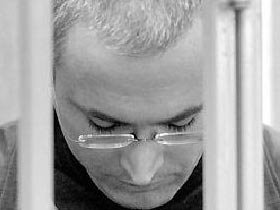
Under the heading "Russia Will Have To Explain", a leading item on the Kasparov.ru web site reports that the Strasbourg European Court of Human Rights has instructed the Russian government to give explanations concerning complaints by Mikhail Khodorkovsky's lawyers. If the complaints are accepted, this will open a new stage in the case. Meanwhile, Khodorkovsky is under medical obsvervation after Thursday's knife attack on him in the labour camp where he is imprisoned.

Update: The Ekho Moskvy report on which the Kasparov.ru item is based can be read here (in Russian). However, the EM report now states that Khodorkovsky's defence lawyer Karina Moskarenko "does not yet know of demands made to the Russian leadership"(19:05).


Ultra-Right Threat in UK

With Britain's May council elections approaching, the BBC reports that
Anger with the main parties has led more people to consider voting for the British National Party, a report for a social policy research group says.

The Joseph Rowntree Foundation said up to 25% of voters admitted they "might vote" for the far-right party.

Sunday, April 16, 2006


Britain in the 1920s

There's a remarkable 3-hour sequence of colour film footage by the pioneer British documentary film-maker Claude Friese-Greene, giving a picture of life in Britain in the years following the First World War, at this link.


Media Protest in Moscow

AFP has a report on today's protest in Moscow by about 1,000 people against the Putin government's clampdown on independent media:
Viktor Chenderovitch, a writer and former NTV presenter, said "Russia has changed a lot" since the oil giant Gazprom, in which the Russian government is the main shareholder, bought NTV in 2001.

"I hope that the Russian flag will once again symbolise a democratic country and not a KGB colonel," he said, referring to President Vladimir Putin's former role in the secret service.

He said the state's stranglehold on television was preventing the emergence of a strong opposition and an independent justice system.


St Petersburg Attacks Continue

The series of racially motivated attacks on foreigners in St Petersburg, Russia, shows little sign of coming to an end. Lenta.ru reports that two Mongolian students were badly beaten by a group of attackers in a metro train on Saturday. The students were taken to hospital.

RIAN has an English-language report here.

Saturday, April 15, 2006


Khodorkovsky Assaulted in Prison


Re the knife attack on Mikhail Khodorkovsky, the New York Times reports:
Another Khodorkovsky lawyer, Natalya Terekhova, said her client had been stabbed in the left nostril, the Gazeta.ru news Web site reported.

Terekhova, who practices in the Siberian region of Chita where the prison is located and is due to meet Khodorkovsky on Monday, said the assailant was a 23-year-old cellmate called Kuchma who was now being held in solitary confinement, according to Gazeta.ru.

The aim was not to kill Khodorkovsky but probably to disfigure him, Gazeta.ru quoted his lawyers as saying.

Mikhail Khodorkovsky website


Poetry and Justice

A poem by W.H. Auden has become the subject of a ban by a school in the United States, the U.K. Times reports:
A school in Reno, Nevada, has attempted to ban a 14-year-old boy from reciting The More Loving One by the gay British poet on the grounds that the verse contains “profanity” and “poor language”.

This week Jacob Behymer-Smith won a restraining order from a federal judge against the Coral Academy of Science, which should allow him to read the poem in a state-wide competition at the Governor’s mansion.

The lines in question might appear fairly innocent by the standards of some literature. “Looking up at the stars, I know quite well/That, for all they care, I can go to hell”, was one example that the school found unacceptable. “Admirer as I think I am/Of stars that do not give a damn”, was another.

But after Jacob recited them in a district contest ten days ago, Steven West, the school’s human resources dean, ordered him to select another poem.

He issued a memo to teachers and students, advising them that there would be no tolerance of “use (of) poor language in public events”.

Cheryl Garlock, the dean of the academy, said that her policy was to present children only with “pristine” language.

Jacob said that he felt “completely disgusted and appalled by (the) school’s decision”.

At the court hearing on Wednesday, he told the judge that he had practised reciting the poem twice a day for two months, and that forcing him to choose another would be unfair. In granting the injunction, Judge Brian Sandoval said that there was “a total absence of any evidence” that the school’s ban was legal under the US Constitution and that Jacob’s First Amendment rights to free speech were probably being violated.

Nevada’s attempted poetry censorship is not an isolated case in a country where there appears once again to be growing tension between free speech and public morals.

Friday, April 14, 2006


Changing Italy - II

From the Guardian:
Before the revised figures were announced, Mr Prodi told Italian news agencies that the checks on the contested ballots were not "leading to any change".

His office yesterday revealed that foreign leaders, including EU partners Tony Blair and Angela Merkel of Germany had telephoned with their congratulations. Mr Blair and Mr Prodi were said to have held "a long, friendly and cordial conversation".


Felgenhauer on Russia/Iran

Novaya Gazeta defence analyst and correspondent Pavel Felgenhauer recently published an article ("The Iranian Threat Is Being Increased By Russia") exploring the connection between Iran's current nuclear posturing and its links with the Russian federal military and intelligence establishments. The piece concludes (my tr.):
It is well known that in our special services, among the military, and in the defence and nuclear industries, there flourishes an unbridled anti-Americanism, which is usually combined with anti-semitism (according to the old Soviet formula "the Zionists are the main accomplices of the American military"). Similar moods are noticeable in the Kremlin. The recent warm reception in Moscow of the leadership of Hamas is an obvious confirmation of that.

The sale to Iran of weapons which can cause serious losses to the Americans in the case of conflict in the Persian Gulf, or to Jews in Israel, is seen by many influential Russian heads not only as something advantageous, but also ideologically correct. In addition, if the Iranians are able to close the Straits of Hormuz the prices of oil will quadruple, and all one has to do is fill one’s pockets.

So far we know for certain that among the Iranian soldiers and revolutionary guards who directly collaborate with the terrorist organizations in Lebanon, and also among the Palestinians, secret Soviet nuclear delivery systems are appearing one after the other. In such circumstances the falling of nuclear warheads into the same hands is possible at any moment, if it has not already happened.

Thursday, April 13, 2006


Few Answers

Sarah E. Mendelson, writing - in 2002 - about Strobe Talbott's memoirs:
There was, in short, a central inconsistency in the Clinton administration's approach to Russia. Washington's tolerance for Russian noncompliance with democratic values, norms, laws, and treaties was often breathtaking. This was especially true regarding Chechnya. If Clinton and his staff believed (correctly) that Russia's political trajectory affected U.S. national security, why did the death and destruction wrought by Russian federal forces in Chechnya figure so little in their engagement?

The human cost of the Chechen conflict has been horrific, causing deaths in the tens of thousands. The abuses are ongoing and well documented. Highly respected organizations have evidence that Russian federal forces have clearly and repeatedly violated both the Geneva Conventions and the Universal Declaration of Human Rights. Russian and Western organizations have documented the disproportionate use of force, the indiscriminate targeting of civilians, and the "mop-up" operations that regularly involve looting, ransom, rape, and execution. They have detailed the forced disappearances of up to 2,000 people and noted the "filtration camps" where rebels and civilians are routinely tortured. There is even evidence that human rights monitors are being targeted and killed by federal forces. The scale of abuses is far greater than in Kosovo, where NATO intervened. Moreover, the wars in Chechnya have had a symbiotic and deleterious influence on developments in the Russian media and bear directly on Russia's political transition and Western efforts to support democracy there.

Talbott does not shy away from these details. He recognizes the wars as threats to democracy in Russia; in contrast to some apologists, he also acknowledges that the U.S. Civil War is a poor analogy. He sees critics as justified in charging that the Clinton administration gave "Moscow a pass on the military's continuing rampage in Chechnya." So why did Talbott's misgivings have essentially no effect on the U.S.-Russia relationship?

The book hints at a few reasons, the most prominent being Clinton's reluctance to "pile-on against Yeltsin." According to Talbott, Clinton was "not comfortable about hectoring" the Russians to seek a political solution "when we didn't really know what that meant." He was reluctant to use his personal relationship with Yeltsin to push him hard on the war, and then when Putin came on the scene, there was little chemistry between the two. Putin dismissed the substantial body of evidence of war crimes committed by Russian forces as "alleged, mythical atrocities," and Clinton let it go.

This inaction is regrettable on so many different levels. The second Chechen campaign began after a series of grisly bombings of apartment buildings in September 1999; mysteriously, the crime scenes were cleared within days and, in one case, even hours. A foiled bombing in the city of Ryazan, which seemed to involve the FSB (the KGB's successor), raised serious questions as to precisely who was responsible for the other bombings. But despite the lack of hard evidence, Moscow blamed the attacks on Chechen separatists and used the incidents as the launching pad for the war -- and eventually as an election strategy. What did the Clinton administration make of all this? This book provides few answers.


Parallel Reactions

Marc Cooper, on the immigration debate:
As long as we are back on this subject...a few random thoughts about what it means to see thousands -- maybe a couple of million of illegals-- demonstrating in the streets. Keep in mind that, back in the late 50's and early 60's, when blacks marched and got clubbed and fire-hosed, they were also "illegals." Jim Crow legislation made it a criminal violation for a black to eat, sleep or work in certain places. A Negro sitting at a Woolworth counter, or sitting in the front of a bus, or drinking out of the wrong water fountain was, indeed, an illegal. Plenty were those who expressed sympathy with the plight of the "good" Negroes but who counseled that by getting uppity, that by marching, sitting-in, getting arrested, actually demanding (instead of politely requesting) their rights, they were only setting back their cause. Doesn't that sort of sound like the panty-twisters of today bent out of shape over some Mexican flags?


Putin's Fear of Elections

Writing in EDM, Pavel K. Baev observes that the result of the Italian elections is yet one more instance of a severed European connection with Moscow, allowing Russia to drift ever further into isolation from the rest of the continent. The defeat and weakness of Moscow-aligned forces in much of Europe are, however, also associated in Putin's mind with the uncertainty regarding his own future, and that of the bureaucratic elites he represents:
Italy is the latest point in this trajectory since Prime Minister Silvio Berlusconi's defeat this week signifies for Russian President Vladimir Putin the loss of a key European ally and the end of a carefully cultivated personal friendship (Vremya novostei, April 11; Gazeta.ru, April 13). The March 26 parliamentary elections in Ukraine, inconclusive as they are, have confirmed Kyiv's European vector and shown the steady retreat of the pro-Russian forces in the multi-colored political arena (Lenta.ru, April 11). Presidential elections in Belarus on March 19 and the swift suppression of public protests against the crudely manipulated voting left Putin, who rushed to congratulate Alexander Lukashenka on his victory, alone against the broad European condemnation of this authoritarian regime (Ekho Moskvy, April 11). Even the elections in the Palestinian Authority fit the pattern, since Moscow's readiness to embrace the Hamas leadership has generated mild disapproval in Europe and bitter acrimony in Israel (Kommersant, April 12).

The trend could easily be traced further back: Parliamentary elections in Poland last September were dominated by parties that hold serious suspicions about Putin's Russia, and elections in Germany forced the departure of Putin's closest and most privileged partner, Gerhard Schroeder, from the Bundestag. Some electoral results that were unfortunate for Moscow were decided by margins slimmer than the "hanging chads" that decided Bush's victory in 2000, and both Berlusconi and Schroeder could complain about bad luck. In other cases, Belarus being the prime example, Moscow was clearly set to lose because of its own political choices. Lukashenka enjoys solid enough popular support to win a free and fair election, but the very possibility of creating a space for uncontrollable political opposition was unacceptable, and he opted to show the "monolithic unity" of the quasi-Soviet regime (Ezhednevny zhurnal, April 1).

Putin is in much the same situation and shows equally deep mistrust in election mechanisms, but he feels the need to hide his true preferences behind many layers of "Euro-correct" rhetoric. This habitual hypocrisy serves to make him an acceptable partner for Western leaders, but the Russian public apparently prefers a more frank expression of political views; a recent poll by Ekho Moskvy radio (March 20) showed that 82% of listeners would vote for Lukashenka as the president of a hypothetical union of Russia and Belarus, while only 18% preferred Putin. Finalizing the text of his annual address to the parliament, Putin now may take a clue from this rather unexpected choice and add a few explicitly populist condemnations of his own bureaucracy (Vedomosti, April 12). He also knows that he has no real competitor in the country so that the officially discarded idea of a third presidential term remains far more popular than any of his potential successors; 45% of Russians are now ready to amend the constitution accordingly (Kommersant, April 12).

Read the whole thing.


Cell Phone Protest

An item I translated for Prague Watchdog:

Chechen youth protest against quality of local mobile network

By Umalt Chadayev

GROZNY, Chechnya – A large protest rally by young people took place in the centre of Grozny today. The participants demanded that Megafon, the only mobile carrier operating in Chechnya, should improve the quality of its service to subscribers.

"At the beginning of April it was announced that the tariffs for the use of the Megafon mobile phone network in our republic would be lowered and brought into line with those in the territory of the Southern Federal District. The tariffs have now been reduced, but the quality of the connection is still the same as before, i.e., terrible. It has even got worse. It can take up to half an hour to get through to one’s friends and family, the audibility is very poor at times, and the connection is frequently interrupted. This can only cause dissatisfaction," said one of the rally participants, 23-year-old Timur Bekbulatov, a student of the Grozny Pedagogical Institute.

"These problems have existed for a long time, practically ever since mobile phone communications were established in our republic, but no one has resolved them so far. Thanks to Ramzan Kadyrov’s efforts, the tariffs have been lowered somewhat, but even so they are higher than in other regions of Russia," he says. "So we’ve come here in order to demand a reduction in tariffs to the federal level, and a serious improvement in the quality of connections.”

In an interview on local television channels broadcast on the evening of April 10, the head of the Moscow-backed Chechen government Ramzan Kadyrov addressed the republic’s young people with a call to show civic courage and demand that Megafon improve the quality of its service to subscribers. "I have done everything within my power", the premier said. "You must also demand an improvement in the service."

In the first half of March this year, Ramzan Kadyrov demanded that Megafon’s subsidiary, Mobikom-Kavkaz, reduce the tariffs for the use of its network in Chechnya in two weeks. Otherwise the premier promised to stop the company’s operations in Chechnya. Since April 4, Megafon’s tariffs have been lowered three times. However, the quality of the connection has considerably deteriorated.

The Megafon mobile phone network has been operating in the territory of the Chechen Republic since February 2003. The signal has been transmitted (and still is) by Mobikom-Kavkaz and coverage within the republic is implemented with the aid of its regional subsidiary "Chechenskaya sotovaya svyaz".

Wednesday, April 12, 2006


Changing Italy

One probable outcome of Silvio Berlusconi's defeat and the election of Romano Prodi's coalition is a reorientation of Italian foreign policy. As the BBC's Paul Reynolds points out, Prodi
is also likely to have rather cooler relations with Russia. Again, Mr Berlusconi liked to conduct personal diplomacy and he did so with President Putin.

"Berlusconi had a special relationship with Putin which Prodi is not prepared to endorse. This will be a significant change," said Paola Subacchi.


Racism and Xenophobia in Russia

From RFE/RL:
More than 20 million migrants enter Russia each year, according to Russia's Federal Migration Service. Some come in search of work, others are drawn by Russia's affordable and still prestigious higher education. But the tide of racism and xenophobia unleashed by the collapse of the Soviet Union has made life in Russian cities a nightmare for dark-skinned immigrants and foreign students. Attacks on foreigners have become particularly common in St. Petersburg -- the nongovernmental association Sova estimates that 14 people have already been injured and two killed in racially motivated attacks this year in the city. The latest victim, a Senegalese student, was shot dead last week with a hunting rifle decorated with a Nazi swastika.
RFE/RL presents an account of how, "in a rare show of solidarity, several hundred Russians and foreign students took to the street on April 11 to denounce escalating violence against dark-skinned foreigners in St. Petersburg." There is also analysis of the growing problem, and some interviews with human rights activists and foreign students.

Neeka's Backlog has a link to photos of yesterday's rally.


Nuclear Iran

From Anthony H. Cordesman and Khalid R. Al-Rodhan, Iranian Nuclear Weapons? The Options If Diplomacy Fails (Center for Strategic and International Studies):

In January 1995, Iran signed an $800 million contract with the Russian Ministry of Atomic Energy to complete reactors at Bushehr. This included a 1,000 megawatt reactor plant. This was scheduled to finish in 2005, but the revelation in 2002 about Iran’s uranium enrichment facility at Natanz and heavy-water reactor at Arak led to further scrutiny of Iran’s nuclear program. The Russian President, Vladimir Putin, promised the US and the EU3 that Moscow would not provide Iran with the reactor unless it complies with the IAEA safeguards. The concern, however, is that Iran would use the technology and the reactors provided by Russia to advance its “covert” nuclear program.

In spite of the perceived concealment activities by Iran, however, Moscow and Tehran signed a fuel supply deal in early 2005 that paved the way for Bushehr to come online in late 2006.

In June 2005, Russian President, Vladimir Putin said that Russia would continue its nuclear cooperation with Iran’s new president, Mahmoud Ahmadinejad. In addition, the head of the Russian Atomic Energy Agency, Alexander Rumyantsev, announced that, “Tehran intends to build another six nuclear reactors,” and that Russia would be willing to help.

Russian engineers continue their work on the Bushehr reactor. The Iranian-Russian negotiations regarding the Bushehr reactor and uranium enrichment continued through the referral of Iran to the UNSC. The US, the EU3, the IAEA, and the UN Secretary General have publicly voiced their backing of the Russian plan, but privately, officials in France, Germany, the UK, and the US have voiced skepticism about the chance of success.


Dmitrievsky Conviction Upheld


A Nizhny Novgorod court has upheld the conviction of human rights activist Stanislav Dmitrievsky, Human Rights First reports.
“It is regrettable that in today’s Russia, the right to speak out peacefully on human rights will not be upheld by the courts,” said Maureen Byrnes, Executive Director of Human Rights First. “This court decision will further disrupt the work of the RCFS and send a chilling message to anyone in Russia who dares to speak out against human rights violations in Chechnya and the North Caucasus.”
See also in this blog:
Dmitrievsky Trial
Dmitrievsky: Politkovskaya Testifies

Update: In a related development, the Moscow City Court today upheld a decision by a lower court to seize the bank accounts of Open Russia, the charity run by Mikhail Khodorkovsky, former chief executive of the Yukos oil company, who is now serving a 9-year sentence in a Siberian labour camp.

Tuesday, April 11, 2006


Both Ways

It's interesting, and instructive, to observe how Putin's government and its backers continue to attempt to manipulate Western public opinion over the matter of Russia's supposed participation in the international war on terror. On April 5, the Financial Times carried a comment article by two US-based Kremlin apologists, Nikolas Gvosdev and Dimitri Simes, who claimed that "America cannot have it both ways with Russia" - in other words that the US must decide whether "pursuing a new containment of Russia in Eurasia" is a higher priority than "forging an effective coalition of the permanent five members of the Security Council on Iran's nuclear programme." After all, the article's authors commented,
even though Russia and the US both have been targeted by al-Qaeda, the post-1999 chill on relations precluded any joint action in dealing with the Taliban in Afghanistan prior to September 11 2001 - as Mr Putin himself had proposed.
The assertion that Russia has been "targeted by Al Qaeda" is slipped into the discourse unobtrusively, and without an attempt at substantiation. As Jeremy Putley has noted, Russia has indeed suffered at the hands of terrorists, but there are no proper grounds for saying al-Qaeda was involved.

Monday, April 10, 2006


Gearing Up


Has the Prosecutor General’s Office grown tired of the incessant campaign against it for effectively covering for fascists by opening criminal cases that are not based on the “ethnic” statutes? Or are we starting to see a realization of that political scenario which has long been mentioned as one of the most probable during 2007-2008 – the government against the fascists?

Unfortunately, it’s hard to give much credit to the theory that the government has addressed this problem simply because it has decided not to disgrace itself.
Ivan Grushin in Lenta.ru, on the ongoing series of racially-motivated attacks on the streets of Russia's cities, and the government's response.


Lukashenko Takes the Oath

From the Newsline:
BELARUSIAN PRESIDENT TAKES OATH OF OFFICE. President Alyaksandr Lukashenka took the oath of office in the Palace of the Republic in Minsk on April 8, thus formally beginning his third presidential term, Belarusian and international media reported. In a speech after the swearing-in ceremony, Lukashenka said the March 19 presidential election, in which he officially won 83 percent of the vote, demonstrated "the unity of the authorities and the people" in Belarus. The president blasted his opponents both at home and abroad for what he said was their desire "to humiliate Belarus -- this islet of stability -- and turn it into another testing ground for color revolutions." He stressed that "certain countries" are seeking to export "foreign techniques of destruction, total chaos, poverty, and spiritual degradation" to Belarus. "Unfortunately, this crusade against Belarus is being spearheaded by our neighbors -- newcomers to the European Union," Lukashenka added. After the speech, Lukashenka donned a military uniform to hear an oath of allegiance that Defense Minister Leonid Maltseu read in front of several thousand troops on October Square, where the opposition staged a series of antipresidential protests last month. JM


Recovering the Music

I've just come back from York, North Yorkshire, where I was visiting Eva and Tony Fox-Gál, and listening to more of the remarkable and growing collection of recordings of compositions by the Austrian composer and musicologist Hans Gál (1890-1987). I was particularly struck by the new recording of the Serenade for clarinet, violin and piano Op. 93 by members of the Berganza Quartet - this hasn't yet been released on CD. It was also interesting to hear and discuss the constantly developing issues of how Gál's prodigious output of compositions can best be presented to a contemporary audience. While the focus on the suppressed music of the Nazi era reflects an important aspect of the work, care needs to be taken not to let this become too much emphasized, as it has a tendency to deflect attention from the intrinsic qualities of the music itself. None the less, the fine series of Wigmore Hall recordings - from the 2002 "Continental Britons" festival - which include a complete performance of Gál's First Violin Sonata of 1920, played by Konstantin Lifschitz and Nurit Pacht, gives an important guide to the background and context of Gál's development as a composer.

I also had a chance to listen to the new recording by the Edinburgh Quartet of Gál's String Quartets Nos. 1 and 4 - very achieved performances, given with great precision and intellectual warmth.

See also in this blog: Hans Gál
Music Behind Barbed Wire

Saturday, April 08, 2006


Belarus Protest

RFE/RL noted on April 7 that
Belarusian police broke up a demonstration by some 50 opposition activists in central Minsk today, detaining at least two people.


Holocaust Note

Via Reuters:
Nazi Germany planned to expand the extermination of Jews beyond the borders of Europe and into British-controlled Palestine during World War Two, two German historians say.

In 1942, the Nazis created a special "Einsatzgruppe," a mobile SS death squad, which was to carry out the mass slaughter of Jews in Palestine similar to the way they operated in eastern Europe, the historians argue in a new study.

The director of the Nazi research center in Ludwigsburg, Klaus-Michael Mallman, and Berlin historian Martin Cueppers say an Einsatzgruppe was all set to go to Palestine and begin killing the roughly half a million Jews that had fled Europe to escape Nazi death camps like Auschwitz and Birkenau.

- - - - - - - - - - - - - - - - - - - - - - - - - - - - -

As they did in eastern Europe, the plan was for the 24 members involved in the death squad to enlist Palestinian collaborators so that the "mass murder would continue under German leadership without interruption."

Friday, April 07, 2006


Maszkiewicz Released

From RFE/RL:
Mariusz Maszkiewicz, who was hospitalized with heart problems soon after his arrest, says he was beaten in detention.


Stalin and Us

On April 1, the Washington Post published an opinion editorial by Anna Politkovskaya entitled "Stalinism Forever", in which she wrote about the hundreds of cases involving alleged Islamic terrorism which are currently passing through Russia's courts. This is a subject that is now forbidden in the Russian press and media, and Politkovskaya gave this as her reason for publishing her article in a U.S. newspaper. She stated that most of the "Islamic terrorism" cases "have been fabricated by the government so that the special services can demonstrate how ‘effective' Russia is in fighting terrorism and so that President Vladimir Putin has something with which to impress the West."

Politkovskaya focused on the case of two Grozny college students, Musa Lomayev and Mikhail Vladovskikh, who were accused by the police and the prosecutor's office of "all small, previously unsolved acts of terrorism" that had occurred about six months before in a district of Grozny, and described the treatment they received at the hands of the police and special services:

As a result, Vladovskikh is now severely disabled: Both his legs were broken under torture; his kneecaps were shattered; his kidneys badly damaged by beating; his genitalia mutilated; his eyesight lost; his eardrums torn; and all of his front teeth sawed off," Politkovskaya wrote. "That is how he appeared before the court. To get Lomayev to sign - and he did sign confessions for five acts of terrorism—they inserted electrical wires in his anus and applied current. He would lose consciousness, and they would pour water on him, show him the wires again, turn him around backward—and he would sign confessions that he belonged to a gang with Vladovskikh. This despite the fact that the two defendants were first introduced to one another by their prison torturers.
A former neighbour of the Vladovskikh family, Muslim Chudalov, was also implicated in the alleged terrorism.
Within 48 hours of being jailed, he produced confessions to 15 crimes, after which the torturers dragged him as a witness to testify at the Lomayev-Vladovskikh trial. The left side of his face was burned, his arms and legs were swollen, and he had bruises and bloodstains all over his body. He could neither walk nor stand—security personnel had to carry him in. Responding to the prosecutor's demand, his tongue faltering, Chudalov confirmed all of his testimony against Lomayev and Vladovskikh. And certainly against himself.
Politkovskaya writes that
The plight of those sentenced for "Islamic terrorism" today is the same as that of the political prisoners of the Gulag Archipelago. They receive long terms -- 18 to 25 years in strict security camps in Siberian swamps and woods, with virtually all communication with the outside forbidden. Even the Red Cross is not admitted.

Russia continues to be infected by Stalinism. But it seems to me that the rest of the world has been infected along with it, a world shrunken and frightened before the threat of terrorism. I recall the words of one torture victim at his trial: "What will become of me? How will I be able to live in this country if you sentence me to such a long prison term for a crime that I did not commit, and without any proof of my guilt?"

He never received an answer to his question. Indeed, what will become of all the rest of us, who tolerate this? What has become of us already?


And Another

From RIAN:
A student from Senegal has been shot to death in an apparently racially motivated killing in St. Petersburg, local law-enforcement officials said Friday.

The student, Samba Lanzar, was making his way home from a nightclub with a group of fellow African students when the group was fired upon on a street in the south of the city center, a representative of local student organization African Unity said.
According to kasparov.ru, the murdered student was a member of the Nashi ("Ours") young people's organization, where he led a "Lessons of Friendship" program. He was also a member of the "African Unity" organization, which represents the interests of St Petersburg's African emigre community.

RFE/RL has a report here.


Belarus

RIAN reports that 600 people have been charged over the Belarus "election" protests. Meanwhile Alexander Kozulin's defence lawyer says that his client will have to wait months in prison before his case goes to trial.

(via ML)


Another Attack

Via AP, an account of yet another racially-motivated attack in a Russian city - St Petersburg. A nine-year-old girl was stabbed in the neck by two young men.
Drinking tea in a cafe outside the hospital where Liliana is recovering, Katya recalls how she met Liliana's father Fomkan, a young musician from Mali. They soon married and had a child.

"Of course it's unusual in Russia to have a mixed race child. Even my parents were against it at the start. But I was proud of my marriage and my child," she says.

Four years later the couple divorced and Fomkan returned to Mali. Liliana's life took a turn for the worse. Children began insulting her at school and the stares became ever more insistent.

"It's monstrous to say this but sometimes I'm ashamed to have a mixed race child and I avoid telling people," Katya says.

The three stab wounds on Liliana's neck and ear are healing. But the trauma remains. "She talks only about that, she asks 'why me?'"

Katya, in tears, says she is thinking of sending Liliana to her father in Mali to protect her.

"Liliana has told me 'I don't want to live without you, but I don't want to die here either.'"
The end of the report gives an indication that such attacks are being orchestrated for political reasons:
A Russian neo-Nazi website with a Saint Petersburg contact address this week carried a report of the attack on Liliana calling her a "nine-year-old monster" under a headline reading: "The Clean-Up of the City Continues."

Thursday, April 06, 2006


Coalition Offer Rejected

RFE/RL:
...both Tymoshenko and Moroz today rejected the offer. Addressing reporters at a joint press briefing with the Socialist Party leader, Tymoshenko accused the pro-presidential party of dragging its feet for political purposes.

"I know for sure that these guys would rather eat their own hands than sign a memorandum under which our political force would have the right to form a government," Tymoshenko said.


Our Ukraine Agrees to Coalition

UNIAN reports that
Ukrainian President Viktor Yushchenko`s Our Ukraine party will team up in parliament with an alliance led by former premier Yulia Tymoshenko and the Socialists, said Our Ukraine spokesman Valentyn Mondrievsky.

The Regions Party, led by Viktor Yanukovych, which won the most votes in March 26 elections, will remain in opposition, Mondrievsky said in a telephone interview today in Kiev, according to Bloomberg. Our Ukraine party was third in the elections, behind Tymoshenko’s bloc and the Regions Party.

"It is not the forming of a coalition itself," Mondrievsky said. "But we have signed just a general document to show our intention to form a coalition. We reiterate that the elections were free and fair and our main intention is to sustain economic growth, build a civil society and defend human rights."


Mass Grave Discovered in Chechnya

Another recent report I translated for Prague Watchdog:

April 5th 2006 · Prague Watchdog

Mass grave discovered in Grozny contains bodies of guerrillas and civilians

By Umalt Chadayev

CHECHNYA - In early April it was reported that a mass grave had been discovered in the grounds of Kirov Park, in Grozny’s Leninsky district. The remains of a total of 57 people have been extracted from the place.

According to representatives of the law enforcement agencies, six bodies have not yet been identified. It is planned to send their remains to the South Russian city of Rostov-on-Don for forensic medical examination.

One of the inhabitants of Grozny who was an eyewitness of the sad events told Prague Watchdog’s correspondent that the burial of people in the grounds of Kirov Park took place in the winter of 2000, when Russian soldiers stormed the Chechen capital.

"Someone was buried there almost every day,” says 44-year-old Adlan. "After all, it was precisely in January-February 2000 that Grozny underwent the most intensive shelling and air raids. Among the people killed were both guerrillas and civilians.”

"There was almost no possibility of transporting the bodies to the villages, as is usually done. The city was completely blockaded, and it was subjected to continuous bombing and shelling with all kinds of weaponry. Like many tens of thousands of Grozny’s inhabitants, I found myself in the blockaded city. It was a terrible time. There was no heat and no light, and the shortage of food supplies and water constantly made itself felt. It was impossible to evacuate the sick and wounded, and many of them died because they did not receive aid in time," he asserts.

"I also took part several times in the burials of those who had been killed. I even had a list of the surnames of everyone who was buried there, but later on I lost it. In addition, we placed a note (usually in jars or bottles) in each grave, showing the surnames and first names of the victims. As far as I know, in April-May of 2000 nine graves were uncovered in Kirov Park, and the relatives took away the remains for burial in cemeteries,” Adlan says.

“I can’t speak with certainty today, but I think that many more people were buried there. As for the bodies which could not be identified, they were most probably buried as unknowns,” the respondent believes.

As is now known, a criminal case has been opened by the Leninsky district Prosecutor’s Office concerning the discovery of the mass grave in the Chechen capital. However, local residents express doubt that the Russian soldiers who are to blame for the deaths of people in the winter of 2000 will ever be punished.

"As a result of non-selective artillery fire, which included the use of multiple-launch rocket systems such as ‘Grad’, ‘Uragan’ and ‘Smerch’, and of vacuum, needle and other bombs, thousands of innocent civilians perished in Chechnya, and in particular the city of Grozny, during 1999-2000," says Alikhan Isayev, who teaches at one of Grozny’s institutions of higher education.

"The responsibility for this lies first and foremost with the high Russian military command, including Yeltsin and Putin as commanders-in-chief," he is convinced.

"I would like to see them charged with criminal responsibility. For that reason, I consider the opening of a criminal case concerning the discovery of a mass grave in Kirov Park to be a pure formality.".

On the site of the former Kirov Park the local authorities plan to build a large entertainment centre which will bear the name of Akhmat-Khadji Kadyrov, the late Moscow-backed Chechen leader.

Wednesday, April 05, 2006


Condemning the West

The Russian Orthodox Church has once again questioned the validity of the concept of universal human rights.


Bad Talk

In Yezhednevnyi Zhurnal, Leonid Radzikhovsky writes with unconcealed distaste and irony about a recent edition of Vladimir Pozner’s news and analysis program ("Vremena") on the de facto state-controlled ORT television channel, devoted to the issue of racism and racially-motivated attacks:
For the broadcast discussion Pozner invited Krutov (the letter about the "prohibition of Jewish organizations"), Prokhanov and Zhirinovsky. From "the other side" there were a number of sane persons about whose appearances I will not write here - not my theme. Zhirinovsky, as always, shone. With his small town accent, witticisms and temperament, he explained with relish that a) the father of the murdered Tajik girl dealt in narcotics and the brother of the adolescent who killed the girl died of an overdose (the law court decreed that no killer was found), b) that the whole of Russia belongs to the Jews, c) that the poorest and most oppressed people in Russia are Russians d) that the former director of the CIA Allen Dulles issued a call to destroy Russian people and that the skinheads are fighting (with 9-year-old Tajik girls, agents of the deceased Dulles) for the survival of the Russian people. He also explained a few more things, just as interesting, but I was no longer able to take them in.

And Radzikhovsky wonders:
But to invite him on to the air - why?

And why do our pop singers - Khazanov and Galkin, Vinokur and Kobzon, Pugacheva and Gazmanov – invite him to all their get-togethers? As a table decoration? And – aren’t they ashamed?


There are more accounts of new racist attacks, this time in Siberia, here.


Release Maszkiewicz


Poland's Prime Minister Kazimierz Marcinkiewicz has demanded that Alexander Lukashenko "immediately release" former Polish ambassador to Belarus Mariusz Maszkiewicz, writes Gazeta Wyborcza's correspondent:
"I demand this not only because he's a former Polish ambassador, but also because he's a man who needs some medical care at this moment" - said Marcinkiewicz after the meeting with Maszkiewicz's father - who has begun a hunger strike in front of the Ministry of Foreign Affairs.

The chief of government has given assurances that the Polish side has taken all "necessary actions" and will work more for the release of the former Polish ambassador.
Marius Labentowicz writes that "there was an interview published in Rzeczpospolita with Pavel Sheremyet - a Belorussian journalist with Russian passport who was also jailed, later released but spent a few days in same cell with Maszkiewicz. He said that the Georgians and Poles are treated the worst in jails. In the cell he and others played chess (made from bread) with Maszkiewicz, who was telling stories to his cellmates about Solidarity and gen. Jaruzelski."

RFE/RL has a report here.

Tuesday, April 04, 2006


Back from Nowhere


President Alexander Lukashenko of Belarus has reappeared. There's a web news clip from Belarus TV here.

Meanwhile, President Vladimir Putin of Russia has announced that the first package of 38 documents which are to form the basis of the Single Economic Space are to be signed by Russia, Belarus and Kazakhstan "in the very near future".


Predictions

There are new posts at México desde fuera, which is currently based in New Hampshire, U.S.A. - one on immigration, and another on the prospects for Mexico's July presidential election. The blog predicts a victory for populist leader Andrés Manuel López Obrador, but also a new chapter in Mexican politics, which promise to be much less predictable than in the recent past.


Tutov: Update

From RFE/RL:
Although Tutov claimed his assailants had shouted: "Russia for Russians, get out of here!" a Moscow prosecutor declared on April 2 that there was no evidence the attack was racially motivated.

Today, however, Russia's Prosecutor-General's Office ordered local prosecutors to modify the charge to "infliction of serious bodily injuries motivated by ethnic, racial, and religious enmity."

The decision came as a pleasant surprise to both Tutov and rights groups, since even blatantly racist attacks are often treated as 'hooliganism' instead of being prosecuted as racial crimes, which carry severe penalties.

Despite Tutov's claim that his assailants shouted: "Russia for Russians, get out of here!" a Moscow prosecutor determined there was no evidence to consider the attack racially motivated. The press service of the Prosecutor-General's Office told RFE/RL that its response had been delayed because it first needed to corroborate part of Tutov's testimony, which, the press service said, was difficult immediately after the attack.

But why is the Prosecutor-General's Office suddenly overruling local authorities by insisting that Tutov's beating be investigated as a racially motivated attack, after displaying so much reluctance to use this charge in the past?

Lev Ponomaryov, a veteran human rights activist, heads the All-Russian Movement For Human Rights. He says the prosecutors' decision suggests Russian authorities are finally awaking to the danger of the surge of nationalist feelings across the country.

"It is definitely a good sign," Ponomaryov said. "I see how United Russia is now saying things absolutely in favor of human rights. Let this problem, the 'fascization' of the country, become mainstream, let officials talk more about this. It is a serious problem. Before, the Kremlin used to flirt with these national extremists. But at some point they understood that they may be losing control over this process, that nationalists are becoming uncontrollable. This is exactly what rights campaigners were saying."

The attack on Tutov comes amid public anger over three lenient verdicts recently handed down to young men accused of assaulting ethnic minorities.
Now, however, gazeta.ru is reporting that three of the four attackers who were arrested have been released by police authorities with a warning. The attackers are said to be Spartak football fans. And in spite of the request by the Prosecutor General's office that the attack be considered racially motivated, the local prosecutors are still treating it as an act of "hooliganism".

Monday, April 03, 2006


A Chechen Author

from Prague Watchdog (my translation):

Musa Akhmadov: "I don’t understand people who are unwilling to master their native language.”

By Tamara Chagayeva

Musa Akhmadov is one of the best known and most productive Chechen authors writing today. Recently he was marking his 50th birthday, and adding up the balance of many years of literary activity.

He began to write in early adolescence. His first reader, first critic and also first literary mentor was Uvays Aliyev, editor of the Shatoysky district newspaper. During his numerous meetings with readers, Musa often mentions Aliyev’s name with appreciation.

Akhmadov’s literary output is very diverse. He works mainly in the genre of fiction. Today he has nine books to his credit. They include the Chechen-language Night In An Empty House (1983, short stories, novellas), At Dawn, When The Stars Go Out (1986, novel, short stories), Trees In The Twillight (1989, novel, novellas, short stories), 100,000 Good Deeds (2002, short stories, play and poems for children). In Russian, there are Don’t Destroy The Anthill (1990), Night In An Empty House (1991), and At Dawn, When The Stars Go Out (1993). A collection of Musa Akhmadov’s works in five volumes is currently being prepared. The first volume, which contains the early novellas and short stories, was published last year.

Musa Akhmadov’s literary appeal is not restricted to fiction. He has also written lyrical poetry, longer poems and a whole series of plays, and the songs written to his verses have for many years been popular hits.

Those who love literature are also familiar with Akhmadov as a dramatist. The Chechen State Theatre has staged two presentations of his plays After The Earthquake (1989) and The Departed Behind The Shroud (1993), and the Chechen Puppet Theatre has staged his Adventures Of A Flea (1988). The writer has also attracted notice at the Ingush State Theatre, where his comedy Wolf Tail (2000) was performed, while the Ingush Puppet Theatre’s production of More Adventures Of Chirdig (2001) is also enjoying success.

The war has brought new, corrective influences to bear on Musa Akhmadov’s creative work. He has long held a firm and irrevocable belief that without their customs and traditions, their native language and national culture, the Chechen people will not survive. The writer has never tired of speaking on this subject, not only in his numerous works, but also in his television series Ochag, which was extremely popular before the war. Life itself, and also the duties of a writer compelled him to take up a form of work to which he was rather unaccustomed – he began to write textbooks. Now not only his readers, but also people in charge at various levels are noting with satisfaction how valuable and extremely in demand his new experiment is.

Three years ago his textbook for the senior classes of secondary schools, Chechen Traditional Culture and Ethics, was published, and this year saw the publication of his book for fourth year students on Chechen traditions, entitled You Came Into This World. Musa Akhmadov has also written systematic textbooks and programs on ethics and Chechen language for schools and institutions of higher education. It’s interesting to note that Chechen Traditional Culture and Ethics is presently being translated into Japanese, and is due to be published in Japan towards the middle of 2006.

Recently another “breakthrough” in the writer’s work took place, this time beyond the borders of Russia. It’s his famous play Berzaloy (The Wolves). Written in the late 1980s, it deals with a very important time in the life of the Chechen people – the period of deportation. It portrays the complex human interrelations, the deprivations suffered by people who were forced to hide in the mountains, the endless years spent in inhuman conditions when their native country was taken away from them and they themselves were hunted down.

The play was first published in the pages of the arts and literature journal Orga. Much later, in 2002, it was translated into French and published as a separate book. It should be observed that The Wolves has enjoyed great popularity in France and has even been reprinted several times. The well-known French director Dominique Dolmieu has staged a presentation of this play: its premiere took place on March 10, 2006 at La Maison d'Europe et d'Orient in Paris.

In his works Musa Akhmadov seeks to portray the life of the Chechen people at different periods of history. The individual people who lived in a different time are described as if from nature. The writer’s upbringing played an important role in helping him to do this. He grew up in a family where Chechen etiquette was rigorously observed, where relations between people were founded on the basis of age-old national traditions, and where everyone honoured Muslim rituals. Hence his conviction that a very fine line exists in the souls of Chechens between religious faith and the other social norms. The norms of Islam have entered everyday life and become so closely interwoven with the adats and customs of the Chechens that it is impossible to break this connection. For this reason, Musa Akhmadov is convinced that Chechen literature can only be created by taking this postulate as its starting point.

As an established literary figure, Musa has his own opinion about the state of contemporary Chechen literature. And where this issue is concerned, he cannot remain an outside observer. He finds it depressing that the writing environment has seen the emergence of people who write works of inferior quality for financial gain, with crudely manufactured scenes of cruelty and amoral behaviour. He himself tries not to yield to such temptations, preserving his reputation unsullied.

He is also worried about the state of the Chechen language, which was not a compulsory subject in the schools. In one of his publications devoted to the problems of the Chechen language, Musa Akhmadov writes: "The system of national moral values in which a Chechen must be included right from childhood is a unique immunity from alien ideas. Unfortunately, the majority of our population has not had this immunity, because it hasn’t received a national education in its own language, and so some people have easily fallen prey to foreign influences which go against the true spirit of our nation, its moral guidelines, its ideas... And this is one of the main reasons for what has happened to our people recently, and what continues to happen."

He also considers that "those for whom the spiritual and national depersonalisation of our children and descendants is not a matter of indifference must clearly realize the danger of cultural death which has hung over us, and do everything possible to revive the language and traditions of our nation." Sometimes he angrily exclaims: "I don’t understand people who are unwilling to master their native language to perfection!”

Musa Akhmadov took over the post of editor-in-chief of the literary and artistic journal Vaynakh at a very difficult period. He had to assemble a creative team that would be able to work together, to sort out the accommodation of the staff, and to solve a number of complicated problems connected with improving the quality of the material published in the journal. And although the quality of the printing still leaves much to be desired, the journal itself has become more interesting. It now covers a variety of genres, and there are many new names among the authors. As he continues to mastermind the journal, Musa Akhmadov doesn’t forget about his creation – the Chechen Cultural Centre.

There are many plans and ideas. Time and energy are needed for their realization. But author Musa Akhmadov is only fifty. He is now in the full bloom of his creative forces, and he will continue to gladden his admirers with works that are new, interesting, and full of wisdom in the true sense. At any rate, that is what we, his readers, sincerely desire.

Tamara Chagayeva is a Chechen translator and journalist.


Defining Europe

Carl Bildt has some thoughts about the task facing the EU when it comes to the question of deciding where the borders of Europe are. After looking at Russia and Belarus, Bildt continues:
That really takes us down to Caucasus, and here I agree that it becomes somewhat tricky. The classical boundary of Europe was seen as running along the Caucasus mountain ridge, and Georgia, Armenia and Azerbaijan are clearly beyond this.

This we can debate for a long time.


New Date for Lukashenko Inauguration

from RFE/RL:

April 3, 2006 -- The president of Belarus, Alyaksandr Lukashenka, is to be sworn in on April 8 following his controversial victory in presidential elections on March 19. It will be his third term in office.

Lukashenka was due to have been sworn in on March 31, but postponed the ceremony for undisclosed reasons.


Moscow Skinhead Attacks: Update

Ekho Moskvy says that the beatings of Kabardino-Balkarian Minister of Culture Zaur Tutov, and NTV producer Elkhan Mirzoyev - who was attacked last night by skinheads in the Moscow subway - "will be investigated taking into account the motive of national hatred".

Sunday, April 02, 2006


Tyrants

L. - Si le monde est tragique, si nous vivons dans le déchirement ce n'est pas tant à cause des tyrans. Toi et moi savons qu'il y a une liberté, une justice, une joie profonde et partagée, une communauté enfin dans la lutte contre les tyrans. Lorsque le mal domine il n'y a pas de problème. Quand l'adversaire a tort, ceux qui le combattent sont libres et pacifiés. Mais le déchirement vient parce que des hommes qui veulent également le bien de l'homme le veulent pour tout de suite ou le fixent á trois générations, et que cela suffit á les séparer pour jamais. Quand les adversaires ont également raison, alors nous entrons dans la tragédie. Et au bout de la tragédie, tu sais ce qu'il y a?
Camus, Carnets 1945-48


Culture Minister Attacked by Skinheads

From RIAN:
MOSCOW, April 2 (RIA Novosti) - A lawyer of the culture minister of Russia's North Caucasus republic beaten up in Moscow Saturday night said Sunday that his client had been attacked by skinheads.

"Witnesses saw the fight and heard the attackers shout: 'Russia is for Russians!" Ruslan Koblev said.

Zaur Tutov, culture minister of Kabardino-Balkaria and a famous singer, said he had been attacked by some 15 men when he was picking up his daughter from a folk dance class Saturday night.

The attackers also beat the children who had been taking part in the dance performance, which was to celebrate the minister's 55th birthday.

RFE/RL has a report here.


Choice

Nous sommes dans un monde où il faut choisir d'être victime ou bourreau --- et rien d'autre. Ce choix n'est pas facile. Il m'a toujours semblé qu'en fait il n'y avait pas de bourreaux, mais seulement des victimes. Au bout du compte, bien entendu. Mais c'est une vérité qui n'est pas répandue.
Camus, Carnets 1945-48

Saturday, April 01, 2006


Ukraine: The Status Quo

Igor Torbakov, in EDM:
Most Russian pundits agree that the recent Ukrainian elections once again underscored that politically, geographically, and linguistically, Ukraine is a divided country. However, the plurality of votes garnered by Viktor Yanukovych's allegedly "pro-Russian" Regions of Ukraine Party will not necessarily lead to Moscow having more leverage over Kyiv's politics. The trick is that the various dividing lines cutting across Ukraine prevent the executive -- or any other branch of power, for that matter -- from forming what in Russia and other post-Soviet lands is known as a "party of power." Ukraine's pronounced regional differences, so vividly reflected in the voting patterns, coupled with the recently enacted constitutional changes that gave more political clout to the local parliament, paved the way for the emergence of a political system in Ukraine that differs markedly from those existing in the other former Soviet republics. It is a system where there is no absolute winner. "From now on, no one in Ukraine will enjoy absolute power," one perceptive Russian observer has noted.

Archives

May 2004   June 2004   July 2004   August 2004   September 2004   October 2004   November 2004   December 2004   January 2005   February 2005   March 2005   April 2005   May 2005   June 2005   July 2005   August 2005   September 2005   October 2005   November 2005   December 2005   January 2006   February 2006   March 2006   April 2006   May 2006   June 2006   July 2006   August 2006   September 2006   October 2006   November 2006   December 2006   January 2007   February 2007   March 2007   April 2007   May 2007   June 2007   July 2007   August 2007   September 2007   October 2007   November 2007   December 2007   January 2008   February 2008   March 2008   April 2008   May 2008   June 2008   July 2008   August 2008   September 2008   October 2008   November 2008   December 2008   January 2009   February 2009   March 2009   April 2009   May 2009   June 2009   July 2009   August 2009   September 2009   October 2009   November 2009  

This page is powered by Blogger. Isn't yours?


TERROR-99: Moscow Bombings